eClerx Services PESTLE Analysis

Your Competitive Advantage Starts with This Report
Discover how political shifts, economic cycles, and rapid tech change are shaping eClerx Services’ strategy in our concise PESTLE overview, tailored for investors and strategists. This snapshot highlights key risks and opportunities to inform your next move. Purchase the full, editable PESTLE for a complete, actionable breakdown you can use instantly.
Political factors

Data localization policies
India (RBI/payment data rules, draft PDPB debates) and the EU (GDPR plus adequacy regimes) and over 60 jurisdictions now impose local storage/processing for sensitive data, forcing eClerx to rearchitect delivery and data hubs to maintain latency and SLAs; such fragmentation raises infrastructure/compliance costs but can boost client trust, and embedding proactive compliance by design can serve as a measurable sales differentiator.
Government digital agendas
Public-sector pushes for digitization and e‑governance — exemplified by programs like India’s Digital India (serving ~1.4 billion people) — expand demand for BPM and analytics as governments digitize services; incentives for automation and Industry 4.0 (tax breaks, grants in multiple markets) can accelerate adoption across client verticals. Alignment with national digital missions facilitates partnerships and pilots, while policy reversals or budget cuts remain a tangible pipeline risk.

Trade and geopolitical tensions
US‑India trade (~$192bn in 2023) and strengthening EU‑India ties shift offshoring sentiment as geopolitical frictions reshape sourcing. Tight visa regimes (H‑1B cap 85,000 plus 20,000 master’s) constrain onsite support and raise costs. Sanctions or export curbs make supply assurance critical for clients. Diversified delivery locations (India, Philippines, UK) hedge exposure and maintain continuity.

Tax and incentive regimes
SEZ duty and GST exemptions and transferable benefits materially improve eClerx margin profiles, while R&D tax incentives and OECD minimum tax (15%) and transfer pricing rules directly shape reported profitability; shifts in GST/VAT (India standard GST 18%) or cross‑border taxation force pricing model changes. Stable tax policy supports long‑term contracts; sudden incentive withdrawals compress margins.
- SEZ benefits: reduced indirect taxes
- R&D credits: improve effective tax rate
- Transfer pricing: impacts margin recognition
- GST 18% / BEPS 15%: alters pricing
Public procurement and compliance
Winning government or quasi‑government work for eClerx requires strict procurement adherence and documented audit trails; political scrutiny in 2024 increased expectations on transparency and auditability. Industry certifications such as SOC 1/2 and ISO 27001 and a proven track record unlock tenders, while India’s 2024 Make in India procurement preferences favor vendors with local presence.
- Certifications: SOC 1/2, ISO 27001
- 2024 policy: expanded Make in India procurement
- Priority: transparency, auditability, local presence
Data localization, Digital India growth, GST 18% & BEPS 15% risks
Political factors: data localization in 60+ jurisdictions raises infra/compliance costs but can be a sales differentiator; public digitization (Digital India ~1.4bn) and incentives expand BPM demand while reversals pose pipeline risk. Geopolitical shifts (US‑India trade $192bn in 2023) and H‑1B caps constrain onsite support; GST 18% and OECD BEPS 15% shape margins.
| Metric | Value | Impact |
|---|---|---|
| Data localization | 60+ jurisdictions | Higher infra/compliance cost |
| Digital India | ~1.4bn citizens | Increased BPM demand |
| US‑India trade | $192bn (2023) | Sourcing shift |
| Tax rules | GST 18% / BEPS 15% | Margin pressure |
What is included in the product
 Detailed Word Document
Explores how Political, Economic, Social, Technological, Environmental and Legal forces specifically affect eClerx Services, with data-driven trends, scenario insights and actionable implications to help executives, consultants and investors identify risks, opportunities and strategic responses.

 Customizable Excel Spreadsheet
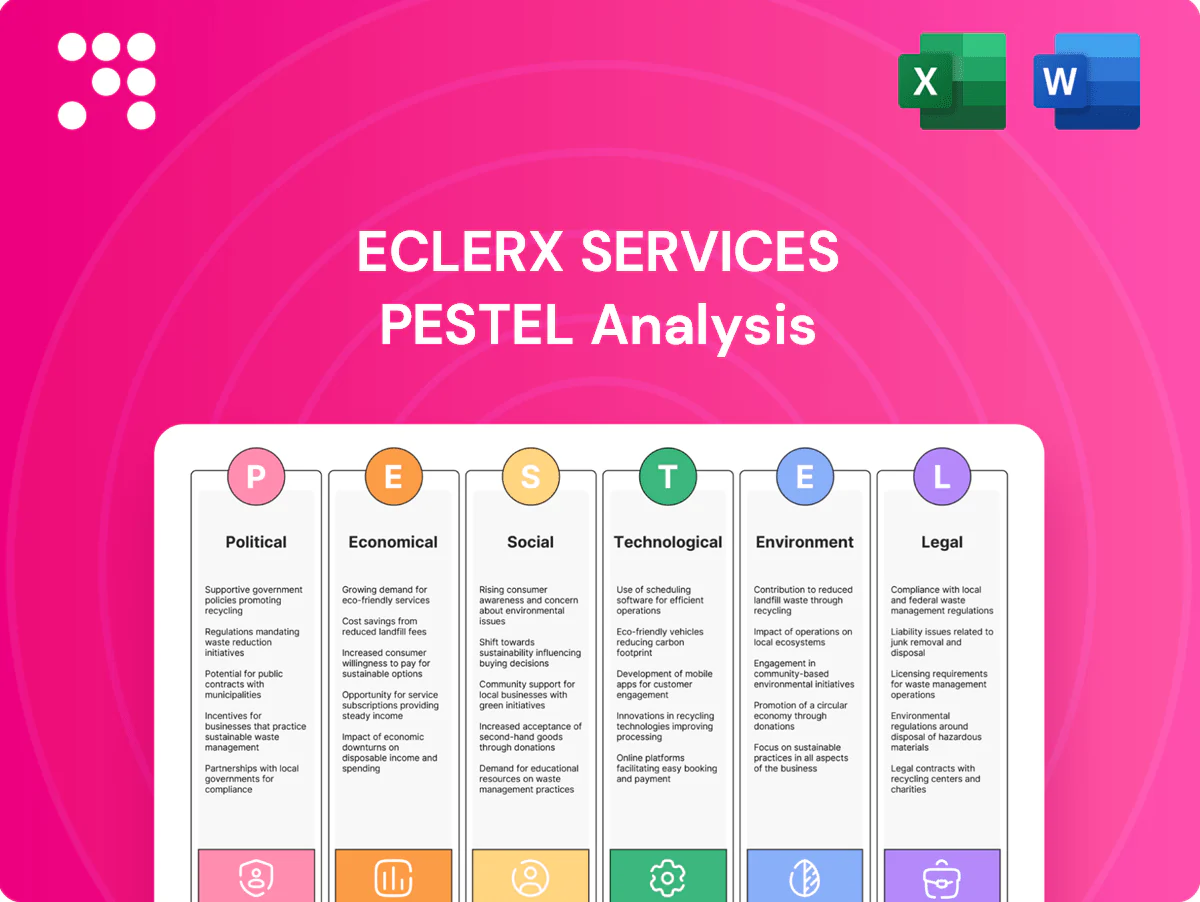
A concise, visually segmented PESTLE summary for eClerx Services that can be dropped into presentations, shared across teams for quick alignment, and annotated with region- or business-specific notes to streamline planning and risk discussions.
Economic factors

Global demand cycles
BPM and analytics budgets track macro cycles: IMF projected global GDP growth of about 3.2% in 2024 and 3.0% in 2025, which correlates with spending in FS, retail, media and manufacturing. Deloitte Global 2024 CFO survey found ~55% of firms prioritized cost takeouts in downturns, delaying transformation projects. Recoveries shift spend into growth analytics and digital marketing, with global digital ad spend rising double digits in 2024. A diversified client mix smooths revenue volatility across cycles.
Currency fluctuations
eClerx earns a majority of revenue in USD/EUR while costs are largely in INR, creating direct FX exposure; USD/INR averaged about 82.5 in 2024. The company’s hedging policies and use of forwards/natural hedges materially influence realized margins. A sharp INR appreciation/depreciation can alter pricing competitiveness in global bids. Contractual pricing clauses and client-linked natural hedges help mitigate this risk.

Wage inflation and talent costs
Tight tech labor markets in India and nearshore hubs are exerting upward pressure on salaries, making utilization and pyramid optimization critical levers to protect margins. Scaling automation initiatives can materially offset rising talent costs if deployment reaches meaningful coverage across repeatable processes. Controlling attrition remains essential to preserve delivery quality and the underlying cost base, reducing expensive rehire and ramp-up cycles.

Interest rates and capital access
Higher interest rates raise client hurdle rates for transformation programs, with RBI repo at 6.5% and US Fed funds at 5.25–5.5% (June 2024). Internal cost of capital directly affects timing of automation and platform investments. Strong operational cash flow enables countercyclical investment and strategic M&A. Flexible, outcome-linked contracts help align with client budget cycles.
- Hurdle-rates ↑ (RBI 6.5%)
- Cost of capital → investment timing
- Cash generation = countercyclical capacity
- Flexible contracts align budgets
Client consolidation and vendor rationalization
- Impact: buyer consolidation
- Favored: scale & end‑to‑end
- Opportunity: higher cross‑sell
- Risk: concentrated wallet share
Data localization, Digital India growth, GST 18% & BEPS 15% risks
Macroeconomic slowdown (IMF GDP 2024 3.2%, 2025 3.0%) compresses BPM spend; USD/INR ~82.5 (2024) drives margin FX; RBI repo 6.5% / Fed 5.25–5.5% raise hurdle rates and delay projects; consolidation (global M&A $2.9T 2023) favors scale vendors, boosting cross‑sell but concentrating wallet risk.
| Metric | Value |
|---|---|
| IMF GDP 2024/25 | 3.2% / 3.0% |
| USD/INR (2024) | ~82.5 |
| RBI / Fed (Jun 2024) | 6.5% / 5.25–5.5% |
| Global M&A (2023) | $2.9T |
Preview the Actual Deliverable
eClerx Services PESTLE Analysis
This eClerx Services PESTLE Analysis provides a concise, professionally structured review of political, economic, social, technological, legal, and environmental factors affecting the company. The preview shown here is the exact document you’ll receive after purchase—fully formatted and ready to use. It contains actionable insights and clear headings for immediate application. No placeholders or surprises—what you see is what you’ll download.

Original: $10.00
-65%$10.00
$3.50Product Information
Product Information
Shipping & Returns
Shipping & Returns
Description
Your Competitive Advantage Starts with This Report
Discover how political shifts, economic cycles, and rapid tech change are shaping eClerx Services’ strategy in our concise PESTLE overview, tailored for investors and strategists. This snapshot highlights key risks and opportunities to inform your next move. Purchase the full, editable PESTLE for a complete, actionable breakdown you can use instantly.
Political factors
Data localization policies
India (RBI/payment data rules, draft PDPB debates) and the EU (GDPR plus adequacy regimes) and over 60 jurisdictions now impose local storage/processing for sensitive data, forcing eClerx to rearchitect delivery and data hubs to maintain latency and SLAs; such fragmentation raises infrastructure/compliance costs but can boost client trust, and embedding proactive compliance by design can serve as a measurable sales differentiator.
Government digital agendas
Public-sector pushes for digitization and e‑governance — exemplified by programs like India’s Digital India (serving ~1.4 billion people) — expand demand for BPM and analytics as governments digitize services; incentives for automation and Industry 4.0 (tax breaks, grants in multiple markets) can accelerate adoption across client verticals. Alignment with national digital missions facilitates partnerships and pilots, while policy reversals or budget cuts remain a tangible pipeline risk.
Trade and geopolitical tensions
US‑India trade (~$192bn in 2023) and strengthening EU‑India ties shift offshoring sentiment as geopolitical frictions reshape sourcing. Tight visa regimes (H‑1B cap 85,000 plus 20,000 master’s) constrain onsite support and raise costs. Sanctions or export curbs make supply assurance critical for clients. Diversified delivery locations (India, Philippines, UK) hedge exposure and maintain continuity.
Tax and incentive regimes
SEZ duty and GST exemptions and transferable benefits materially improve eClerx margin profiles, while R&D tax incentives and OECD minimum tax (15%) and transfer pricing rules directly shape reported profitability; shifts in GST/VAT (India standard GST 18%) or cross‑border taxation force pricing model changes. Stable tax policy supports long‑term contracts; sudden incentive withdrawals compress margins.
- SEZ benefits: reduced indirect taxes
- R&D credits: improve effective tax rate
- Transfer pricing: impacts margin recognition
- GST 18% / BEPS 15%: alters pricing
Public procurement and compliance
Winning government or quasi‑government work for eClerx requires strict procurement adherence and documented audit trails; political scrutiny in 2024 increased expectations on transparency and auditability. Industry certifications such as SOC 1/2 and ISO 27001 and a proven track record unlock tenders, while India’s 2024 Make in India procurement preferences favor vendors with local presence.
- Certifications: SOC 1/2, ISO 27001
- 2024 policy: expanded Make in India procurement
- Priority: transparency, auditability, local presence
Data localization, Digital India growth, GST 18% & BEPS 15% risks
Political factors: data localization in 60+ jurisdictions raises infra/compliance costs but can be a sales differentiator; public digitization (Digital India ~1.4bn) and incentives expand BPM demand while reversals pose pipeline risk. Geopolitical shifts (US‑India trade $192bn in 2023) and H‑1B caps constrain onsite support; GST 18% and OECD BEPS 15% shape margins.
| Metric | Value | Impact |
|---|---|---|
| Data localization | 60+ jurisdictions | Higher infra/compliance cost |
| Digital India | ~1.4bn citizens | Increased BPM demand |
| US‑India trade | $192bn (2023) | Sourcing shift |
| Tax rules | GST 18% / BEPS 15% | Margin pressure |
What is included in the product
Detailed Word Document
Explores how Political, Economic, Social, Technological, Environmental and Legal forces specifically affect eClerx Services, with data-driven trends, scenario insights and actionable implications to help executives, consultants and investors identify risks, opportunities and strategic responses.
Customizable Excel Spreadsheet
A concise, visually segmented PESTLE summary for eClerx Services that can be dropped into presentations, shared across teams for quick alignment, and annotated with region- or business-specific notes to streamline planning and risk discussions.
Economic factors
Global demand cycles
BPM and analytics budgets track macro cycles: IMF projected global GDP growth of about 3.2% in 2024 and 3.0% in 2025, which correlates with spending in FS, retail, media and manufacturing. Deloitte Global 2024 CFO survey found ~55% of firms prioritized cost takeouts in downturns, delaying transformation projects. Recoveries shift spend into growth analytics and digital marketing, with global digital ad spend rising double digits in 2024. A diversified client mix smooths revenue volatility across cycles.
Currency fluctuations
eClerx earns a majority of revenue in USD/EUR while costs are largely in INR, creating direct FX exposure; USD/INR averaged about 82.5 in 2024. The company’s hedging policies and use of forwards/natural hedges materially influence realized margins. A sharp INR appreciation/depreciation can alter pricing competitiveness in global bids. Contractual pricing clauses and client-linked natural hedges help mitigate this risk.
Wage inflation and talent costs
Tight tech labor markets in India and nearshore hubs are exerting upward pressure on salaries, making utilization and pyramid optimization critical levers to protect margins. Scaling automation initiatives can materially offset rising talent costs if deployment reaches meaningful coverage across repeatable processes. Controlling attrition remains essential to preserve delivery quality and the underlying cost base, reducing expensive rehire and ramp-up cycles.
Interest rates and capital access
Higher interest rates raise client hurdle rates for transformation programs, with RBI repo at 6.5% and US Fed funds at 5.25–5.5% (June 2024). Internal cost of capital directly affects timing of automation and platform investments. Strong operational cash flow enables countercyclical investment and strategic M&A. Flexible, outcome-linked contracts help align with client budget cycles.
- Hurdle-rates ↑ (RBI 6.5%)
- Cost of capital → investment timing
- Cash generation = countercyclical capacity
- Flexible contracts align budgets
Client consolidation and vendor rationalization
- Impact: buyer consolidation
- Favored: scale & end‑to‑end
- Opportunity: higher cross‑sell
- Risk: concentrated wallet share
Data localization, Digital India growth, GST 18% & BEPS 15% risks
Macroeconomic slowdown (IMF GDP 2024 3.2%, 2025 3.0%) compresses BPM spend; USD/INR ~82.5 (2024) drives margin FX; RBI repo 6.5% / Fed 5.25–5.5% raise hurdle rates and delay projects; consolidation (global M&A $2.9T 2023) favors scale vendors, boosting cross‑sell but concentrating wallet risk.
| Metric | Value |
|---|---|
| IMF GDP 2024/25 | 3.2% / 3.0% |
| USD/INR (2024) | ~82.5 |
| RBI / Fed (Jun 2024) | 6.5% / 5.25–5.5% |
| Global M&A (2023) | $2.9T |
Preview the Actual Deliverable
eClerx Services PESTLE Analysis
This eClerx Services PESTLE Analysis provides a concise, professionally structured review of political, economic, social, technological, legal, and environmental factors affecting the company. The preview shown here is the exact document you’ll receive after purchase—fully formatted and ready to use. It contains actionable insights and clear headings for immediate application. No placeholders or surprises—what you see is what you’ll download.