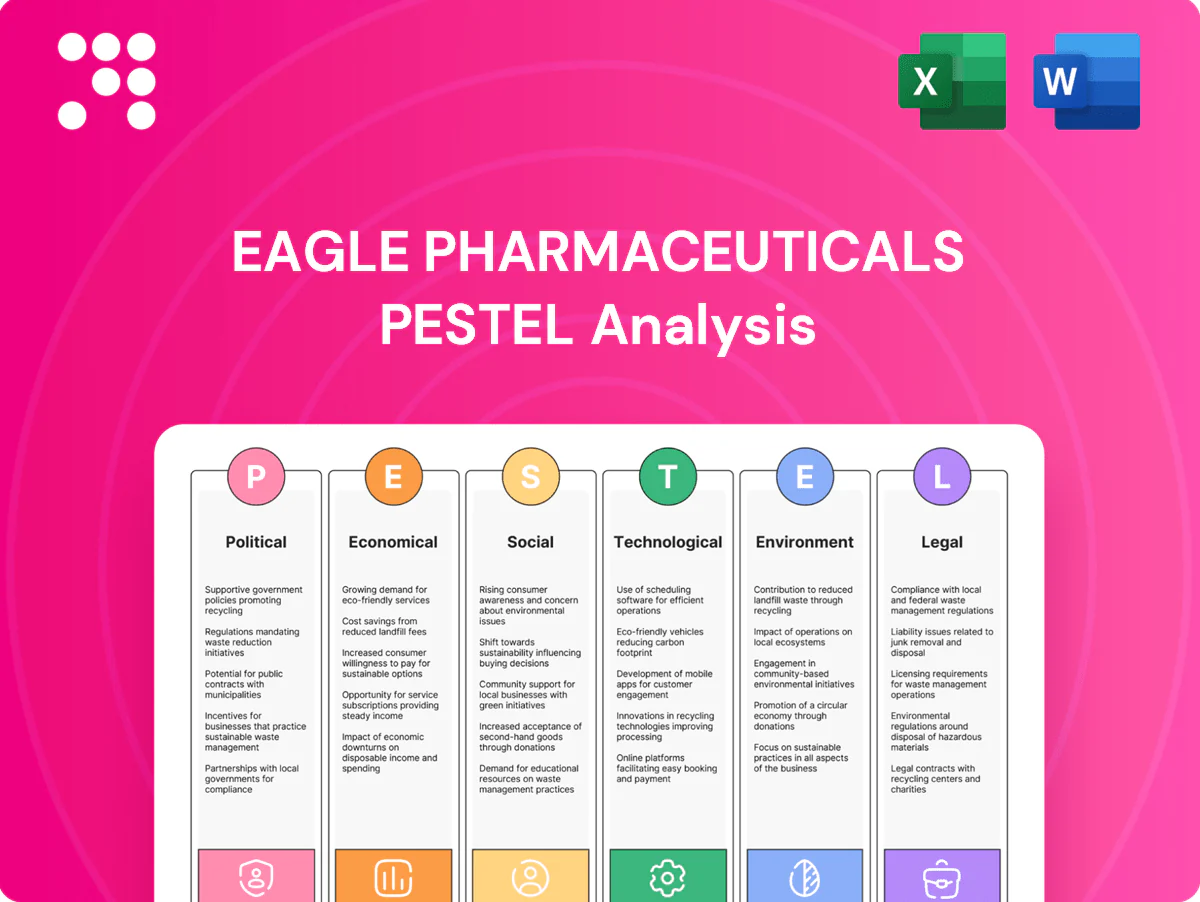
Eagle Pharmaceuticals PESTLE Analysis

Your Shortcut to Market Insight Starts Here
Gain a competitive edge with our PESTLE analysis of Eagle Pharmaceuticals. Discover how political, economic, social, technological, legal, and environmental forces shape strategy, risk, and growth opportunities. Ideal for investors and strategists—buy the full, downloadable report for actionable insights now.
Political factors

Drug pricing reform momentum
Government moves on drug pricing, notably the Inflation Reduction Act enabling Medicare Part D negotiation for up to 10 drugs beginning 2026, heighten risk of margin compression for hospital/oncology injectables; concurrent reference‑pricing and 340B expansion proposals remain under debate and could shift channel incentives and formulary dynamics quickly. Eagle should scenario‑plan pricing floors and volume‑offsets via access programs.
FDA priorities and funding
PDUFA review goals (standard 10 months, priority 6 months) and rising inspection throughput directly affect approval speed for reformulated injectables, with guidance updates in 2023–2024 narrowing chemistry and device expectations. Stable FDA funding and a defined 505(b)(2) pathway materially benefit Eagle’s reformulation strategy. Changes in enforcement intensity can lengthen time-to-market and increase post-approval obligations. Proactive engagement via meetings and comment letters reduces regulatory uncertainty.

Geopolitical supply chain risk
APIs and excipients for many sterile injectables remain concentrated in China/India, with 2024 estimates indicating about 70% of API sourcing abroad; tariffs on Chinese goods (up to 25% under Section 301) and export controls raise supply risk. Buy American procurement preferences can shift hospital and federal buying toward domestic suppliers. Eagle should dual-source critical inputs and evaluate nearshoring; 2024 government incentives expanded support for domestic sterile manufacturing capacity.

Healthcare policy and reimbursement
CMS 2% sequestration (in effect since 2023) and MS-DRG inpatient bundling compress margins for hospital-administered injectables, while outpatient pass-through status for select drugs and NTAP-like payments preserve higher reimbursement; state Medicaid covers about 82 million enrollees (2024) with aggressive formulary/PA controls; policy emphasis on safety/quality favors ready-to-use formulations and advocacy can secure appropriate coding and coverage.
- CMS sequestration: 2% cut (since 2023)
- Inpatient: MS-DRG bundling limits separate drug payment
- Outpatient: pass-through preserves higher reimbursement for select injectables
- Medicaid: ~82 million enrollees; strong formulary/PA influence
- Advocacy: J-code/coverage can capture clinical value
Pandemic and public health readiness
National preparedness agendas have prioritized critical-care injectables and stockpiles, driving government procurement that can create sharp surges but requires proven reliability and rapid surge capacity; BARDA obligated over 5 billion USD for COVID-19 countermeasures, signaling persistent federal buying power. Policy-driven allocation rules and SNS allocation frameworks can limit commercial pricing and distribution flexibility, so Eagle should align portfolios to WHO essential medicines and BARDA/ASPR opportunity pipelines.
- Stockpile demand: government procurements drive volume volatility
- Reliability: procurement favors manufacturers with surge capacity
- Constraints: allocation rules limit commercial flexibility
- Action: align with WHO EML and pursue BARDA/ASPR contracts
Medicare negotiation of 10 drugs, 70% API risk and BARDA 5B surge pressure
Medicare Part D negotiation (up to 10 drugs from 2026) plus drug‑pricing and 340B/ reference‑pricing proposals raise margin risk; FDA PDUFA timelines (6/10 months) and 505(b)(2) clarity support reformulations; ~70% APIs sourced abroad (2024) and CMS 2% sequestration (since 2023) pressure supply and reimbursement; BARDA procurement (>5B USD) creates surge contract opportunities.
| Policy | Impact | 2024/25 Data |
|---|---|---|
| Medicare negotiation | Price/margin risk | Up to 10 drugs from 2026 |
| API sourcing | Supply risk | ~70% abroad (2024) |
| Reimbursement | Payment pressure | CMS 2% sequestration (since 2023) |
What is included in the product
 Detailed Word Document
Explores how external macro-environmental factors uniquely affect Eagle Pharmaceuticals across Political, Economic, Social, Technological, Environmental, and Legal dimensions, with each section grounded in current industry data and regulatory trends; designed to help executives, investors, and strategists identify threats, opportunities, and forward-looking scenarios for planning and funding decisions.

 Customizable Excel Spreadsheet
A concise, visually segmented PESTLE summary of Eagle Pharmaceuticals that highlights external risks, regulatory pressures and market drivers—ready to drop into presentations or share across teams; editable notes let stakeholders adapt insights to region or business line for faster decision-making.
Economic factors

Hospital budget pressure
GPO contracting—over 80% of US hospitals participate—plus compressed hospital operating margins increase price sensitivity for injectables, pressuring Eagle Pharmaceuticals on negotiated rates. Value propositions must highlight measurable waste reduction, safety gains, and workflow efficiency to justify premium pricing. Bundling and tiered pricing structures can defend share within GPO portfolios. Robust cost-offset health economic data strengthens negotiation leverage.
Inflation and input costs
Volatile prices for APIs, excipients, vials, stoppers and logistics have lifted COGS for injectables, exacerbated by general inflation (US CPI 2024 annual 3.4% per BLS) that raises input and transport costs. Long-term supply contracts and commodity hedges can stabilize margins by locking prices and volumes. Investment in sterile fill-finish automation reduces exposure to labor inflation and productivity loss. Pricing must reflect pass-through limits in hospital channels and reimbursement constraints.

Generic and biosimilar competition
Reformulations at Eagle face rapid price erosion—industry data show median price declines of roughly 60–90% once multiple generic entrants appear—so weak differentiation quickly eliminates premiums. Demonstrable clinical, safety, or operational advantages are needed to sustain pricing power. Speed to market and proactive lifecycle management determine share recovery, and vigilant competitive intelligence on ANDA entrants is required to anticipate 60–90% erosion risks.

Capital access and cost
Rising policy rates (federal funds 5.25–5.50% as of mid‑2025) increase Eagle Pharmaceuticals’ cost of debt, raising financing costs for capacity expansion, acquisitions, and inventory carrying; partnering and royalty deals can preserve cash and lower upfront capital needs. Focus capital on high‑ROIC oncology and critical‑care assets and maintain liquidity buffers to absorb regulatory or supply shocks.
- Fed funds 5.25–5.50% (Jul 2025)
- Use royalties/partners to optimize cash flow
- Prioritize high‑ROIC oncology/critical‑care assets
Demand volatility
Demand volatility for Eagle Pharmaceuticals is driven by epidemics, drug shortages and guideline changes that can swing volumes; proactive shortage response creates share gains and customer stickiness. Sales forecasting must integrate hospital census and oncology incidence trends (US ~1.9M new cancer cases/year, 2024) and prioritize flexible manufacturing and inventory strategies.
- Integrate hospital census and oncology incidence
- Flexible contract manufacturing capacity
- Safety stock for shortage response
- Shortage wins = durable customer stickiness
Medicare negotiation of 10 drugs, 70% API risk and BARDA 5B surge pressure
GPO contracting (over 80% of US hospitals) amplifies price sensitivity, forcing negotiated rebates and value-based pricing. US CPI 2024 3.4% and Fed funds 5.25–5.50% (Jul 2025) raise input and financing costs, pushing capital-light deals. Generic entry typically causes 60–90% price erosion; oncology demand ~1.9M new US cases (2024) and shortages drive volume volatility.
| Metric | Value |
|---|---|
| GPO hospital participation | >80% |
| US CPI (2024) | 3.4% |
| Fed funds (Jul 2025) | 5.25–5.50% |
| Oncology incidence (US, 2024) | ~1.9M |
| Post-generic price erosion | 60–90% |
Preview the Actual Deliverable
Eagle Pharmaceuticals PESTLE Analysis
The preview shown here is the exact document you’ll receive after purchase—fully formatted and ready to use. This Eagle Pharmaceuticals PESTLE Analysis includes political, economic, social, technological, legal, and environmental assessments tailored for strategic and investment decisions. No placeholders or teasers—this is the final file you’ll download immediately after payment.

Product Information
Product Information
Shipping & Returns
Shipping & Returns
Description
Your Shortcut to Market Insight Starts Here
Gain a competitive edge with our PESTLE analysis of Eagle Pharmaceuticals. Discover how political, economic, social, technological, legal, and environmental forces shape strategy, risk, and growth opportunities. Ideal for investors and strategists—buy the full, downloadable report for actionable insights now.
Political factors
Drug pricing reform momentum
Government moves on drug pricing, notably the Inflation Reduction Act enabling Medicare Part D negotiation for up to 10 drugs beginning 2026, heighten risk of margin compression for hospital/oncology injectables; concurrent reference‑pricing and 340B expansion proposals remain under debate and could shift channel incentives and formulary dynamics quickly. Eagle should scenario‑plan pricing floors and volume‑offsets via access programs.
FDA priorities and funding
PDUFA review goals (standard 10 months, priority 6 months) and rising inspection throughput directly affect approval speed for reformulated injectables, with guidance updates in 2023–2024 narrowing chemistry and device expectations. Stable FDA funding and a defined 505(b)(2) pathway materially benefit Eagle’s reformulation strategy. Changes in enforcement intensity can lengthen time-to-market and increase post-approval obligations. Proactive engagement via meetings and comment letters reduces regulatory uncertainty.
Geopolitical supply chain risk
APIs and excipients for many sterile injectables remain concentrated in China/India, with 2024 estimates indicating about 70% of API sourcing abroad; tariffs on Chinese goods (up to 25% under Section 301) and export controls raise supply risk. Buy American procurement preferences can shift hospital and federal buying toward domestic suppliers. Eagle should dual-source critical inputs and evaluate nearshoring; 2024 government incentives expanded support for domestic sterile manufacturing capacity.
Healthcare policy and reimbursement
CMS 2% sequestration (in effect since 2023) and MS-DRG inpatient bundling compress margins for hospital-administered injectables, while outpatient pass-through status for select drugs and NTAP-like payments preserve higher reimbursement; state Medicaid covers about 82 million enrollees (2024) with aggressive formulary/PA controls; policy emphasis on safety/quality favors ready-to-use formulations and advocacy can secure appropriate coding and coverage.
- CMS sequestration: 2% cut (since 2023)
- Inpatient: MS-DRG bundling limits separate drug payment
- Outpatient: pass-through preserves higher reimbursement for select injectables
- Medicaid: ~82 million enrollees; strong formulary/PA influence
- Advocacy: J-code/coverage can capture clinical value
Pandemic and public health readiness
National preparedness agendas have prioritized critical-care injectables and stockpiles, driving government procurement that can create sharp surges but requires proven reliability and rapid surge capacity; BARDA obligated over 5 billion USD for COVID-19 countermeasures, signaling persistent federal buying power. Policy-driven allocation rules and SNS allocation frameworks can limit commercial pricing and distribution flexibility, so Eagle should align portfolios to WHO essential medicines and BARDA/ASPR opportunity pipelines.
- Stockpile demand: government procurements drive volume volatility
- Reliability: procurement favors manufacturers with surge capacity
- Constraints: allocation rules limit commercial flexibility
- Action: align with WHO EML and pursue BARDA/ASPR contracts
Medicare negotiation of 10 drugs, 70% API risk and BARDA 5B surge pressure
Medicare Part D negotiation (up to 10 drugs from 2026) plus drug‑pricing and 340B/ reference‑pricing proposals raise margin risk; FDA PDUFA timelines (6/10 months) and 505(b)(2) clarity support reformulations; ~70% APIs sourced abroad (2024) and CMS 2% sequestration (since 2023) pressure supply and reimbursement; BARDA procurement (>5B USD) creates surge contract opportunities.
| Policy | Impact | 2024/25 Data |
|---|---|---|
| Medicare negotiation | Price/margin risk | Up to 10 drugs from 2026 |
| API sourcing | Supply risk | ~70% abroad (2024) |
| Reimbursement | Payment pressure | CMS 2% sequestration (since 2023) |
What is included in the product
Detailed Word Document
Explores how external macro-environmental factors uniquely affect Eagle Pharmaceuticals across Political, Economic, Social, Technological, Environmental, and Legal dimensions, with each section grounded in current industry data and regulatory trends; designed to help executives, investors, and strategists identify threats, opportunities, and forward-looking scenarios for planning and funding decisions.
Customizable Excel Spreadsheet
A concise, visually segmented PESTLE summary of Eagle Pharmaceuticals that highlights external risks, regulatory pressures and market drivers—ready to drop into presentations or share across teams; editable notes let stakeholders adapt insights to region or business line for faster decision-making.
Economic factors
Hospital budget pressure
GPO contracting—over 80% of US hospitals participate—plus compressed hospital operating margins increase price sensitivity for injectables, pressuring Eagle Pharmaceuticals on negotiated rates. Value propositions must highlight measurable waste reduction, safety gains, and workflow efficiency to justify premium pricing. Bundling and tiered pricing structures can defend share within GPO portfolios. Robust cost-offset health economic data strengthens negotiation leverage.
Inflation and input costs
Volatile prices for APIs, excipients, vials, stoppers and logistics have lifted COGS for injectables, exacerbated by general inflation (US CPI 2024 annual 3.4% per BLS) that raises input and transport costs. Long-term supply contracts and commodity hedges can stabilize margins by locking prices and volumes. Investment in sterile fill-finish automation reduces exposure to labor inflation and productivity loss. Pricing must reflect pass-through limits in hospital channels and reimbursement constraints.
Generic and biosimilar competition
Reformulations at Eagle face rapid price erosion—industry data show median price declines of roughly 60–90% once multiple generic entrants appear—so weak differentiation quickly eliminates premiums. Demonstrable clinical, safety, or operational advantages are needed to sustain pricing power. Speed to market and proactive lifecycle management determine share recovery, and vigilant competitive intelligence on ANDA entrants is required to anticipate 60–90% erosion risks.
Capital access and cost
Rising policy rates (federal funds 5.25–5.50% as of mid‑2025) increase Eagle Pharmaceuticals’ cost of debt, raising financing costs for capacity expansion, acquisitions, and inventory carrying; partnering and royalty deals can preserve cash and lower upfront capital needs. Focus capital on high‑ROIC oncology and critical‑care assets and maintain liquidity buffers to absorb regulatory or supply shocks.
- Fed funds 5.25–5.50% (Jul 2025)
- Use royalties/partners to optimize cash flow
- Prioritize high‑ROIC oncology/critical‑care assets
Demand volatility
Demand volatility for Eagle Pharmaceuticals is driven by epidemics, drug shortages and guideline changes that can swing volumes; proactive shortage response creates share gains and customer stickiness. Sales forecasting must integrate hospital census and oncology incidence trends (US ~1.9M new cancer cases/year, 2024) and prioritize flexible manufacturing and inventory strategies.
- Integrate hospital census and oncology incidence
- Flexible contract manufacturing capacity
- Safety stock for shortage response
- Shortage wins = durable customer stickiness
Medicare negotiation of 10 drugs, 70% API risk and BARDA 5B surge pressure
GPO contracting (over 80% of US hospitals) amplifies price sensitivity, forcing negotiated rebates and value-based pricing. US CPI 2024 3.4% and Fed funds 5.25–5.50% (Jul 2025) raise input and financing costs, pushing capital-light deals. Generic entry typically causes 60–90% price erosion; oncology demand ~1.9M new US cases (2024) and shortages drive volume volatility.
| Metric | Value |
|---|---|
| GPO hospital participation | >80% |
| US CPI (2024) | 3.4% |
| Fed funds (Jul 2025) | 5.25–5.50% |
| Oncology incidence (US, 2024) | ~1.9M |
| Post-generic price erosion | 60–90% |
Preview the Actual Deliverable
Eagle Pharmaceuticals PESTLE Analysis
The preview shown here is the exact document you’ll receive after purchase—fully formatted and ready to use. This Eagle Pharmaceuticals PESTLE Analysis includes political, economic, social, technological, legal, and environmental assessments tailored for strategic and investment decisions. No placeholders or teasers—this is the final file you’ll download immediately after payment.