DMG Mori SWOT Analysis

Dive Deeper Into the Company’s Strategic Blueprint
Our DMG Mori SWOT analysis highlights the company's precision manufacturing strengths, global footprint, and innovation pipeline while flagging supply-chain risks and market cyclicality. Want the full strategic picture and actionable recommendations? Purchase the complete, editable SWOT (Word + Excel) to support investment decisions, pitches, and operational planning.
Strengths

Global brand with dual heritage
DMG MORI’s German-Japanese roots convey precision, reliability and kaizen-style continuous improvement, bolstering trust across automotive, aerospace, medical and job-shop customers. The brand’s global footprint—over 140 sales and service locations serving 70+ countries—lowers buyer risk and supports premium pricing and higher margin tenders. This credibility enables effective cross-selling of machines, automation and services across regions and industries.
Broad portfolio across CNC, automation, software
DMG MORI offers turning, milling, 5‑axis, ULTRASONIC and LASER technologies plus automation cells and CELOS software, creating a one‑stop stack that simplifies vendor management. Integrated solutions lift throughput and OEE, helping capture larger wallet share per installation. Group revenue was around EUR 2.8bn in FY 2023/24, underscoring scale and market reach.

Lifecycle services and global support
Lifecycle services—maintenance, training, retrofits and digital services—create recurring revenue and customer stickiness, with services contributing a double-digit share of DMG MORI group sales in recent years. A global service footprint reduces downtime for multinational manufacturers through rapid local response. Strong parts availability and remote support improve machine uptime, deepening relationships and supporting higher long-term margins.

Innovation in advanced and hybrid manufacturing
DMG MORI’s competence in ultrasonic machining, laser texturing and integrated process chains differentiates its complex-part capability, enabling hybrid solutions that cut setups and add novel surface functions for aerospace, medical and mold sectors.
- R&D footprint: global centers in Japan and Germany
- Hybrid machining: fewer setups, higher part functionality
- High-spec barrier: protects niche margins
Large installed base and ecosystem
A substantial global installed base in over 70 countries fuels recurring spare-parts, retrofit and software attach, supporting DMG MORI group revenue of about 3.2 billion EUR in FY 2023/24 and strong service margins. Active user communities and 50+ training centers accelerate uptake of digital and automation upgrades. Partner ecosystems for tooling, metrology and automation widen solution scope while network effects push industry standardization on DMG MORI platforms.
- Installed-base-driven spare parts and retrofits
- Training centers and user communities boost tech adoption
- Tooling/metrology/automation partners expand value
- Network effects reinforce platform standardization
German-Japanese engineering and global reach boost premium machines, automation and EUR 3.2bn
DMG MORI’s German‑Japanese engineering and global footprint (140+ locations, 70+ countries) underpin premium positioning and cross‑sell strength. Integrated machines, automation and CELOS software drive higher OEE and wallet share. Services and spare parts (double‑digit share) deliver recurring revenue and strong margins—group revenue ~EUR 3.2bn FY 2023/24.
| Metric | Value |
|---|---|
| Group revenue FY23/24 | EUR 3.2bn |
| Sales/service locations | 140+ |
| Countries | 70+ |
| Training centers | 50+ |
What is included in the product
 Detailed Word Document
Provides a strategic overview of DMG Mori’s internal strengths and weaknesses and external opportunities and threats, mapping competitive position, technological capabilities, market expansion prospects, and industrial risks shaping its future.

 Customizable Excel Spreadsheet
Delivers a concise, visual SWOT of DMG Mori to quickly surface strategic risks and opportunities, enabling fast stakeholder alignment and decision-making.
Weaknesses

Exposure to capital spending cycles
Machine tools are discretionary capex and swing with manufacturing PMI cycles; global manufacturing PMI averaged about 50 in 2023, amplifying demand sensitivity for DMG MORI. Order intake can be highly volatile, pressuring plant utilization and compressing margins when cancellations occur. Backlog timing and cancellations create forecasting risk and revenue recognition timing variability. This cyclicality complicates capacity planning and capital allocation.
Premium pricing vs low-cost rivals
High-spec DMG MORI machines face intense pricing pressure as lower-cost Chinese and Korean rivals, which together account for roughly 40% of global machine-tool production, undercut list prices. Cost-sensitive SMEs often opt for cheaper models, reducing order size and mix. Increased discounting to win deals risks compressing gross margins and ROIC. Clear, data-driven value communication is essential to defend premium pricing.

Complex integration and commissioning
End-to-end solutions require complex integration of machines, automation, and software, driving commissioning that often extends project timelines and raises costs. Large integration programs face overruns—McKinsey finds complex tech projects run about 45% over budget—harming DMG MORI margins and customer satisfaction. Skilled integrators and customer talent are scarce, with talent shortages cited by ~69% of employers in 2024 surveys, prolonging post-install optimization that can take months.

Supply chain reliance on precision components
High-precision spindles, CNC controls and specialist electronics often carry lead times exceeding 12 weeks, making DMG MORI vulnerable to supplier delays that push out machine deliveries and raise component costs. Qualification cycles limit multi-sourcing, so disruptions force reliance on single vendors and larger inventory buffers that tie up working capital.
Concentration in cyclical end-markets
Automotive, aerospace and heavy industrials account for the core of DMG MORI demand and follow pronounced business cycles, making revenue and order intake vulnerable to sector slowdowns; regional downturns often cluster temporally, amplifying cash‑flow pressure. Recent diversification into medtech and energy has reduced but not eliminated exposure, and adverse mix shifts can compress gross margins and utilization.
- Concentration risk: automotive/aerospace/industrials
- Geographic/temporal clustering of downturns
- Diversification into medtech/energy still limited
- Product mix swings pressure margins and utilization
Cyclical machine-tool demand, margin squeeze from Asian rivals, talent gaps and long lead times
DMG MORI is highly cyclical with demand tied to PMI (~50 in 2023), causing volatile order intake and margin pressure. Premium machines face pricing competition from Chinese/Korean players (~40% of global output), compressing margins. Complex system integrations and talent shortages (~69% employers, 2024) drive overruns (~45% over budget) and longer commissioning; key components have lead times >12 weeks.
| Metric | Value |
|---|---|
| Global mfg PMI (2023) | ~50 |
| China/Korea share | ~40% |
| Project overruns (McKinsey) | ~45% |
| Talent shortage (2024) | ~69% |
| Critical lead times | >12 weeks |
Preview Before You Purchase
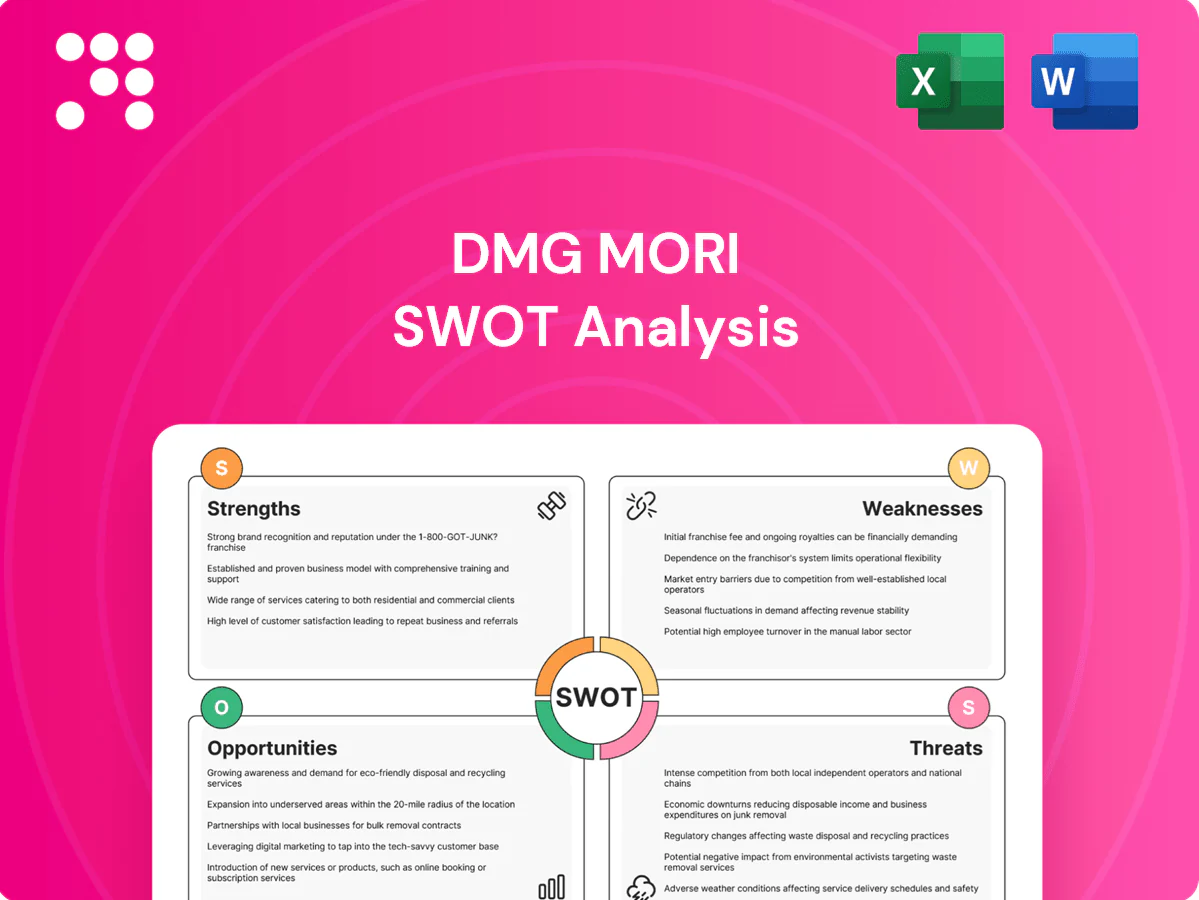
DMG Mori SWOT Analysis
This is the actual SWOT analysis document you’ll receive upon purchase—no surprises, just professional quality. The preview below is taken directly from the full SWOT report you'll get; purchase unlocks the entire in-depth version. The file shown is the real, editable analysis you'll download post-purchase and is ready to use.

Product Information
Product Information
Shipping & Returns
Shipping & Returns
Description
Dive Deeper Into the Company’s Strategic Blueprint
Our DMG Mori SWOT analysis highlights the company's precision manufacturing strengths, global footprint, and innovation pipeline while flagging supply-chain risks and market cyclicality. Want the full strategic picture and actionable recommendations? Purchase the complete, editable SWOT (Word + Excel) to support investment decisions, pitches, and operational planning.
Strengths
Global brand with dual heritage
DMG MORI’s German-Japanese roots convey precision, reliability and kaizen-style continuous improvement, bolstering trust across automotive, aerospace, medical and job-shop customers. The brand’s global footprint—over 140 sales and service locations serving 70+ countries—lowers buyer risk and supports premium pricing and higher margin tenders. This credibility enables effective cross-selling of machines, automation and services across regions and industries.
Broad portfolio across CNC, automation, software
DMG MORI offers turning, milling, 5‑axis, ULTRASONIC and LASER technologies plus automation cells and CELOS software, creating a one‑stop stack that simplifies vendor management. Integrated solutions lift throughput and OEE, helping capture larger wallet share per installation. Group revenue was around EUR 2.8bn in FY 2023/24, underscoring scale and market reach.
Lifecycle services and global support
Lifecycle services—maintenance, training, retrofits and digital services—create recurring revenue and customer stickiness, with services contributing a double-digit share of DMG MORI group sales in recent years. A global service footprint reduces downtime for multinational manufacturers through rapid local response. Strong parts availability and remote support improve machine uptime, deepening relationships and supporting higher long-term margins.
Innovation in advanced and hybrid manufacturing
DMG MORI’s competence in ultrasonic machining, laser texturing and integrated process chains differentiates its complex-part capability, enabling hybrid solutions that cut setups and add novel surface functions for aerospace, medical and mold sectors.
- R&D footprint: global centers in Japan and Germany
- Hybrid machining: fewer setups, higher part functionality
- High-spec barrier: protects niche margins
Large installed base and ecosystem
A substantial global installed base in over 70 countries fuels recurring spare-parts, retrofit and software attach, supporting DMG MORI group revenue of about 3.2 billion EUR in FY 2023/24 and strong service margins. Active user communities and 50+ training centers accelerate uptake of digital and automation upgrades. Partner ecosystems for tooling, metrology and automation widen solution scope while network effects push industry standardization on DMG MORI platforms.
- Installed-base-driven spare parts and retrofits
- Training centers and user communities boost tech adoption
- Tooling/metrology/automation partners expand value
- Network effects reinforce platform standardization
German-Japanese engineering and global reach boost premium machines, automation and EUR 3.2bn
DMG MORI’s German‑Japanese engineering and global footprint (140+ locations, 70+ countries) underpin premium positioning and cross‑sell strength. Integrated machines, automation and CELOS software drive higher OEE and wallet share. Services and spare parts (double‑digit share) deliver recurring revenue and strong margins—group revenue ~EUR 3.2bn FY 2023/24.
| Metric | Value |
|---|---|
| Group revenue FY23/24 | EUR 3.2bn |
| Sales/service locations | 140+ |
| Countries | 70+ |
| Training centers | 50+ |
What is included in the product
Detailed Word Document
Provides a strategic overview of DMG Mori’s internal strengths and weaknesses and external opportunities and threats, mapping competitive position, technological capabilities, market expansion prospects, and industrial risks shaping its future.
Customizable Excel Spreadsheet
Delivers a concise, visual SWOT of DMG Mori to quickly surface strategic risks and opportunities, enabling fast stakeholder alignment and decision-making.
Weaknesses
Exposure to capital spending cycles
Machine tools are discretionary capex and swing with manufacturing PMI cycles; global manufacturing PMI averaged about 50 in 2023, amplifying demand sensitivity for DMG MORI. Order intake can be highly volatile, pressuring plant utilization and compressing margins when cancellations occur. Backlog timing and cancellations create forecasting risk and revenue recognition timing variability. This cyclicality complicates capacity planning and capital allocation.
Premium pricing vs low-cost rivals
High-spec DMG MORI machines face intense pricing pressure as lower-cost Chinese and Korean rivals, which together account for roughly 40% of global machine-tool production, undercut list prices. Cost-sensitive SMEs often opt for cheaper models, reducing order size and mix. Increased discounting to win deals risks compressing gross margins and ROIC. Clear, data-driven value communication is essential to defend premium pricing.
Complex integration and commissioning
End-to-end solutions require complex integration of machines, automation, and software, driving commissioning that often extends project timelines and raises costs. Large integration programs face overruns—McKinsey finds complex tech projects run about 45% over budget—harming DMG MORI margins and customer satisfaction. Skilled integrators and customer talent are scarce, with talent shortages cited by ~69% of employers in 2024 surveys, prolonging post-install optimization that can take months.
Supply chain reliance on precision components
High-precision spindles, CNC controls and specialist electronics often carry lead times exceeding 12 weeks, making DMG MORI vulnerable to supplier delays that push out machine deliveries and raise component costs. Qualification cycles limit multi-sourcing, so disruptions force reliance on single vendors and larger inventory buffers that tie up working capital.
Concentration in cyclical end-markets
Automotive, aerospace and heavy industrials account for the core of DMG MORI demand and follow pronounced business cycles, making revenue and order intake vulnerable to sector slowdowns; regional downturns often cluster temporally, amplifying cash‑flow pressure. Recent diversification into medtech and energy has reduced but not eliminated exposure, and adverse mix shifts can compress gross margins and utilization.
- Concentration risk: automotive/aerospace/industrials
- Geographic/temporal clustering of downturns
- Diversification into medtech/energy still limited
- Product mix swings pressure margins and utilization
Cyclical machine-tool demand, margin squeeze from Asian rivals, talent gaps and long lead times
DMG MORI is highly cyclical with demand tied to PMI (~50 in 2023), causing volatile order intake and margin pressure. Premium machines face pricing competition from Chinese/Korean players (~40% of global output), compressing margins. Complex system integrations and talent shortages (~69% employers, 2024) drive overruns (~45% over budget) and longer commissioning; key components have lead times >12 weeks.
| Metric | Value |
|---|---|
| Global mfg PMI (2023) | ~50 |
| China/Korea share | ~40% |
| Project overruns (McKinsey) | ~45% |
| Talent shortage (2024) | ~69% |
| Critical lead times | >12 weeks |
Preview Before You Purchase
DMG Mori SWOT Analysis
This is the actual SWOT analysis document you’ll receive upon purchase—no surprises, just professional quality. The preview below is taken directly from the full SWOT report you'll get; purchase unlocks the entire in-depth version. The file shown is the real, editable analysis you'll download post-purchase and is ready to use.