Avenue Supermarts PESTLE Analysis

Make Smarter Strategic Decisions with a Complete PESTEL View
Unlock strategic clarity with our targeted PESTLE Analysis of Avenue Supermarts—revealing how political changes, economic shifts, and tech trends will shape growth. Ideal for investors and strategists, it’s fully sourced and actionable. Purchase the full report to access the complete, editable analysis instantly.
Political factors

FDI and retail policy
India’s multi-brand retail FDI policy remains capped at 51% with state-level approvals, and evolving relaxations or conditions directly affect Avenue Supermarts’ sourcing and expansion optionality. DMart’s low-cost, high-turnover model depends on tight control of merchandising and pricing, so any policy shift altering procurement or stocking norms could constrain formats or enable larger-format growth. With over 360 stores nationwide and state-specific retail rules, close monitoring lets management ensure compliance and plan footprint rollouts proactively.
GST and indirect taxes
GST slabs of 0%, 5%, 12% and 18% shape Avenue Supermats pricing: staple food largely sits at 0–5%, many FMCG items at 18%, and general merchandise at 12–18%, directly affecting margins and consumer price points. Input tax credit (ITC) flow and eligibility determine working capital and supply‑chain design; frequent rate clarifications raise compliance complexity, while optimized tax planning helps preserve the everyday low‑price (EDLP) model.

State-level permits
Licenses for shops, weights and measures, fire, food and signage in India vary by state and municipality, with approval timelines typically ranging from 30 to 180 days, affecting Avenue Supermarts’ store opening and refurbishment cadence. Local political dynamics and inspections can delay permits by months, disrupting planned openings for the retailer that operated over 350 stores as of mid-2024. Strong government relations have been shown to shorten cycle times and reduce compliance risk, improving rollout predictability.

Public procurement and subsidies
Policies on MSP and subsidies — with NFSA covering about 800 million beneficiaries and annual central buffer movements often exceeding 20 mt in staples — directly shape farm-gate prices and retail availability; DMart must adjust pricing and promo cadence to protect gross margins and SKU turns. Avenue Supermarts reported ~INR 88,000 crore revenue in FY24, underscoring sensitivity to staples pricing swings.
- MSP/subsidy impact: farm-gate prices
- Buffer releases: downward price pressure
- PDS reach: demand shift for essentials (800m beneficiaries)
- DMart action: recalibrate assortment & promo intensity
Infrastructure push
Government spending under the National Infrastructure Pipeline (~₹111 trillion for 2020–25) and PM Gati Shakti integration reduces inbound costs and shrinkage, while improved road, warehousing and logistics parks cut transit times; India’s logistics cost at ~13% of GDP has a government target toward ~8%, boosting store throughput and catchment accessibility. Policy support for cold-chain expansion lifts perishables quality, enabling DMart to deepen penetration as logistics friction declines.
- National Infrastructure Pipeline: ~₹111 trillion (2020–25)
- Logistics cost: ~13% of GDP, target ~8%
- Cold-chain policy expansion: improves perishables shelf quality
- Outcome: lower inbound costs, reduced shrinkage, higher store throughput
FDI caps, state approvals and GST/ITC risks constrain large retail expansion despite scale
Policy caps on multi‑brand FDI (51%) and state approvals constrain Avenue Supermarts’ expansion and sourcing; with 360+ stores and ~INR 88,000 crore revenue (FY24), compliance risk is material. GST bands (0/5/12/18%) and ITC rules affect margins and working capital. MSP/subsidy moves, NFSA coverage (~800m beneficiaries) and buffer releases shift staples pricing. Infrastructure push (NIP ₹111 trillion) and logistics cost (~13% of GDP) lower inbound costs.
| Factor | Key metric |
|---|---|
| Stores / Revenue | 360+ / INR 88,000 cr (FY24) |
| GST bands | 0,5,12,18% |
| NFSA beneficiaries | ~800 million |
| NIP / Logistics | ₹111 tn (2020–25) / ~13% GDP |
What is included in the product
 Detailed Word Document
Explores how external macro-environmental factors uniquely affect Avenue Supermarts across Political, Economic, Social, Technological, Environmental and Legal dimensions, with data-backed, region-specific insights and detailed sub-points; designed for executives, investors and strategists, ready for reports and forward-looking scenario planning to identify risks, opportunities and funding-grade narratives.

 Customizable Excel Spreadsheet
A concise, visually segmented PESTLE summary for Avenue Supermarts that distills regulatory, economic and consumer risks into an editable, slide-ready format—easy to share across teams and ideal for quick alignment during planning or client presentations.
Economic factors

Consumer income trends
Rising middle-class incomes—estimated at roughly 300–350 million Indians—have expanded basket sizes for value retailers, supporting Avenue Supermarts’ growth; the company reported consolidated revenue of Rs 83,232 crore in FY2024. Wage inflation and improving employment levels boost discretionary categories when present, but slowdowns shift sales toward essentials and private labels. DMart’s EDLP model cushions downcycles by trading customers down rather than out, protecting volumes and margins.
Inflation and input costs
Food and commodity inflation (~7% in India in 2024) pressures Avenue Supermarts pricing, squeezing gross margins and shaping customer price perception; frequent repricing risks eroding trust if not transparently managed. Aggressive vendor negotiations and scale buying—DMart's higher private-label share and centralized buying—are critical to protect spreads. Faster inventory turns reduce carrying costs during price volatility.

Interest rates and capital
Policy rates (RBI repo at 6.50% as of July 2025) directly affect lease economics, warehouse capex and working capital costs for Avenue Supermarts; lower rates reduce financing costs and favor faster store expansion. Higher rates force stricter hurdle rates and tighter site selectivity. Robust cash generation enables self-funded growth cycles, lowering dependence on external debt.

Currency and imports
INR volatility (around 82–83 per USD in 2024–25) raises costs for imported general merchandise and select FMCG inputs, though imports remain a low-single-digit share of Avenue Supermarts inventory. Hedging and increased local sourcing have trimmed FX exposure and supported gross margins. Measured price passthrough plus assortment localization preserves value perception and stabilises margins.
- INR ~82–83/USD (2024–25)
- Imports: low-single-digit share
- Hedging + local sourcing = reduced FX risk
- Price passthrough needed to protect value
- Assortment localization stabilises margins
Urbanization and tier mix
India’s urbanization (~35% urban population in 2023, World Bank) and migration to peri-urban areas enlarge DMart’s core catchments; Avenue Supermarts operated 331 stores as of March 2024, many focused on fast-growing tier‑2/3 corridors. Tier‑2/3 sites offer materially lower real‑estate costs and thinner category depth, while clustered expansion enables shared logistics and distribution efficiency.
- Urbanization: ~35% (2023)
- Stores: 331 (Mar 2024)
- Tier‑2/3: lower rents, thinner SKUs
- Strategy: clustered expansion for shared logistics
FDI caps, state approvals and GST/ITC risks constrain large retail expansion despite scale
Rising middle class (~300–350m) and DMart’s FY2024 revenue Rs83,232cr drive volume growth; EDLP cushions downcycles. RBI repo 6.50% (Jul 2025) raises lease/capex costs but strong cash flow limits external borrowing. INR ~82–83/USD (2024–25) and low-single-digit import share contain FX risk; private label and scale buying protect margins.
| Metric | Value |
|---|---|
| Revenue FY2024 | Rs83,232cr |
| Repo | 6.50% |
| INR/USD | 82–83 |
| Stores (Mar 2024) | 331 |
Preview Before You Purchase
Avenue Supermarts PESTLE Analysis
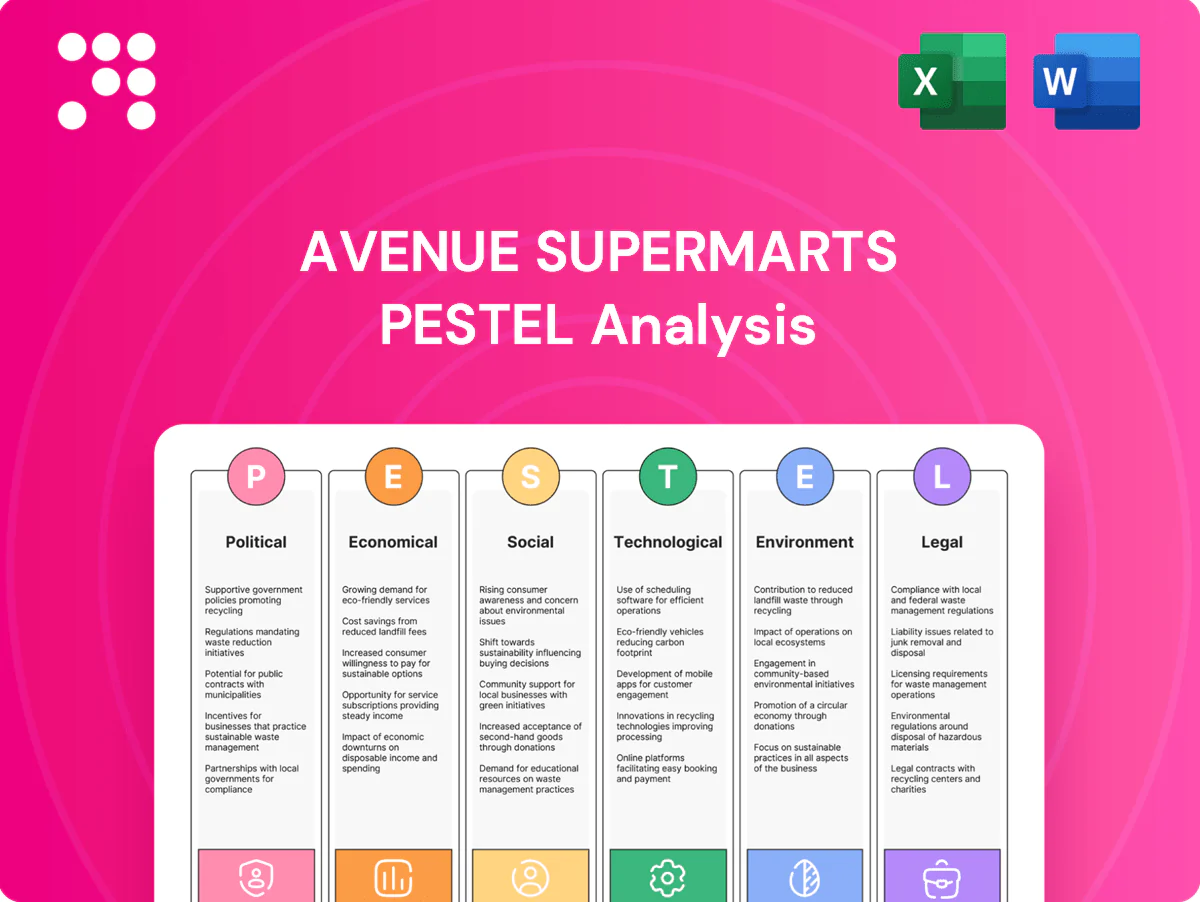
The Avenue Supermarts PESTLE Analysis preview shown here is the exact document you’ll receive after purchase—fully formatted and ready to use. The content, layout, and structure visible are the final version with no placeholders. After payment you’ll instantly download this same professionally structured file.

Product Information
Product Information
Shipping & Returns
Shipping & Returns
Description
Make Smarter Strategic Decisions with a Complete PESTEL View
Unlock strategic clarity with our targeted PESTLE Analysis of Avenue Supermarts—revealing how political changes, economic shifts, and tech trends will shape growth. Ideal for investors and strategists, it’s fully sourced and actionable. Purchase the full report to access the complete, editable analysis instantly.
Political factors
FDI and retail policy
India’s multi-brand retail FDI policy remains capped at 51% with state-level approvals, and evolving relaxations or conditions directly affect Avenue Supermarts’ sourcing and expansion optionality. DMart’s low-cost, high-turnover model depends on tight control of merchandising and pricing, so any policy shift altering procurement or stocking norms could constrain formats or enable larger-format growth. With over 360 stores nationwide and state-specific retail rules, close monitoring lets management ensure compliance and plan footprint rollouts proactively.
GST and indirect taxes
GST slabs of 0%, 5%, 12% and 18% shape Avenue Supermats pricing: staple food largely sits at 0–5%, many FMCG items at 18%, and general merchandise at 12–18%, directly affecting margins and consumer price points. Input tax credit (ITC) flow and eligibility determine working capital and supply‑chain design; frequent rate clarifications raise compliance complexity, while optimized tax planning helps preserve the everyday low‑price (EDLP) model.
State-level permits
Licenses for shops, weights and measures, fire, food and signage in India vary by state and municipality, with approval timelines typically ranging from 30 to 180 days, affecting Avenue Supermarts’ store opening and refurbishment cadence. Local political dynamics and inspections can delay permits by months, disrupting planned openings for the retailer that operated over 350 stores as of mid-2024. Strong government relations have been shown to shorten cycle times and reduce compliance risk, improving rollout predictability.
Public procurement and subsidies
Policies on MSP and subsidies — with NFSA covering about 800 million beneficiaries and annual central buffer movements often exceeding 20 mt in staples — directly shape farm-gate prices and retail availability; DMart must adjust pricing and promo cadence to protect gross margins and SKU turns. Avenue Supermarts reported ~INR 88,000 crore revenue in FY24, underscoring sensitivity to staples pricing swings.
- MSP/subsidy impact: farm-gate prices
- Buffer releases: downward price pressure
- PDS reach: demand shift for essentials (800m beneficiaries)
- DMart action: recalibrate assortment & promo intensity
Infrastructure push
Government spending under the National Infrastructure Pipeline (~₹111 trillion for 2020–25) and PM Gati Shakti integration reduces inbound costs and shrinkage, while improved road, warehousing and logistics parks cut transit times; India’s logistics cost at ~13% of GDP has a government target toward ~8%, boosting store throughput and catchment accessibility. Policy support for cold-chain expansion lifts perishables quality, enabling DMart to deepen penetration as logistics friction declines.
- National Infrastructure Pipeline: ~₹111 trillion (2020–25)
- Logistics cost: ~13% of GDP, target ~8%
- Cold-chain policy expansion: improves perishables shelf quality
- Outcome: lower inbound costs, reduced shrinkage, higher store throughput
FDI caps, state approvals and GST/ITC risks constrain large retail expansion despite scale
Policy caps on multi‑brand FDI (51%) and state approvals constrain Avenue Supermarts’ expansion and sourcing; with 360+ stores and ~INR 88,000 crore revenue (FY24), compliance risk is material. GST bands (0/5/12/18%) and ITC rules affect margins and working capital. MSP/subsidy moves, NFSA coverage (~800m beneficiaries) and buffer releases shift staples pricing. Infrastructure push (NIP ₹111 trillion) and logistics cost (~13% of GDP) lower inbound costs.
| Factor | Key metric |
|---|---|
| Stores / Revenue | 360+ / INR 88,000 cr (FY24) |
| GST bands | 0,5,12,18% |
| NFSA beneficiaries | ~800 million |
| NIP / Logistics | ₹111 tn (2020–25) / ~13% GDP |
What is included in the product
Detailed Word Document
Explores how external macro-environmental factors uniquely affect Avenue Supermarts across Political, Economic, Social, Technological, Environmental and Legal dimensions, with data-backed, region-specific insights and detailed sub-points; designed for executives, investors and strategists, ready for reports and forward-looking scenario planning to identify risks, opportunities and funding-grade narratives.
Customizable Excel Spreadsheet
A concise, visually segmented PESTLE summary for Avenue Supermarts that distills regulatory, economic and consumer risks into an editable, slide-ready format—easy to share across teams and ideal for quick alignment during planning or client presentations.
Economic factors
Consumer income trends
Rising middle-class incomes—estimated at roughly 300–350 million Indians—have expanded basket sizes for value retailers, supporting Avenue Supermarts’ growth; the company reported consolidated revenue of Rs 83,232 crore in FY2024. Wage inflation and improving employment levels boost discretionary categories when present, but slowdowns shift sales toward essentials and private labels. DMart’s EDLP model cushions downcycles by trading customers down rather than out, protecting volumes and margins.
Inflation and input costs
Food and commodity inflation (~7% in India in 2024) pressures Avenue Supermarts pricing, squeezing gross margins and shaping customer price perception; frequent repricing risks eroding trust if not transparently managed. Aggressive vendor negotiations and scale buying—DMart's higher private-label share and centralized buying—are critical to protect spreads. Faster inventory turns reduce carrying costs during price volatility.
Interest rates and capital
Policy rates (RBI repo at 6.50% as of July 2025) directly affect lease economics, warehouse capex and working capital costs for Avenue Supermarts; lower rates reduce financing costs and favor faster store expansion. Higher rates force stricter hurdle rates and tighter site selectivity. Robust cash generation enables self-funded growth cycles, lowering dependence on external debt.
Currency and imports
INR volatility (around 82–83 per USD in 2024–25) raises costs for imported general merchandise and select FMCG inputs, though imports remain a low-single-digit share of Avenue Supermarts inventory. Hedging and increased local sourcing have trimmed FX exposure and supported gross margins. Measured price passthrough plus assortment localization preserves value perception and stabilises margins.
- INR ~82–83/USD (2024–25)
- Imports: low-single-digit share
- Hedging + local sourcing = reduced FX risk
- Price passthrough needed to protect value
- Assortment localization stabilises margins
Urbanization and tier mix
India’s urbanization (~35% urban population in 2023, World Bank) and migration to peri-urban areas enlarge DMart’s core catchments; Avenue Supermarts operated 331 stores as of March 2024, many focused on fast-growing tier‑2/3 corridors. Tier‑2/3 sites offer materially lower real‑estate costs and thinner category depth, while clustered expansion enables shared logistics and distribution efficiency.
- Urbanization: ~35% (2023)
- Stores: 331 (Mar 2024)
- Tier‑2/3: lower rents, thinner SKUs
- Strategy: clustered expansion for shared logistics
FDI caps, state approvals and GST/ITC risks constrain large retail expansion despite scale
Rising middle class (~300–350m) and DMart’s FY2024 revenue Rs83,232cr drive volume growth; EDLP cushions downcycles. RBI repo 6.50% (Jul 2025) raises lease/capex costs but strong cash flow limits external borrowing. INR ~82–83/USD (2024–25) and low-single-digit import share contain FX risk; private label and scale buying protect margins.
| Metric | Value |
|---|---|
| Revenue FY2024 | Rs83,232cr |
| Repo | 6.50% |
| INR/USD | 82–83 |
| Stores (Mar 2024) | 331 |
Preview Before You Purchase
Avenue Supermarts PESTLE Analysis
The Avenue Supermarts PESTLE Analysis preview shown here is the exact document you’ll receive after purchase—fully formatted and ready to use. The content, layout, and structure visible are the final version with no placeholders. After payment you’ll instantly download this same professionally structured file.