DGB Financial Group PESTLE Analysis

Your Shortcut to Market Insight Starts Here
Get strategic advantage with our PESTLE Analysis of DGB Financial Group — uncover how political shifts, economic cycles, and technological change are reshaping its outlook. This concise, research-backed briefing highlights regulatory risks, market opportunities, and societal trends that matter to investors and planners. Purchase the full report for the complete, actionable breakdown and downloadable deliverables.
Political factors

Financial regulatory direction (FSC/FSS)
Policy shifts by Korea’s FSC/FSS on capital, consumer protection and conduct directly shape DGB’s product design and risk appetite; recent macroprudential moves tightening real‑estate project finance and DSR (amid household debt near 1,900 trillion KRW in 2023) can constrain loan growth and margin targets. Proactive regulatory engagement and rapid compliance agility are strategic advantages, and scenario planning should assume periodic FSC/FSS adjustments.
Geopolitical risk on the Korean Peninsula
Periodic North Korea tensions elevate market volatility, funding costs and FX risk; South Korea’s nominal GDP was about $1.9 trillion in 2024 (IMF), so regional shocks can have large spillovers. Stress events trigger flight-to-quality into US Treasuries and won outflows, altering depositor behavior and deposit betas. Strong business continuity plans and liquidity buffers (LCR and NSFR focus) are essential, while geographic and asset-class diversification mitigates event risk.

Regional development and decentralization policies
Government initiatives to revitalize Daegu-Gyeongbuk can boost SME credit demand and public-private projects in a region of about 5 million people. Preferential programs and government-backed guarantees improve risk-adjusted returns for regional lenders. DGB Financial Group, headquartered in Daegu, is well positioned to capture policy-linked growth and, through close alignment with local authorities, gains clearer pipeline visibility.

Digital finance and open banking mandates
National pushes—open banking launched in Korea in 2019 and MyData regulation in 2020—are reshaping distribution and data monetization; by 2024 the MyData ecosystem exceeded 2,000 licensed providers, compressing fees even as compliance creates new channels.
DGB can monetize shared data to personalize offers and tighten underwriting, and partnering with licensed fintechs accelerates adoption and customer reach.
- regulation: open banking (2019) + MyData (2020)
- ecosystem: >2,000 licensed MyData providers (2024)
- impact: fee compression; new channels for distribution
- strategy: data-driven personalization; fintech partnerships
International expansion and trade diplomacy
Bilateral relations and trade policies shape DGB’s overseas licensing and partnerships, while host-country prudential rules, taxation and political stability materially affect ROI. South Korea, the world’s 10th-largest economy in 2024, leverages economic diplomacy to smooth market entry. Structured risk-sharing and JV models limit balance-sheet exposure and cap downside.
- Bilateral ties drive licensing scope
- Prudential/tax rules alter returns
- Korea’s diplomacy eases entry
- JV/risk-share reduce exposure
Korea: macroprudential limits and open-data reshape lending; strong liquidity and JV risk-share needed
FSC/FSS macroprudential moves (household debt ~1,900t KRW in 2023) and open banking/MyData (>2,000 providers in 2024) constrain loan growth while creating data-driven channels; regional policies for Daegu–Gyeongbuk (pop ~5m) and diplomacy (Korea #10 economy, 2024) shape expansion, so strong liquidity (LCR/NSFR) and JV risk‑share models are critical.
| Factor | Key number |
|---|---|
| Household debt | ~1,900 t KRW (2023) |
| MyData providers | >2,000 (2024) |
| Daegu–Gyeongbuk pop | ~5M |
What is included in the product
 Detailed Word Document
Explores how Political, Economic, Social, Technological, Environmental and Legal forces uniquely affect DGB Financial Group, with each category supported by relevant data and regional regulatory context. Designed for executives and investors, it highlights risks, opportunities and forward-looking scenarios to inform strategic planning.

 Customizable Excel Spreadsheet
A concise, visually segmented PESTLE summary of DGB Financial Group for quick sharing and insertion into presentations, allowing note-taking by region or business line and supporting risk discussions and team alignment during planning sessions.
Economic factors

Interest rate cycle (Bank of Korea)
Bank of Korea policy rate at 3.50% (July 2025) drives DGB Financial Group NIM, loan demand and deposit mix—cuts compress NIM but boost lending, hikes widen margins yet dent credit demand. High household debt in Korea (around 104% of GDP in 2024) amplifies sensitivity to rate shifts. Active ALM, dynamic deposit pricing and hedging plus duration management are critical to stabilize earnings.
Regional SME and manufacturing cycle
Daegu-Gyeongbuk’s SME/manufacturing base—within a national economy where SMEs make up 99.9% of firms and 88% of employment—anchors credit quality to domestic demand and exports. Economic slowdowns elevate NPL risk, notably in supply-chain-exposed auto-parts, machinery and textile clusters. Providing tailored working-capital lines and invoice factoring reduces liquidity stress; enhanced sectoral monitoring (firm-level cashflow and order-book tracking) sharpens early warning.

KRW volatility and external shocks
KRW volatility—with swings exceeding 8% in 2022–24—raises DGB's funding costs, pressures overseas earnings and marks-to-market for securities, widening NII and capital volatility. Global risk-off episodes (eg 2022–23) strained wholesale funding markets, highlighting reliance on diversified funding and contingency plans. Tight FX risk limits and liquidity buffers (eg maintaining 3–6 months wholesale cover) reduce vulnerability.

Real estate and project finance exposure
DGB's real estate and project-finance exposure drives credit-loss volatility as construction and PF cycles widen; Korea household debt remained about 104% of GDP in 2024, intensifying downside risk and provisioning needs. Regulatory scrutiny since 2023 has increased capital intensity for higher-risk PF deals, while a shift toward pre-sold, guaranteed or public-backed projects—about 50% of new PF lending in 2024—improves resilience and supports portfolio rebalancing to lower concentration risk.
- Construction/PF cycles: amplify provisioning
- Regulatory: higher capital for risky PF
- Pre-sold/public-backed ~50% (2024): raises resilience
- Portfolio rebalancing: reduces concentration risk
Inflation and consumer spending dynamics
Inflation (South Korea CPI ~2.6% in 2024) squeezes household cash flows and nudges delinquency rates higher amid household debt-to-GDP near 104% (2024), pressuring DGB’s retail lending book; fee income from cards/payments tracks consumption (retail sales +3.2% in 2024) supporting noninterest revenue. Pricing power and tight cost discipline sustain NIM/margins, while data-driven affordability checks reduce loss rates and refine underwriting.
- Inflation: 2.6% (2024)
- Household debt/GDP: ~104% (2024)
- Retail sales: +3.2% (2024)
- Card fee income: supports revenue; underwriting improved by data checks
Korea: macroprudential limits and open-data reshape lending; strong liquidity and JV risk-share needed
BOK policy rate 3.50% (Jul 2025) steers NIM, lending and deposit mix; cuts compress margins while boosting loan demand. Household debt ~104% of GDP (2024) and CPI 2.6% (2024) heighten delinquency risk; retail sales +3.2% (2024) supports fee income. KRW volatility >8% (2022–24) raises FX and funding risk; 50% of new PF lending pre-sold/public-backed (2024) improves resilience.
| Metric | Value |
|---|---|
| BOK rate | 3.50% (Jul 2025) |
| Household debt/GDP | ~104% (2024) |
| CPI | 2.6% (2024) |
| Retail sales | +3.2% (2024) |
| KRW vol | >8% (2022–24) |
| Pre-sold PF | ~50% (2024) |
Preview Before You Purchase
DGB Financial Group PESTLE Analysis
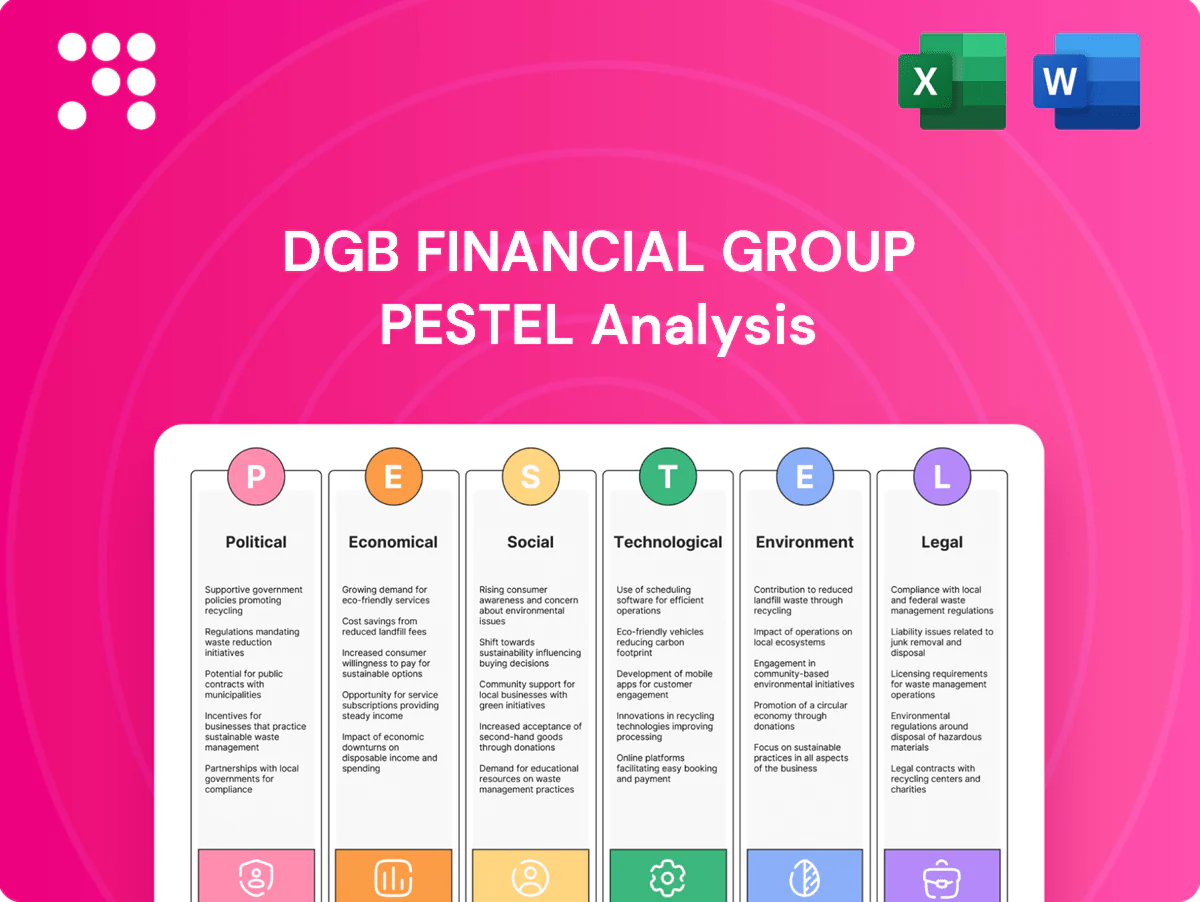
The preview shown here is the exact DGB Financial Group PESTLE Analysis you’ll receive after purchase—fully formatted, professionally structured, and ready to use. This screenshot reflects the real product with complete content and no placeholders. After checkout you’ll be able to download this identical, final document immediately.

Original: $10.00
-65%$10.00
$3.50Product Information
Product Information
Shipping & Returns
Shipping & Returns
Description
Your Shortcut to Market Insight Starts Here
Get strategic advantage with our PESTLE Analysis of DGB Financial Group — uncover how political shifts, economic cycles, and technological change are reshaping its outlook. This concise, research-backed briefing highlights regulatory risks, market opportunities, and societal trends that matter to investors and planners. Purchase the full report for the complete, actionable breakdown and downloadable deliverables.
Political factors
Financial regulatory direction (FSC/FSS)
Policy shifts by Korea’s FSC/FSS on capital, consumer protection and conduct directly shape DGB’s product design and risk appetite; recent macroprudential moves tightening real‑estate project finance and DSR (amid household debt near 1,900 trillion KRW in 2023) can constrain loan growth and margin targets. Proactive regulatory engagement and rapid compliance agility are strategic advantages, and scenario planning should assume periodic FSC/FSS adjustments.
Geopolitical risk on the Korean Peninsula
Periodic North Korea tensions elevate market volatility, funding costs and FX risk; South Korea’s nominal GDP was about $1.9 trillion in 2024 (IMF), so regional shocks can have large spillovers. Stress events trigger flight-to-quality into US Treasuries and won outflows, altering depositor behavior and deposit betas. Strong business continuity plans and liquidity buffers (LCR and NSFR focus) are essential, while geographic and asset-class diversification mitigates event risk.
Regional development and decentralization policies
Government initiatives to revitalize Daegu-Gyeongbuk can boost SME credit demand and public-private projects in a region of about 5 million people. Preferential programs and government-backed guarantees improve risk-adjusted returns for regional lenders. DGB Financial Group, headquartered in Daegu, is well positioned to capture policy-linked growth and, through close alignment with local authorities, gains clearer pipeline visibility.
Digital finance and open banking mandates
National pushes—open banking launched in Korea in 2019 and MyData regulation in 2020—are reshaping distribution and data monetization; by 2024 the MyData ecosystem exceeded 2,000 licensed providers, compressing fees even as compliance creates new channels.
DGB can monetize shared data to personalize offers and tighten underwriting, and partnering with licensed fintechs accelerates adoption and customer reach.
- regulation: open banking (2019) + MyData (2020)
- ecosystem: >2,000 licensed MyData providers (2024)
- impact: fee compression; new channels for distribution
- strategy: data-driven personalization; fintech partnerships
International expansion and trade diplomacy
Bilateral relations and trade policies shape DGB’s overseas licensing and partnerships, while host-country prudential rules, taxation and political stability materially affect ROI. South Korea, the world’s 10th-largest economy in 2024, leverages economic diplomacy to smooth market entry. Structured risk-sharing and JV models limit balance-sheet exposure and cap downside.
- Bilateral ties drive licensing scope
- Prudential/tax rules alter returns
- Korea’s diplomacy eases entry
- JV/risk-share reduce exposure
Korea: macroprudential limits and open-data reshape lending; strong liquidity and JV risk-share needed
FSC/FSS macroprudential moves (household debt ~1,900t KRW in 2023) and open banking/MyData (>2,000 providers in 2024) constrain loan growth while creating data-driven channels; regional policies for Daegu–Gyeongbuk (pop ~5m) and diplomacy (Korea #10 economy, 2024) shape expansion, so strong liquidity (LCR/NSFR) and JV risk‑share models are critical.
| Factor | Key number |
|---|---|
| Household debt | ~1,900 t KRW (2023) |
| MyData providers | >2,000 (2024) |
| Daegu–Gyeongbuk pop | ~5M |
What is included in the product
Detailed Word Document
Explores how Political, Economic, Social, Technological, Environmental and Legal forces uniquely affect DGB Financial Group, with each category supported by relevant data and regional regulatory context. Designed for executives and investors, it highlights risks, opportunities and forward-looking scenarios to inform strategic planning.
Customizable Excel Spreadsheet
A concise, visually segmented PESTLE summary of DGB Financial Group for quick sharing and insertion into presentations, allowing note-taking by region or business line and supporting risk discussions and team alignment during planning sessions.
Economic factors
Interest rate cycle (Bank of Korea)
Bank of Korea policy rate at 3.50% (July 2025) drives DGB Financial Group NIM, loan demand and deposit mix—cuts compress NIM but boost lending, hikes widen margins yet dent credit demand. High household debt in Korea (around 104% of GDP in 2024) amplifies sensitivity to rate shifts. Active ALM, dynamic deposit pricing and hedging plus duration management are critical to stabilize earnings.
Regional SME and manufacturing cycle
Daegu-Gyeongbuk’s SME/manufacturing base—within a national economy where SMEs make up 99.9% of firms and 88% of employment—anchors credit quality to domestic demand and exports. Economic slowdowns elevate NPL risk, notably in supply-chain-exposed auto-parts, machinery and textile clusters. Providing tailored working-capital lines and invoice factoring reduces liquidity stress; enhanced sectoral monitoring (firm-level cashflow and order-book tracking) sharpens early warning.
KRW volatility and external shocks
KRW volatility—with swings exceeding 8% in 2022–24—raises DGB's funding costs, pressures overseas earnings and marks-to-market for securities, widening NII and capital volatility. Global risk-off episodes (eg 2022–23) strained wholesale funding markets, highlighting reliance on diversified funding and contingency plans. Tight FX risk limits and liquidity buffers (eg maintaining 3–6 months wholesale cover) reduce vulnerability.
Real estate and project finance exposure
DGB's real estate and project-finance exposure drives credit-loss volatility as construction and PF cycles widen; Korea household debt remained about 104% of GDP in 2024, intensifying downside risk and provisioning needs. Regulatory scrutiny since 2023 has increased capital intensity for higher-risk PF deals, while a shift toward pre-sold, guaranteed or public-backed projects—about 50% of new PF lending in 2024—improves resilience and supports portfolio rebalancing to lower concentration risk.
- Construction/PF cycles: amplify provisioning
- Regulatory: higher capital for risky PF
- Pre-sold/public-backed ~50% (2024): raises resilience
- Portfolio rebalancing: reduces concentration risk
Inflation and consumer spending dynamics
Inflation (South Korea CPI ~2.6% in 2024) squeezes household cash flows and nudges delinquency rates higher amid household debt-to-GDP near 104% (2024), pressuring DGB’s retail lending book; fee income from cards/payments tracks consumption (retail sales +3.2% in 2024) supporting noninterest revenue. Pricing power and tight cost discipline sustain NIM/margins, while data-driven affordability checks reduce loss rates and refine underwriting.
- Inflation: 2.6% (2024)
- Household debt/GDP: ~104% (2024)
- Retail sales: +3.2% (2024)
- Card fee income: supports revenue; underwriting improved by data checks
Korea: macroprudential limits and open-data reshape lending; strong liquidity and JV risk-share needed
BOK policy rate 3.50% (Jul 2025) steers NIM, lending and deposit mix; cuts compress margins while boosting loan demand. Household debt ~104% of GDP (2024) and CPI 2.6% (2024) heighten delinquency risk; retail sales +3.2% (2024) supports fee income. KRW volatility >8% (2022–24) raises FX and funding risk; 50% of new PF lending pre-sold/public-backed (2024) improves resilience.
| Metric | Value |
|---|---|
| BOK rate | 3.50% (Jul 2025) |
| Household debt/GDP | ~104% (2024) |
| CPI | 2.6% (2024) |
| Retail sales | +3.2% (2024) |
| KRW vol | >8% (2022–24) |
| Pre-sold PF | ~50% (2024) |
Preview Before You Purchase
DGB Financial Group PESTLE Analysis
The preview shown here is the exact DGB Financial Group PESTLE Analysis you’ll receive after purchase—fully formatted, professionally structured, and ready to use. This screenshot reflects the real product with complete content and no placeholders. After checkout you’ll be able to download this identical, final document immediately.