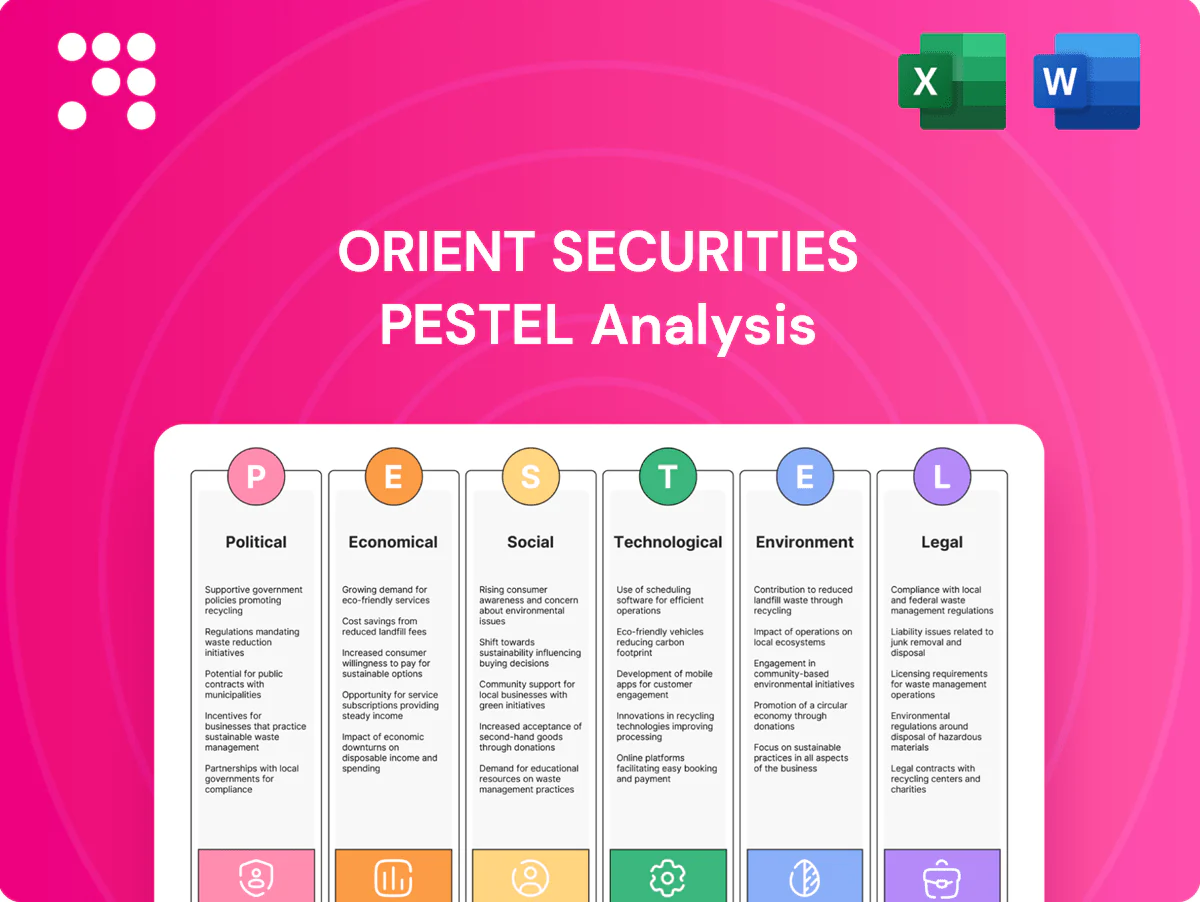
Orient Securities PESTLE Analysis

Your Competitive Advantage Starts with This Report
Discover how political shifts, economic trends, and tech innovation shape Orient Securities with our concise PESTLE Analysis. This brief preview highlights key external risks and opportunities for investors and strategists. Purchase the full report to access the complete, actionable insights and data-ready appendices.
Political factors

Centralized financial regulation
China’s capital markets are tightly supervised by three national regulators (CSRC, PBoC, SAFE) and three major exchanges (Shanghai, Shenzhen, HK), and frequent policy guidance—dozens of notices annually—shapes IPO pacing, margin rules and product approvals. Orient Securities must align rapidly with shifting priorities to maintain license access and product flow. Proactive compliance and active policy engagement are competitive necessities in this environment.
Capital market reforms
Registration-based IPOs, first piloted on the STAR Market in June 2019 and extended to ChiNext and other boards through 2021–2022, expand underwriting and sponsorship opportunities while raising disclosure standards and gatekeeping liability. Orient Securities can capture deeper deal flow by upgrading due diligence and issuer selection processes. Execution quality and tightened risk control will determine its share of wallet in a more competitive pipeline.

State priorities and industrial policy
China’s 14th Five-Year Plan (2021–25) and carbon-neutrality-by-2060 commitment steer capital into advanced manufacturing, the digital economy and green sectors; the digital economy was reported at about 45% of GDP in 2021. Orient Securities must align brokerage research and IB coverage with these policy lanes. Structuring products and distribution to channel household savings into priority industries lowers approval friction and reputational risk.

Geopolitical tensions
Geopolitical tensions, notably US–China frictions and expanded tech export controls targeting 60+ Chinese entities, depress cross-border listings and investor sentiment, widening trading spreads and disrupting deal pipelines; Hong Kong equity fundraising saw sharp declines in 2023–24. Orient Securities must diversify revenue, build contingency plans for overseas operations, and embed geopolitics in client risk advice.
- Impact: wider spreads, volatile flows
- Controls: 60+ entities affected
- Action: diversify revenues, contingency plans
- Advisory: geopolitics in risk assessments
Regional development agendas
Regional agendas such as Yangtze River Delta integration and the Greater Bay Area deepen local capital pools—GBA GDP surpassed US$1.8 trillion by 2023 and the YRD accounts for roughly a quarter of national GDP—prompting local governments to back listings and bond issues for infrastructure and strategic firms. Orient Securities can scale in policy-favored clusters; covering regional champions boosts deal origination and fee income.
- GBA GDP > US$1.8T (2023)
- YRD ~25% of China GDP
- Local govt support raises IPO/bond supply
- Regional coverage = stronger origination
China markets: regulation-led IPO reform and green-digital funding — GBA > US$1.8T
China’s capital markets are tightly regulated by CSRC, PBoC and SAFE and three exchanges; policy notices (dozens annually) force rapid compliance and product alignment. Registration-based IPOs (STAR market 2019) widen underwriting but raise disclosure and liability. 14th Five-Year priorities and carbon targets steer capital to green and digital sectors (digital economy ~45% of GDP in 2021). GBA GDP >US$1.8T (2023); diversify revenues vs geopolitical shocks.
| Factor | Key data | Action |
|---|---|---|
| Regulation | Dozens notices/yr | Proactive compliance |
| IPO regime | STAR 2019 | Upgrade due diligence |
| Policy lanes | Digital ~45% GDP (2021) | Align coverage |
| Regional | GBA >US$1.8T (2023) | Scale regionally |
What is included in the product
 Detailed Word Document
Explores how Political, Economic, Social, Technological, Environmental and Legal forces uniquely impact Orient Securities, combining data-driven trends and region-specific regulatory insights to identify risks, opportunities and actionable strategic responses for executives and investors.

 Customizable Excel Spreadsheet
A concise, visually segmented Orient Securities PESTLE summary that speeds decision-making in meetings, is editable for local context or business line, and can be dropped into presentations for quick cross-team alignment.
Economic factors

Growth and market cycles
Brokerage revenues at Orient Securities move with market turnover and investor risk appetite; China GDP grew 5.2% in 2023 (NBS), but episodic property stress squeezes valuations and fee pools. Slower growth compresses deal flow and brokerage margins, while recovery spurts historically reignite trading and IPO activity. Orient should balance cyclical brokerage with countercyclical asset-management income to stabilize net fees.
Liquidity and interest rates
Monetary easing historically lifts equities, margin financing and bond underwriting—evident when global policy rates fell from the 2022-23 tightening cycle; US fed funds were 5.25–5.50% in mid-2024 as a reference for tightening effects. Tight liquidity compresses leverage and primary issuance, while Orient Securities’ treasury and funding costs directly pressure prop-trading returns. Active duration and collateral management help protect margins and funding spreads.

Capital flows and RMB dynamics
Exchange rate swings via RMB volatility influence foreign participation through Stock Connect: northbound flows remain the principal channel as foreign ownership of A-shares rose to about 5% by 2024, lifting valuations during inflow episodes. Inflows compress fees and tighten spreads, while sudden outflows widen trading costs and fee pressure. Orient Securities can tailor FX-hedged products and use onshore/offshore linkages for arbitrage and differentiated China research.

Commodity and futures cycles
Volatile commodity cycles (oil swings ~25% in 2024) boost demand for hedging and futures brokerage, elevating fee income for Orient Securities while raising margin-call frequency and counterparty concentration risks that require tighter limits and stress-testing.
- Hedging demand up → revenue opportunity
- Margin risk → enforce limits
- Cross-sell research → industrial clients
- Robust clearing → critical in stress
Household savings reallocation
Household savings reallocation from property toward financial assets is boosting brokerage and wealth-management demand, increasing client appetite for mutual funds, structured notes, and advisory services; Orient Securities can expand discretionary mandates by offering risk-tiered portfolios and scalable operations while investor education programs help sustain flows.
- shift: property to financial assets
- demand: funds, structured notes, advisory
- strategy: scale discretionary, risk-tiered
- support: investor education for sustainable flows
China markets: regulation-led IPO reform and green-digital funding — GBA > US$1.8T
Orient Securities faces cyclical brokerage tied to turnover; China GDP 5.2% in 2023 and A-share foreign ownership ~5% by 2024 drive episodic fee pools. Tightening (US funds 5.25–5.50% mid-2024) raises funding costs and compresses issuance, while oil volatility (~25% in 2024) boosts hedging demand and margin risk. Household shift from property to financial assets increases wealth-management flows.
| Metric | 2023–24 | Impact |
|---|---|---|
| China GDP | 5.2% (2023) | trading/IPO sensitivity |
| Foreign A-share | ~5% (2024) | inflow-driven valuation |
| Fed funds | 5.25–5.50% (mid-2024) | funding pressure |
| Oil vol | ~25% (2024) | hedging demand |
Same Document Delivered
Orient Securities PESTLE Analysis
The Orient Securities PESTLE Analysis preview shown here is the exact document you’ll receive after purchase—fully formatted and ready to use. It contains the complete PESTLE assessment, structured insights, and actionable implications for strategy and risk. No placeholders or teasers—this is the final file, available for immediate download after checkout.

Product Information
Product Information
Shipping & Returns
Shipping & Returns
Description
Your Competitive Advantage Starts with This Report
Discover how political shifts, economic trends, and tech innovation shape Orient Securities with our concise PESTLE Analysis. This brief preview highlights key external risks and opportunities for investors and strategists. Purchase the full report to access the complete, actionable insights and data-ready appendices.
Political factors
Centralized financial regulation
China’s capital markets are tightly supervised by three national regulators (CSRC, PBoC, SAFE) and three major exchanges (Shanghai, Shenzhen, HK), and frequent policy guidance—dozens of notices annually—shapes IPO pacing, margin rules and product approvals. Orient Securities must align rapidly with shifting priorities to maintain license access and product flow. Proactive compliance and active policy engagement are competitive necessities in this environment.
Capital market reforms
Registration-based IPOs, first piloted on the STAR Market in June 2019 and extended to ChiNext and other boards through 2021–2022, expand underwriting and sponsorship opportunities while raising disclosure standards and gatekeeping liability. Orient Securities can capture deeper deal flow by upgrading due diligence and issuer selection processes. Execution quality and tightened risk control will determine its share of wallet in a more competitive pipeline.
State priorities and industrial policy
China’s 14th Five-Year Plan (2021–25) and carbon-neutrality-by-2060 commitment steer capital into advanced manufacturing, the digital economy and green sectors; the digital economy was reported at about 45% of GDP in 2021. Orient Securities must align brokerage research and IB coverage with these policy lanes. Structuring products and distribution to channel household savings into priority industries lowers approval friction and reputational risk.
Geopolitical tensions
Geopolitical tensions, notably US–China frictions and expanded tech export controls targeting 60+ Chinese entities, depress cross-border listings and investor sentiment, widening trading spreads and disrupting deal pipelines; Hong Kong equity fundraising saw sharp declines in 2023–24. Orient Securities must diversify revenue, build contingency plans for overseas operations, and embed geopolitics in client risk advice.
- Impact: wider spreads, volatile flows
- Controls: 60+ entities affected
- Action: diversify revenues, contingency plans
- Advisory: geopolitics in risk assessments
Regional development agendas
Regional agendas such as Yangtze River Delta integration and the Greater Bay Area deepen local capital pools—GBA GDP surpassed US$1.8 trillion by 2023 and the YRD accounts for roughly a quarter of national GDP—prompting local governments to back listings and bond issues for infrastructure and strategic firms. Orient Securities can scale in policy-favored clusters; covering regional champions boosts deal origination and fee income.
- GBA GDP > US$1.8T (2023)
- YRD ~25% of China GDP
- Local govt support raises IPO/bond supply
- Regional coverage = stronger origination
China markets: regulation-led IPO reform and green-digital funding — GBA > US$1.8T
China’s capital markets are tightly regulated by CSRC, PBoC and SAFE and three exchanges; policy notices (dozens annually) force rapid compliance and product alignment. Registration-based IPOs (STAR market 2019) widen underwriting but raise disclosure and liability. 14th Five-Year priorities and carbon targets steer capital to green and digital sectors (digital economy ~45% of GDP in 2021). GBA GDP >US$1.8T (2023); diversify revenues vs geopolitical shocks.
| Factor | Key data | Action |
|---|---|---|
| Regulation | Dozens notices/yr | Proactive compliance |
| IPO regime | STAR 2019 | Upgrade due diligence |
| Policy lanes | Digital ~45% GDP (2021) | Align coverage |
| Regional | GBA >US$1.8T (2023) | Scale regionally |
What is included in the product
Detailed Word Document
Explores how Political, Economic, Social, Technological, Environmental and Legal forces uniquely impact Orient Securities, combining data-driven trends and region-specific regulatory insights to identify risks, opportunities and actionable strategic responses for executives and investors.
Customizable Excel Spreadsheet
A concise, visually segmented Orient Securities PESTLE summary that speeds decision-making in meetings, is editable for local context or business line, and can be dropped into presentations for quick cross-team alignment.
Economic factors
Growth and market cycles
Brokerage revenues at Orient Securities move with market turnover and investor risk appetite; China GDP grew 5.2% in 2023 (NBS), but episodic property stress squeezes valuations and fee pools. Slower growth compresses deal flow and brokerage margins, while recovery spurts historically reignite trading and IPO activity. Orient should balance cyclical brokerage with countercyclical asset-management income to stabilize net fees.
Liquidity and interest rates
Monetary easing historically lifts equities, margin financing and bond underwriting—evident when global policy rates fell from the 2022-23 tightening cycle; US fed funds were 5.25–5.50% in mid-2024 as a reference for tightening effects. Tight liquidity compresses leverage and primary issuance, while Orient Securities’ treasury and funding costs directly pressure prop-trading returns. Active duration and collateral management help protect margins and funding spreads.
Capital flows and RMB dynamics
Exchange rate swings via RMB volatility influence foreign participation through Stock Connect: northbound flows remain the principal channel as foreign ownership of A-shares rose to about 5% by 2024, lifting valuations during inflow episodes. Inflows compress fees and tighten spreads, while sudden outflows widen trading costs and fee pressure. Orient Securities can tailor FX-hedged products and use onshore/offshore linkages for arbitrage and differentiated China research.
Commodity and futures cycles
Volatile commodity cycles (oil swings ~25% in 2024) boost demand for hedging and futures brokerage, elevating fee income for Orient Securities while raising margin-call frequency and counterparty concentration risks that require tighter limits and stress-testing.
- Hedging demand up → revenue opportunity
- Margin risk → enforce limits
- Cross-sell research → industrial clients
- Robust clearing → critical in stress
Household savings reallocation
Household savings reallocation from property toward financial assets is boosting brokerage and wealth-management demand, increasing client appetite for mutual funds, structured notes, and advisory services; Orient Securities can expand discretionary mandates by offering risk-tiered portfolios and scalable operations while investor education programs help sustain flows.
- shift: property to financial assets
- demand: funds, structured notes, advisory
- strategy: scale discretionary, risk-tiered
- support: investor education for sustainable flows
China markets: regulation-led IPO reform and green-digital funding — GBA > US$1.8T
Orient Securities faces cyclical brokerage tied to turnover; China GDP 5.2% in 2023 and A-share foreign ownership ~5% by 2024 drive episodic fee pools. Tightening (US funds 5.25–5.50% mid-2024) raises funding costs and compresses issuance, while oil volatility (~25% in 2024) boosts hedging demand and margin risk. Household shift from property to financial assets increases wealth-management flows.
| Metric | 2023–24 | Impact |
|---|---|---|
| China GDP | 5.2% (2023) | trading/IPO sensitivity |
| Foreign A-share | ~5% (2024) | inflow-driven valuation |
| Fed funds | 5.25–5.50% (mid-2024) | funding pressure |
| Oil vol | ~25% (2024) | hedging demand |
Same Document Delivered
Orient Securities PESTLE Analysis
The Orient Securities PESTLE Analysis preview shown here is the exact document you’ll receive after purchase—fully formatted and ready to use. It contains the complete PESTLE assessment, structured insights, and actionable implications for strategy and risk. No placeholders or teasers—this is the final file, available for immediate download after checkout.