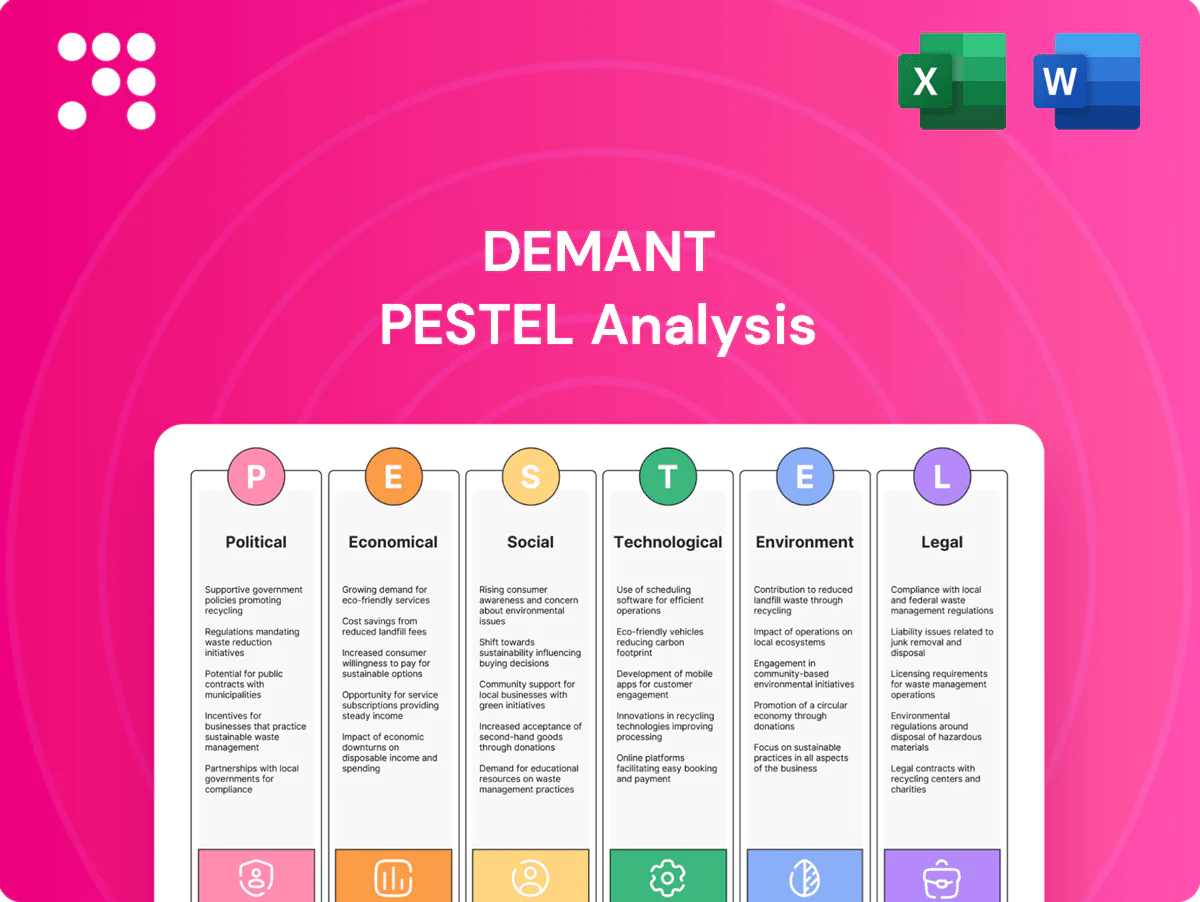
Demant PESTLE Analysis

Make Smarter Strategic Decisions with a Complete PESTEL View
Gain strategic clarity with our PESTLE analysis of Demant, revealing political, economic, social, technological, legal and environmental forces shaping its outlook. Ideal for investors, consultants and managers, it turns external trends into actionable insights and risk forecasts. Buy the full, editable report for instant, board-ready intelligence.
Political factors

Healthcare reimbursement policies
National reimbursement schemes and public payer decisions directly determine demand and pricing for hearing aids, implants and diagnostics, shaping upgrade cycles and market size. WHO estimates 430 million people have disabling hearing loss, underscoring large but policy-dependent potential. Changes in coverage criteria or co‑pays can accelerate or delay adoption, so Demant must generate health‑economic evidence to secure listings and tailor market access per country.
Government procurement and tenders
Public tenders in hospitals and clinics drive 40-60% of volumes for diagnostics and implants, directly compressing margins when tender pricing prevails. Centralized buying through EU/GPO frameworks often forces 10-25% price concessions and accelerates vendor consolidation. Winning framework agreements requires compliance, spare-parts/service capacity and demonstrated lifecycle value. Losing a major tender can cut local revenue by 15-30% within a year.

Geopolitical trade and supply chain exposure
Tariffs such as US duties of up to 25% on many Chinese imports and export controls on advanced chips raise component costs and constrain availability for Demant’s electronics. Diversifying suppliers and nearshoring — supported by the US CHIPS Act $52 billion subsidy program — reduces reliance on strained Asian supply chains for semiconductors. Customs delays of days to weeks can push product launches and degrade service levels, while broad sanctions require continuous screening to avoid heavy penalties.

Public health priorities and aging agendas
Governments prioritizing healthy aging and productivity are directing funding toward hearing care pathways, supported by WHO data showing about 430 million people with disabling hearing loss globally (2021) and growing elder populations; screening programs and awareness campaigns (newborn/age-based) have measurably expanded diagnosis rates. Policy alignment can unlock funding for teleaudiology and community clinics, while shifting priorities risk diverting budgets to acute care.
- 430 million people with disabling hearing loss (WHO)
- Screening/awareness drive higher diagnosis and treatment uptake
- Policy alignment enables teleaudiology/community clinic funding; budget shifts pose downside
Industrial policy and R&D incentives
Grants, tax credits and Horizon Europe funding (€95.5bn for 2021–27) plus Digital Europe (~€7.5bn) cut Demant’s R&D costs; India’s PLI for electronics (₹76,000 crore) can shift manufacturing. Participation in national digital health schemes (Germany DiGA: >30 approvals by 2024) speeds adoption, while variability in incentives risks long‑term tech roadmaps.
- Horizon Europe: €95.5bn
- Digital Europe: ~€7.5bn
- India PLI electronics: ₹76,000 crore
- Germany DiGA: >30 apps (2024)
Public Payers, Tenders and Trade Risks Drive Hearing Device Access and Pricing
Reimbursement and public payers shape demand for hearing aids/implants; WHO: 430 million with disabling hearing loss. Public tenders (40–60% volumes) force 10–25% price concessions; losing a major tender can cut local revenue 15–30%. Trade/tariff risks (US duties up to 25%) and policy grants (CHIPS $52B; Horizon €95.5bn; DiGA >30; India PLI ₹76,000cr) affect costs and access.
| Tag | Metric | Value |
|---|---|---|
| WHO | Disabling hearing loss | 430M (2021) |
| Tenders | Share / price impact | 40–60% / 10–25% |
| Funding | Key programs | CHIPS $52B; Horizon €95.5bn |
What is included in the product
 Detailed Word Document
Explores how macro-environmental factors uniquely impact Demant across Political, Economic, Social, Technological, Environmental, and Legal dimensions, each backed by current data and trends to identify risks and opportunities; formatted for direct use in strategic planning and investor materials.

 Customizable Excel Spreadsheet
A concise, visually segmented Demant PESTLE summary that relieves time-consuming external risk analysis by enabling quick edits, easy sharing, and direct insertion into presentations to align teams and support strategic planning.
Economic factors

Macroeconomic cycles and consumer spending
Recessions reduce discretionary out‑of‑pocket purchases for premium hearing aids, cutting demand for higher ASP models as consumers prioritize essentials; WHO reports 430 million people had disabling hearing loss in 2021, underpinning long‑term demand. Premium mix and upgrade cycles track income and employment trends, while financing and mid‑tier offering cushion volatility; the global hearing‑aid market was about USD 7–8bn in 2023, and recoveries lift ASPs and accessory attach rates.
Currency fluctuations
Demant’s global footprint—with approximately 90% of revenue generated outside Denmark—exposes it to significant FX translation and transaction risk; a stronger USD or EUR can erode reported revenue in weaker local currencies and raise component costs.
Hedging programs reported by the group moderate short‑term volatility but cannot fix long‑term structural mismatches.
Pricing agility and increased local sourcing are used to offset FX headwinds and protect margins.

Healthcare budget constraints
Public payers face strong cost containment that compresses reimbursement levels and volumes for hearing solutions. Value-based purchasing and outcome metrics increasingly determine acceptable price points. Demonstrating reduced comorbidities and lower social costs—WHO estimates unaddressed hearing loss costs the global economy about 980 billion USD annually—supports funding. Efficient fitting and aftercare help meet payer productivity targets.

Demographic tailwinds
Aging populations expand Demants addressable market: WHO projects 2.5 billion people with some hearing loss by 2050, driving demand among seniors and raising replacement cycles as lifespans increase (average hearing aid replacement ~5 years). Urban noise exposure leaves 1.1 billion young people at risk, boosting incidence in working‑age adults and elevating need for diagnostics and accessories; capacity and channel planning must match this growing demand.
- WHO: 2.5 billion with hearing loss by 2050
- 1.1 billion youth at risk from unsafe listening
- Average device replacement ~5 years
- Align capacity and channels to rising demand
Cost inflation and component availability
Cost inflation across electronics, logistics and labor is compressing margins for device-makers like Demant, while strategic inventory buffers and multi-sourcing reduce exposure to component shortages; lean operations and automation further support cost control, and targeted price increases must be calibrated to demand elasticity and competitive dynamics.
- Inventory buffers and multi-sourcing
- Lean ops & automation
- Careful price adjustments vs elasticity
Public Payers, Tenders and Trade Risks Drive Hearing Device Access and Pricing
Demand tied to income cycles and aging demographics supports long‑term growth (WHO: 430m disabling loss 2021; 2.5bn some loss by 2050) while recessions and payer cost‑containment pressure premium ASPs and volumes; FX risk is material with ~90% revenue outside Denmark; cost inflation and supply constraints compress margins, managed via hedging, local sourcing and automation.
| Metric | Value |
|---|---|
| Global market (2023) | USD 7–8bn |
| Unaddressed cost | USD 980bn/yr |
| Replacement cycle | ~5 yrs |
| Revenue outside DK | ~90% |
Preview Before You Purchase
Demant PESTLE Analysis
The preview shown here is the exact Demant PESTLE Analysis document you’ll receive after purchase—fully formatted and ready to use. The content, structure, and insights visible in this preview are identical to the downloadable file delivered immediately upon payment. No placeholders or teasers—this is the final, professionally organized report you’ll own.

Product Information
Product Information
Shipping & Returns
Shipping & Returns
Description
Make Smarter Strategic Decisions with a Complete PESTEL View
Gain strategic clarity with our PESTLE analysis of Demant, revealing political, economic, social, technological, legal and environmental forces shaping its outlook. Ideal for investors, consultants and managers, it turns external trends into actionable insights and risk forecasts. Buy the full, editable report for instant, board-ready intelligence.
Political factors
Healthcare reimbursement policies
National reimbursement schemes and public payer decisions directly determine demand and pricing for hearing aids, implants and diagnostics, shaping upgrade cycles and market size. WHO estimates 430 million people have disabling hearing loss, underscoring large but policy-dependent potential. Changes in coverage criteria or co‑pays can accelerate or delay adoption, so Demant must generate health‑economic evidence to secure listings and tailor market access per country.
Government procurement and tenders
Public tenders in hospitals and clinics drive 40-60% of volumes for diagnostics and implants, directly compressing margins when tender pricing prevails. Centralized buying through EU/GPO frameworks often forces 10-25% price concessions and accelerates vendor consolidation. Winning framework agreements requires compliance, spare-parts/service capacity and demonstrated lifecycle value. Losing a major tender can cut local revenue by 15-30% within a year.
Geopolitical trade and supply chain exposure
Tariffs such as US duties of up to 25% on many Chinese imports and export controls on advanced chips raise component costs and constrain availability for Demant’s electronics. Diversifying suppliers and nearshoring — supported by the US CHIPS Act $52 billion subsidy program — reduces reliance on strained Asian supply chains for semiconductors. Customs delays of days to weeks can push product launches and degrade service levels, while broad sanctions require continuous screening to avoid heavy penalties.
Public health priorities and aging agendas
Governments prioritizing healthy aging and productivity are directing funding toward hearing care pathways, supported by WHO data showing about 430 million people with disabling hearing loss globally (2021) and growing elder populations; screening programs and awareness campaigns (newborn/age-based) have measurably expanded diagnosis rates. Policy alignment can unlock funding for teleaudiology and community clinics, while shifting priorities risk diverting budgets to acute care.
- 430 million people with disabling hearing loss (WHO)
- Screening/awareness drive higher diagnosis and treatment uptake
- Policy alignment enables teleaudiology/community clinic funding; budget shifts pose downside
Industrial policy and R&D incentives
Grants, tax credits and Horizon Europe funding (€95.5bn for 2021–27) plus Digital Europe (~€7.5bn) cut Demant’s R&D costs; India’s PLI for electronics (₹76,000 crore) can shift manufacturing. Participation in national digital health schemes (Germany DiGA: >30 approvals by 2024) speeds adoption, while variability in incentives risks long‑term tech roadmaps.
- Horizon Europe: €95.5bn
- Digital Europe: ~€7.5bn
- India PLI electronics: ₹76,000 crore
- Germany DiGA: >30 apps (2024)
Public Payers, Tenders and Trade Risks Drive Hearing Device Access and Pricing
Reimbursement and public payers shape demand for hearing aids/implants; WHO: 430 million with disabling hearing loss. Public tenders (40–60% volumes) force 10–25% price concessions; losing a major tender can cut local revenue 15–30%. Trade/tariff risks (US duties up to 25%) and policy grants (CHIPS $52B; Horizon €95.5bn; DiGA >30; India PLI ₹76,000cr) affect costs and access.
| Tag | Metric | Value |
|---|---|---|
| WHO | Disabling hearing loss | 430M (2021) |
| Tenders | Share / price impact | 40–60% / 10–25% |
| Funding | Key programs | CHIPS $52B; Horizon €95.5bn |
What is included in the product
Detailed Word Document
Explores how macro-environmental factors uniquely impact Demant across Political, Economic, Social, Technological, Environmental, and Legal dimensions, each backed by current data and trends to identify risks and opportunities; formatted for direct use in strategic planning and investor materials.
Customizable Excel Spreadsheet
A concise, visually segmented Demant PESTLE summary that relieves time-consuming external risk analysis by enabling quick edits, easy sharing, and direct insertion into presentations to align teams and support strategic planning.
Economic factors
Macroeconomic cycles and consumer spending
Recessions reduce discretionary out‑of‑pocket purchases for premium hearing aids, cutting demand for higher ASP models as consumers prioritize essentials; WHO reports 430 million people had disabling hearing loss in 2021, underpinning long‑term demand. Premium mix and upgrade cycles track income and employment trends, while financing and mid‑tier offering cushion volatility; the global hearing‑aid market was about USD 7–8bn in 2023, and recoveries lift ASPs and accessory attach rates.
Currency fluctuations
Demant’s global footprint—with approximately 90% of revenue generated outside Denmark—exposes it to significant FX translation and transaction risk; a stronger USD or EUR can erode reported revenue in weaker local currencies and raise component costs.
Hedging programs reported by the group moderate short‑term volatility but cannot fix long‑term structural mismatches.
Pricing agility and increased local sourcing are used to offset FX headwinds and protect margins.
Healthcare budget constraints
Public payers face strong cost containment that compresses reimbursement levels and volumes for hearing solutions. Value-based purchasing and outcome metrics increasingly determine acceptable price points. Demonstrating reduced comorbidities and lower social costs—WHO estimates unaddressed hearing loss costs the global economy about 980 billion USD annually—supports funding. Efficient fitting and aftercare help meet payer productivity targets.
Demographic tailwinds
Aging populations expand Demants addressable market: WHO projects 2.5 billion people with some hearing loss by 2050, driving demand among seniors and raising replacement cycles as lifespans increase (average hearing aid replacement ~5 years). Urban noise exposure leaves 1.1 billion young people at risk, boosting incidence in working‑age adults and elevating need for diagnostics and accessories; capacity and channel planning must match this growing demand.
- WHO: 2.5 billion with hearing loss by 2050
- 1.1 billion youth at risk from unsafe listening
- Average device replacement ~5 years
- Align capacity and channels to rising demand
Cost inflation and component availability
Cost inflation across electronics, logistics and labor is compressing margins for device-makers like Demant, while strategic inventory buffers and multi-sourcing reduce exposure to component shortages; lean operations and automation further support cost control, and targeted price increases must be calibrated to demand elasticity and competitive dynamics.
- Inventory buffers and multi-sourcing
- Lean ops & automation
- Careful price adjustments vs elasticity
Public Payers, Tenders and Trade Risks Drive Hearing Device Access and Pricing
Demand tied to income cycles and aging demographics supports long‑term growth (WHO: 430m disabling loss 2021; 2.5bn some loss by 2050) while recessions and payer cost‑containment pressure premium ASPs and volumes; FX risk is material with ~90% revenue outside Denmark; cost inflation and supply constraints compress margins, managed via hedging, local sourcing and automation.
| Metric | Value |
|---|---|
| Global market (2023) | USD 7–8bn |
| Unaddressed cost | USD 980bn/yr |
| Replacement cycle | ~5 yrs |
| Revenue outside DK | ~90% |
Preview Before You Purchase
Demant PESTLE Analysis
The preview shown here is the exact Demant PESTLE Analysis document you’ll receive after purchase—fully formatted and ready to use. The content, structure, and insights visible in this preview are identical to the downloadable file delivered immediately upon payment. No placeholders or teasers—this is the final, professionally organized report you’ll own.