De'Longhi PESTLE Analysis

Your Competitive Advantage Starts with This Report
Discover how political shifts, economic trends, social preferences, technological advances, legal changes, and environmental pressures are shaping De'Longhi’s market position. Our concise PESTLE highlights key risks and opportunities you can act on now. Purchase the full analysis for the complete, editable report and immediate strategic value.
Political factors

EU industrial and trade policy
As an Italy-based global manufacturer, De'Longhi is exposed to EU trade stances, standards and industrial policy which shape sourcing and market access across its €-denominated supply chain. Shifts in tariffs or anti-dumping measures on components from Asia can materially alter input costs and margins. The EU Carbon Border Adjustment Mechanism entered a transitional phase in 2023 for iron, steel, cement, fertilizers, aluminum, electricity and hydrogen, with full application planned from 2026, potentially raising upstream metal and energy costs. Proximity to EU incentives under the Green Deal and Ecodesign/energy labelling rules supports R&D and capex for energy-efficient appliances.
Geopolitical supply chain exposure
Political tensions in Asia-Pacific threaten supply of electronics, motors and semiconductors, noting Asia supplies roughly 75% of global semiconductor capacity. Export controls and chokepoints such as the Strait of Malacca, which carries about 30% of seaborne trade, raise lead times and working capital needs. Diversifying suppliers or nearshoring reduces disruption risk but increases input costs; government-to-government trade facilitation agreements can ease customs friction in key markets.

Public procurement and subsidies
Policies promoting energy-efficient home comfort products—backed by the US Inflation Reduction Act’s roughly 369 billion USD for clean energy and efficiency—can materially boost DeLonghi sales via rebates and tax credits. National heatwave or winterization programs (EU Renovation Wave aiming to double renovation rates by 2030) spur demand for ACs and heaters. Accessing subsidies requires strict compliance and local documentation, and political cycles create demand volatility as programs start and stop.

Labor and immigration policy
Labor and immigration policy shapes De'Longhi’s access to skilled technicians and factory workers; the group reported about €2.3bn revenue and ~8,500 employees in 2023, so changes in EU mobility rules materially affect staffing costs and capacity. Minimum wage hikes and stronger unions raise baseline labor costs, while political support for vocational training can boost productivity and reduce recruitment gaps.
- Skilled labor dependence
- EU mobility impacts hiring
- Minimum wage/union cost pressure
- Vocational training boosts productivity
Sanctions and market access
CBAM 2026 raises input costs; Green Deal boosts demand; Asia risks ~75% chip supply
De'Longhi faces EU trade and regulatory shifts (CBAM full 2026) that can raise input costs while Green Deal incentives and national efficiency programs (EU Renovation Wave) support demand; geopolitical risks in Asia threaten ~75% semiconductor supply and seaborne chokepoints (~30% via Malacca). Labor rules, wages and sanctions materially affect costs and market access; compliance and re‑entry planning raise operating overhead.
| Metric | Value |
|---|---|
| Revenue (2023) | €2.3bn |
| Employees (2023) | ≈8,500 |
| Global semiconductor capacity | ≈75% |
| Strait of Malacca seaborne trade | ≈30% |
| US IRA funding | ≈$369bn |
| CBAM full application | 2026 |
What is included in the product
 Detailed Word Document
Provides a concise PESTLE assessment of De'Longhi, examining Political, Economic, Social, Technological, Environmental, and Legal drivers with data-backed trends and industry-specific examples to surface risks, opportunities, and forward-looking scenarios for executives, investors, and strategists—delivered in clean, presentation-ready format.

 Customizable Excel Spreadsheet
A concise, visually segmented De'Longhi PESTLE summary that relieves planning pain points by making external risks and strategic drivers easy to reference, annotate for local context, and drop into presentations for swift team alignment.
Economic factors

Consumer discretionary cycles
Small appliances track household confidence and real incomes; with IMF 2024 global growth ~3.1% demand is uneven, and recessions commonly defer upgrades so promotional intensity rises and margins compress. Stay-at-home trends have historically boosted premium coffee and cooking device sales, while recoveries favor mix improvement and accessory/consumable attach rates that lift profitability.
Input cost volatility
Input costs for De'Longhi — plastics (PP ~€1,100–1,400/t in 2024), steel (HRC ~€700–900/t), copper (~€8,500–10,000/t), electronics components and packaging — track commodity and freight cycles (Asia-Europe container ≈$1,000–1,500/FEU 2024). Energy (EU industrial power ≈€0.12–0.18/kWh; gas volatility) raises manufacturing/logistics cost. Hedging and multi-year supply contracts reduce but don’t remove swings, so price passes must weigh retailer margins and demand elasticity.

FX exposure and pricing
As a euro-reporting group with global sales, EUR/USD and EUR/JPY moves materially affect translation and competitiveness; a 10% EUR appreciation cuts USD-reported sales by about 9.1%, directly pressuring margin comparisons. Sourcing in USD while selling in other currencies creates currency mismatches that localized pricing and natural hedges (pricing in local currency, local manufacturing) can materially reduce. Persistent FX shifts may force footprint and supplier rebalancing to restore cost parity.

Channel mix and retail dynamics
E-commerce now represents roughly 25% of global retail sales (2024), shifting promotion cadence, increasing returns (online small-appliance returns ~20% in 2023–24) and raising last-mile costs (up ~10–15% vs 2019). Marketplace algorithms privilege high-rated, well-reviewed SKUs, intensifying SKU-level competition. Brick-and-mortar partners demand co-op marketing and exclusives, while DTC growth boosts data access but requires logistics and service investment.
- e-commerce_share: ~25% (2024)
- returns_rate: ~20% (small appliances)
- last_mile_cost_increase: ~10–15%
- marketplace_algo: favors top-rated SKUs
- retail_demands: co-op marketing & exclusives
- DTC_tradeoff: data gain vs logistics/service capex
Interest rates and consumer credit
Higher rates (ECB deposit rate ~4.00% and US Fed funds 5.25–5.50% in mid‑2024) curb household spending and reduce BNPL usage, pressuring De'Longhi's non‑essential sales; retailers keep leaner inventories, shifting sell‑in timing. Rising rates increase working capital costs via higher financing on receivables and stock, while lower‑rate periods historically boost category trade‑up and attachment sales.
- Rates: ECB ~4.00%, Fed 5.25–5.50%
- Impact: lower discretionary demand, reduced BNPL
- Working capital: higher financing costs
- Lower rates: support premium upgrades
CBAM 2026 raises input costs; Green Deal boosts demand; Asia risks ~75% chip supply
Global growth ~3.1% (IMF 2024) keeps demand uneven; recessions defer upgrades, raising promotions and margin squeeze. Input costs (PP €1,100–1,400/t; HRC €700–900/t; copper €8,500–10,000/t) and freight (~$1,000–1,500/FEU) drive COGS. 10% EUR appreciation ≈9.1% USD sales hit; e‑commerce ~25% with ~20% returns. ECB ~4.00%, Fed 5.25–5.50% curb discretionary spend.
| Metric | Value |
|---|---|
| Global growth | ~3.1% (IMF 2024) |
| PP | €1,100–1,400/t |
| HRC | €700–900/t |
| Copper | €8,500–10,000/t |
| Freight | $1,000–1,500/FEU |
| e‑commerce | ~25% |
| Returns | ~20% |
| ECB / Fed | ~4.00% / 5.25–5.50% |
Preview the Actual Deliverable
De'Longhi PESTLE Analysis
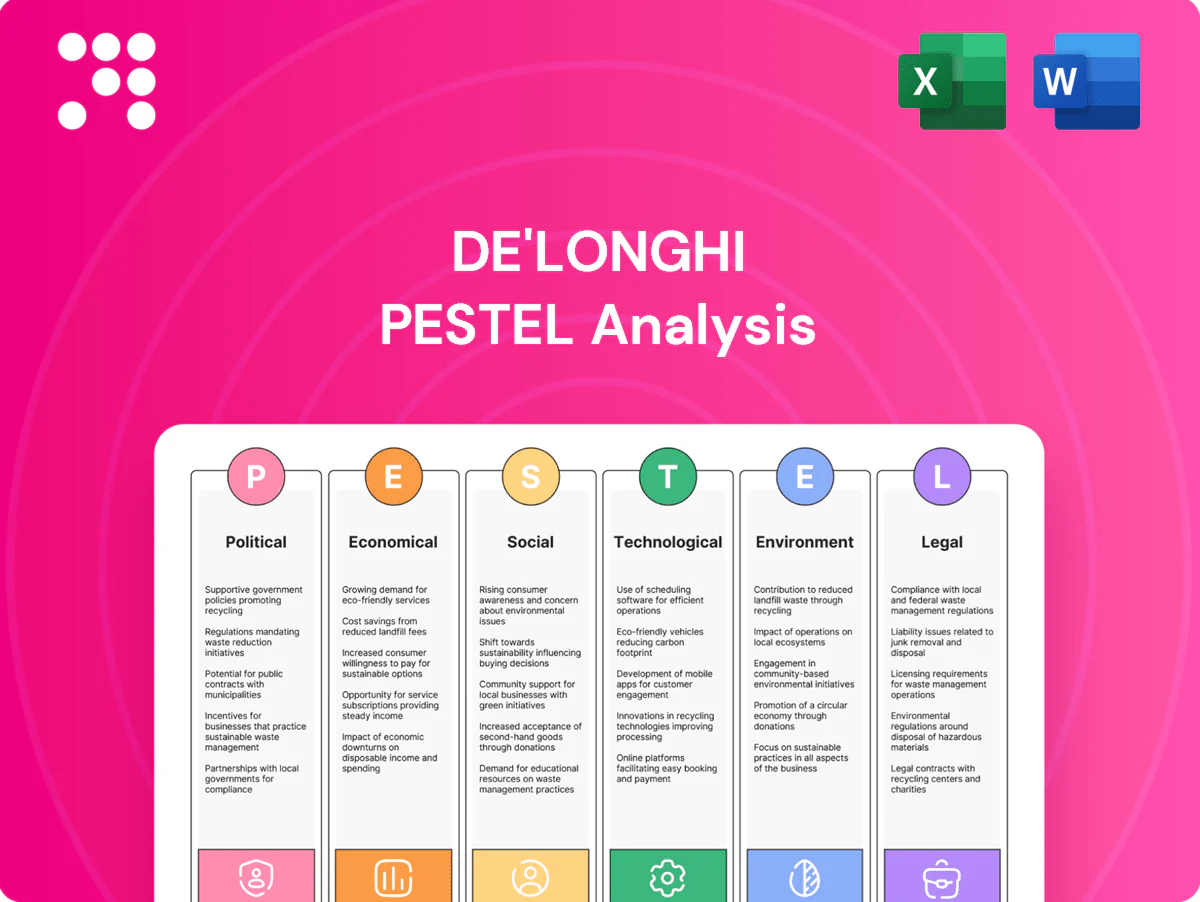
The preview shown here is the exact De'Longhi PESTLE Analysis document you’ll receive after purchase—fully formatted and ready to use. The layout, content, and structure visible are exactly what you’ll download immediately after buying. No placeholders or teasers; this is the final, professional file.

Product Information
Product Information
Shipping & Returns
Shipping & Returns
Description
Your Competitive Advantage Starts with This Report
Discover how political shifts, economic trends, social preferences, technological advances, legal changes, and environmental pressures are shaping De'Longhi’s market position. Our concise PESTLE highlights key risks and opportunities you can act on now. Purchase the full analysis for the complete, editable report and immediate strategic value.
Political factors
EU industrial and trade policy
As an Italy-based global manufacturer, De'Longhi is exposed to EU trade stances, standards and industrial policy which shape sourcing and market access across its €-denominated supply chain. Shifts in tariffs or anti-dumping measures on components from Asia can materially alter input costs and margins. The EU Carbon Border Adjustment Mechanism entered a transitional phase in 2023 for iron, steel, cement, fertilizers, aluminum, electricity and hydrogen, with full application planned from 2026, potentially raising upstream metal and energy costs. Proximity to EU incentives under the Green Deal and Ecodesign/energy labelling rules supports R&D and capex for energy-efficient appliances.
Geopolitical supply chain exposure
Political tensions in Asia-Pacific threaten supply of electronics, motors and semiconductors, noting Asia supplies roughly 75% of global semiconductor capacity. Export controls and chokepoints such as the Strait of Malacca, which carries about 30% of seaborne trade, raise lead times and working capital needs. Diversifying suppliers or nearshoring reduces disruption risk but increases input costs; government-to-government trade facilitation agreements can ease customs friction in key markets.
Public procurement and subsidies
Policies promoting energy-efficient home comfort products—backed by the US Inflation Reduction Act’s roughly 369 billion USD for clean energy and efficiency—can materially boost DeLonghi sales via rebates and tax credits. National heatwave or winterization programs (EU Renovation Wave aiming to double renovation rates by 2030) spur demand for ACs and heaters. Accessing subsidies requires strict compliance and local documentation, and political cycles create demand volatility as programs start and stop.
Labor and immigration policy
Labor and immigration policy shapes De'Longhi’s access to skilled technicians and factory workers; the group reported about €2.3bn revenue and ~8,500 employees in 2023, so changes in EU mobility rules materially affect staffing costs and capacity. Minimum wage hikes and stronger unions raise baseline labor costs, while political support for vocational training can boost productivity and reduce recruitment gaps.
- Skilled labor dependence
- EU mobility impacts hiring
- Minimum wage/union cost pressure
- Vocational training boosts productivity
Sanctions and market access
CBAM 2026 raises input costs; Green Deal boosts demand; Asia risks ~75% chip supply
De'Longhi faces EU trade and regulatory shifts (CBAM full 2026) that can raise input costs while Green Deal incentives and national efficiency programs (EU Renovation Wave) support demand; geopolitical risks in Asia threaten ~75% semiconductor supply and seaborne chokepoints (~30% via Malacca). Labor rules, wages and sanctions materially affect costs and market access; compliance and re‑entry planning raise operating overhead.
| Metric | Value |
|---|---|
| Revenue (2023) | €2.3bn |
| Employees (2023) | ≈8,500 |
| Global semiconductor capacity | ≈75% |
| Strait of Malacca seaborne trade | ≈30% |
| US IRA funding | ≈$369bn |
| CBAM full application | 2026 |
What is included in the product
Detailed Word Document
Provides a concise PESTLE assessment of De'Longhi, examining Political, Economic, Social, Technological, Environmental, and Legal drivers with data-backed trends and industry-specific examples to surface risks, opportunities, and forward-looking scenarios for executives, investors, and strategists—delivered in clean, presentation-ready format.
Customizable Excel Spreadsheet
A concise, visually segmented De'Longhi PESTLE summary that relieves planning pain points by making external risks and strategic drivers easy to reference, annotate for local context, and drop into presentations for swift team alignment.
Economic factors
Consumer discretionary cycles
Small appliances track household confidence and real incomes; with IMF 2024 global growth ~3.1% demand is uneven, and recessions commonly defer upgrades so promotional intensity rises and margins compress. Stay-at-home trends have historically boosted premium coffee and cooking device sales, while recoveries favor mix improvement and accessory/consumable attach rates that lift profitability.
Input cost volatility
Input costs for De'Longhi — plastics (PP ~€1,100–1,400/t in 2024), steel (HRC ~€700–900/t), copper (~€8,500–10,000/t), electronics components and packaging — track commodity and freight cycles (Asia-Europe container ≈$1,000–1,500/FEU 2024). Energy (EU industrial power ≈€0.12–0.18/kWh; gas volatility) raises manufacturing/logistics cost. Hedging and multi-year supply contracts reduce but don’t remove swings, so price passes must weigh retailer margins and demand elasticity.
FX exposure and pricing
As a euro-reporting group with global sales, EUR/USD and EUR/JPY moves materially affect translation and competitiveness; a 10% EUR appreciation cuts USD-reported sales by about 9.1%, directly pressuring margin comparisons. Sourcing in USD while selling in other currencies creates currency mismatches that localized pricing and natural hedges (pricing in local currency, local manufacturing) can materially reduce. Persistent FX shifts may force footprint and supplier rebalancing to restore cost parity.
Channel mix and retail dynamics
E-commerce now represents roughly 25% of global retail sales (2024), shifting promotion cadence, increasing returns (online small-appliance returns ~20% in 2023–24) and raising last-mile costs (up ~10–15% vs 2019). Marketplace algorithms privilege high-rated, well-reviewed SKUs, intensifying SKU-level competition. Brick-and-mortar partners demand co-op marketing and exclusives, while DTC growth boosts data access but requires logistics and service investment.
- e-commerce_share: ~25% (2024)
- returns_rate: ~20% (small appliances)
- last_mile_cost_increase: ~10–15%
- marketplace_algo: favors top-rated SKUs
- retail_demands: co-op marketing & exclusives
- DTC_tradeoff: data gain vs logistics/service capex
Interest rates and consumer credit
Higher rates (ECB deposit rate ~4.00% and US Fed funds 5.25–5.50% in mid‑2024) curb household spending and reduce BNPL usage, pressuring De'Longhi's non‑essential sales; retailers keep leaner inventories, shifting sell‑in timing. Rising rates increase working capital costs via higher financing on receivables and stock, while lower‑rate periods historically boost category trade‑up and attachment sales.
- Rates: ECB ~4.00%, Fed 5.25–5.50%
- Impact: lower discretionary demand, reduced BNPL
- Working capital: higher financing costs
- Lower rates: support premium upgrades
CBAM 2026 raises input costs; Green Deal boosts demand; Asia risks ~75% chip supply
Global growth ~3.1% (IMF 2024) keeps demand uneven; recessions defer upgrades, raising promotions and margin squeeze. Input costs (PP €1,100–1,400/t; HRC €700–900/t; copper €8,500–10,000/t) and freight (~$1,000–1,500/FEU) drive COGS. 10% EUR appreciation ≈9.1% USD sales hit; e‑commerce ~25% with ~20% returns. ECB ~4.00%, Fed 5.25–5.50% curb discretionary spend.
| Metric | Value |
|---|---|
| Global growth | ~3.1% (IMF 2024) |
| PP | €1,100–1,400/t |
| HRC | €700–900/t |
| Copper | €8,500–10,000/t |
| Freight | $1,000–1,500/FEU |
| e‑commerce | ~25% |
| Returns | ~20% |
| ECB / Fed | ~4.00% / 5.25–5.50% |
Preview the Actual Deliverable
De'Longhi PESTLE Analysis
The preview shown here is the exact De'Longhi PESTLE Analysis document you’ll receive after purchase—fully formatted and ready to use. The layout, content, and structure visible are exactly what you’ll download immediately after buying. No placeholders or teasers; this is the final, professional file.