DATAGROUP PESTLE Analysis

Your Competitive Advantage Starts with This Report
Discover how political, economic, social, technological, legal, and environmental forces are shaping DATAGROUP's strategic path in our concise PESTLE snapshot. Ideal for investors and strategists, this briefing highlights risks and opportunities—buy the full PESTLE to access the complete, editable analysis and make informed decisions today.
Political factors

EU digital strategy and funding
EU Digital Europe Programme (€7.5bn for 2021–2027) and EU-backed initiatives like GAIA-X (launched 2020 with German-French leadership) plus national cloud sovereignty drives boost demand for domestic cloud/managed services such as DATAGROUPs CORBOX; subsidies and public tenders increasingly favor providers with compliance and local data hosting. DATAGROUP can align offerings to capture public-sector and regulated-industry contracts, though policy shifts or budget cuts could slow project pipelines.
Public procurement dependencies
Significant opportunities stem from federal/state IT modernization and e-government rollouts, with public procurement representing about 14% of EU GDP and large addressable demand. Long bidding cycles of 6–18 months, strict qualification rules and intense price pressure compress margins and reduce revenue visibility. Framework contracts often run 3–5 years, securing recurring revenue but increasing key-account concentration risk. Political turnover can reorder priorities mid-cycle, disrupting forecast accuracy.

Geopolitics and supply chain
Geopolitical tensions, sanctions and export controls since 2023 have constrained hardware sourcing and vendor choices for DATAGROUP, particularly for advanced NICs and CPUs. Server and network gear lead times of 8–16 weeks in 2024–25 strain CORBOX capacity planning and SLA commitments. Trusted-supplier rules limit technology stacks but enable EU-hosted services to command 10–20% price premiums. Contingency inventory and multi-vendor sourcing are now essential.

Cybersecurity policy tightening
NIS2-driven national implementations expand mandatory security and incident reporting to an estimated 160,000 entities in the EU; non-compliance carries fines up to €10 million or 2% of global turnover, raising regulatory pressure. Clients will increasingly push stricter requirements onto service providers, inflating compliance workloads and audit frequency. DATAGROUP can monetize this via security operations, managed detection and response, and compliance services while avoiding reputational and financial penalties.
- Impact: ~160,000 entities affected
- Penalty risk: up to €10M or 2% turnover
- Client demand: tighter supplier security
- Opportunity: monetize SOC, MDR, compliance
Energy and industrial policy
German and EU energy and industrial policy—backed by the EU Fit for 55 framework (55% GHG reduction target by 2030) and Germany’s carbon neutrality goal by 2045—raise incentives for renewables and efficiency that directly lower data center power costs.
Energy accounts for roughly 30–40% of data center OPEX, so reliefs for strategic IT infrastructure or preferential grid access materially improve cost curves, while high electricity levies compress margins on fixed-price outsourcing contracts.
Location strategy benefits from political incentive zones and grid capacity planning, enabling DATAGROUP to optimize site selection and access to renewable PPAs.
- EU policy: Fit for 55 (55% GHG cut by 2030)
- Germany: carbon neutrality target 2045
- Data center OPEX: ~30–40% energy
- Policy levers: reliefs, incentive zones, renewables/PPAs
EU €7.5bn spurs cloud; NIS2 covers ~160,000
EU Digital Europe (€7.5bn) and GAIA-X favor domestic cloud demand; public procurement (~14% of EU GDP) offers large but low-margin contracts. NIS2 expands coverage to ~160,000 entities with fines up to €10M or 2% turnover, raising compliance costs and SOC/MDR opportunities. Energy policy (Fit for 55, 55% by 2030; DE net-zero 2045) cuts data-center OPEX (30–40%).
| Metric | Value |
|---|---|
| Digital Europe | €7.5bn |
| Public procurement | ~14% GDP |
| NIS2 affected | ~160,000 |
| Fines | €10M / 2% |
| Data-center energy OPEX | 30–40% |
What is included in the product
 Detailed Word Document
Explores how external macro-environmental factors uniquely affect DATAGROUP across Political, Economic, Social, Technological, Environmental and Legal dimensions, with data-driven, region- and industry-specific insights; designed for executives and investors, formatted for easy inclusion in plans and decks, and including forward-looking implications to support scenario planning and risk mitigation.

 Customizable Excel Spreadsheet
A compact, visually segmented PESTLE summary of DATAGROUP that’s easily dropped into presentations and shared across teams, enabling quick interpretation of regulatory, technological and market risks to support alignment in planning sessions.
Economic factors

IT spending cycle sensitivity
Enterprise IT budgets expand with productivity and digitization needs but tighten in recessions; Gartner estimated global IT spending around $4.8 trillion in 2023, highlighting cyclicality. Managed services and outsourcing often act countercyclical as firms shift to opex. Project-based consulting is more volatile than recurring CORBOX revenues, and DATAGROUPs diversification across industries smooths overall demand.
Inflation and wage pressure
Scarce German IT talent—Bitkom reported about 137,000 unfilled IT positions in 2023—drives rising personnel costs, squeezing margins on fixed-price contracts. Indexation clauses and value-based pricing adoption help defend margins. Automation plus offshore/nearshore delivery can cut unit labour costs materially. Delays in repricing legacy deals continue to erode profitability.

Energy price volatility
Data center power is a major cost driver in Germany, accounting for roughly 30–40% of OPEX with industrial electricity at about €0.25–€0.30/kWh in 2024–25. Hedging and renewable PPAs have reduced CORBOX energy cost volatility by an estimated 10–15%. Improving cooling and PUE from ~1.6 to ~1.3 can cut energy use ~20%, and clients increasingly scrutinize energy surcharges in SLAs.

Interest rates and M&A
Higher interest rates (ECB policy rates near 4% in 2024–25) raise financing costs and can slow roll-up acquisitions common in German IT services, although DATAGROUPs strong recurring-revenue base supports selective M&A; integration synergies expand service breadth and geography while valuation multiples may compress, creating opportunistic targets.
- Financing cost up → fewer bolt-ons
- Recurring contracts → sustain selective deals
- Integration synergies → scale services/geography
- Compressed multiples → acquisition opportunities
SME and large-enterprise mix
Germany has about 3.6 million SMEs (≈99% of firms), and Mittelstand digitization drives managed workplace, SAP and security demand; large enterprises push hybrid/multi‑cloud and regulated workloads. A broad customer basket lowers single‑logo risk but raises integration complexity, while tailored bundles lift ARPU and stickiness.
- SME-led demand: managed workplace/SAP/security
- Enterprise focus: hybrid/multi‑cloud, regulated workloads
- Risk mix: lower single‑logo risk, higher solution complexity
- Commercial: bundles → higher ARPU & retention
EU €7.5bn spurs cloud; NIS2 covers ~160,000
Global IT spend ~€4.5T–$4.8T in 2023; demand cyclic but managed services more resilient. Germany: ~137,000 IT vacancies (2023) driving wage pressure; electricity ~€0.25–0.30/kWh (2024–25) raises data‑center OPEX. ECB rates ~4% (2024–25) elevate financing costs while 3.6M SMEs sustain steady managed‑services demand.
| Metric | Value |
|---|---|
| Global IT spend (2023) | $4.8T |
| German IT vacancies (2023) | 137,000 |
| Electricity (2024–25) | €0.25–0.30/kWh |
| ECB policy rate (2024–25) | ~4% |
| German SMEs | 3.6M |
What You See Is What You Get
DATAGROUP PESTLE Analysis
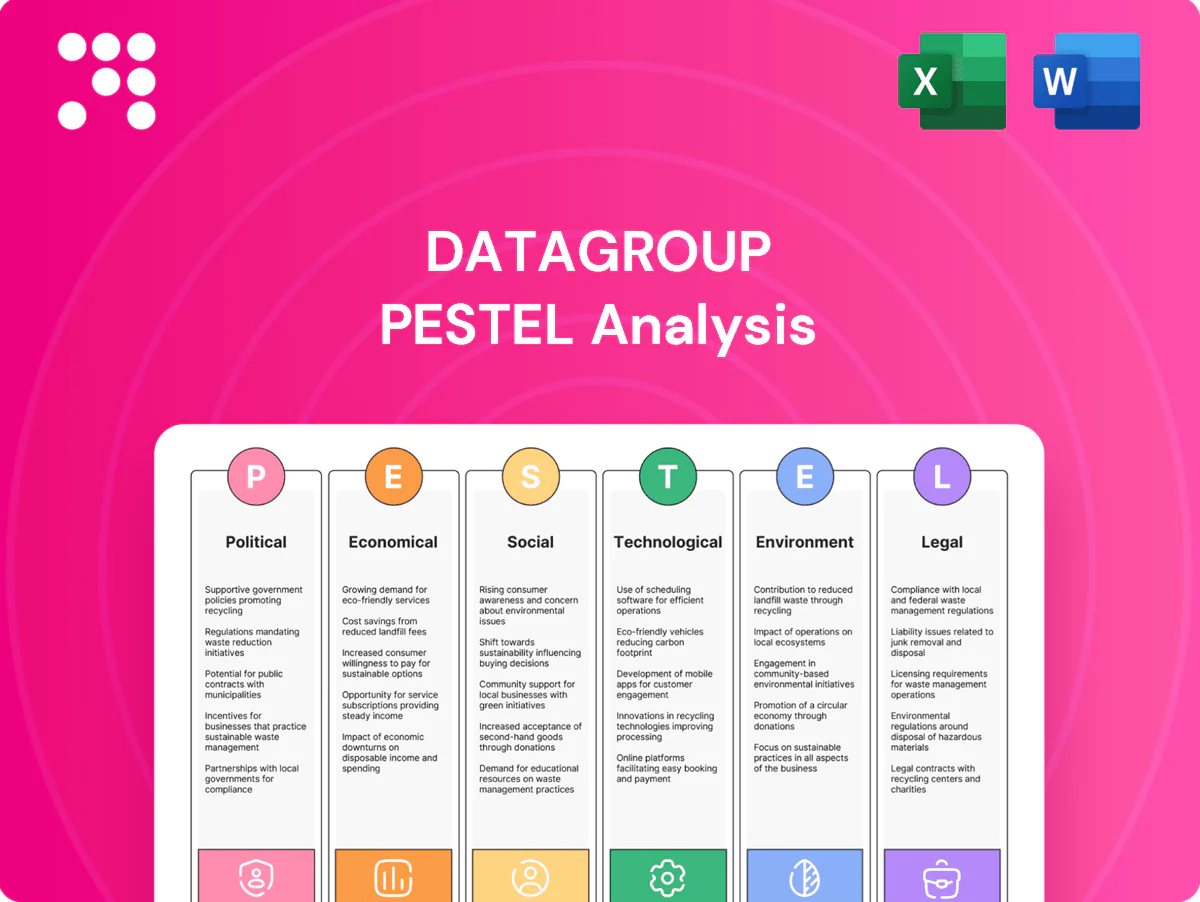
The preview shown here is the exact DATAGROUP PESTLE Analysis you’ll receive after purchase—fully formatted and ready to use. No placeholders or surprises; the content, layout, and structure match the final downloadable file. You’ll get this same professional, ready-to-use document instantly after payment.

Original: $10.00
-65%$10.00
$3.50Product Information
Product Information
Shipping & Returns
Shipping & Returns
Description
Your Competitive Advantage Starts with This Report
Discover how political, economic, social, technological, legal, and environmental forces are shaping DATAGROUP's strategic path in our concise PESTLE snapshot. Ideal for investors and strategists, this briefing highlights risks and opportunities—buy the full PESTLE to access the complete, editable analysis and make informed decisions today.
Political factors
EU digital strategy and funding
EU Digital Europe Programme (€7.5bn for 2021–2027) and EU-backed initiatives like GAIA-X (launched 2020 with German-French leadership) plus national cloud sovereignty drives boost demand for domestic cloud/managed services such as DATAGROUPs CORBOX; subsidies and public tenders increasingly favor providers with compliance and local data hosting. DATAGROUP can align offerings to capture public-sector and regulated-industry contracts, though policy shifts or budget cuts could slow project pipelines.
Public procurement dependencies
Significant opportunities stem from federal/state IT modernization and e-government rollouts, with public procurement representing about 14% of EU GDP and large addressable demand. Long bidding cycles of 6–18 months, strict qualification rules and intense price pressure compress margins and reduce revenue visibility. Framework contracts often run 3–5 years, securing recurring revenue but increasing key-account concentration risk. Political turnover can reorder priorities mid-cycle, disrupting forecast accuracy.
Geopolitics and supply chain
Geopolitical tensions, sanctions and export controls since 2023 have constrained hardware sourcing and vendor choices for DATAGROUP, particularly for advanced NICs and CPUs. Server and network gear lead times of 8–16 weeks in 2024–25 strain CORBOX capacity planning and SLA commitments. Trusted-supplier rules limit technology stacks but enable EU-hosted services to command 10–20% price premiums. Contingency inventory and multi-vendor sourcing are now essential.
Cybersecurity policy tightening
NIS2-driven national implementations expand mandatory security and incident reporting to an estimated 160,000 entities in the EU; non-compliance carries fines up to €10 million or 2% of global turnover, raising regulatory pressure. Clients will increasingly push stricter requirements onto service providers, inflating compliance workloads and audit frequency. DATAGROUP can monetize this via security operations, managed detection and response, and compliance services while avoiding reputational and financial penalties.
- Impact: ~160,000 entities affected
- Penalty risk: up to €10M or 2% turnover
- Client demand: tighter supplier security
- Opportunity: monetize SOC, MDR, compliance
Energy and industrial policy
German and EU energy and industrial policy—backed by the EU Fit for 55 framework (55% GHG reduction target by 2030) and Germany’s carbon neutrality goal by 2045—raise incentives for renewables and efficiency that directly lower data center power costs.
Energy accounts for roughly 30–40% of data center OPEX, so reliefs for strategic IT infrastructure or preferential grid access materially improve cost curves, while high electricity levies compress margins on fixed-price outsourcing contracts.
Location strategy benefits from political incentive zones and grid capacity planning, enabling DATAGROUP to optimize site selection and access to renewable PPAs.
- EU policy: Fit for 55 (55% GHG cut by 2030)
- Germany: carbon neutrality target 2045
- Data center OPEX: ~30–40% energy
- Policy levers: reliefs, incentive zones, renewables/PPAs
EU €7.5bn spurs cloud; NIS2 covers ~160,000
EU Digital Europe (€7.5bn) and GAIA-X favor domestic cloud demand; public procurement (~14% of EU GDP) offers large but low-margin contracts. NIS2 expands coverage to ~160,000 entities with fines up to €10M or 2% turnover, raising compliance costs and SOC/MDR opportunities. Energy policy (Fit for 55, 55% by 2030; DE net-zero 2045) cuts data-center OPEX (30–40%).
| Metric | Value |
|---|---|
| Digital Europe | €7.5bn |
| Public procurement | ~14% GDP |
| NIS2 affected | ~160,000 |
| Fines | €10M / 2% |
| Data-center energy OPEX | 30–40% |
What is included in the product
Detailed Word Document
Explores how external macro-environmental factors uniquely affect DATAGROUP across Political, Economic, Social, Technological, Environmental and Legal dimensions, with data-driven, region- and industry-specific insights; designed for executives and investors, formatted for easy inclusion in plans and decks, and including forward-looking implications to support scenario planning and risk mitigation.
Customizable Excel Spreadsheet
A compact, visually segmented PESTLE summary of DATAGROUP that’s easily dropped into presentations and shared across teams, enabling quick interpretation of regulatory, technological and market risks to support alignment in planning sessions.
Economic factors
IT spending cycle sensitivity
Enterprise IT budgets expand with productivity and digitization needs but tighten in recessions; Gartner estimated global IT spending around $4.8 trillion in 2023, highlighting cyclicality. Managed services and outsourcing often act countercyclical as firms shift to opex. Project-based consulting is more volatile than recurring CORBOX revenues, and DATAGROUPs diversification across industries smooths overall demand.
Inflation and wage pressure
Scarce German IT talent—Bitkom reported about 137,000 unfilled IT positions in 2023—drives rising personnel costs, squeezing margins on fixed-price contracts. Indexation clauses and value-based pricing adoption help defend margins. Automation plus offshore/nearshore delivery can cut unit labour costs materially. Delays in repricing legacy deals continue to erode profitability.
Energy price volatility
Data center power is a major cost driver in Germany, accounting for roughly 30–40% of OPEX with industrial electricity at about €0.25–€0.30/kWh in 2024–25. Hedging and renewable PPAs have reduced CORBOX energy cost volatility by an estimated 10–15%. Improving cooling and PUE from ~1.6 to ~1.3 can cut energy use ~20%, and clients increasingly scrutinize energy surcharges in SLAs.
Interest rates and M&A
Higher interest rates (ECB policy rates near 4% in 2024–25) raise financing costs and can slow roll-up acquisitions common in German IT services, although DATAGROUPs strong recurring-revenue base supports selective M&A; integration synergies expand service breadth and geography while valuation multiples may compress, creating opportunistic targets.
- Financing cost up → fewer bolt-ons
- Recurring contracts → sustain selective deals
- Integration synergies → scale services/geography
- Compressed multiples → acquisition opportunities
SME and large-enterprise mix
Germany has about 3.6 million SMEs (≈99% of firms), and Mittelstand digitization drives managed workplace, SAP and security demand; large enterprises push hybrid/multi‑cloud and regulated workloads. A broad customer basket lowers single‑logo risk but raises integration complexity, while tailored bundles lift ARPU and stickiness.
- SME-led demand: managed workplace/SAP/security
- Enterprise focus: hybrid/multi‑cloud, regulated workloads
- Risk mix: lower single‑logo risk, higher solution complexity
- Commercial: bundles → higher ARPU & retention
EU €7.5bn spurs cloud; NIS2 covers ~160,000
Global IT spend ~€4.5T–$4.8T in 2023; demand cyclic but managed services more resilient. Germany: ~137,000 IT vacancies (2023) driving wage pressure; electricity ~€0.25–0.30/kWh (2024–25) raises data‑center OPEX. ECB rates ~4% (2024–25) elevate financing costs while 3.6M SMEs sustain steady managed‑services demand.
| Metric | Value |
|---|---|
| Global IT spend (2023) | $4.8T |
| German IT vacancies (2023) | 137,000 |
| Electricity (2024–25) | €0.25–0.30/kWh |
| ECB policy rate (2024–25) | ~4% |
| German SMEs | 3.6M |
What You See Is What You Get
DATAGROUP PESTLE Analysis
The preview shown here is the exact DATAGROUP PESTLE Analysis you’ll receive after purchase—fully formatted and ready to use. No placeholders or surprises; the content, layout, and structure match the final downloadable file. You’ll get this same professional, ready-to-use document instantly after payment.