CURO PESTLE Analysis

Your Shortcut to Market Insight Starts Here
Gain a strategic edge with our focused PESTLE analysis of CURO—three to five external forces that truly matter to its future are distilled into actionable insights. Ideal for investors, advisors, and strategists seeking concise, decision-ready intelligence. Purchase the full report for the complete, editable breakdown and immediate download.
Political factors

Interest rate caps
States and provinces periodically tighten usury and APR caps, directly constraining pricing for small-dollar credit; payday APRs often exceed 300–400% and the CFPB estimates about 12 million annual users, so caps bite into revenue. Ballot initiatives and legislative sessions can rapidly change rules, requiring CURO to monitor multi-jurisdictional shifts and adjust product mix. Political appetite for caps rises during cost-of-living crises (U.S. inflation peaked at 9.1% in June 2022).
CFPB priorities
Federal consumer protection agendas ebb and flow with administrations; under Director Rohit Chopra since 2021 the CFPB has intensified focus on underwriting, collections and fee practices. Supervision covers roughly 12,000 nonbank firms, raising chances of product redesigns and higher compliance costs. Heightened enforcement in 2022–24 forced several lenders to revise collections and fee structures, and leadership changes can quickly reset enforcement intensity and guidance.

State-federal preemption
Clashes over state-federal preemption determine whether state rules or federal charters dominate, shaping CURO’s ability to standardize product terms across dozens of state and provincial regimes as of 2024. Court and Congressional outcomes drive operating complexity and can push legal and compliance costs into the low- to mid-single-digit millions annually. Divergent regimes elevate legal risk, compliance overhead and hinder scale efficiencies.

Financial inclusion policy
Pro-inclusion agendas can boost CURO by expanding access to underbanked consumers—FDIC 2022 reports 4.5% unbanked and 14.1% underbanked in the US—while subsidies, public-private partnerships and pilots can scale addressable markets rapidly; conversely, by 2024 more than 20 US municipalities exploring public banks could disintermediate private lenders, and policy framing will shape CURO’s social license to operate.
- Pro-inclusion support: market expansion
- FDIC 2022: 4.5% unbanked, 14.1% underbanked
- 20+ municipalities exploring public banks (2024)
- P3s/pilots/subsidies: lower acquisition costs
International exposure
CURO's cross-border operations (primarily US and Canada) face differing political cycles and regulatory philosophies, and in 2024 more than 20 jurisdictions tightened small-dollar lending rules, directly compressing margins and routing originations. Trade, currency swings and consumer-policy shifts amplified earnings volatility, while political-risk premiums—which rose sharply in 2023–24—reallocated capital toward lower-risk states. Local elections frequently produced abrupt rule changes in payday and instalment lending that reduced market access within months.
- Operations: US, Canada
- 2024: >20 jurisdictions changed lending rules
- Political-risk premiums: notable rise in 2023–24
- Local elections → abrupt rule shifts, rapid market impact
Political volatility and APR caps compress margins as inclusion and public banks reshape markets
Political volatility—state APR caps, intensified CFPB enforcement under Rohit Chopra (since 2021), and rising political‑risk premiums in 2023–24—has compressed CURO margins and raised compliance costs; >20 jurisdictions tightened small‑dollar rules by 2024. Pro‑inclusion policies (FDIC 2022: 4.5% unbanked, 14.1% underbanked) expand markets but 20+ municipalities exploring public banks by 2024 threaten disintermediation.
| Factor | 2024 datapoint | Impact |
|---|---|---|
| Jurisdiction tightening | >20 jurisdictions | Margin compression |
| CFPB enforcement | Active since 2021 | Product redesign, higher costs |
| Financial inclusion | FDIC: 4.5% unbanked, 14.1% underbanked | Market expansion |
What is included in the product
 Detailed Word Document
Explores how external macro-environmental factors uniquely affect CURO across Political, Economic, Social, Technological, Environmental and Legal dimensions, with data-driven trends and region-specific regulatory context. Designed for executives, consultants and investors, it offers detailed sub-points, forward-looking insights and clean formatting ready for business plans, pitch decks or scenario planning.

 Customizable Excel Spreadsheet
A concise, visually segmented CURO PESTLE summary that’s easily shareable and editable for meetings, slides, and cross-team alignment—uses clear language and note fields for region-specific risks to streamline planning, client reports, and quick decision-making.
Economic factors

Unemployment and delinquencies
Labor market softness raises default rates in subprime segments; with US unemployment at 3.7% (BLS June 2025) even small upticks drive higher delinquencies for CURO. Higher losses force tighter underwriting and reduced originations, compressing revenue. Strong employment supports repayment and demand, and CURO’s credit performance remains highly cyclical and closely correlated with monthly jobs data.
Interest rate environment
Rising benchmark rates—federal funds near 5.25–5.50% and the 10-year around 4.2% in mid‑2025—elevate funding costs for nonbank lenders like CURO, squeezing funding spreads by roughly 150–250 bps versus low‑rate years. Compression of net interest margins pressures profitability unless loan pricing or fee income adjusts. Rate volatility has tightened securitization and warehouse spreads and slowed issuance, while easing cycles would reopen growth and refinancing windows.

Inflation and consumer stress
High inflation—U.S. CPI rose about 3.4% in 2024—erodes borrowers’ real incomes, weakening capacity to repay while driving a rise in short-term credit demand as households bridge gaps. CURO must adjust loss provisioning to reflect changing household budgets and higher late-payment incidence. Persistent inflation forces product redesigns, tighter affordability screens and dynamic pricing to preserve margins and credit quality.

Capital markets access
Capital markets access for CURO is driven by securitization spreads and investor risk appetite, which directly set lending capacity; with the US federal funds target at 5.25–5.50% (July 2025), higher funding costs compress margin and slow originations. Tight ABS markets force balance-sheet limits and slower growth, while open equity and debt windows enable acquisitions or share buybacks. Diversified funding (warehouse lines, ABS, term debt) reduces cycle sensitivity.
Competitive dynamics
- 2024 regulatory pressure on BNPL increased market consolidation
- Underbanked consumers have fewer low-cost alternatives, boosting pricing leverage
- Scale and cost discipline determined survivorship during 2023–24 downturn
Political volatility and APR caps compress margins as inclusion and public banks reshape markets
Labor softness (U.S. unemployment 3.7% June 2025) raises subprime delinquencies, tightening CURO underwriting and reducing originations.
Higher rates (fed funds 5.25–5.50% Jul 2025; 10y ~4.2% mid‑2025) and wide ABS spreads cut funding capacity and compress NIMs.
Inflation (CPI ~3.4% 2024) squeezes real incomes, boosting short‑term credit demand and loss provisioning.
| Metric | Value |
|---|---|
| Unemployment | 3.7% (Jun 2025) |
| Fed funds | 5.25–5.50% (Jul 2025) |
| 10‑yr | ~4.2% (mid‑2025) |
| CPI | 3.4% (2024) |
What You See Is What You Get
CURO PESTLE Analysis
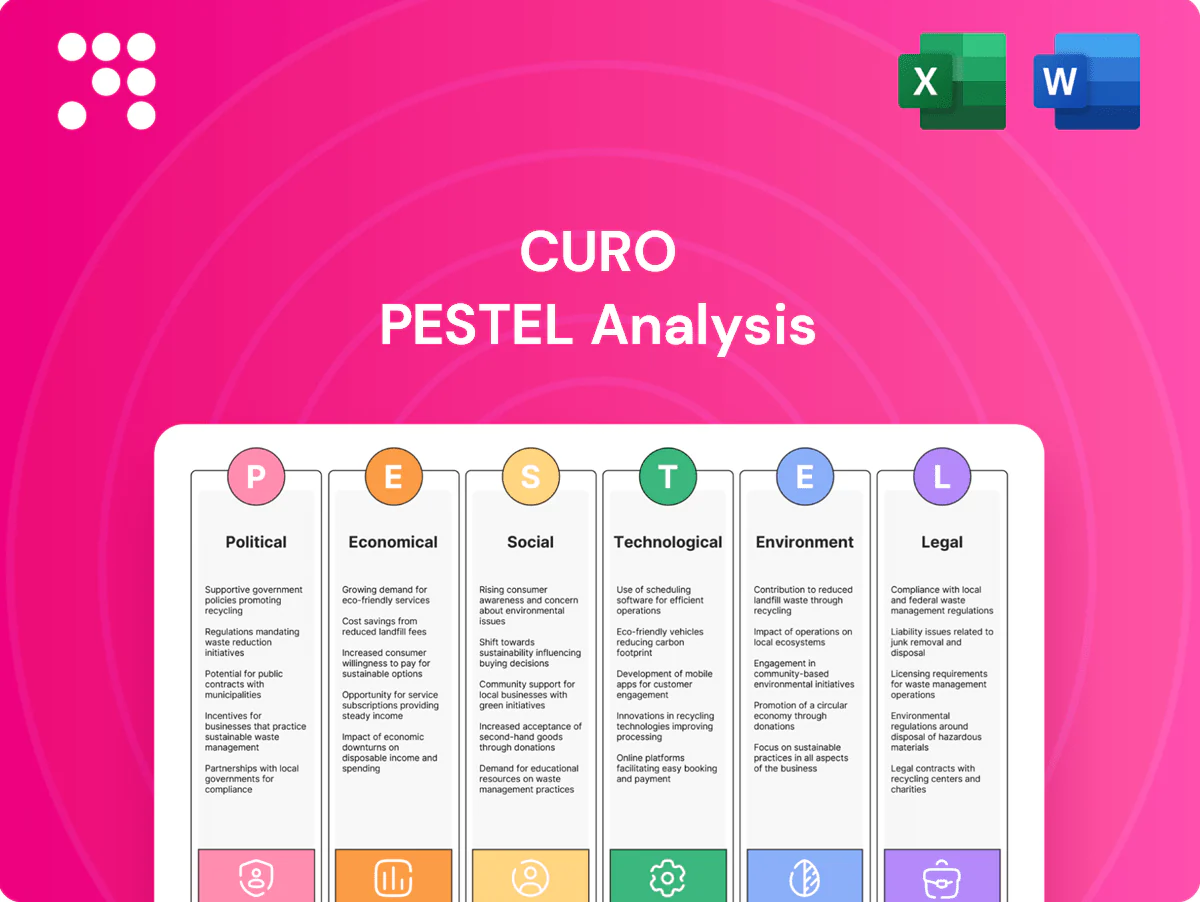
The preview shown here is the exact CURO PESTLE Analysis document you’ll receive after purchase—fully formatted and ready to use. The layout, content, and structure visible are exactly what you’ll download immediately after buying. No placeholders, no surprises.

Product Information
Product Information
Shipping & Returns
Shipping & Returns
Description
Your Shortcut to Market Insight Starts Here
Gain a strategic edge with our focused PESTLE analysis of CURO—three to five external forces that truly matter to its future are distilled into actionable insights. Ideal for investors, advisors, and strategists seeking concise, decision-ready intelligence. Purchase the full report for the complete, editable breakdown and immediate download.
Political factors
Interest rate caps
States and provinces periodically tighten usury and APR caps, directly constraining pricing for small-dollar credit; payday APRs often exceed 300–400% and the CFPB estimates about 12 million annual users, so caps bite into revenue. Ballot initiatives and legislative sessions can rapidly change rules, requiring CURO to monitor multi-jurisdictional shifts and adjust product mix. Political appetite for caps rises during cost-of-living crises (U.S. inflation peaked at 9.1% in June 2022).
CFPB priorities
Federal consumer protection agendas ebb and flow with administrations; under Director Rohit Chopra since 2021 the CFPB has intensified focus on underwriting, collections and fee practices. Supervision covers roughly 12,000 nonbank firms, raising chances of product redesigns and higher compliance costs. Heightened enforcement in 2022–24 forced several lenders to revise collections and fee structures, and leadership changes can quickly reset enforcement intensity and guidance.
State-federal preemption
Clashes over state-federal preemption determine whether state rules or federal charters dominate, shaping CURO’s ability to standardize product terms across dozens of state and provincial regimes as of 2024. Court and Congressional outcomes drive operating complexity and can push legal and compliance costs into the low- to mid-single-digit millions annually. Divergent regimes elevate legal risk, compliance overhead and hinder scale efficiencies.
Financial inclusion policy
Pro-inclusion agendas can boost CURO by expanding access to underbanked consumers—FDIC 2022 reports 4.5% unbanked and 14.1% underbanked in the US—while subsidies, public-private partnerships and pilots can scale addressable markets rapidly; conversely, by 2024 more than 20 US municipalities exploring public banks could disintermediate private lenders, and policy framing will shape CURO’s social license to operate.
- Pro-inclusion support: market expansion
- FDIC 2022: 4.5% unbanked, 14.1% underbanked
- 20+ municipalities exploring public banks (2024)
- P3s/pilots/subsidies: lower acquisition costs
International exposure
CURO's cross-border operations (primarily US and Canada) face differing political cycles and regulatory philosophies, and in 2024 more than 20 jurisdictions tightened small-dollar lending rules, directly compressing margins and routing originations. Trade, currency swings and consumer-policy shifts amplified earnings volatility, while political-risk premiums—which rose sharply in 2023–24—reallocated capital toward lower-risk states. Local elections frequently produced abrupt rule changes in payday and instalment lending that reduced market access within months.
- Operations: US, Canada
- 2024: >20 jurisdictions changed lending rules
- Political-risk premiums: notable rise in 2023–24
- Local elections → abrupt rule shifts, rapid market impact
Political volatility and APR caps compress margins as inclusion and public banks reshape markets
Political volatility—state APR caps, intensified CFPB enforcement under Rohit Chopra (since 2021), and rising political‑risk premiums in 2023–24—has compressed CURO margins and raised compliance costs; >20 jurisdictions tightened small‑dollar rules by 2024. Pro‑inclusion policies (FDIC 2022: 4.5% unbanked, 14.1% underbanked) expand markets but 20+ municipalities exploring public banks by 2024 threaten disintermediation.
| Factor | 2024 datapoint | Impact |
|---|---|---|
| Jurisdiction tightening | >20 jurisdictions | Margin compression |
| CFPB enforcement | Active since 2021 | Product redesign, higher costs |
| Financial inclusion | FDIC: 4.5% unbanked, 14.1% underbanked | Market expansion |
What is included in the product
Detailed Word Document
Explores how external macro-environmental factors uniquely affect CURO across Political, Economic, Social, Technological, Environmental and Legal dimensions, with data-driven trends and region-specific regulatory context. Designed for executives, consultants and investors, it offers detailed sub-points, forward-looking insights and clean formatting ready for business plans, pitch decks or scenario planning.
Customizable Excel Spreadsheet
A concise, visually segmented CURO PESTLE summary that’s easily shareable and editable for meetings, slides, and cross-team alignment—uses clear language and note fields for region-specific risks to streamline planning, client reports, and quick decision-making.
Economic factors
Unemployment and delinquencies
Labor market softness raises default rates in subprime segments; with US unemployment at 3.7% (BLS June 2025) even small upticks drive higher delinquencies for CURO. Higher losses force tighter underwriting and reduced originations, compressing revenue. Strong employment supports repayment and demand, and CURO’s credit performance remains highly cyclical and closely correlated with monthly jobs data.
Interest rate environment
Rising benchmark rates—federal funds near 5.25–5.50% and the 10-year around 4.2% in mid‑2025—elevate funding costs for nonbank lenders like CURO, squeezing funding spreads by roughly 150–250 bps versus low‑rate years. Compression of net interest margins pressures profitability unless loan pricing or fee income adjusts. Rate volatility has tightened securitization and warehouse spreads and slowed issuance, while easing cycles would reopen growth and refinancing windows.
Inflation and consumer stress
High inflation—U.S. CPI rose about 3.4% in 2024—erodes borrowers’ real incomes, weakening capacity to repay while driving a rise in short-term credit demand as households bridge gaps. CURO must adjust loss provisioning to reflect changing household budgets and higher late-payment incidence. Persistent inflation forces product redesigns, tighter affordability screens and dynamic pricing to preserve margins and credit quality.
Capital markets access
Capital markets access for CURO is driven by securitization spreads and investor risk appetite, which directly set lending capacity; with the US federal funds target at 5.25–5.50% (July 2025), higher funding costs compress margin and slow originations. Tight ABS markets force balance-sheet limits and slower growth, while open equity and debt windows enable acquisitions or share buybacks. Diversified funding (warehouse lines, ABS, term debt) reduces cycle sensitivity.
Competitive dynamics
- 2024 regulatory pressure on BNPL increased market consolidation
- Underbanked consumers have fewer low-cost alternatives, boosting pricing leverage
- Scale and cost discipline determined survivorship during 2023–24 downturn
Political volatility and APR caps compress margins as inclusion and public banks reshape markets
Labor softness (U.S. unemployment 3.7% June 2025) raises subprime delinquencies, tightening CURO underwriting and reducing originations.
Higher rates (fed funds 5.25–5.50% Jul 2025; 10y ~4.2% mid‑2025) and wide ABS spreads cut funding capacity and compress NIMs.
Inflation (CPI ~3.4% 2024) squeezes real incomes, boosting short‑term credit demand and loss provisioning.
| Metric | Value |
|---|---|
| Unemployment | 3.7% (Jun 2025) |
| Fed funds | 5.25–5.50% (Jul 2025) |
| 10‑yr | ~4.2% (mid‑2025) |
| CPI | 3.4% (2024) |
What You See Is What You Get
CURO PESTLE Analysis
The preview shown here is the exact CURO PESTLE Analysis document you’ll receive after purchase—fully formatted and ready to use. The layout, content, and structure visible are exactly what you’ll download immediately after buying. No placeholders, no surprises.