CTBC Holding PESTLE Analysis

Skip the Research. Get the Strategy.
Discover how political shifts, economic trends, and technological disruption are shaping CTBC Holding’s strategic outlook and risk profile. Our concise PESTLE highlights the most critical external forces and their implications for investors and managers. Purchase the full analysis to access detailed, actionable insights and ready-to-use strategic recommendations.
Political factors

Cross-strait geopolitical tensions
Heightened Taiwan–China tensions elevate macro, market and operational risk premia for a Taiwan-headquartered financial group, especially given Taiwan's 2024 defense budget of TWD 610 billion. CTBC must plan liquidity buffers, contingency staffing and business continuity for overseas branches to withstand sudden shocks. Investor sentiment and capital flows can reverse quickly, stressing funding costs and valuations. Diversifying revenue across regions mitigates concentration risk.
Domestic regulatory oversight (FSC/Taiwan)
Taiwan’s Financial Supervisory Commission enforces Basel‑III aligned rules on capital adequacy, conduct and risk governance, with minimum capital buffers effectively around 8–9% and annual industry stress tests shaping bank resilience. Regular FSC stress tests and supervisory reviews constrain CTBC Holding’s growth pace and product mix, influencing capital allocation across retail, corporate and digital lines. Policy shifts on consumer protection or digital banking can rapidly reshape competition; CTBC reported a CET1 ratio of about 13.1% and consolidated assets near TWD 10.2 trillion in 2024 and thus prioritizes proactive compliance spending to preserve licensing and reputation.

Government industrial and financial policy alignment
Government support for semiconductors and green energy—Taiwan supplies roughly 50–60% of global foundry capacity and targets 20% renewable power by 2025—steers corporate banking demand and fee income for CTBC. Public SME inclusion and guarantee schemes expand subsidized lending channels, lowering risk weights and boosting net interest margins, while policy misalignment heightens political scrutiny and stranded-exposure risk.

International relations, sanctions, and AML expectations
Evolving U.S./EU sanctions and rising global AML standards constrain cross-border flows; USD remains dominant in 88% of FX trades (BIS 2022) so access to dollar corridors is critical. CTBC must maintain robust screening and correspondent due diligence to avoid fines and access restrictions. Continuous policy monitoring reduces transaction friction and penalties.
- FATF membership 39 (as of 2024)
- USD in 88% FX trades (BIS 2022)
- Robust screening and correspondent due diligence required
Public health and disaster response governance
Taiwan’s centralized CECC and disaster-response agencies drive coordinated pandemic and natural-disaster actions that support CTBC Holding’s operational continuity; Taiwan achieved adult COVID-19 full vaccination rates above 85% by 2023, reducing severe-case disruptions. Policy directives on branch closures, relief loans and premium holidays directly time revenue recognition and provisioning. CTBC’s participation in government relief efforts historically boosts brand trust and preparedness frameworks lower service disruption and credit-loss exposure.
- CECC-led coordination — reduces operational downtime
- Vaccination >85% (by 2023) — fewer service disruptions
- Relief loans/premium holidays — shift earnings timing
- Relief participation — enhances brand equity
- Preparedness frameworks — lower credit-loss risk
Taiwan tensions, defense spend and regulatory pressure push banks to shore up liquidity, compliance
Heightened Taiwan–China tensions (TWD 610bn defense budget in 2024) raise market and operational risk, requiring CTBC to boost liquidity and contingency plans. FSC oversight (CET1 ~13.1%, assets ~TWD 10.2tn in 2024) limits growth and forces compliance spend. Government green/tech support (20% renewables target by 2025) and global AML/sanctions (USD ~88% FX share) shape lending and cross‑border access.
| Metric | Value |
|---|---|
| Taiwan defense budget (2024) | TWD 610bn |
| CTBC CET1 (2024) | ~13.1% |
| CTBC assets (2024) | ~TWD 10.2tn |
| Renewables target (2025) | 20% |
| USD share FX (BIS 2022) | ~88% |
| FATF members (2024) | 39 |
| Vaccination rate (2023) | >85% |
What is included in the product
 Detailed Word Document
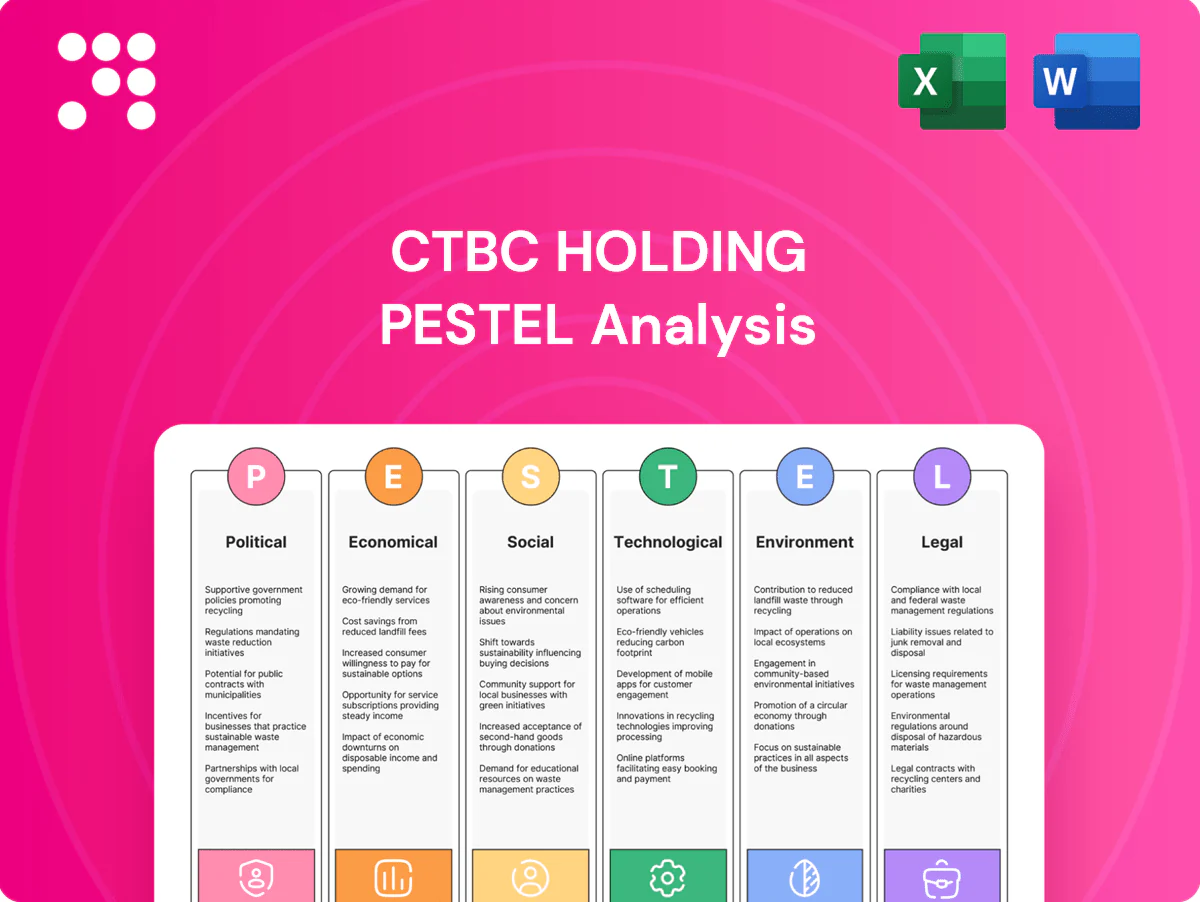
Provides a concise PESTLE review of CTBC Holding, examining Political, Economic, Social, Technological, Environmental and Legal forces shaping Taiwan’s banking and financial services, with data-backed trends and region-specific regulatory context. Designed to help executives, investors and strategists identify risks, opportunities and forward-looking scenarios for proactive decision-making.

 Customizable Excel Spreadsheet
A concise, visually segmented PESTLE summary for CTBC Holding that streamlines external risk assessment, is easily dropped into presentations, editable for local context, and shareable across teams for faster alignment in strategy sessions.
Economic factors

Interest rate cycles and NIM sensitivity
Policy rates in Taiwan (central bank policy rate 1.875% as of mid‑2024) and major markets (US federal funds 5.25–5.50% in 2024–25) drive deposit betas and asset repricing for CTBC Bank, with deposit beta shifts of 40–60% typically moving NIM by ~10–30 bps.
Margin compression or expansion directly impacts profitability—CTBC reported a core NIM near 1.35% in 2024, so a 20 bps NIM swing can change pre‑tax income materially.
Balance sheet hedging and product mix (fixed‑rate securities, floating loans, non‑rate deposit products) help stabilize NIM across cycles, and sensitivity analysis guides pricing and duration management to limit downside.
Taiwan GDP and export-led cyclicality
Taiwan GDP and exports are highly cyclical, with exports about 60% of GDP and semiconductors accounting for roughly 35% of merchandise exports, so global electronics swings drive loan demand and credit quality. Slowdowns elevate NPL risk for SMEs and supply-chain lenders (bank NPLs ~0.25% in 2024). Upturns boost fee income and wealth inflows. Prudent underwriting and exposure limits to cyclical names are critical.

FX volatility and cross-border earnings
NTD traded around 31–32 per USD in H1 2025, so fluctuations versus USD and regional currencies materially affect CTBC Holding’s translated profits and capital ratios; swings can compress CET1 sensitivity. Clients’ hedging demand boosts treasury fee income but adds market risk, which CTBC manages via ALM frameworks and derivatives within regulatory limits. Transparent FX disclosure sustains investor confidence.

Capital market conditions and fee income
Equity and bond market momentum directly affects CTBCs brokerage, underwriting and asset-management fees, while insurance investment returns depend on yield-curve direction and credit spreads; market swings lift trading volumes yet can pressure AUM through outflows.
- Market-driven fees
- Yield-curve sensitivity
- Volatility: +trading, -AUM
- Diversified fee engine = revenue smoothing
Inflation and household balance sheets
Rising inflation compresses CTBC Holding’s margins via higher operating costs and reduced consumer disposable income; Taiwan CPI moderated to about 2.5% in 2024, keeping pressure on household budgets and nudging credit card delinquencies upward while lifting demand for deposit and term-saving products.
- Cost pressure → margin risk
- Higher living costs → ↑ delinquencies
- Demand ↑ for savings
- Pricing discipline + cost efficiency → margin protection
- Data-driven credit control → limits loss rates
Taiwan tensions, defense spend and regulatory pressure push banks to shore up liquidity, compliance
Policy rates (TW 1.875%, US 5.25–5.50%) drive deposit betas and NIM exposure; CTBC core NIM ~1.35% in 2024 so a 20 bps swing is material. Taiwan’s export concentration (exports ~60% of GDP; semiconductors ~35% of merchandise exports) raises cyclical credit risk and fee volatility. NTD 31–32/USD (H1 2025) and CPI ~2.5% (2024) affect translated capital, client demand and delinquency trends.
| Metric | Value |
|---|---|
| Policy rates (TW / US) | 1.875% / 5.25–5.50% |
| CTBC core NIM (2024) | ~1.35% |
| Bank NPLs (2024) | ~0.25% |
| NTD/USD (H1 2025) | 31–32 |
| Taiwan CPI (2024) | ~2.5% |
Same Document Delivered
CTBC Holding PESTLE Analysis
This CTBC Holding PESTLE Analysis preview is the exact document you’ll receive after purchase—fully formatted and ready to use. It contains the complete political, economic, social, technological, legal and environmental assessment with charts and concise insights tailored for investors and strategists. No placeholders or teasers—what you see is the final file available for immediate download.

Original: $10.00
-65%$10.00
$3.50Product Information
Product Information
Shipping & Returns
Shipping & Returns
Description
Skip the Research. Get the Strategy.
Discover how political shifts, economic trends, and technological disruption are shaping CTBC Holding’s strategic outlook and risk profile. Our concise PESTLE highlights the most critical external forces and their implications for investors and managers. Purchase the full analysis to access detailed, actionable insights and ready-to-use strategic recommendations.
Political factors
Cross-strait geopolitical tensions
Heightened Taiwan–China tensions elevate macro, market and operational risk premia for a Taiwan-headquartered financial group, especially given Taiwan's 2024 defense budget of TWD 610 billion. CTBC must plan liquidity buffers, contingency staffing and business continuity for overseas branches to withstand sudden shocks. Investor sentiment and capital flows can reverse quickly, stressing funding costs and valuations. Diversifying revenue across regions mitigates concentration risk.
Domestic regulatory oversight (FSC/Taiwan)
Taiwan’s Financial Supervisory Commission enforces Basel‑III aligned rules on capital adequacy, conduct and risk governance, with minimum capital buffers effectively around 8–9% and annual industry stress tests shaping bank resilience. Regular FSC stress tests and supervisory reviews constrain CTBC Holding’s growth pace and product mix, influencing capital allocation across retail, corporate and digital lines. Policy shifts on consumer protection or digital banking can rapidly reshape competition; CTBC reported a CET1 ratio of about 13.1% and consolidated assets near TWD 10.2 trillion in 2024 and thus prioritizes proactive compliance spending to preserve licensing and reputation.
Government industrial and financial policy alignment
Government support for semiconductors and green energy—Taiwan supplies roughly 50–60% of global foundry capacity and targets 20% renewable power by 2025—steers corporate banking demand and fee income for CTBC. Public SME inclusion and guarantee schemes expand subsidized lending channels, lowering risk weights and boosting net interest margins, while policy misalignment heightens political scrutiny and stranded-exposure risk.
International relations, sanctions, and AML expectations
Evolving U.S./EU sanctions and rising global AML standards constrain cross-border flows; USD remains dominant in 88% of FX trades (BIS 2022) so access to dollar corridors is critical. CTBC must maintain robust screening and correspondent due diligence to avoid fines and access restrictions. Continuous policy monitoring reduces transaction friction and penalties.
- FATF membership 39 (as of 2024)
- USD in 88% FX trades (BIS 2022)
- Robust screening and correspondent due diligence required
Public health and disaster response governance
Taiwan’s centralized CECC and disaster-response agencies drive coordinated pandemic and natural-disaster actions that support CTBC Holding’s operational continuity; Taiwan achieved adult COVID-19 full vaccination rates above 85% by 2023, reducing severe-case disruptions. Policy directives on branch closures, relief loans and premium holidays directly time revenue recognition and provisioning. CTBC’s participation in government relief efforts historically boosts brand trust and preparedness frameworks lower service disruption and credit-loss exposure.
- CECC-led coordination — reduces operational downtime
- Vaccination >85% (by 2023) — fewer service disruptions
- Relief loans/premium holidays — shift earnings timing
- Relief participation — enhances brand equity
- Preparedness frameworks — lower credit-loss risk
Taiwan tensions, defense spend and regulatory pressure push banks to shore up liquidity, compliance
Heightened Taiwan–China tensions (TWD 610bn defense budget in 2024) raise market and operational risk, requiring CTBC to boost liquidity and contingency plans. FSC oversight (CET1 ~13.1%, assets ~TWD 10.2tn in 2024) limits growth and forces compliance spend. Government green/tech support (20% renewables target by 2025) and global AML/sanctions (USD ~88% FX share) shape lending and cross‑border access.
| Metric | Value |
|---|---|
| Taiwan defense budget (2024) | TWD 610bn |
| CTBC CET1 (2024) | ~13.1% |
| CTBC assets (2024) | ~TWD 10.2tn |
| Renewables target (2025) | 20% |
| USD share FX (BIS 2022) | ~88% |
| FATF members (2024) | 39 |
| Vaccination rate (2023) | >85% |
What is included in the product
Detailed Word Document
Provides a concise PESTLE review of CTBC Holding, examining Political, Economic, Social, Technological, Environmental and Legal forces shaping Taiwan’s banking and financial services, with data-backed trends and region-specific regulatory context. Designed to help executives, investors and strategists identify risks, opportunities and forward-looking scenarios for proactive decision-making.
Customizable Excel Spreadsheet
A concise, visually segmented PESTLE summary for CTBC Holding that streamlines external risk assessment, is easily dropped into presentations, editable for local context, and shareable across teams for faster alignment in strategy sessions.
Economic factors
Interest rate cycles and NIM sensitivity
Policy rates in Taiwan (central bank policy rate 1.875% as of mid‑2024) and major markets (US federal funds 5.25–5.50% in 2024–25) drive deposit betas and asset repricing for CTBC Bank, with deposit beta shifts of 40–60% typically moving NIM by ~10–30 bps.
Margin compression or expansion directly impacts profitability—CTBC reported a core NIM near 1.35% in 2024, so a 20 bps NIM swing can change pre‑tax income materially.
Balance sheet hedging and product mix (fixed‑rate securities, floating loans, non‑rate deposit products) help stabilize NIM across cycles, and sensitivity analysis guides pricing and duration management to limit downside.
Taiwan GDP and export-led cyclicality
Taiwan GDP and exports are highly cyclical, with exports about 60% of GDP and semiconductors accounting for roughly 35% of merchandise exports, so global electronics swings drive loan demand and credit quality. Slowdowns elevate NPL risk for SMEs and supply-chain lenders (bank NPLs ~0.25% in 2024). Upturns boost fee income and wealth inflows. Prudent underwriting and exposure limits to cyclical names are critical.
FX volatility and cross-border earnings
NTD traded around 31–32 per USD in H1 2025, so fluctuations versus USD and regional currencies materially affect CTBC Holding’s translated profits and capital ratios; swings can compress CET1 sensitivity. Clients’ hedging demand boosts treasury fee income but adds market risk, which CTBC manages via ALM frameworks and derivatives within regulatory limits. Transparent FX disclosure sustains investor confidence.
Capital market conditions and fee income
Equity and bond market momentum directly affects CTBCs brokerage, underwriting and asset-management fees, while insurance investment returns depend on yield-curve direction and credit spreads; market swings lift trading volumes yet can pressure AUM through outflows.
- Market-driven fees
- Yield-curve sensitivity
- Volatility: +trading, -AUM
- Diversified fee engine = revenue smoothing
Inflation and household balance sheets
Rising inflation compresses CTBC Holding’s margins via higher operating costs and reduced consumer disposable income; Taiwan CPI moderated to about 2.5% in 2024, keeping pressure on household budgets and nudging credit card delinquencies upward while lifting demand for deposit and term-saving products.
- Cost pressure → margin risk
- Higher living costs → ↑ delinquencies
- Demand ↑ for savings
- Pricing discipline + cost efficiency → margin protection
- Data-driven credit control → limits loss rates
Taiwan tensions, defense spend and regulatory pressure push banks to shore up liquidity, compliance
Policy rates (TW 1.875%, US 5.25–5.50%) drive deposit betas and NIM exposure; CTBC core NIM ~1.35% in 2024 so a 20 bps swing is material. Taiwan’s export concentration (exports ~60% of GDP; semiconductors ~35% of merchandise exports) raises cyclical credit risk and fee volatility. NTD 31–32/USD (H1 2025) and CPI ~2.5% (2024) affect translated capital, client demand and delinquency trends.
| Metric | Value |
|---|---|
| Policy rates (TW / US) | 1.875% / 5.25–5.50% |
| CTBC core NIM (2024) | ~1.35% |
| Bank NPLs (2024) | ~0.25% |
| NTD/USD (H1 2025) | 31–32 |
| Taiwan CPI (2024) | ~2.5% |
Same Document Delivered
CTBC Holding PESTLE Analysis
This CTBC Holding PESTLE Analysis preview is the exact document you’ll receive after purchase—fully formatted and ready to use. It contains the complete political, economic, social, technological, legal and environmental assessment with charts and concise insights tailored for investors and strategists. No placeholders or teasers—what you see is the final file available for immediate download.