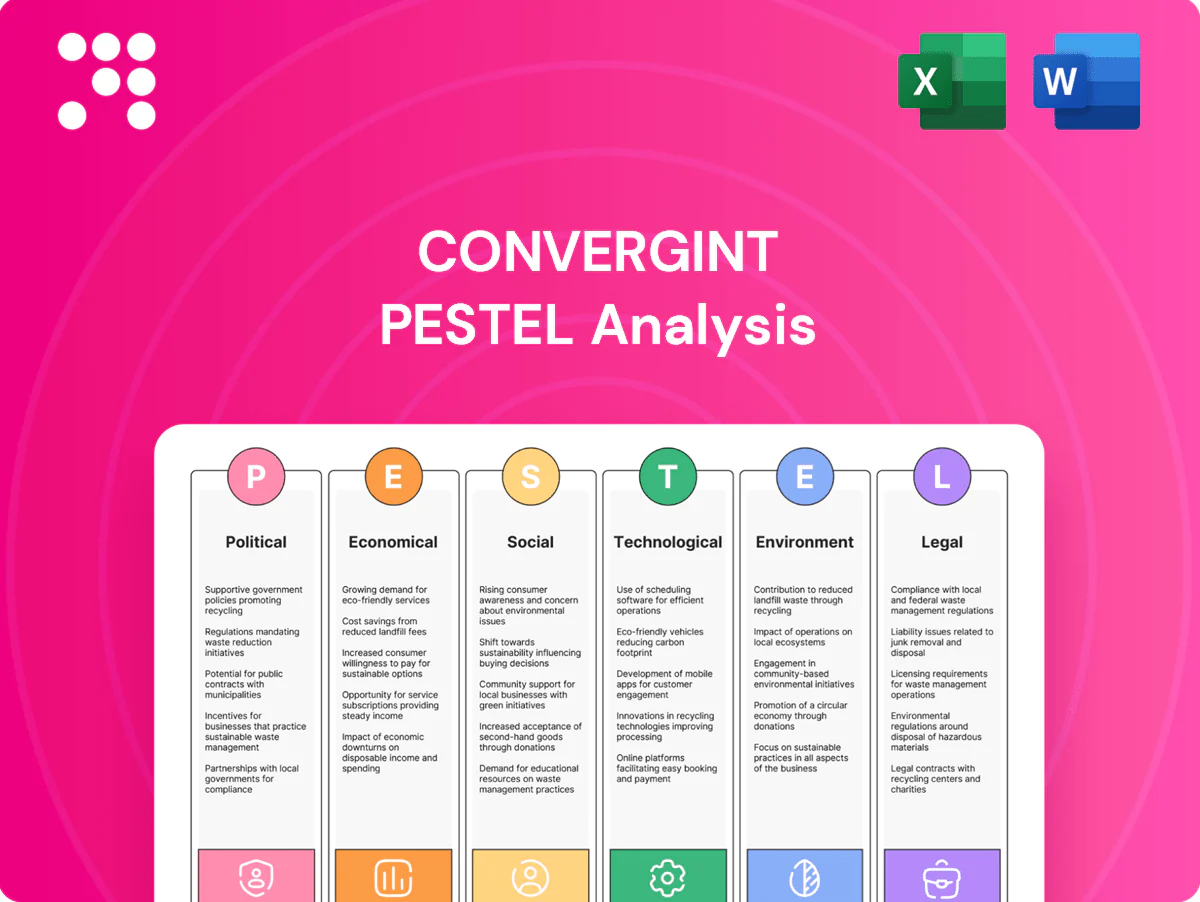
Convergint PESTLE Analysis

Make Smarter Strategic Decisions with a Complete PESTEL View
Unlock how political, economic, social, technological, legal, and environmental forces are shaping Convergint’s trajectory with our concise PESTLE snapshot. Ideal for investors, consultants, and strategists, it highlights risks and opportunities you can act on immediately. Purchase the full PESTLE for the complete, editable analysis and start making smarter decisions today.
Political factors

Government security spending
National and local governments prioritize public safety and critical-infrastructure protection, sustaining demand for integrated security and life-safety systems; US federal, state and local security-related spend exceeds $100 billion annually. Budget cycles and appropriations shift project timing and scope, while administration changes often reallocate funds toward surveillance, access control and school safety. Convergint must align solutions, certifications and bidding to evolving public-sector priorities.
Public procurement and localization
Procurement rules, local content requirements and vendor qualification lists directly shape market access and can disqualify global bidders lacking country-specific credentials. Preference for domestic suppliers or integrators with local presence raises bid competitiveness and can add price or partnership constraints. Convergint’s global footprint and partner ecosystems must align with tender criteria, and strategic localization plus compliant documentation are essential in a public procurement market estimated at $1.7 trillion under the WTO GPA.

Geopolitics and supply chain
Trade tensions and tariffs — including US duties covering about 360 billion USD of Chinese goods — plus sanctions and import controls have tightened sourcing for cameras, sensors, and networking hardware, while US government restrictions on vendors such as Huawei and Hikvision have increased country-of-origin scrutiny for security tech in critical sites. Diversified supplier bases and approved-vendor lists are cited industry-wide as primary mitigation tactics, and Convergint’s proactive supply-chain governance and traceability reduce disruption and compliance risk.

Critical infrastructure policy
Policies for utilities, transportation, healthcare and data centers now mandate higher resilience and security; US Infrastructure Investment and Jobs Act ($1.2 trillion) and expanded federal grant programs in 2024 are driving upgrades to access control, video and intrusion systems. Sector rules like NERC CIP and TSA/FTA guidance dictate technology choice, and Convergint can tailor vertical solutions to meet these policy-driven requirements.
- IIJA $1.2 trillion
- NERC CIP compliance
- 2024 federal grants boosting modernization
- Convergint vertical tailoring
Urban safety and smart city agendas
Smart city programs drive integrated surveillance, analytics and incident-response platforms; 2024 estimates put annual global smart-city spend above $200 billion, accelerating citywide deployments as political backing creates interoperability and procurement mandates. Public-private partnerships increasingly secure 7–15 year service contracts, creating opportunities for Convergint to position as the multi-agency command-and-control systems integrator.
- Integrated surveillance & analytics
- Political mandates → faster rollouts
- PPP opportunities, 7–15yr contracts
- Convergint as multi-agency integrator
Public-sector demand fuels $100B+ security and $200B+ smart-city markets
Public-sector focus on safety sustains demand for security systems (US security spend >$100B/year); procurement rules and WTO GPA markets (~$1.7T) favor local-qualified bidders. Trade controls and tariffs (~$360B Chinese goods) tighten sourcing; IIJA $1.2T and 2024 federal grants drive infrastructure upgrades. Smart-city spend >$200B/year and PPPs (7–15yr) create integrator opportunities.
| Metric | Value |
|---|---|
| US security spend | >$100B/yr |
| WTO GPA market | ~$1.7T |
| IIJA | $1.2T |
| Smart-city spend | >$200B/yr |
| Tariff scope | ~$360B (China) |
What is included in the product
 Detailed Word Document
Explores how external macro-environmental factors uniquely affect Convergint across Political, Economic, Social, Technological, Environmental and Legal dimensions, with data-backed trends and region/industry specifics; designed for executives and investors with detailed sub-points, forward-looking insights, and clean formatting for plans or decks.

 Customizable Excel Spreadsheet
A clean, summarized Convergint PESTLE that’s visually segmented by category for quick interpretation, easily dropped into presentations or shared across teams to align on external risks and market positioning.
Economic factors

Capital spending cycles
Client capex in commercial real estate, healthcare, and education drives Convergint project pipelines, with IMF-estimated global growth of 3.1% in 2024 affecting investment timing. Economic slowdowns commonly defer retrofit projects, while growth periods unlock multi-site rollouts and large-scale deployments. Opex-friendly managed services and recurring maintenance revenue help smooth topline during capex downturns; Convergint’s blend of project work and services balances cyclicality.
Interest rates and financing
Elevated rates (US fed funds ~5.25–5.50% mid‑2025) raise hurdle rates for building upgrades and large integrations, increasing ROI thresholds for clients. As‑a‑service and vendor financing reduce upfront capex and protect cash flow, while corporate borrowing costs have risen ~200–300 bps since 2021. Public sector projects often continue despite rate pressure due to mandated safety needs. Convergint can offer phased deployments to align spend with budgets.

Supply chain costs and availability
Semiconductor constraints and logistics volatility extended component lead times (averaging about 14 weeks in 2024) and pressured pricing, driving higher project costs and schedule risk. Standardizing on multi-vendor, interoperable components reduces single-supplier bottlenecks and mitigates price spikes. Rigorous inventory planning and demand forecasting are essential to meet on-time delivery targets. Convergint’s global scale and multi-region sourcing help secure allocations and volume pricing.

Labor market and wage inflation
Skilled technicians, project managers, and cybersecurity talent remain scarce; ISC2 reported a global cybersecurity workforce gap of 3.4 million in 2024, pressuring hiring and delivery. Mid-single-digit wage inflation in 2024 compressed project margins and pushed service pricing higher, prompting Convergint to invest in training and retention to protect delivery quality and capacity. Convergint’s field workforce — over 14,000 employees globally in 2024 — and high local density are competitive differentiators.
- Talent gap: ISC2 2024 — 3.4M short
- Workforce size: Convergint >14,000 (2024)
- Wage pressure: mid-single-digit inflation (2024)
- Mitigation: training, retention, field density
Client consolidation and M&A
Enterprise clients increasingly consolidate sites and vendors to reduce complexity and cost; Convergint, operating in 70+ countries with over 9,000 employees, benefits as integrator consolidation boosts bargaining power with OEMs and broadens capabilities. Multi-year, multi-region contracts favor scaled operators; Convergint can gain share via cross-selling and standardized enterprise programs.
- Client consolidation reduces vendor count and TCO
- Integrator scale improves OEM terms and solution breadth
- Multi-year, multi-region deals favor large integrators
- Cross-selling and standardized programs drive share
Public-sector demand fuels $100B+ security and $200B+ smart-city markets
Client capex cyclic; IMF 2024 GDP +3.1% and US fed funds ~5.25–5.50% (mid‑2025) raise ROI hurdles; managed services smooth revenue; lead times ~14 weeks (2024) and cybersecurity gap 3.4M constrain delivery; Convergint >14,000 employees across 70+ countries support scale.
| Metric | Value |
|---|---|
| Global GDP (2024) | +3.1% |
| US fed funds (mid‑2025) | 5.25–5.50% |
| Component lead time (2024) | ~14 weeks |
| Cyber gap (2024) | 3.4M |
| Convergint workforce (2024) | >14,000 |
Same Document Delivered
Convergint PESTLE Analysis
The Convergint PESTLE Analysis preview shown here is the exact, fully formatted document you’ll receive after purchase—professionally structured and ready to use. No placeholders or teasers: the content, layout, and insights visible in the preview are the final file you’ll download immediately after checkout.

Product Information
Product Information
Shipping & Returns
Shipping & Returns
Description
Make Smarter Strategic Decisions with a Complete PESTEL View
Unlock how political, economic, social, technological, legal, and environmental forces are shaping Convergint’s trajectory with our concise PESTLE snapshot. Ideal for investors, consultants, and strategists, it highlights risks and opportunities you can act on immediately. Purchase the full PESTLE for the complete, editable analysis and start making smarter decisions today.
Political factors
Government security spending
National and local governments prioritize public safety and critical-infrastructure protection, sustaining demand for integrated security and life-safety systems; US federal, state and local security-related spend exceeds $100 billion annually. Budget cycles and appropriations shift project timing and scope, while administration changes often reallocate funds toward surveillance, access control and school safety. Convergint must align solutions, certifications and bidding to evolving public-sector priorities.
Public procurement and localization
Procurement rules, local content requirements and vendor qualification lists directly shape market access and can disqualify global bidders lacking country-specific credentials. Preference for domestic suppliers or integrators with local presence raises bid competitiveness and can add price or partnership constraints. Convergint’s global footprint and partner ecosystems must align with tender criteria, and strategic localization plus compliant documentation are essential in a public procurement market estimated at $1.7 trillion under the WTO GPA.
Geopolitics and supply chain
Trade tensions and tariffs — including US duties covering about 360 billion USD of Chinese goods — plus sanctions and import controls have tightened sourcing for cameras, sensors, and networking hardware, while US government restrictions on vendors such as Huawei and Hikvision have increased country-of-origin scrutiny for security tech in critical sites. Diversified supplier bases and approved-vendor lists are cited industry-wide as primary mitigation tactics, and Convergint’s proactive supply-chain governance and traceability reduce disruption and compliance risk.
Critical infrastructure policy
Policies for utilities, transportation, healthcare and data centers now mandate higher resilience and security; US Infrastructure Investment and Jobs Act ($1.2 trillion) and expanded federal grant programs in 2024 are driving upgrades to access control, video and intrusion systems. Sector rules like NERC CIP and TSA/FTA guidance dictate technology choice, and Convergint can tailor vertical solutions to meet these policy-driven requirements.
- IIJA $1.2 trillion
- NERC CIP compliance
- 2024 federal grants boosting modernization
- Convergint vertical tailoring
Urban safety and smart city agendas
Smart city programs drive integrated surveillance, analytics and incident-response platforms; 2024 estimates put annual global smart-city spend above $200 billion, accelerating citywide deployments as political backing creates interoperability and procurement mandates. Public-private partnerships increasingly secure 7–15 year service contracts, creating opportunities for Convergint to position as the multi-agency command-and-control systems integrator.
- Integrated surveillance & analytics
- Political mandates → faster rollouts
- PPP opportunities, 7–15yr contracts
- Convergint as multi-agency integrator
Public-sector demand fuels $100B+ security and $200B+ smart-city markets
Public-sector focus on safety sustains demand for security systems (US security spend >$100B/year); procurement rules and WTO GPA markets (~$1.7T) favor local-qualified bidders. Trade controls and tariffs (~$360B Chinese goods) tighten sourcing; IIJA $1.2T and 2024 federal grants drive infrastructure upgrades. Smart-city spend >$200B/year and PPPs (7–15yr) create integrator opportunities.
| Metric | Value |
|---|---|
| US security spend | >$100B/yr |
| WTO GPA market | ~$1.7T |
| IIJA | $1.2T |
| Smart-city spend | >$200B/yr |
| Tariff scope | ~$360B (China) |
What is included in the product
Detailed Word Document
Explores how external macro-environmental factors uniquely affect Convergint across Political, Economic, Social, Technological, Environmental and Legal dimensions, with data-backed trends and region/industry specifics; designed for executives and investors with detailed sub-points, forward-looking insights, and clean formatting for plans or decks.
Customizable Excel Spreadsheet
A clean, summarized Convergint PESTLE that’s visually segmented by category for quick interpretation, easily dropped into presentations or shared across teams to align on external risks and market positioning.
Economic factors
Capital spending cycles
Client capex in commercial real estate, healthcare, and education drives Convergint project pipelines, with IMF-estimated global growth of 3.1% in 2024 affecting investment timing. Economic slowdowns commonly defer retrofit projects, while growth periods unlock multi-site rollouts and large-scale deployments. Opex-friendly managed services and recurring maintenance revenue help smooth topline during capex downturns; Convergint’s blend of project work and services balances cyclicality.
Interest rates and financing
Elevated rates (US fed funds ~5.25–5.50% mid‑2025) raise hurdle rates for building upgrades and large integrations, increasing ROI thresholds for clients. As‑a‑service and vendor financing reduce upfront capex and protect cash flow, while corporate borrowing costs have risen ~200–300 bps since 2021. Public sector projects often continue despite rate pressure due to mandated safety needs. Convergint can offer phased deployments to align spend with budgets.
Supply chain costs and availability
Semiconductor constraints and logistics volatility extended component lead times (averaging about 14 weeks in 2024) and pressured pricing, driving higher project costs and schedule risk. Standardizing on multi-vendor, interoperable components reduces single-supplier bottlenecks and mitigates price spikes. Rigorous inventory planning and demand forecasting are essential to meet on-time delivery targets. Convergint’s global scale and multi-region sourcing help secure allocations and volume pricing.
Labor market and wage inflation
Skilled technicians, project managers, and cybersecurity talent remain scarce; ISC2 reported a global cybersecurity workforce gap of 3.4 million in 2024, pressuring hiring and delivery. Mid-single-digit wage inflation in 2024 compressed project margins and pushed service pricing higher, prompting Convergint to invest in training and retention to protect delivery quality and capacity. Convergint’s field workforce — over 14,000 employees globally in 2024 — and high local density are competitive differentiators.
- Talent gap: ISC2 2024 — 3.4M short
- Workforce size: Convergint >14,000 (2024)
- Wage pressure: mid-single-digit inflation (2024)
- Mitigation: training, retention, field density
Client consolidation and M&A
Enterprise clients increasingly consolidate sites and vendors to reduce complexity and cost; Convergint, operating in 70+ countries with over 9,000 employees, benefits as integrator consolidation boosts bargaining power with OEMs and broadens capabilities. Multi-year, multi-region contracts favor scaled operators; Convergint can gain share via cross-selling and standardized enterprise programs.
- Client consolidation reduces vendor count and TCO
- Integrator scale improves OEM terms and solution breadth
- Multi-year, multi-region deals favor large integrators
- Cross-selling and standardized programs drive share
Public-sector demand fuels $100B+ security and $200B+ smart-city markets
Client capex cyclic; IMF 2024 GDP +3.1% and US fed funds ~5.25–5.50% (mid‑2025) raise ROI hurdles; managed services smooth revenue; lead times ~14 weeks (2024) and cybersecurity gap 3.4M constrain delivery; Convergint >14,000 employees across 70+ countries support scale.
| Metric | Value |
|---|---|
| Global GDP (2024) | +3.1% |
| US fed funds (mid‑2025) | 5.25–5.50% |
| Component lead time (2024) | ~14 weeks |
| Cyber gap (2024) | 3.4M |
| Convergint workforce (2024) | >14,000 |
Same Document Delivered
Convergint PESTLE Analysis
The Convergint PESTLE Analysis preview shown here is the exact, fully formatted document you’ll receive after purchase—professionally structured and ready to use. No placeholders or teasers: the content, layout, and insights visible in the preview are the final file you’ll download immediately after checkout.











