Converge SWOT Analysis

Go Beyond the Preview—Access the Full Strategic Report
Converge’s SWOT snapshot highlights strong market momentum, network scale advantages, and regulatory tailwinds, plus competitive and execution risks that matter to investors. Want the full picture with financial context, strategic takeaways, and editable tools? Purchase the complete SWOT analysis to get a polished Word report and bonus Excel workbook for planning, pitching, and confident decision-making.
Strengths

Pure end-to-end fiber network
Owning a contiguous end-to-end fiber network gives Converge materially lower latency and higher reliability versus mixed copper-wireless rivals, enabling consistent 1 Gbps+ residential services compared with copper limits near 100 Mbps. Control of backbone and last-mile enables faster upgrades and tighter QoS SLAs. Vertical integration drives unit-cost declines as passings scale and supports branding around speed and stability.
High-speed, fixed broadband focus
Converge clear positioning on high-speed fixed fiber—serving over 3 million retail subscribers—sharpens product execution and marketing, enabling targeted upsell and regional expansion. Engineering resources focus on speed, uptime and capacity, supporting industry-leading throughput and low latency. Simpler product lines reduce complexity and churn drivers, a message that resonates with both residential households and enterprise clients.

Enterprise and wholesale capabilities
Converge leverages integrated data, internet and ICT bundles to diversify revenue beyond residential, servicing over 3 million retail subscribers as of 2024. Wholesale and carrier services monetize backbone capacity and peering, with wholesale contributing roughly mid-teens percent of 2024 revenue. Enterprise SLAs deepen client relationships and reduce churn, while cross-sell of ICT services lifts ARPU and improves margin mix.

Rapidly scalable infrastructure
Converge’s fiber entails high upfront capex but minimal marginal cost, with DWDM enabling multi-terabit links (multiple 400 Gbps wavelengths) and XGS-PON/NG-PON2 supporting 10 Gbps+ customer tiers.
Densification and additional waves/ports expand capacity rapidly; modular, geography-targeted rollouts optimize payback periods and support future tech and higher bandwidth tiers.
- High upfront capex, low marginal cost
- DWDM: multi-400 Gbps waves → multi-Tbps
- XGS-PON/NG-PON2 → 10 Gbps+ per subscriber
- Modular rollouts enable targeted ROI
Brand recognition in reliability and speed
Converge’s strong brand recognition for reliable, high-speed fiber acts as a competitive moat, with Ookla naming it the Philippines’ top fixed-broadband provider in 2024, boosting consumer trust and adoption. Word-of-mouth and visible speed-test results reinforce positioning and validate premium tiers, while proven performance helps secure enterprise procurement across multiple sectors.
- Moat: persistent consumer awareness
- Evidence: Ookla top fixed-broadband 2024
- Monetization: justifies premium tiers
- Enterprise: aids cross-sector wins
3.0M+ fiber subscribers; 1 Gbps+ tiers, multi-Tbps backbone, top PH fixed-broadband
Converge owns a contiguous end-to-end fiber network serving over 3.0 million retail subscribers (2024), delivering 1 Gbps+ residential tiers with lower latency and higher reliability versus copper rivals. Vertical integration and modular rollouts compress unit costs and accelerate upgrades (DWDM multi-400 Gbps waves, XGS-PON/NG-PON2 for 10 Gbps+). Wholesale/wholesale carrier services contributed roughly mid-teens percent of 2024 revenue, while Ookla named Converge Philippines’ top fixed-broadband provider in 2024, reinforcing brand moat.
| Metric | Value (2024) |
|---|---|
| Retail subscribers | 3.0M+ |
| Ookla ranking | Top fixed-broadband PH |
| Wholesale revenue | ~mid-teens % |
| Backbone capacity | Multi-Tbps (DWDM) |
| Customer tech | XGS-PON / NG-PON2 (10 Gbps+) |
What is included in the product
 Detailed Word Document
Provides a concise SWOT analysis of Converge, highlighting internal strengths and weaknesses alongside external opportunities and threats shaping its competitive position and growth prospects.

 Customizable Excel Spreadsheet
Converge SWOT Analysis distills complex competitive and operational risks into a clear, visual matrix for rapid strategic alignment, enabling teams to pinpoint pain points and prioritize actionable fixes.
Weaknesses

Capital-intensive buildouts
Converge's capital-intensive buildouts (notably PHP ~42 billion capex in 2023) exert strong pressure on free cash flow as backbone and last-mile investments are front-loaded. Payback hinges on subscriber take-up and ARPU stability—slower uptake extends multi-year payback periods. Rising interest rates in 2022–24 cycles raised financing costs, and capex timing mismatches can compress near-term margins.
Geographic concentration in the Philippines
Geographic concentration in the Philippines leaves Converge exposed to macro, regulatory and disaster shocks, with over 90% of revenues generated domestically. Currency and inflation volatility — Philippines peso weakness and 2024 inflation around 5% — directly raise capex and compress consumer demand. Limited regional diversification reduces resilience versus ASEAN peers, capping growth as domestic broadband penetration approaches saturation.

Service and installation bottlenecks
Last-mile installs, permitting delays and limited field workforce capacity have extended Converge provisioning times, hurting customer experience and NPS; Converge reported revenue of PHP 48.6 billion in 2023, making operational efficiency critical. Backlogs can push customers to alternatives where available, increasing churn risk. Persistent inefficiencies inflate unit costs and compress margins.

ARPU pressure from price competition
Intense rivalry and frequent promos force Converge into discounting, compressing ARPU as competitors chase market share; entry-level plans cap average yields even as data usage per subscriber rises. Telco incumbents' bundled services (mobile, TV) erode Converge's pricing power, and up-selling to higher tiers often lags behind capacity investments and network expansion timelines.
- Promo-driven discounting
- Entry-plan yield caps
- Incumbent bundling pressure
- Up-sell lag v capacity spend
Vulnerability to outages and cuts
Converge's fiber routes remain exposed to construction digs, the Philippines' ~20 annual tropical cyclones and frequent seismic activity, raising outage risk and customer churn. Restoration costs and SLA penalties from prolonged outages can hit margins, often running into millions of pesos for major incidents. High-profile public outages erode brand trust while building true redundancy increases capex, Opex and network complexity.
- Exposure: construction, typhoons (~20/yr), earthquakes
- Financial hit: restoration/SLA costs often reach millions of pesos
- Reputation: public incidents damage trust
- Redundancy: higher capex/opex and complexity
Heavy capex PHP 42.0B strains FCF; domestic exposure and typhoon risk
Converge's heavy capex (PHP 42.0B in 2023) strains FCF and prolongs payback if ARPU or subscriber growth decelerates. Domestic concentration (>90% revenue) and 2024 inflation ~5% raise capex and dampen demand. Operational backlogs slow provisioning and increase churn; outages from ~20 typhoons/yr and seismic activity raise restoration and SLA costs.
| Metric | Value |
|---|---|
| Capex 2023 | PHP 42.0B |
| Revenue 2023 | PHP 48.6B |
| Domestic revenue | >90% |
| Inflation 2024 | ~5% |
| Typhoons/yr | ~20 |
Preview Before You Purchase
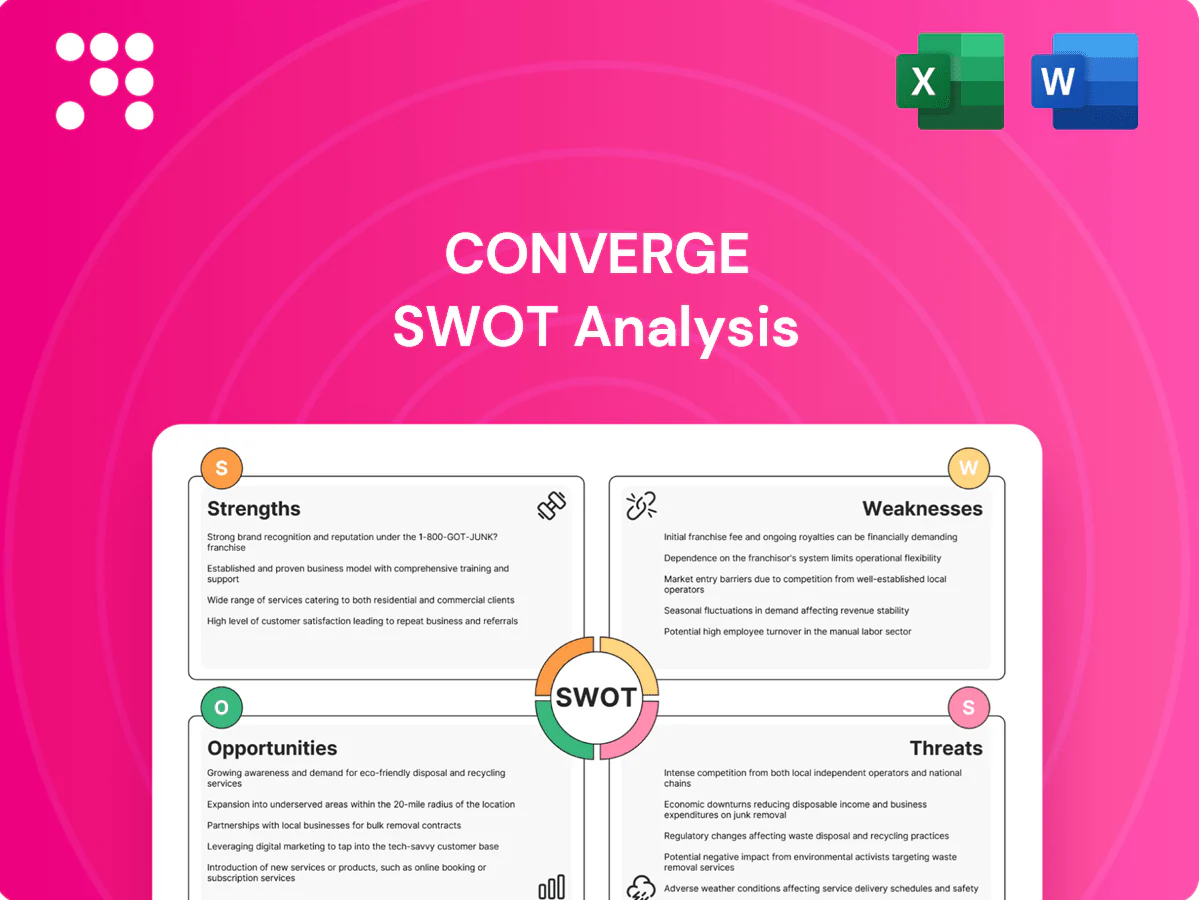
Converge SWOT Analysis
This is the actual Converge SWOT analysis document you’ll receive upon purchase—no surprises, just professional quality. The preview below is taken directly from the full report; buy to unlock the complete, editable version. The file shown is the real analysis included in your download.

Original: $10.00
-65%$10.00
$3.50Product Information
Product Information
Shipping & Returns
Shipping & Returns
Description
Go Beyond the Preview—Access the Full Strategic Report
Converge’s SWOT snapshot highlights strong market momentum, network scale advantages, and regulatory tailwinds, plus competitive and execution risks that matter to investors. Want the full picture with financial context, strategic takeaways, and editable tools? Purchase the complete SWOT analysis to get a polished Word report and bonus Excel workbook for planning, pitching, and confident decision-making.
Strengths
Pure end-to-end fiber network
Owning a contiguous end-to-end fiber network gives Converge materially lower latency and higher reliability versus mixed copper-wireless rivals, enabling consistent 1 Gbps+ residential services compared with copper limits near 100 Mbps. Control of backbone and last-mile enables faster upgrades and tighter QoS SLAs. Vertical integration drives unit-cost declines as passings scale and supports branding around speed and stability.
High-speed, fixed broadband focus
Converge clear positioning on high-speed fixed fiber—serving over 3 million retail subscribers—sharpens product execution and marketing, enabling targeted upsell and regional expansion. Engineering resources focus on speed, uptime and capacity, supporting industry-leading throughput and low latency. Simpler product lines reduce complexity and churn drivers, a message that resonates with both residential households and enterprise clients.
Enterprise and wholesale capabilities
Converge leverages integrated data, internet and ICT bundles to diversify revenue beyond residential, servicing over 3 million retail subscribers as of 2024. Wholesale and carrier services monetize backbone capacity and peering, with wholesale contributing roughly mid-teens percent of 2024 revenue. Enterprise SLAs deepen client relationships and reduce churn, while cross-sell of ICT services lifts ARPU and improves margin mix.
Rapidly scalable infrastructure
Converge’s fiber entails high upfront capex but minimal marginal cost, with DWDM enabling multi-terabit links (multiple 400 Gbps wavelengths) and XGS-PON/NG-PON2 supporting 10 Gbps+ customer tiers.
Densification and additional waves/ports expand capacity rapidly; modular, geography-targeted rollouts optimize payback periods and support future tech and higher bandwidth tiers.
- High upfront capex, low marginal cost
- DWDM: multi-400 Gbps waves → multi-Tbps
- XGS-PON/NG-PON2 → 10 Gbps+ per subscriber
- Modular rollouts enable targeted ROI
Brand recognition in reliability and speed
Converge’s strong brand recognition for reliable, high-speed fiber acts as a competitive moat, with Ookla naming it the Philippines’ top fixed-broadband provider in 2024, boosting consumer trust and adoption. Word-of-mouth and visible speed-test results reinforce positioning and validate premium tiers, while proven performance helps secure enterprise procurement across multiple sectors.
- Moat: persistent consumer awareness
- Evidence: Ookla top fixed-broadband 2024
- Monetization: justifies premium tiers
- Enterprise: aids cross-sector wins
3.0M+ fiber subscribers; 1 Gbps+ tiers, multi-Tbps backbone, top PH fixed-broadband
Converge owns a contiguous end-to-end fiber network serving over 3.0 million retail subscribers (2024), delivering 1 Gbps+ residential tiers with lower latency and higher reliability versus copper rivals. Vertical integration and modular rollouts compress unit costs and accelerate upgrades (DWDM multi-400 Gbps waves, XGS-PON/NG-PON2 for 10 Gbps+). Wholesale/wholesale carrier services contributed roughly mid-teens percent of 2024 revenue, while Ookla named Converge Philippines’ top fixed-broadband provider in 2024, reinforcing brand moat.
| Metric | Value (2024) |
|---|---|
| Retail subscribers | 3.0M+ |
| Ookla ranking | Top fixed-broadband PH |
| Wholesale revenue | ~mid-teens % |
| Backbone capacity | Multi-Tbps (DWDM) |
| Customer tech | XGS-PON / NG-PON2 (10 Gbps+) |
What is included in the product
Detailed Word Document
Provides a concise SWOT analysis of Converge, highlighting internal strengths and weaknesses alongside external opportunities and threats shaping its competitive position and growth prospects.
Customizable Excel Spreadsheet
Converge SWOT Analysis distills complex competitive and operational risks into a clear, visual matrix for rapid strategic alignment, enabling teams to pinpoint pain points and prioritize actionable fixes.
Weaknesses
Capital-intensive buildouts
Converge's capital-intensive buildouts (notably PHP ~42 billion capex in 2023) exert strong pressure on free cash flow as backbone and last-mile investments are front-loaded. Payback hinges on subscriber take-up and ARPU stability—slower uptake extends multi-year payback periods. Rising interest rates in 2022–24 cycles raised financing costs, and capex timing mismatches can compress near-term margins.
Geographic concentration in the Philippines
Geographic concentration in the Philippines leaves Converge exposed to macro, regulatory and disaster shocks, with over 90% of revenues generated domestically. Currency and inflation volatility — Philippines peso weakness and 2024 inflation around 5% — directly raise capex and compress consumer demand. Limited regional diversification reduces resilience versus ASEAN peers, capping growth as domestic broadband penetration approaches saturation.
Service and installation bottlenecks
Last-mile installs, permitting delays and limited field workforce capacity have extended Converge provisioning times, hurting customer experience and NPS; Converge reported revenue of PHP 48.6 billion in 2023, making operational efficiency critical. Backlogs can push customers to alternatives where available, increasing churn risk. Persistent inefficiencies inflate unit costs and compress margins.
ARPU pressure from price competition
Intense rivalry and frequent promos force Converge into discounting, compressing ARPU as competitors chase market share; entry-level plans cap average yields even as data usage per subscriber rises. Telco incumbents' bundled services (mobile, TV) erode Converge's pricing power, and up-selling to higher tiers often lags behind capacity investments and network expansion timelines.
- Promo-driven discounting
- Entry-plan yield caps
- Incumbent bundling pressure
- Up-sell lag v capacity spend
Vulnerability to outages and cuts
Converge's fiber routes remain exposed to construction digs, the Philippines' ~20 annual tropical cyclones and frequent seismic activity, raising outage risk and customer churn. Restoration costs and SLA penalties from prolonged outages can hit margins, often running into millions of pesos for major incidents. High-profile public outages erode brand trust while building true redundancy increases capex, Opex and network complexity.
- Exposure: construction, typhoons (~20/yr), earthquakes
- Financial hit: restoration/SLA costs often reach millions of pesos
- Reputation: public incidents damage trust
- Redundancy: higher capex/opex and complexity
Heavy capex PHP 42.0B strains FCF; domestic exposure and typhoon risk
Converge's heavy capex (PHP 42.0B in 2023) strains FCF and prolongs payback if ARPU or subscriber growth decelerates. Domestic concentration (>90% revenue) and 2024 inflation ~5% raise capex and dampen demand. Operational backlogs slow provisioning and increase churn; outages from ~20 typhoons/yr and seismic activity raise restoration and SLA costs.
| Metric | Value |
|---|---|
| Capex 2023 | PHP 42.0B |
| Revenue 2023 | PHP 48.6B |
| Domestic revenue | >90% |
| Inflation 2024 | ~5% |
| Typhoons/yr | ~20 |
Preview Before You Purchase
Converge SWOT Analysis
This is the actual Converge SWOT analysis document you’ll receive upon purchase—no surprises, just professional quality. The preview below is taken directly from the full report; buy to unlock the complete, editable version. The file shown is the real analysis included in your download.