CompoSecure PESTLE Analysis

Make Smarter Strategic Decisions with a Complete PESTEL View
Gain a strategic advantage with our PESTLE Analysis of CompoSecure—three to five actionable insights reveal how political, economic, social, technological, legal, and environmental forces shape its prospects. Use this concise briefing to inform investment or strategy decisions. Purchase the full report for the complete, editable deep-dive and immediate download.
Political factors

Fintech policy and payments regulation direction
Shifts toward cashless economies accelerate demand for premium cards and stronger authentication, exemplified by Sweden where cashless payments exceed 80%, benefiting secure-card issuers like CompoSecure. Protectionist rules can tilt procurement toward domestic networks, altering partner mixes and margins. Public-sector digital ID rollouts — India’s Aadhaar serving ~1.4 billion — expand authentication-led card use. Election cycles often delay regulation and large public tenders, adding timing risk.
Sanctions and geopolitical risk exposure
Sanctions regimes limit cross-border issuance and crypto custody eligibility, with banks in at least six widely sanctioned jurisdictions (Russia, Iran, North Korea, Syria, Venezuela, Belarus) effectively off-limits, shrinking addressable markets. OFAC’s SDN listings exceed 8,000 entries, forcing stricter vendor screening and ultimate beneficial ownership checks that raise onboarding costs and extend KYC timelines. Geopolitical flare-ups also spike logistics and insurance premiums for high-value card shipments, disrupting delivery chains.

Trade policy, tariffs, and metals sourcing
Tariffs such as the US Section 232 steel levy (25%) materially shift bill-of-materials economics for stainless, titanium and specialty alloys, raising per-unit costs and margins pressure. Country-of-origin rules (e.g., USMCA/CPTPP provisions) can force supply-chain redesigns to maintain preferential treatment. Preferential trade agreements open cost-advantaged corridors, while customs delays commonly add weeks of lead-time and strain working capital.

Government stance on crypto and digital assets
Pro-innovation regimes such as the EU under MiCA (effective 2024) create regulatory tailwinds for custody and hardware security products, while restrictive jurisdictions curb features or block services, complicating global go-to-market. Divergent national frameworks force fragmented roadmaps; BIS data show 114 central banks exploring CBDCs (2023), and central bank guidance materially shapes institutional appetite for crypto-linked cards.
- MiCA effective 2024: market clarity in EU
- 114 central banks exploring CBDCs (BIS 2023)
- Restrictive jurisdictions limit features or access
- Divergent laws complicate unified product roadmap
National cybersecurity strategies and data localization
National mandates for local data storage (over 50 countries by 2024) push CompoSecure toward onshore infrastructure and regional vendors, increasing capex and O&M; government authentication certifications are becoming table stakes for public-sector sales. Cross-border transfer rules constrain telemetry and support models, raising compliance costs. Public-private security initiatives (NIST-style) create certification pathways and procurement demand signals.
- Data localization: >50 countries (2024)
- Certifications: required for public contracts
- Cross-border rules: limit telemetry/support
- Public-private programs: drive demand/certification
Political shifts, sanctions and data-localization spur regional payments and secure-card demand
Political shifts boost secure-card demand (Sweden cashless >80% 2024) but protectionism, sanctions (OFAC SDN >8,000) and tariffs raise costs and constrain markets. Data-localization (>50 countries 2024) and divergent crypto/CBDC rules (MiCA 2024; 114 central banks exploring CBDCs) force regionalization.
| Factor | Metric |
|---|---|
| Cashless demand | Sweden >80% (2024) |
| Sanctions/KYC | OFAC SDN >8,000 (2024) |
| Data & regulation | >50 countries loc. (2024); MiCA 2024; 114 CBDCs (BIS 2023) |
What is included in the product
 Detailed Word Document
Explores how Political, Economic, Social, Technological, Environmental and Legal forces uniquely impact CompoSecure, with data-backed, region- and industry-specific insights and forward-looking scenarios to help executives, advisors and entrepreneurs identify opportunities, risks and actionable strategies ready for decks and plans.

 Customizable Excel Spreadsheet
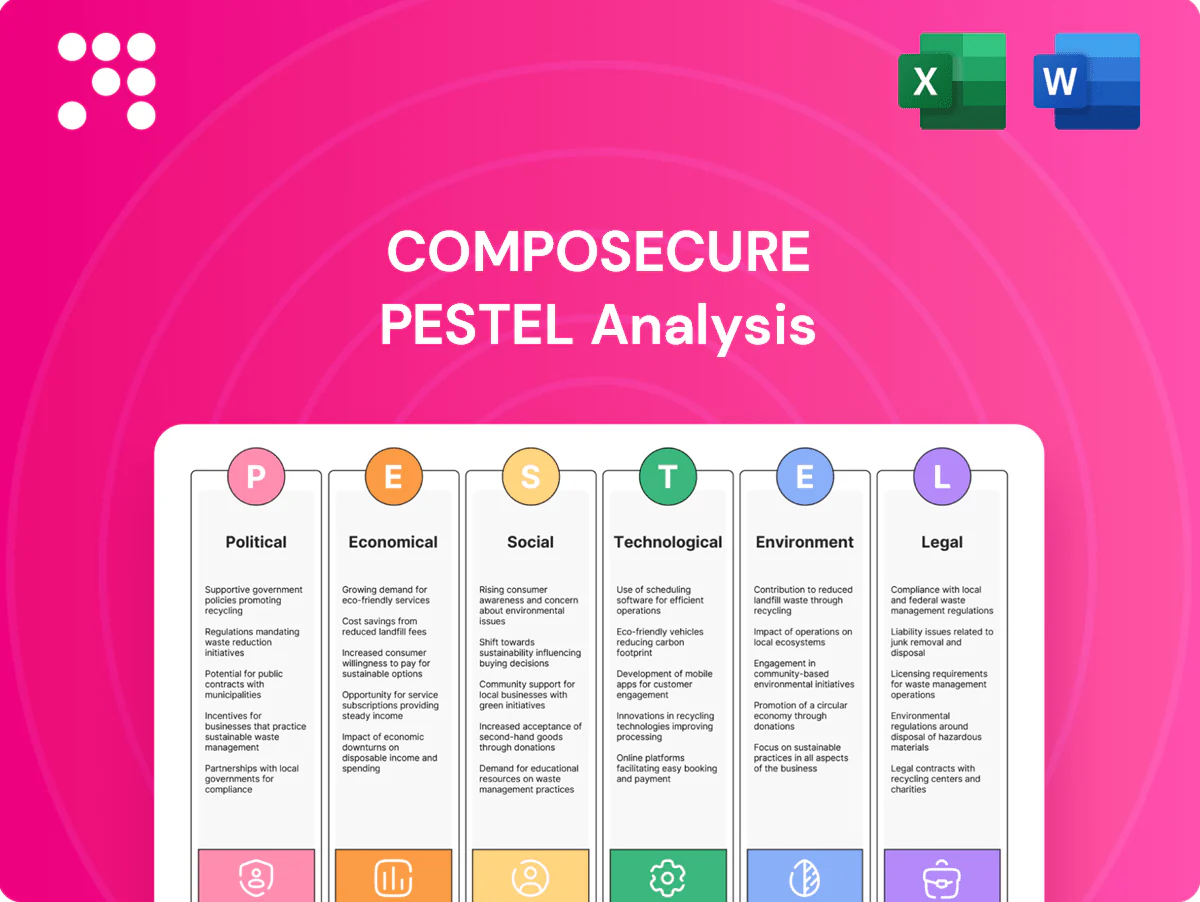
Visually segmented by PESTLE categories for quick interpretation, the CompoSecure PESTLE summary provides a clean, shareable snapshot that can be dropped into presentations or used in planning sessions to align teams and support external risk discussions.
Economic factors

Interest rates and bank marketing budgets
Rising rates (effective federal funds rate ~5.33% in June 2025) have lifted net interest margins—U.S. banks' aggregate NIM averaged about 3.3% in 2024 (FDIC)—supporting spend on premium card marketing. In downturns issuers have trimmed acquisition budgets, pressuring metal card volumes. Higher capital costs raise the hurdle for capacity expansion, while corporate budget cycles create uneven quarterly demand.
Commodity and FX volatility
Metal input price swings (stainless steel up about 7% YoY in 2024) and currency moves (EUR/USD ~1.08 in mid-2025) directly lift COGS and force price adjustments; supplier contracts often include index-linked clauses that pass through cost changes. Hedging programs cut raw-material and FX variance but add hedging costs and operational complexity, typically costing 0.5–1.0% of revenues while smoothing P&L. FX translation also alters reported international revenue and relative competitiveness across markets.

Consumer spending and travel cycles
Premium card usage tracks travel and luxury spend, with IATA reporting 2024 passenger demand roughly 2% above 2019 and Bain estimating global luxury sales rose about 5% in 2024, boosting premium-card transaction value. Macro slowdowns compress wallets and shift demand toward lower-cost card tiers and reloadable options. Travel rebounds often spark co-branded premium launches by issuers. Seasonal peaks require CompoSecure to maintain manufacturing agility and buffer inventory.

Crypto market cycles and institutional adoption
Crypto cycles drive CompoSecure demand: bull markets (crypto peak ~3 trillion USD in Nov 2021) expand custody and security budgets while the 2022 bear pushed total crypto market below 1 trillion USD, compressing spend; institutions elongate sales cycles but raise deal sizes; stablecoins and tokenization (stablecoins >150 billion USD market cap by 2023) diversify revenue, forcing flexible forecasting amid revenue mix volatility.
- Budget sensitivity: higher in bulls, lower in bears
- Sales dynamics: longer cycles, larger deal sizes
- Product mix: stablecoins/tokenization reduce pure-speculative correlation
- Planning: require scenario-based, flexible forecasts
Industry consolidation among issuers and processors
Industry consolidation among issuers and processors concentrates purchasing power—post-2019 mega-deals (FIS-Worldpay, Fiserv-First Data, Global Payments-TSYS, Worldline-Ingenico) created a handful of dominant partners that pressure vendor margins while enabling global scale and multi-year contracts; lengthy integrations often slow CompoSecure’s new product launches even as standardization reduces SKU complexity and unit costs.
- Concentration: few large processors control most global processing after 2019 mega-deals
- Margin pressure: larger buyers extract lower prices, longer contracts
- Integration lag: product rollout delays during partner consolidations
- Cost upside: standardization cuts SKU and production costs
Political shifts, sanctions and data-localization spur regional payments and secure-card demand
Rising rates (fed funds ~5.33% Jun 2025) lifted NIMs (US banks ~3.3% 2024), supporting premium-card spend but raising capital costs and uneven demand; metal input costs (stainless steel +7% YoY 2024) and EUR/USD ~1.08 mid‑2025 lift COGS; travel and luxury recovery (+2% pax vs 2019; luxury +5% 2024) boost premium volumes; crypto swings make revenue mix volatile.
| Metric | Value |
|---|---|
| Fed funds | ~5.33% (Jun 2025) |
| US NIM | ~3.3% (2024) |
| Stainless steel | +7% YoY (2024) |
| EUR/USD | ~1.08 (mid‑2025) |
What You See Is What You Get
CompoSecure PESTLE Analysis
The preview shown here is the exact CompoSecure PESTLE Analysis you’ll receive after purchase—fully formatted and ready to use. The layout, content, and structure visible are the final file you’ll download immediately—no placeholders, no surprises. This is the real, professionally structured document you’ll own after checkout.

Product Information
Product Information
Shipping & Returns
Shipping & Returns
Description
Make Smarter Strategic Decisions with a Complete PESTEL View
Gain a strategic advantage with our PESTLE Analysis of CompoSecure—three to five actionable insights reveal how political, economic, social, technological, legal, and environmental forces shape its prospects. Use this concise briefing to inform investment or strategy decisions. Purchase the full report for the complete, editable deep-dive and immediate download.
Political factors
Fintech policy and payments regulation direction
Shifts toward cashless economies accelerate demand for premium cards and stronger authentication, exemplified by Sweden where cashless payments exceed 80%, benefiting secure-card issuers like CompoSecure. Protectionist rules can tilt procurement toward domestic networks, altering partner mixes and margins. Public-sector digital ID rollouts — India’s Aadhaar serving ~1.4 billion — expand authentication-led card use. Election cycles often delay regulation and large public tenders, adding timing risk.
Sanctions and geopolitical risk exposure
Sanctions regimes limit cross-border issuance and crypto custody eligibility, with banks in at least six widely sanctioned jurisdictions (Russia, Iran, North Korea, Syria, Venezuela, Belarus) effectively off-limits, shrinking addressable markets. OFAC’s SDN listings exceed 8,000 entries, forcing stricter vendor screening and ultimate beneficial ownership checks that raise onboarding costs and extend KYC timelines. Geopolitical flare-ups also spike logistics and insurance premiums for high-value card shipments, disrupting delivery chains.
Trade policy, tariffs, and metals sourcing
Tariffs such as the US Section 232 steel levy (25%) materially shift bill-of-materials economics for stainless, titanium and specialty alloys, raising per-unit costs and margins pressure. Country-of-origin rules (e.g., USMCA/CPTPP provisions) can force supply-chain redesigns to maintain preferential treatment. Preferential trade agreements open cost-advantaged corridors, while customs delays commonly add weeks of lead-time and strain working capital.
Government stance on crypto and digital assets
Pro-innovation regimes such as the EU under MiCA (effective 2024) create regulatory tailwinds for custody and hardware security products, while restrictive jurisdictions curb features or block services, complicating global go-to-market. Divergent national frameworks force fragmented roadmaps; BIS data show 114 central banks exploring CBDCs (2023), and central bank guidance materially shapes institutional appetite for crypto-linked cards.
- MiCA effective 2024: market clarity in EU
- 114 central banks exploring CBDCs (BIS 2023)
- Restrictive jurisdictions limit features or access
- Divergent laws complicate unified product roadmap
National cybersecurity strategies and data localization
National mandates for local data storage (over 50 countries by 2024) push CompoSecure toward onshore infrastructure and regional vendors, increasing capex and O&M; government authentication certifications are becoming table stakes for public-sector sales. Cross-border transfer rules constrain telemetry and support models, raising compliance costs. Public-private security initiatives (NIST-style) create certification pathways and procurement demand signals.
- Data localization: >50 countries (2024)
- Certifications: required for public contracts
- Cross-border rules: limit telemetry/support
- Public-private programs: drive demand/certification
Political shifts, sanctions and data-localization spur regional payments and secure-card demand
Political shifts boost secure-card demand (Sweden cashless >80% 2024) but protectionism, sanctions (OFAC SDN >8,000) and tariffs raise costs and constrain markets. Data-localization (>50 countries 2024) and divergent crypto/CBDC rules (MiCA 2024; 114 central banks exploring CBDCs) force regionalization.
| Factor | Metric |
|---|---|
| Cashless demand | Sweden >80% (2024) |
| Sanctions/KYC | OFAC SDN >8,000 (2024) |
| Data & regulation | >50 countries loc. (2024); MiCA 2024; 114 CBDCs (BIS 2023) |
What is included in the product
Detailed Word Document
Explores how Political, Economic, Social, Technological, Environmental and Legal forces uniquely impact CompoSecure, with data-backed, region- and industry-specific insights and forward-looking scenarios to help executives, advisors and entrepreneurs identify opportunities, risks and actionable strategies ready for decks and plans.
Customizable Excel Spreadsheet
Visually segmented by PESTLE categories for quick interpretation, the CompoSecure PESTLE summary provides a clean, shareable snapshot that can be dropped into presentations or used in planning sessions to align teams and support external risk discussions.
Economic factors
Interest rates and bank marketing budgets
Rising rates (effective federal funds rate ~5.33% in June 2025) have lifted net interest margins—U.S. banks' aggregate NIM averaged about 3.3% in 2024 (FDIC)—supporting spend on premium card marketing. In downturns issuers have trimmed acquisition budgets, pressuring metal card volumes. Higher capital costs raise the hurdle for capacity expansion, while corporate budget cycles create uneven quarterly demand.
Commodity and FX volatility
Metal input price swings (stainless steel up about 7% YoY in 2024) and currency moves (EUR/USD ~1.08 in mid-2025) directly lift COGS and force price adjustments; supplier contracts often include index-linked clauses that pass through cost changes. Hedging programs cut raw-material and FX variance but add hedging costs and operational complexity, typically costing 0.5–1.0% of revenues while smoothing P&L. FX translation also alters reported international revenue and relative competitiveness across markets.
Consumer spending and travel cycles
Premium card usage tracks travel and luxury spend, with IATA reporting 2024 passenger demand roughly 2% above 2019 and Bain estimating global luxury sales rose about 5% in 2024, boosting premium-card transaction value. Macro slowdowns compress wallets and shift demand toward lower-cost card tiers and reloadable options. Travel rebounds often spark co-branded premium launches by issuers. Seasonal peaks require CompoSecure to maintain manufacturing agility and buffer inventory.
Crypto market cycles and institutional adoption
Crypto cycles drive CompoSecure demand: bull markets (crypto peak ~3 trillion USD in Nov 2021) expand custody and security budgets while the 2022 bear pushed total crypto market below 1 trillion USD, compressing spend; institutions elongate sales cycles but raise deal sizes; stablecoins and tokenization (stablecoins >150 billion USD market cap by 2023) diversify revenue, forcing flexible forecasting amid revenue mix volatility.
- Budget sensitivity: higher in bulls, lower in bears
- Sales dynamics: longer cycles, larger deal sizes
- Product mix: stablecoins/tokenization reduce pure-speculative correlation
- Planning: require scenario-based, flexible forecasts
Industry consolidation among issuers and processors
Industry consolidation among issuers and processors concentrates purchasing power—post-2019 mega-deals (FIS-Worldpay, Fiserv-First Data, Global Payments-TSYS, Worldline-Ingenico) created a handful of dominant partners that pressure vendor margins while enabling global scale and multi-year contracts; lengthy integrations often slow CompoSecure’s new product launches even as standardization reduces SKU complexity and unit costs.
- Concentration: few large processors control most global processing after 2019 mega-deals
- Margin pressure: larger buyers extract lower prices, longer contracts
- Integration lag: product rollout delays during partner consolidations
- Cost upside: standardization cuts SKU and production costs
Political shifts, sanctions and data-localization spur regional payments and secure-card demand
Rising rates (fed funds ~5.33% Jun 2025) lifted NIMs (US banks ~3.3% 2024), supporting premium-card spend but raising capital costs and uneven demand; metal input costs (stainless steel +7% YoY 2024) and EUR/USD ~1.08 mid‑2025 lift COGS; travel and luxury recovery (+2% pax vs 2019; luxury +5% 2024) boost premium volumes; crypto swings make revenue mix volatile.
| Metric | Value |
|---|---|
| Fed funds | ~5.33% (Jun 2025) |
| US NIM | ~3.3% (2024) |
| Stainless steel | +7% YoY (2024) |
| EUR/USD | ~1.08 (mid‑2025) |
What You See Is What You Get
CompoSecure PESTLE Analysis
The preview shown here is the exact CompoSecure PESTLE Analysis you’ll receive after purchase—fully formatted and ready to use. The layout, content, and structure visible are the final file you’ll download immediately—no placeholders, no surprises. This is the real, professionally structured document you’ll own after checkout.