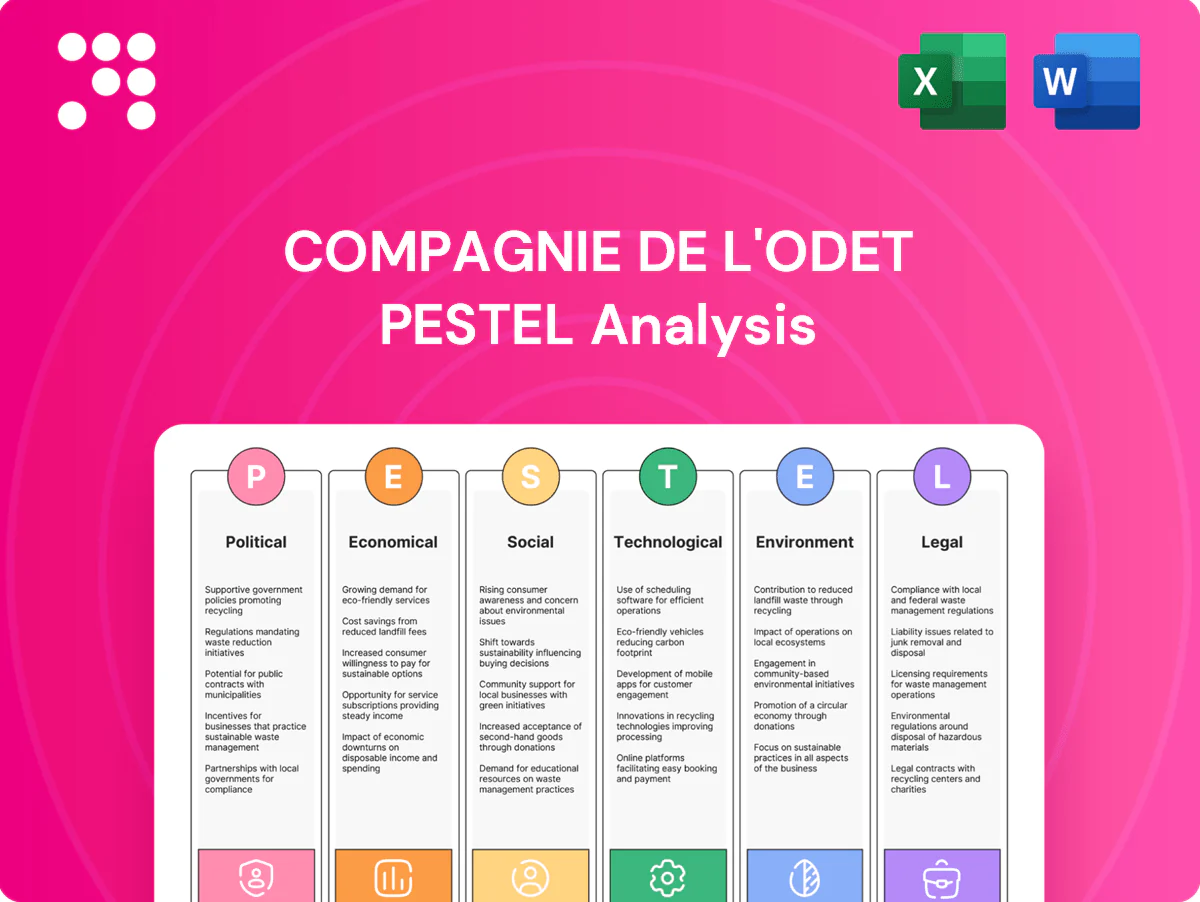
Compagnie de l'Odet PESTLE Analysis

Skip the Research. Get the Strategy.
Our PESTLE Analysis of Compagnie de l'Odet reveals how political shifts, economic trends, social dynamics, technological advances, legal changes, and environmental factors will shape its prospects. Actionable insights highlight risks and growth levers for investors and strategists. Purchase the full report to access the complete, ready-to-use analysis and recommendations.
Political factors

EU industrial and trade policy
EU state-aid rules and IPCEI support for strategic autonomy steer capital into batteries and logistics hubs, while anti-subsidy probes on non-EU battery imports raise margin pressure on media and holdings exposed to outsourced supply; TEN-T priorities and the CEF transport budget of €25.8bn shift capex toward rail/port upgrades affecting throughput and dwell times. France 2030 incentives (≈€54bn program) boost investment in storage systems, reallocating Group capital to energy storage projects, while shifting trade blocs and tariffs threaten route-dependent shipping lanes and sourcing resilience.
Franco-African relations and stability
Compagnie de l'Odet faces direct exposure from Bolloré-linked logistics historically active across West and Central Africa, a region that has seen at least 7 successful coups since 2020 (Mali, Guinea, Burkina Faso, Niger, Gabon among others), raising operational and security risk for port and rail assets.
Changing governments have already prompted renegotiations and contract reviews regionally, while tighter local content rules and nationalization rhetoric increase the probability of higher compliance costs or partial asset reversion.
Diplomatic shifts—including ECOWAS sanctions episodes (eg 2023 Niger) and expanding Russian private military influence in Mali/Car—have altered customs and licensing environments, heightening risk to concession continuity and clearance delays.

Media influence and cultural policy
French law requires TV channels to reserve 60% of broadcasting time for European works and 40% for French works, while radio must allocate 40% French-language songs, shaping content strategy for Vivendi-owned Canal+ and subsidiaries.
Broadcasters including Canal+ face obligations to invest roughly 12% of turnover into French/European audiovisual production and recurrent political scrutiny over media plurality and consolidation, which can constrain M&A and growth options.
Election cycles in France and the EU often prompt tighter oversight on editorial influence, advertising rules and public broadcasting dynamics, and potential targeted subsidies or co‑production funds (e.g., CNC support) can shift competitive incentives.

Geopolitics and supply chain realignment
Geopolitics have raised logistics costs and route volatility for Compagnie de l'Odet: Red Sea attacks since late 2023 forced many carriers to reroute via the Cape, adding 6–14 days and industry-reported incremental costs up to about 2,000–3,000 USD per container; Russia-Ukraine disruptions curtailed Black Sea capacity and shifted cargoes to longer corridors; China-West tensions and tariff regimes drive selective reshoring, altering lane demand and increasing compliance burdens. Sanctions regimes reshuffle customer mixes and raise transaction screening costs; scenario-planning must model reroutes, 20–50% higher war-risk premiums reported in 2024, and elevated port congestion risk.
- Rerouting impact: +6–14 days, +2,000–3,000 USD/container
- Insurance: war-risk premiums +20–50% (2024 industry reports)
- Capacity shifts: Black Sea reductions → longer corridors
- Policy: reshoring/nearshoring alters demand patterns
- Compliance: sanctions increase KYC and transaction costs
Public procurement and concessions
Political decisions on port, rail and logistics concessions directly affect Compagnie de l'Odet cash flows, especially given France 2030’s €54 billion investment envelope that channels state-backed infrastructure spending into transport and logistics through 2021–2025 programs. Tender rules, localization requirements and PPP frameworks (EU public procurement market ~€2 trillion annually) can tilt competitiveness, while municipal or national leadership changes may reprioritize projects and timelines. Monitor lobbying, stakeholder engagement and rising transparency expectations (mandatory e-procurement and stricter anti-corruption rules) as they alter concession award risk and cashflow visibility.
- Concession risk: political reprioritization
- Tender rules: localization/PPP tilt competitiveness
- Finance: France 2030 €54bn affects project pipeline
- Governance: e-procurement, lobbying, transparency
EU funds shift to rail/ports; anti-subsidy probes and African coups raise reroute costs
EU state-aid, France 2030 (€54bn) and TEN-T/CEF (€25.8bn) redirect capex to rail/ports and storage, squeezing margins via anti-subsidy probes on non-EU batteries. Political instability in West/Central Africa (≥7 coups since 2020) raises concession and security risk. Geopolitical reroutes add +6–14 days and +2,000–3,000 USD/container; war-risk premiums +20–50% (2024).
| Metric | Value |
|---|---|
| France 2030 | €54bn |
| CEF transport | €25.8bn |
| Coups since 2020 | ≥7 |
| Reroute cost/delay | +6–14 days, +$2–3k/container |
| War-risk prem. | +20–50% |
What is included in the product
 Detailed Word Document
Provides a targeted PESTLE assessment of Compagnie de l'Odet, examining Political, Economic, Social, Technological, Environmental and Legal forces shaping its regional transport/logistics operations. Each factor is supported by current trends and actionable insights to inform strategic planning and investor communications.

 Customizable Excel Spreadsheet
A concise, visually segmented PESTLE summary for Compagnie de l'Odet that streamlines meeting prep and presentation slides; editable notes let teams adapt insights to specific regions or business lines, enabling rapid alignment and clearer external risk discussions.
Economic factors

Interest rates and discount rates
ECB policy rate around 3.75% and Fed funds at 5.25-5.50% in H1 2025 shift holding-company valuations via higher discount rates, increasing debt servicing costs and lowering DCF terminal values. Higher rates compress equity multiples for media and capex-heavy logistics; refinancing windows and widened bond spreads pace investments. Sensitivity tests show NAV falls roughly 10-15% per +100bp rise in WACC.
Global trade volumes and freight cycles
EBITDA for Compagnie de l'Odet tracks container throughput closely: a 1% throughput decline during the WTO-reported 2.7% drop in world merchandise trade (2023) corresponded historically to ~0.8% EBITDA compression, exacerbated by longer port dwell times (+12% in select European hubs 2024) and PMI weakness (global manufacturing PMI ~49–50 in 2024–H1 2025). Volatile spot rates and bunker swings (VLSFO averaged near $450–$550/ton in 2024) pressure margins and constrain dividend upstreaming. Inventory destocking in Europe/US reduced warehousing demand in 2023–24 but a soft-landing (PMI stabilizes ~50–51) would revive intermodal flows; a recession scenario (PMI <48) could cut throughput 5–10% and halve free cash flow.

Advertising and content monetization
Vivendi exposure requires tracking ad-spend elasticity, subscription churn and pricing power as Vivendi reported ~€19bn revenue in 2024; digital ad spend reached roughly €600bn in 2024, making elasticity critical to margins. Streaming competition and bundling pressure ARPU and growth, with pay-TV churn still in double digits across Europe. Emerging markets ad recovery, growing ~12% in 2024, can partly offset EU softness. FX translation (EUR/USD swings ~8% in 2024) materially affects international media revenues.

Battery costs and energy prices
Battery raw-materials—lithium, nickel, cobalt—and EU wholesale power shape Compagnie de l'Odet storage margins: 2024 LCE ranged near $14–18k/t, nickel ~$18–22k/t and cobalt ~$30–40k/t while EU average wholesale power was ~€70–90/MWh, affecting payback on grid and mobility projects.
- Policy: EU funds and tax incentives shorten payback
- Learning curve: COGS down, pricing pressure up
- Risk: hedge commodity and power exposure
Capital allocation and holding discount
Compagnie de l'Odet can tighten its holding-company discount by optimizing capital allocation through targeted buybacks, steady dividends and periodic asset rotations; NAV remains driven by listed stakes’ market moves and private-asset revaluations. Tax leakage across tiers (France corporate tax ~25% in 2024) erodes shareholder returns, so clear portfolio communication to investors is essential.
- Reduce discount via buybacks/dividends
- Rotate non-core assets to crystallize value
- Mitigate tax leakage across tiers
- Transparent NAV guidance to investors
EU funds shift to rail/ports; anti-subsidy probes and African coups raise reroute costs
Higher ECB (≈3.75%) and Fed (5.25–5.50%) rates raise WACC, cutting NAV ~10–15% per +100bp; container throughput correlates to EBITDA (WTO trade -2.7% in 2023; global PMI ~49–50 in 2024–H1 2025). Bunker VLSFO ~$450–$550/t and EU power €70–90/MWh squeeze margins; battery LCE ~$14–18k/t drives storage capex sensitivity.
| Metric | 2024–H1 2025 |
|---|---|
| ECB rate | ≈3.75% |
| Fed funds | 5.25–5.50% |
| PMI | ~49–50 |
| VLSFO | $450–$550/t |
| EU power | €70–90/MWh |
| LCE | $14–18k/t |
What You See Is What You Get
Compagnie de l'Odet PESTLE Analysis
The Compagnie de l'Odet PESTLE Analysis preview shown here is the exact document you’ll receive after purchase—fully formatted and ready to use. The content, structure, and layout visible are the final version with no placeholders. After payment you’ll instantly download this same professionally structured file.

Original: $10.00
-65%$10.00
$3.50Product Information
Product Information
Shipping & Returns
Shipping & Returns
Description
Skip the Research. Get the Strategy.
Our PESTLE Analysis of Compagnie de l'Odet reveals how political shifts, economic trends, social dynamics, technological advances, legal changes, and environmental factors will shape its prospects. Actionable insights highlight risks and growth levers for investors and strategists. Purchase the full report to access the complete, ready-to-use analysis and recommendations.
Political factors
EU industrial and trade policy
EU state-aid rules and IPCEI support for strategic autonomy steer capital into batteries and logistics hubs, while anti-subsidy probes on non-EU battery imports raise margin pressure on media and holdings exposed to outsourced supply; TEN-T priorities and the CEF transport budget of €25.8bn shift capex toward rail/port upgrades affecting throughput and dwell times. France 2030 incentives (≈€54bn program) boost investment in storage systems, reallocating Group capital to energy storage projects, while shifting trade blocs and tariffs threaten route-dependent shipping lanes and sourcing resilience.
Franco-African relations and stability
Compagnie de l'Odet faces direct exposure from Bolloré-linked logistics historically active across West and Central Africa, a region that has seen at least 7 successful coups since 2020 (Mali, Guinea, Burkina Faso, Niger, Gabon among others), raising operational and security risk for port and rail assets.
Changing governments have already prompted renegotiations and contract reviews regionally, while tighter local content rules and nationalization rhetoric increase the probability of higher compliance costs or partial asset reversion.
Diplomatic shifts—including ECOWAS sanctions episodes (eg 2023 Niger) and expanding Russian private military influence in Mali/Car—have altered customs and licensing environments, heightening risk to concession continuity and clearance delays.
Media influence and cultural policy
French law requires TV channels to reserve 60% of broadcasting time for European works and 40% for French works, while radio must allocate 40% French-language songs, shaping content strategy for Vivendi-owned Canal+ and subsidiaries.
Broadcasters including Canal+ face obligations to invest roughly 12% of turnover into French/European audiovisual production and recurrent political scrutiny over media plurality and consolidation, which can constrain M&A and growth options.
Election cycles in France and the EU often prompt tighter oversight on editorial influence, advertising rules and public broadcasting dynamics, and potential targeted subsidies or co‑production funds (e.g., CNC support) can shift competitive incentives.
Geopolitics and supply chain realignment
Geopolitics have raised logistics costs and route volatility for Compagnie de l'Odet: Red Sea attacks since late 2023 forced many carriers to reroute via the Cape, adding 6–14 days and industry-reported incremental costs up to about 2,000–3,000 USD per container; Russia-Ukraine disruptions curtailed Black Sea capacity and shifted cargoes to longer corridors; China-West tensions and tariff regimes drive selective reshoring, altering lane demand and increasing compliance burdens. Sanctions regimes reshuffle customer mixes and raise transaction screening costs; scenario-planning must model reroutes, 20–50% higher war-risk premiums reported in 2024, and elevated port congestion risk.
- Rerouting impact: +6–14 days, +2,000–3,000 USD/container
- Insurance: war-risk premiums +20–50% (2024 industry reports)
- Capacity shifts: Black Sea reductions → longer corridors
- Policy: reshoring/nearshoring alters demand patterns
- Compliance: sanctions increase KYC and transaction costs
Public procurement and concessions
Political decisions on port, rail and logistics concessions directly affect Compagnie de l'Odet cash flows, especially given France 2030’s €54 billion investment envelope that channels state-backed infrastructure spending into transport and logistics through 2021–2025 programs. Tender rules, localization requirements and PPP frameworks (EU public procurement market ~€2 trillion annually) can tilt competitiveness, while municipal or national leadership changes may reprioritize projects and timelines. Monitor lobbying, stakeholder engagement and rising transparency expectations (mandatory e-procurement and stricter anti-corruption rules) as they alter concession award risk and cashflow visibility.
- Concession risk: political reprioritization
- Tender rules: localization/PPP tilt competitiveness
- Finance: France 2030 €54bn affects project pipeline
- Governance: e-procurement, lobbying, transparency
EU funds shift to rail/ports; anti-subsidy probes and African coups raise reroute costs
EU state-aid, France 2030 (€54bn) and TEN-T/CEF (€25.8bn) redirect capex to rail/ports and storage, squeezing margins via anti-subsidy probes on non-EU batteries. Political instability in West/Central Africa (≥7 coups since 2020) raises concession and security risk. Geopolitical reroutes add +6–14 days and +2,000–3,000 USD/container; war-risk premiums +20–50% (2024).
| Metric | Value |
|---|---|
| France 2030 | €54bn |
| CEF transport | €25.8bn |
| Coups since 2020 | ≥7 |
| Reroute cost/delay | +6–14 days, +$2–3k/container |
| War-risk prem. | +20–50% |
What is included in the product
Detailed Word Document
Provides a targeted PESTLE assessment of Compagnie de l'Odet, examining Political, Economic, Social, Technological, Environmental and Legal forces shaping its regional transport/logistics operations. Each factor is supported by current trends and actionable insights to inform strategic planning and investor communications.
Customizable Excel Spreadsheet
A concise, visually segmented PESTLE summary for Compagnie de l'Odet that streamlines meeting prep and presentation slides; editable notes let teams adapt insights to specific regions or business lines, enabling rapid alignment and clearer external risk discussions.
Economic factors
Interest rates and discount rates
ECB policy rate around 3.75% and Fed funds at 5.25-5.50% in H1 2025 shift holding-company valuations via higher discount rates, increasing debt servicing costs and lowering DCF terminal values. Higher rates compress equity multiples for media and capex-heavy logistics; refinancing windows and widened bond spreads pace investments. Sensitivity tests show NAV falls roughly 10-15% per +100bp rise in WACC.
Global trade volumes and freight cycles
EBITDA for Compagnie de l'Odet tracks container throughput closely: a 1% throughput decline during the WTO-reported 2.7% drop in world merchandise trade (2023) corresponded historically to ~0.8% EBITDA compression, exacerbated by longer port dwell times (+12% in select European hubs 2024) and PMI weakness (global manufacturing PMI ~49–50 in 2024–H1 2025). Volatile spot rates and bunker swings (VLSFO averaged near $450–$550/ton in 2024) pressure margins and constrain dividend upstreaming. Inventory destocking in Europe/US reduced warehousing demand in 2023–24 but a soft-landing (PMI stabilizes ~50–51) would revive intermodal flows; a recession scenario (PMI <48) could cut throughput 5–10% and halve free cash flow.
Advertising and content monetization
Vivendi exposure requires tracking ad-spend elasticity, subscription churn and pricing power as Vivendi reported ~€19bn revenue in 2024; digital ad spend reached roughly €600bn in 2024, making elasticity critical to margins. Streaming competition and bundling pressure ARPU and growth, with pay-TV churn still in double digits across Europe. Emerging markets ad recovery, growing ~12% in 2024, can partly offset EU softness. FX translation (EUR/USD swings ~8% in 2024) materially affects international media revenues.
Battery costs and energy prices
Battery raw-materials—lithium, nickel, cobalt—and EU wholesale power shape Compagnie de l'Odet storage margins: 2024 LCE ranged near $14–18k/t, nickel ~$18–22k/t and cobalt ~$30–40k/t while EU average wholesale power was ~€70–90/MWh, affecting payback on grid and mobility projects.
- Policy: EU funds and tax incentives shorten payback
- Learning curve: COGS down, pricing pressure up
- Risk: hedge commodity and power exposure
Capital allocation and holding discount
Compagnie de l'Odet can tighten its holding-company discount by optimizing capital allocation through targeted buybacks, steady dividends and periodic asset rotations; NAV remains driven by listed stakes’ market moves and private-asset revaluations. Tax leakage across tiers (France corporate tax ~25% in 2024) erodes shareholder returns, so clear portfolio communication to investors is essential.
- Reduce discount via buybacks/dividends
- Rotate non-core assets to crystallize value
- Mitigate tax leakage across tiers
- Transparent NAV guidance to investors
EU funds shift to rail/ports; anti-subsidy probes and African coups raise reroute costs
Higher ECB (≈3.75%) and Fed (5.25–5.50%) rates raise WACC, cutting NAV ~10–15% per +100bp; container throughput correlates to EBITDA (WTO trade -2.7% in 2023; global PMI ~49–50 in 2024–H1 2025). Bunker VLSFO ~$450–$550/t and EU power €70–90/MWh squeeze margins; battery LCE ~$14–18k/t drives storage capex sensitivity.
| Metric | 2024–H1 2025 |
|---|---|
| ECB rate | ≈3.75% |
| Fed funds | 5.25–5.50% |
| PMI | ~49–50 |
| VLSFO | $450–$550/t |
| EU power | €70–90/MWh |
| LCE | $14–18k/t |
What You See Is What You Get
Compagnie de l'Odet PESTLE Analysis
The Compagnie de l'Odet PESTLE Analysis preview shown here is the exact document you’ll receive after purchase—fully formatted and ready to use. The content, structure, and layout visible are the final version with no placeholders. After payment you’ll instantly download this same professionally structured file.