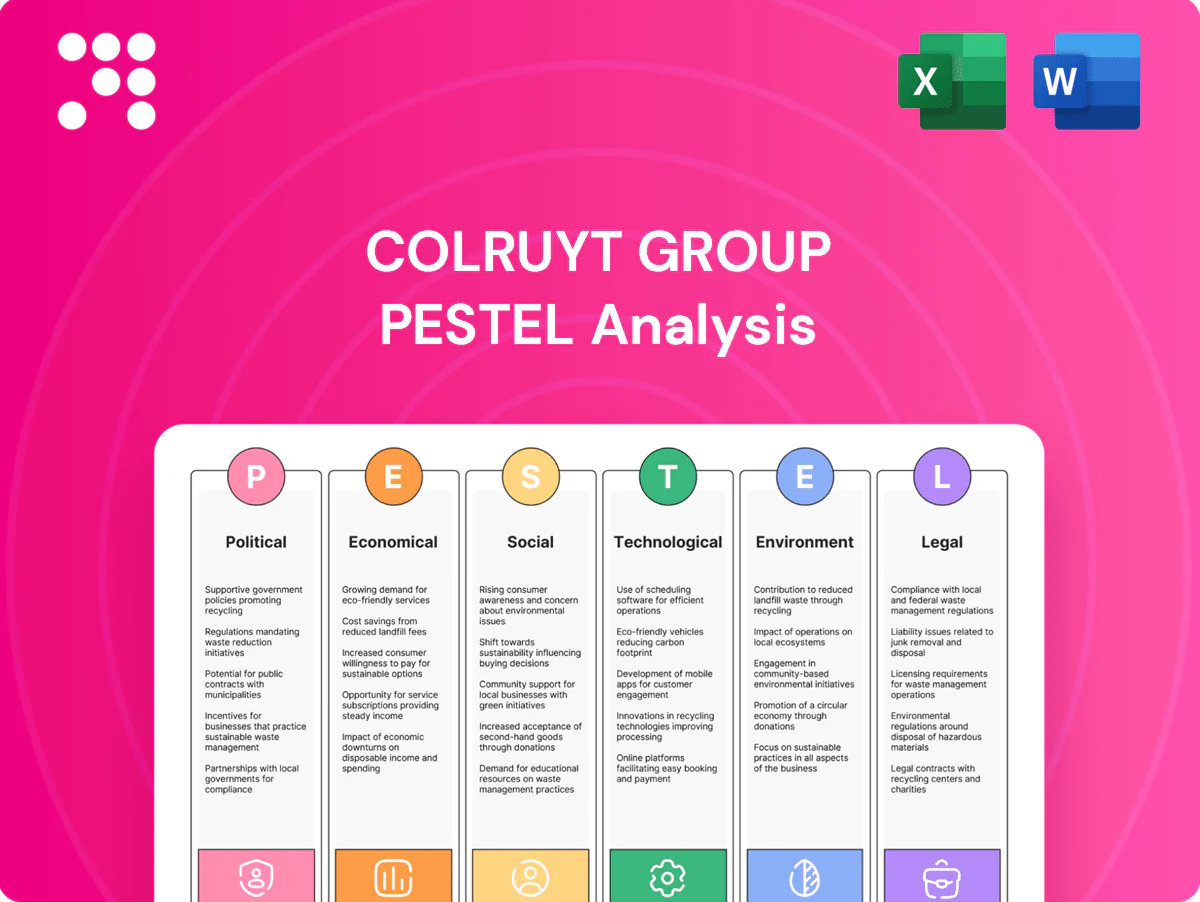
Colruyt Group PESTLE Analysis

Your Competitive Advantage Starts with This Report
Unearth how political shifts, economic trends, social behavior, technological change, legal pressures, and environmental forces shape Colruyt Group’s prospects in our concise PESTLE briefing—designed for investors and strategists. Buy the full analysis to access actionable insights, ready-made slides, and an editable report for immediate use.
Political factors

EU policy alignment
Operating across the EU single market (27 member states) binds Colruyt to harmonized sourcing, labeling and cross‑border logistics rules. CAP reform (EU CAP budget €386.6bn for 2021–27), Farm‑to‑Fork pesticide cut target of 50% by 2030 and Green Deal 55% GHG cut by 2030 raise supplier costs. EU renewables subsidies can aid Colruyt Energy, while changing trade or sanctions can disrupt specific import categories.
Belgium wage indexation politics
Debates over Belgium’s automatic wage indexation directly affect labor costs and pricing strategies, and changes to indexation caps or timing can shift operating margins materially; Colruyt Group, with about 30,000 employees and roughly €11bn+ annual sales (2024), must model upside/downside margin scenarios under differing coalition policies and maintain active communication with unions and stakeholders during any policy shifts.

Tax and fiscal stance
Changes to VAT on food (BE 6%, FR 5.5%, LU 3% on some staples), energy levies and corporate tax rates (roughly 25% across BE/FR/LU) directly affect Colruyt Group’s net pricing and margins. Fiscal consolidation in 2024–25 risks fewer retail-friendly reliefs and higher levies, pressuring volumes. Energy-efficiency and EV incentives (national grants reducing fleet capex) can cut payback times materially. Monitoring budget cycles in BE/FR/LU helps anticipate demand and cost shifts.

Local zoning and permits
Local zoning and permit regimes shape Colruyt Group's network growth: municipal policies on store openings, expansions and logistics hubs can delay projects by months and push the retailer toward smaller-city or urban formats; Colruyt employed about 34,000 people in 2024 and must balance expansion with political constraints. Streamlined permitting for rooftop PV and wind accelerates its energy initiatives, while proactive stakeholder engagement shortens timelines and reduces legal risk.
- municipal policy impacts store footprint and logistics siting
- political pushback limits out‑of‑town large projects
- faster PV/wind permits aid energy arm deployment
- stakeholder engagement de‑risks approval timelines
Food security and price controls
Under 2024–25 inflationary pressure governments have stepped up scrutiny of retail pricing, with France periodically urging price moderation on staples to shield households; such measures can compress Colruyt Group’s gross margins while supporting volume and market share. Maintaining availability during interventions requires coordinated supplier negotiations and temporary margin sacrifices to avoid stockouts and reputational damage.
- political: government price requests
- financial: margin compression vs volume protection
- operational: supplier coordination critical
EU CAP €386.6bn, 50% pesticide cut squeeze retailer margins
Operating in the EU single market ties Colruyt to harmonized rules; EU CAP €386.6bn (2021–27) and Farm‑to‑Fork 50% pesticide cut by 2030 raise supplier costs. Belgium wage indexation and periodic French price scrutiny can compress margins; Colruyt had ~€11bn sales and ~34,000 employees in 2024. VAT (BE 6% FR 5.5% LU 3%) and energy incentives materially affect net pricing and capex payback.
| Metric | Value |
|---|---|
| EU CAP (2021–27) | €386.6bn |
| Sales 2024 | €11bn+ |
| Employees 2024 | ~34,000 |
| VAT (food) | BE 6% / FR 5.5% / LU 3% |
What is included in the product
 Detailed Word Document
Explores how external macro-environmental factors uniquely affect Colruyt Group across Political, Economic, Social, Technological, Environmental and Legal dimensions; each section is data-driven, regionally grounded and offers forward-looking insights for scenario planning. Designed for executives, investors and advisors and delivered in a clean, ready-to-use format to identify threats, opportunities and strategic actions.

 Customizable Excel Spreadsheet
A concise, visually segmented PESTLE summary of Colruyt Group that simplifies external risk and market positioning for quick inclusion in presentations or strategy sessions, editable for regional or business-line notes and easily shareable across teams.
Economic factors

Consumer purchasing power
Persisting inflation—Euro area HICP fell to about 2.4% in 2024 while Belgium, France and Luxembourg saw higher volatility—has compressed real wages and prompted trading-down into lower-cost formats. Colruyt’s strong discount positioning and extensive private-label range capture share in downcycles, protecting margins and footfall. If pressure prolongs, baskets shift toward staples; recoveries reopen demand for premium fresh and convenience lines.
Energy and logistics costs
Volatile electricity, fuel and transport rates—with EU industrial electricity averaging ~€0.18/kWh in 2024 and diesel near €1.70/liter in Belgium—directly pressure Colruyt Group’s distribution margins and route efficiency. Colruyt’s growing on-site solar and wind portfolio and corporate renewables purchases reduce spot-market exposure and hedge part of energy cost volatility. Targeted efficiency programs in refrigeration, LED retrofits and dynamic routing cut energy and transport spend by mid-single digits annually. Long-term PPAs reported by the group help stabilize cost baselines and improve forward cash‑flow visibility.

FX and cross-border sourcing
EUR stability (average EUR/USD ~1.08 in 2024) supports Colruyt Group purchasing power, though a significant portion of non-food suppliers have non-EUR exposures, creating sensitivity to FX swings. Currency moves drive import cost volatility for electronics and textiles, impacting margins within the Group’s ~€11.8bn 2023/24 turnover. Active hedging, multi-sourcing and supplier contracts limit FX pass-through, while pricing agility ensures shelf prices remain competitive.

Labor market tightness
Low unemployment in Belgium (5.4% in 2024, Eurostat) and sectoral skill shortages push wages and hiring costs for Colruyt Group, which employs around 35,000 people (2024). Investment in automation and training can raise productivity per FTE, while competitive benefits improve retention in stores and DCs; collective agreements create structural cost floors.
- Belgium unemployment 5.4% (2024)
- Colruyt ~35,000 employees (2024)
- Automation + training = higher productivity/FTE
- Collective agreements = fixed labor cost floors
Competitive intensity
Competitive intensity for Colruyt Group is rising as hard discounters (Lidl, Aldi), e-commerce grocers and mass merchandisers compress prices and margins, forcing emphasis on scale and private labels to defend share. Promotional efficiency and data-driven assortment selection are key differentiators in retaining customers. Regional macro shifts can quickly accelerate market share movements.
- Hard discounters pressure pricing
- Scale & private labels defend margins
- Promotional efficiency matters
- Data-driven assortment differentiates
- Regional shifts accelerate share loss/gain
EU CAP €386.6bn, 50% pesticide cut squeeze retailer margins
Persisting Euro-area inflation ~2.4% (2024) compresses real wages; Colruyt’s discount/private-label mix protects share. Energy ~€0.18/kWh and diesel ~€1.70/L raise distribution costs; PPAs and onsite renewables hedge exposure. EUR/USD ~1.08 supports purchasing; turnover €11.8bn (2023/24) and ~35,000 employees expose wage pressure (Belgium unemployment 5.4%).
| Metric | Value (2024) |
|---|---|
| Inflation (EA HICP) | ~2.4% |
| Electricity | €0.18/kWh |
| Diesel (BE) | €1.70/L |
| Turnover | €11.8bn |
| Employees | ~35,000 |
| Belgium unemployment | 5.4% |
Full Version Awaits
Colruyt Group PESTLE Analysis
This Colruyt Group PESTLE Analysis preview is the exact document you’ll receive after purchase—fully formatted, professionally structured, and ready to use. The content, layout, and conclusions shown here match the final downloadable file with no placeholders or edits needed.

Original: $10.00
-65%$10.00
$3.50Product Information
Product Information
Shipping & Returns
Shipping & Returns
Description
Your Competitive Advantage Starts with This Report
Unearth how political shifts, economic trends, social behavior, technological change, legal pressures, and environmental forces shape Colruyt Group’s prospects in our concise PESTLE briefing—designed for investors and strategists. Buy the full analysis to access actionable insights, ready-made slides, and an editable report for immediate use.
Political factors
EU policy alignment
Operating across the EU single market (27 member states) binds Colruyt to harmonized sourcing, labeling and cross‑border logistics rules. CAP reform (EU CAP budget €386.6bn for 2021–27), Farm‑to‑Fork pesticide cut target of 50% by 2030 and Green Deal 55% GHG cut by 2030 raise supplier costs. EU renewables subsidies can aid Colruyt Energy, while changing trade or sanctions can disrupt specific import categories.
Belgium wage indexation politics
Debates over Belgium’s automatic wage indexation directly affect labor costs and pricing strategies, and changes to indexation caps or timing can shift operating margins materially; Colruyt Group, with about 30,000 employees and roughly €11bn+ annual sales (2024), must model upside/downside margin scenarios under differing coalition policies and maintain active communication with unions and stakeholders during any policy shifts.
Tax and fiscal stance
Changes to VAT on food (BE 6%, FR 5.5%, LU 3% on some staples), energy levies and corporate tax rates (roughly 25% across BE/FR/LU) directly affect Colruyt Group’s net pricing and margins. Fiscal consolidation in 2024–25 risks fewer retail-friendly reliefs and higher levies, pressuring volumes. Energy-efficiency and EV incentives (national grants reducing fleet capex) can cut payback times materially. Monitoring budget cycles in BE/FR/LU helps anticipate demand and cost shifts.
Local zoning and permits
Local zoning and permit regimes shape Colruyt Group's network growth: municipal policies on store openings, expansions and logistics hubs can delay projects by months and push the retailer toward smaller-city or urban formats; Colruyt employed about 34,000 people in 2024 and must balance expansion with political constraints. Streamlined permitting for rooftop PV and wind accelerates its energy initiatives, while proactive stakeholder engagement shortens timelines and reduces legal risk.
- municipal policy impacts store footprint and logistics siting
- political pushback limits out‑of‑town large projects
- faster PV/wind permits aid energy arm deployment
- stakeholder engagement de‑risks approval timelines
Food security and price controls
Under 2024–25 inflationary pressure governments have stepped up scrutiny of retail pricing, with France periodically urging price moderation on staples to shield households; such measures can compress Colruyt Group’s gross margins while supporting volume and market share. Maintaining availability during interventions requires coordinated supplier negotiations and temporary margin sacrifices to avoid stockouts and reputational damage.
- political: government price requests
- financial: margin compression vs volume protection
- operational: supplier coordination critical
EU CAP €386.6bn, 50% pesticide cut squeeze retailer margins
Operating in the EU single market ties Colruyt to harmonized rules; EU CAP €386.6bn (2021–27) and Farm‑to‑Fork 50% pesticide cut by 2030 raise supplier costs. Belgium wage indexation and periodic French price scrutiny can compress margins; Colruyt had ~€11bn sales and ~34,000 employees in 2024. VAT (BE 6% FR 5.5% LU 3%) and energy incentives materially affect net pricing and capex payback.
| Metric | Value |
|---|---|
| EU CAP (2021–27) | €386.6bn |
| Sales 2024 | €11bn+ |
| Employees 2024 | ~34,000 |
| VAT (food) | BE 6% / FR 5.5% / LU 3% |
What is included in the product
Detailed Word Document
Explores how external macro-environmental factors uniquely affect Colruyt Group across Political, Economic, Social, Technological, Environmental and Legal dimensions; each section is data-driven, regionally grounded and offers forward-looking insights for scenario planning. Designed for executives, investors and advisors and delivered in a clean, ready-to-use format to identify threats, opportunities and strategic actions.
Customizable Excel Spreadsheet
A concise, visually segmented PESTLE summary of Colruyt Group that simplifies external risk and market positioning for quick inclusion in presentations or strategy sessions, editable for regional or business-line notes and easily shareable across teams.
Economic factors
Consumer purchasing power
Persisting inflation—Euro area HICP fell to about 2.4% in 2024 while Belgium, France and Luxembourg saw higher volatility—has compressed real wages and prompted trading-down into lower-cost formats. Colruyt’s strong discount positioning and extensive private-label range capture share in downcycles, protecting margins and footfall. If pressure prolongs, baskets shift toward staples; recoveries reopen demand for premium fresh and convenience lines.
Energy and logistics costs
Volatile electricity, fuel and transport rates—with EU industrial electricity averaging ~€0.18/kWh in 2024 and diesel near €1.70/liter in Belgium—directly pressure Colruyt Group’s distribution margins and route efficiency. Colruyt’s growing on-site solar and wind portfolio and corporate renewables purchases reduce spot-market exposure and hedge part of energy cost volatility. Targeted efficiency programs in refrigeration, LED retrofits and dynamic routing cut energy and transport spend by mid-single digits annually. Long-term PPAs reported by the group help stabilize cost baselines and improve forward cash‑flow visibility.
FX and cross-border sourcing
EUR stability (average EUR/USD ~1.08 in 2024) supports Colruyt Group purchasing power, though a significant portion of non-food suppliers have non-EUR exposures, creating sensitivity to FX swings. Currency moves drive import cost volatility for electronics and textiles, impacting margins within the Group’s ~€11.8bn 2023/24 turnover. Active hedging, multi-sourcing and supplier contracts limit FX pass-through, while pricing agility ensures shelf prices remain competitive.
Labor market tightness
Low unemployment in Belgium (5.4% in 2024, Eurostat) and sectoral skill shortages push wages and hiring costs for Colruyt Group, which employs around 35,000 people (2024). Investment in automation and training can raise productivity per FTE, while competitive benefits improve retention in stores and DCs; collective agreements create structural cost floors.
- Belgium unemployment 5.4% (2024)
- Colruyt ~35,000 employees (2024)
- Automation + training = higher productivity/FTE
- Collective agreements = fixed labor cost floors
Competitive intensity
Competitive intensity for Colruyt Group is rising as hard discounters (Lidl, Aldi), e-commerce grocers and mass merchandisers compress prices and margins, forcing emphasis on scale and private labels to defend share. Promotional efficiency and data-driven assortment selection are key differentiators in retaining customers. Regional macro shifts can quickly accelerate market share movements.
- Hard discounters pressure pricing
- Scale & private labels defend margins
- Promotional efficiency matters
- Data-driven assortment differentiates
- Regional shifts accelerate share loss/gain
EU CAP €386.6bn, 50% pesticide cut squeeze retailer margins
Persisting Euro-area inflation ~2.4% (2024) compresses real wages; Colruyt’s discount/private-label mix protects share. Energy ~€0.18/kWh and diesel ~€1.70/L raise distribution costs; PPAs and onsite renewables hedge exposure. EUR/USD ~1.08 supports purchasing; turnover €11.8bn (2023/24) and ~35,000 employees expose wage pressure (Belgium unemployment 5.4%).
| Metric | Value (2024) |
|---|---|
| Inflation (EA HICP) | ~2.4% |
| Electricity | €0.18/kWh |
| Diesel (BE) | €1.70/L |
| Turnover | €11.8bn |
| Employees | ~35,000 |
| Belgium unemployment | 5.4% |
Full Version Awaits
Colruyt Group PESTLE Analysis
This Colruyt Group PESTLE Analysis preview is the exact document you’ll receive after purchase—fully formatted, professionally structured, and ready to use. The content, layout, and conclusions shown here match the final downloadable file with no placeholders or edits needed.