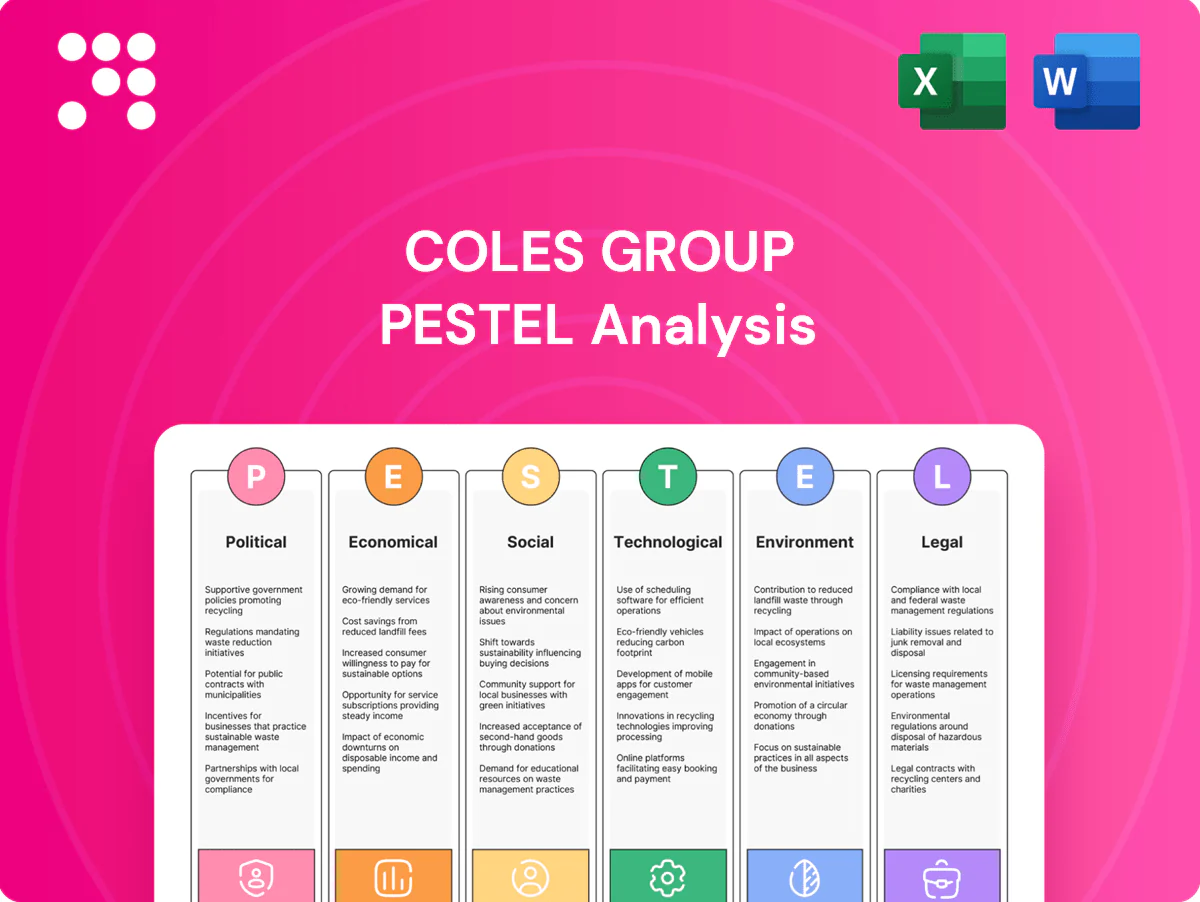
Coles Group PESTLE Analysis

Plan Smarter. Present Sharper. Compete Stronger.
Gain a competitive edge with our PESTLE Analysis of Coles Group. Uncover how political, economic, social, technological, legal and environmental forces shape strategy, risk and growth opportunities. Ideal for investors and strategists—purchase the full report for deep, actionable insights.
Political factors

Food security policy
Australian governments prioritize domestic food security, shaping agricultural support and retailer-supplier dynamics. Policy shifts on export controls or biosecurity can quickly affect availability and pricing, forcing retailers to adapt sourcing and contingency plans. Coles must align sourcing with national resilience goals and deepen engagement in farmer programs and regional development grants to mitigate volatility; Australia population 26.1 million (ABS mid-2024).
Competition scrutiny
Heightened political focus on supermarket pricing places Coles under sustained parliamentary and ACCC scrutiny, especially after 2023–24 grocery market reviews; Coles and Woolworths together hold c.65% of the national grocery market. Inquiries have pushed for greater pricing transparency and tighter voluntary codes since 2023, which can restrict margin flexibility on staples. Political pressure limits pricing power on low-margin essentials, while proactive disclosure and supplier-fairness programs reduce reputational and regulatory risk.

Alcohol policy direction
Public health agendas increasingly shape licensing conditions, trading hours and density caps, influencing Coles Group's 1,300+ liquor outlets and expansion plans. Political shifts at state and local levels can tighten rules, slowing store roll-out and raising compliance work. Higher compliance requirements raise operating costs and delay openings. Responsible retailing and community engagement help reduce policy backlash and regulatory scrutiny.

Industrial relations stance
Government positions on wage floors and bargaining — e.g. national minimum wage $23.23/hr from 1 Jul 2024 — and rules on casualisation directly affect Coles’s labour cost for ~118,000 employees; retail awards and rostering can shift with political cycles. Coles needs flexible workforce planning, productivity programs, union collaboration and targeted training to protect margins and continuity.
- Wage floor exposure: $23.23/hr (1 Jul 2024)
- Workforce size: ~118,000 employees
- Mitigants: rostering flexibility, productivity, union engagement, training
Infrastructure and regional investment
Budget priorities for roads, ports and cold-chain corridors directly affect Coles logistics efficiency, with freight link upgrades reducing last-mile costs and shrinkage; Coles reported group retail sales of about AUD 44 billion in FY24, amplifying the value of lower transport unit costs.
Regional funding shapes store viability in growth corridors; co-locating distribution centres with upgraded freight links supports inventory velocity and fresher produce, and Coles' advocacy engages state and federal planners to reflect network needs in public works.
- Roads/ports/cold-chain: affect transport unit costs and freshness
- Regional funding: determines store openings in growth corridors
- DC co-location: boosts inventory velocity and reduces spoilage
- Advocacy: aligns public works with Coles' network requirements
Regulatory, wage and market pressures hit major grocer; min wage $23.23/hr
Political risks shape Coles via food-security policy, ACCC/grocery scrutiny and state liquor/trading rules, while wage and labour law shifts (minimum wage $23.23/hr from 1 Jul 2024) and infrastructure funding affect costs and store rollout; market concentration ~65%, workforce ~118,000, FY24 retail sales ~AUD44bn.
| Indicator | Value |
|---|---|
| Min wage | $23.23/hr (1 Jul 2024) |
| Workforce | ~118,000 |
| Market share | c.65% |
| FY24 sales | AUD44bn |
What is included in the product
 Detailed Word Document
Explores how external macro-environmental factors uniquely affect the Coles Group across Political, Economic, Social, Technological, Environmental and Legal dimensions; each section is data-backed, region-specific and forward-looking to help executives, investors and strategists identify risks, opportunities and scenario actions.

 Customizable Excel Spreadsheet
Visually segmented by PESTLE categories for quick at-a-glance interpretation, this Coles Group summary is easily droppable into presentations or planning sessions and ideal for rapid alignment across teams.
Economic factors

Inflation and food prices
Volatile input costs from commodities, energy and packaging continue to pass through to shelf prices, pressuring margins and pricing decisions. Shoppers trade down to private label when inflation bites, with private-label penetration in Australian supermarkets around 25% (2024). Coles must balance price leadership with margin protection; promotional cadence and supplier negotiations are critical levers to manage cost volatility.
Consumer demand cycles
Disposable income and wage growth — with Australian wage price index rising around 4% year‑on‑year to early 2025 and unemployment near 3.9% — directly shape Coles shoppers’ basket size and mix. Economic slowdowns push spend toward essentials and value tiers, reducing spend in premium and discretionary categories which become more price‑elastic. Coles’ loyalty offers and everyday low price strategy help defend share by retaining price‑sensitive customers.

Interest rates impact
Rising RBA cash rate (4.35% at May 2024) increases mortgage stress, reducing discretionary retail spending and dampening large baskets and online add‑ons. Higher rates also raise financing costs for inventory and capex, squeezing margins. Coles has emphasized working capital discipline and targeted investments, maintaining FY24 capex guidance of about A$1.2bn to prioritise essentials and efficiency.

FX and import exposure
AUD movements materially affect Coles landed costs for imported groceries, liquor and equipment; with the AUD averaging around 0.66 USD in 2024, weaker currency raised import bills and margin pressure. Hedging programmes smooth near-term volatility but cannot offset prolonged structural shifts, forcing category pricing and assortment rebalancing to protect margins. Local sourcing programs reduce currency exposure and stabilize input costs.
- FX exposure: imported groceries, liquor, equipment
- Hedging: short-term smoothing, not structural fixes
- Response: pricing, assortment rebalance
- Mitigation: local sourcing reduces currency risk
Fuel and freight costs
Diesel and ocean freight price moves feed directly into Coles distribution and last-mile economics, with diesel-related transport costs reportedly up ~15% year-on-year through 2023–24, squeezing online delivery margins and contributing to higher cost-to-serve for Click&Collect and home delivery channels.
- Network optimisation and pilot use of low-emission vehicles offset volatility
- Delivery fees and dynamic slot management protect unit economics
- Spike risks remain tied to diesel and global shipping rate swings
Regulatory, wage and market pressures hit major grocer; min wage $23.23/hr
Commodity, energy and packaging cost volatility (diesel transport +15% YoY 2023–24) pressures margins, driving promotional cadence and supplier negotiation. Wage Price Index ~4% YoY (early 2025) and unemployment ~3.9% shift spend to essentials; private‑label penetration ~25% (2024). RBA cash rate 4.35% (May 2024) and AUD ~0.66 USD (2024) raise financing and import costs, capex ~A$1.2bn FY24.
| Metric | Value |
|---|---|
| Private label | ~25% (2024) |
| WPI | ~4% YoY (early 2025) |
| Unemployment | ~3.9% |
| RBA cash rate | 4.35% (May 2024) |
| AUD/USD | ~0.66 (2024) |
| Diesel transport | +15% YoY (2023–24) |
| Capex | A$1.2bn FY24 |
What You See Is What You Get
Coles Group PESTLE Analysis
The preview shown here is the exact Coles Group PESTLE Analysis you’ll receive after purchase—fully formatted and ready to use. It covers political, economic, social, technological, legal and environmental factors with concise insights and practical implications. The layout, content, and structure visible here are exactly what you’ll download immediately after payment.

Original: $10.00
-65%$10.00
$3.50Product Information
Product Information
Shipping & Returns
Shipping & Returns
Description
Plan Smarter. Present Sharper. Compete Stronger.
Gain a competitive edge with our PESTLE Analysis of Coles Group. Uncover how political, economic, social, technological, legal and environmental forces shape strategy, risk and growth opportunities. Ideal for investors and strategists—purchase the full report for deep, actionable insights.
Political factors
Food security policy
Australian governments prioritize domestic food security, shaping agricultural support and retailer-supplier dynamics. Policy shifts on export controls or biosecurity can quickly affect availability and pricing, forcing retailers to adapt sourcing and contingency plans. Coles must align sourcing with national resilience goals and deepen engagement in farmer programs and regional development grants to mitigate volatility; Australia population 26.1 million (ABS mid-2024).
Competition scrutiny
Heightened political focus on supermarket pricing places Coles under sustained parliamentary and ACCC scrutiny, especially after 2023–24 grocery market reviews; Coles and Woolworths together hold c.65% of the national grocery market. Inquiries have pushed for greater pricing transparency and tighter voluntary codes since 2023, which can restrict margin flexibility on staples. Political pressure limits pricing power on low-margin essentials, while proactive disclosure and supplier-fairness programs reduce reputational and regulatory risk.
Alcohol policy direction
Public health agendas increasingly shape licensing conditions, trading hours and density caps, influencing Coles Group's 1,300+ liquor outlets and expansion plans. Political shifts at state and local levels can tighten rules, slowing store roll-out and raising compliance work. Higher compliance requirements raise operating costs and delay openings. Responsible retailing and community engagement help reduce policy backlash and regulatory scrutiny.
Industrial relations stance
Government positions on wage floors and bargaining — e.g. national minimum wage $23.23/hr from 1 Jul 2024 — and rules on casualisation directly affect Coles’s labour cost for ~118,000 employees; retail awards and rostering can shift with political cycles. Coles needs flexible workforce planning, productivity programs, union collaboration and targeted training to protect margins and continuity.
- Wage floor exposure: $23.23/hr (1 Jul 2024)
- Workforce size: ~118,000 employees
- Mitigants: rostering flexibility, productivity, union engagement, training
Infrastructure and regional investment
Budget priorities for roads, ports and cold-chain corridors directly affect Coles logistics efficiency, with freight link upgrades reducing last-mile costs and shrinkage; Coles reported group retail sales of about AUD 44 billion in FY24, amplifying the value of lower transport unit costs.
Regional funding shapes store viability in growth corridors; co-locating distribution centres with upgraded freight links supports inventory velocity and fresher produce, and Coles' advocacy engages state and federal planners to reflect network needs in public works.
- Roads/ports/cold-chain: affect transport unit costs and freshness
- Regional funding: determines store openings in growth corridors
- DC co-location: boosts inventory velocity and reduces spoilage
- Advocacy: aligns public works with Coles' network requirements
Regulatory, wage and market pressures hit major grocer; min wage $23.23/hr
Political risks shape Coles via food-security policy, ACCC/grocery scrutiny and state liquor/trading rules, while wage and labour law shifts (minimum wage $23.23/hr from 1 Jul 2024) and infrastructure funding affect costs and store rollout; market concentration ~65%, workforce ~118,000, FY24 retail sales ~AUD44bn.
| Indicator | Value |
|---|---|
| Min wage | $23.23/hr (1 Jul 2024) |
| Workforce | ~118,000 |
| Market share | c.65% |
| FY24 sales | AUD44bn |
What is included in the product
Detailed Word Document
Explores how external macro-environmental factors uniquely affect the Coles Group across Political, Economic, Social, Technological, Environmental and Legal dimensions; each section is data-backed, region-specific and forward-looking to help executives, investors and strategists identify risks, opportunities and scenario actions.
Customizable Excel Spreadsheet
Visually segmented by PESTLE categories for quick at-a-glance interpretation, this Coles Group summary is easily droppable into presentations or planning sessions and ideal for rapid alignment across teams.
Economic factors
Inflation and food prices
Volatile input costs from commodities, energy and packaging continue to pass through to shelf prices, pressuring margins and pricing decisions. Shoppers trade down to private label when inflation bites, with private-label penetration in Australian supermarkets around 25% (2024). Coles must balance price leadership with margin protection; promotional cadence and supplier negotiations are critical levers to manage cost volatility.
Consumer demand cycles
Disposable income and wage growth — with Australian wage price index rising around 4% year‑on‑year to early 2025 and unemployment near 3.9% — directly shape Coles shoppers’ basket size and mix. Economic slowdowns push spend toward essentials and value tiers, reducing spend in premium and discretionary categories which become more price‑elastic. Coles’ loyalty offers and everyday low price strategy help defend share by retaining price‑sensitive customers.
Interest rates impact
Rising RBA cash rate (4.35% at May 2024) increases mortgage stress, reducing discretionary retail spending and dampening large baskets and online add‑ons. Higher rates also raise financing costs for inventory and capex, squeezing margins. Coles has emphasized working capital discipline and targeted investments, maintaining FY24 capex guidance of about A$1.2bn to prioritise essentials and efficiency.
FX and import exposure
AUD movements materially affect Coles landed costs for imported groceries, liquor and equipment; with the AUD averaging around 0.66 USD in 2024, weaker currency raised import bills and margin pressure. Hedging programmes smooth near-term volatility but cannot offset prolonged structural shifts, forcing category pricing and assortment rebalancing to protect margins. Local sourcing programs reduce currency exposure and stabilize input costs.
- FX exposure: imported groceries, liquor, equipment
- Hedging: short-term smoothing, not structural fixes
- Response: pricing, assortment rebalance
- Mitigation: local sourcing reduces currency risk
Fuel and freight costs
Diesel and ocean freight price moves feed directly into Coles distribution and last-mile economics, with diesel-related transport costs reportedly up ~15% year-on-year through 2023–24, squeezing online delivery margins and contributing to higher cost-to-serve for Click&Collect and home delivery channels.
- Network optimisation and pilot use of low-emission vehicles offset volatility
- Delivery fees and dynamic slot management protect unit economics
- Spike risks remain tied to diesel and global shipping rate swings
Regulatory, wage and market pressures hit major grocer; min wage $23.23/hr
Commodity, energy and packaging cost volatility (diesel transport +15% YoY 2023–24) pressures margins, driving promotional cadence and supplier negotiation. Wage Price Index ~4% YoY (early 2025) and unemployment ~3.9% shift spend to essentials; private‑label penetration ~25% (2024). RBA cash rate 4.35% (May 2024) and AUD ~0.66 USD (2024) raise financing and import costs, capex ~A$1.2bn FY24.
| Metric | Value |
|---|---|
| Private label | ~25% (2024) |
| WPI | ~4% YoY (early 2025) |
| Unemployment | ~3.9% |
| RBA cash rate | 4.35% (May 2024) |
| AUD/USD | ~0.66 (2024) |
| Diesel transport | +15% YoY (2023–24) |
| Capex | A$1.2bn FY24 |
What You See Is What You Get
Coles Group PESTLE Analysis
The preview shown here is the exact Coles Group PESTLE Analysis you’ll receive after purchase—fully formatted and ready to use. It covers political, economic, social, technological, legal and environmental factors with concise insights and practical implications. The layout, content, and structure visible here are exactly what you’ll download immediately after payment.