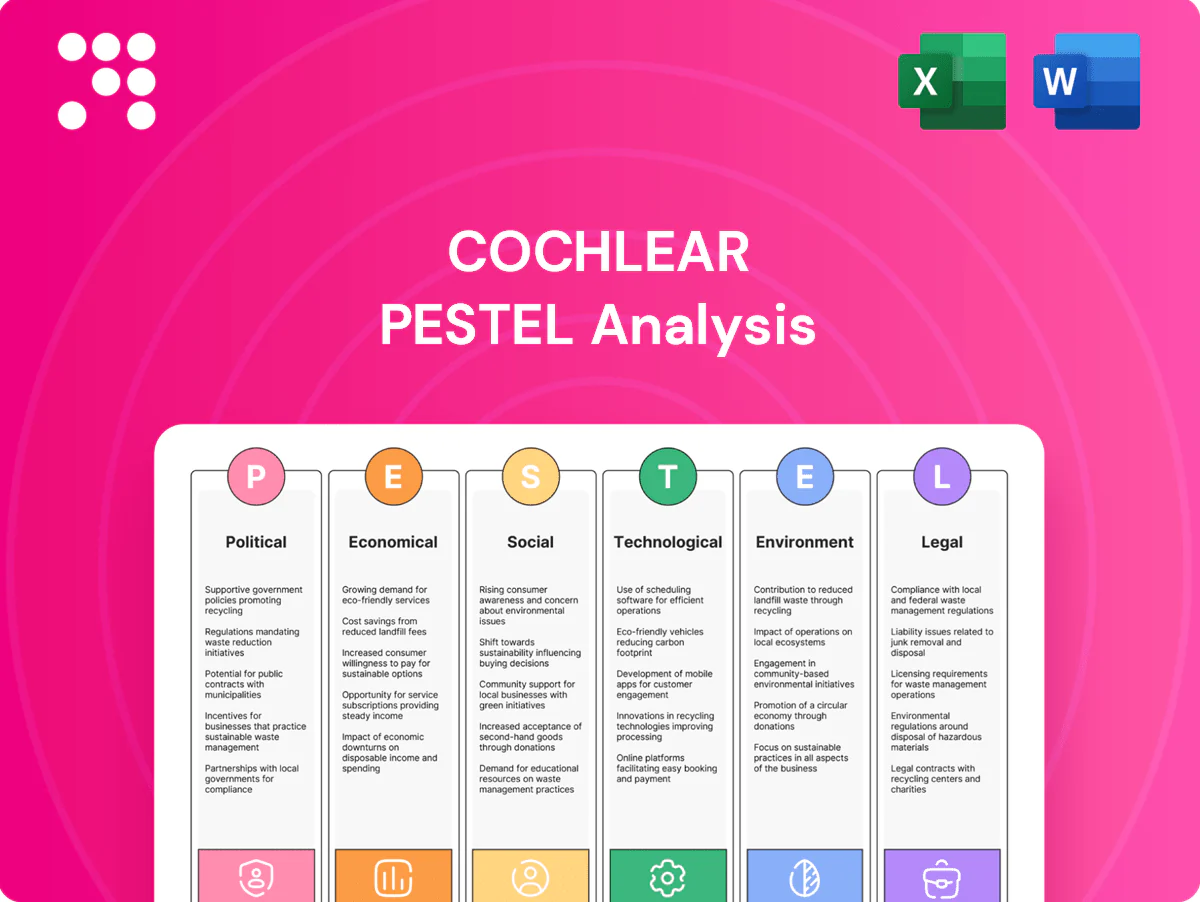
Cochlear PESTLE Analysis

Skip the Research. Get the Strategy.
Discover how political, economic, social, technological, legal, and environmental forces are reshaping Cochlear’s market position and growth prospects in our concise PESTLE snapshot. This analysis highlights regulatory risks, innovation drivers, and demographic trends that matter to investors and strategists. Buy the full PESTLE for a detailed, ready-to-use report you can deploy in strategy, due diligence, or investor decks.
Political factors

Healthcare funding priorities
Government budgets and public health priorities—with US Medicare/Medicaid making up roughly 40% of US health spending and the UK NHS budget around £191bn in 2024/25—directly shape reimbursement and cochlear implant adoption rates. Shifts in Medicare/Medicaid or national insurance allocations can swing procedure volumes year-on-year, while election cycles and coalition changes often reallocate funds from elective to essential care. Strong advocacy and real-world evidence generation have driven expanded coverage and higher reimbursement levels in several markets.
Trade policy and supply chain geopolitics
Tariffs, export controls and geopolitical tensions raise component costs and extend lead times for Cochlear’s globally sourced parts, pressuring margins and scheduling; customs rules-of-origin and delays directly affect implant-kit inventory planning. Diversifying suppliers across regions mitigates single-country risk, while strategic inventory buffers and regional assembly hubs improve resilience and shorten replenishment cycles.

Public procurement and tendering
Many countries run centralized tenders with price-volume terms and multi-year contracts (typically 3–5 years), with public procurement accounting for >50% of implant volumes in several EU and APAC markets. Tender criteria now overweight outcomes data and total cost of care, and win/loss outcomes drive step-changes in market share across contract cycles; strong post-market evidence and service models materially enhance tender competitiveness.

Regulatory harmonization and standards
Alignment across FDA, EU MDR, TGA, NMPA and PMDA materially affects Cochlear’s time-to-market; review windows range from ~6 months for expedited FDA pathways to >12 months in some PMDA/NMPA cases, while EU MDR notified-body backlogs have added 6–18 month delays. Divergent clinical evidence raises multi-jurisdiction trial costs roughly 30–50%. Participation in ISO/IEC bodies steers interoperability and safety norms; early regulator engagement cuts approval uncertainty.
- Review variability: ~6–18+ months
- Trial cost uplift: ~30–50%
- EU MDR backlog: +6–18 months
- Standards influence: ISO/IEC, IMDRF
- Mitigation: early regulator engagement
Political stability and currency regimes
Political instability can disrupt hospital operations and postpone elective cochlear implant surgeries, undermining demand in affected markets; Cochlear operates in over 100 countries, increasing exposure. Capital controls and sudden currency devaluations reduce affordability of imported devices, pressuring volumes. Multi-currency pricing and hedging strategies help protect margins, while local partnerships and manufacturing agreements preserve supply and continuity during policy shifts.
- Exposure: over 100 countries
- Risk: elective surgery delays reduce near-term demand
- Mitigation: multi-currency pricing & hedging
- Continuity: local partnerships stabilize access
Public budgets (~40% US), tenders and regulatory delays hit medtech access
Government budgets (US Medicare/Medicaid ~40% of US health spend; UK NHS £191bn 2024/25), centralized tenders (>50% implant volumes in many EU/APAC markets) and regulatory timelines (review variability ~6–18+ months; EU MDR backlog +6–18 months) drive reimbursement, procurement wins and time-to-market; supply-chain controls and political instability across 100+ countries raise cost and access risks.
| Metric | Value |
|---|---|
| US public pay share | ~40% |
| UK NHS budget | £191bn (2024/25) |
| Centralized tenders | >50% volumes |
| Reg review delay | 6–18+ months |
What is included in the product
 Detailed Word Document
Explores how macro-environmental factors uniquely affect Cochlear across Political, Economic, Social, Technological, Environmental and Legal dimensions, with data-backed trends and region-specific regulatory context; designed to help executives, consultants and investors identify threats, opportunities and actionable scenarios for strategic planning.

 Customizable Excel Spreadsheet
Concise, visually segmented PESTLE summary for Cochlear that clarifies external risks and opportunities at a glance, is easily dropped into presentations, and can be annotated or shared for quick alignment across teams.
Economic factors

Macroeconomic cycles and elective procedure demand
Recessions reduce hospital capital spending and patient willingness for elective cochlear implantation; IMF data showed global growth slowed to about 3.0% in 2024, weighing on discretionary procedures and device capital budgets.
Stimulus and recovery phases release deferred demand—hospitals report surges in elective referrals post-recovery, with some systems seeing 10–25% rebounds in waitlist activity in 2023–24.
Despite high clinical utility of cochlear implants, timing remains sensitive to economic confidence; payor approval and out-of-pocket decisions shift with household real disposable income.
Backlogs created during downturns require capacity planning—surgical centers must scale OR time and audiology support to capture rebounds and protect FY revenue forecasts.
Reimbursement rates and pricing pressure
Payers’ cost-containment pushes lower device prices and bundled payments; Medicare Part B and many insurers cover cochlear implants but negotiate rates. Hearing aids typically cost USD 1,000–6,000 per ear while total US cochlear implant costs often range USD 30,000–60,000, supporting lifetime-value arguments. Value-based contracts linking payment to outcomes and adherence are emerging, and tiered portfolios address varied price points.

FX volatility and global revenue mix
Cochlear's global sales exposure—about 80% of revenue generated outside Australia—leaves earnings sensitive to AUD swings against USD, EUR and CNY, with FX movements materially affecting reported results.
Management cites active hedging and natural offsets (local costs and pricing) to dampen volatility, typically hedging a significant portion of near-term receivables to smooth cash flow.
Pricing corridors must balance competitive market access and selective FX pass-through to protect margins without risking market share; constant-currency reporting in annual results and investor updates enhances transparency for analysts.

Demographic growth in addressable market
Aging populations and expanded screening increase Cochlear’s addressable pool: WHO estimated 430 million people with disabling hearing loss in 2021 and the UN projects people aged 65+ will reach about 16% of global population by 2050, expanding implant candidacy; penetration remains under 10% of eligible patients, while emerging-market income gains and stronger referral/education networks unlock latent first-time demand.
- WHO 2021: 430 million with disabling hearing loss
- UN: 65+ ≈16% by 2050
- Implant penetration <10% of eligible
- Emerging markets + referral networks = growth runway
Input costs and manufacturing efficiency
Input costs for silicon, rare metals and electronics materially affect Cochlear's COGS; semiconductor and commodity pressure created cost headwinds even as shortages eased. Lean operations and automation investments helped preserve gross margin near 70% after FY2024 revenue of ~AUD1.75bn. Dual-sourcing critical components reduced production disruption risk. An installed base above 600,000 implants yields scale economies, lowering per-unit service costs.
- COGS drivers: silicon, rare metals, electronics
- Margins: ~70% (FY2024)
- Mitigation: lean ops, automation, dual-sourcing
- Scale: >600,000 installed base reduces service cost/unit
Public budgets (~40% US), tenders and regulatory delays hit medtech access
Global growth slowed to ~3.0% in 2024, pressuring elective implant demand; Cochlear's FY2024 revenue ~AUD1.75bn with gross margin ~70% reflects margin resilience despite input-cost pressure. ~80% revenue outside Australia creates FX sensitivity; installed base >600,000 and <10% penetration imply long-term upside.
| Metric | Value |
|---|---|
| Global growth (IMF 2024) | ~3.0% |
| FY2024 revenue | AUD1.75bn |
| Gross margin | ~70% |
| Revenue ex-Australia | ~80% |
| Installed base | >600,000 |
Preview the Actual Deliverable
Cochlear PESTLE Analysis
The preview shown here is the exact Cochlear PESTLE Analysis you’ll receive after purchase—fully formatted and ready to use. The content and structure visible are the final document you’ll download immediately after payment, with no placeholders or surprises. Use it straightaway for strategy, market insight, or presentation.

Product Information
Product Information
Shipping & Returns
Shipping & Returns
Description
Skip the Research. Get the Strategy.
Discover how political, economic, social, technological, legal, and environmental forces are reshaping Cochlear’s market position and growth prospects in our concise PESTLE snapshot. This analysis highlights regulatory risks, innovation drivers, and demographic trends that matter to investors and strategists. Buy the full PESTLE for a detailed, ready-to-use report you can deploy in strategy, due diligence, or investor decks.
Political factors
Healthcare funding priorities
Government budgets and public health priorities—with US Medicare/Medicaid making up roughly 40% of US health spending and the UK NHS budget around £191bn in 2024/25—directly shape reimbursement and cochlear implant adoption rates. Shifts in Medicare/Medicaid or national insurance allocations can swing procedure volumes year-on-year, while election cycles and coalition changes often reallocate funds from elective to essential care. Strong advocacy and real-world evidence generation have driven expanded coverage and higher reimbursement levels in several markets.
Trade policy and supply chain geopolitics
Tariffs, export controls and geopolitical tensions raise component costs and extend lead times for Cochlear’s globally sourced parts, pressuring margins and scheduling; customs rules-of-origin and delays directly affect implant-kit inventory planning. Diversifying suppliers across regions mitigates single-country risk, while strategic inventory buffers and regional assembly hubs improve resilience and shorten replenishment cycles.
Public procurement and tendering
Many countries run centralized tenders with price-volume terms and multi-year contracts (typically 3–5 years), with public procurement accounting for >50% of implant volumes in several EU and APAC markets. Tender criteria now overweight outcomes data and total cost of care, and win/loss outcomes drive step-changes in market share across contract cycles; strong post-market evidence and service models materially enhance tender competitiveness.
Regulatory harmonization and standards
Alignment across FDA, EU MDR, TGA, NMPA and PMDA materially affects Cochlear’s time-to-market; review windows range from ~6 months for expedited FDA pathways to >12 months in some PMDA/NMPA cases, while EU MDR notified-body backlogs have added 6–18 month delays. Divergent clinical evidence raises multi-jurisdiction trial costs roughly 30–50%. Participation in ISO/IEC bodies steers interoperability and safety norms; early regulator engagement cuts approval uncertainty.
- Review variability: ~6–18+ months
- Trial cost uplift: ~30–50%
- EU MDR backlog: +6–18 months
- Standards influence: ISO/IEC, IMDRF
- Mitigation: early regulator engagement
Political stability and currency regimes
Political instability can disrupt hospital operations and postpone elective cochlear implant surgeries, undermining demand in affected markets; Cochlear operates in over 100 countries, increasing exposure. Capital controls and sudden currency devaluations reduce affordability of imported devices, pressuring volumes. Multi-currency pricing and hedging strategies help protect margins, while local partnerships and manufacturing agreements preserve supply and continuity during policy shifts.
- Exposure: over 100 countries
- Risk: elective surgery delays reduce near-term demand
- Mitigation: multi-currency pricing & hedging
- Continuity: local partnerships stabilize access
Public budgets (~40% US), tenders and regulatory delays hit medtech access
Government budgets (US Medicare/Medicaid ~40% of US health spend; UK NHS £191bn 2024/25), centralized tenders (>50% implant volumes in many EU/APAC markets) and regulatory timelines (review variability ~6–18+ months; EU MDR backlog +6–18 months) drive reimbursement, procurement wins and time-to-market; supply-chain controls and political instability across 100+ countries raise cost and access risks.
| Metric | Value |
|---|---|
| US public pay share | ~40% |
| UK NHS budget | £191bn (2024/25) |
| Centralized tenders | >50% volumes |
| Reg review delay | 6–18+ months |
What is included in the product
Detailed Word Document
Explores how macro-environmental factors uniquely affect Cochlear across Political, Economic, Social, Technological, Environmental and Legal dimensions, with data-backed trends and region-specific regulatory context; designed to help executives, consultants and investors identify threats, opportunities and actionable scenarios for strategic planning.
Customizable Excel Spreadsheet
Concise, visually segmented PESTLE summary for Cochlear that clarifies external risks and opportunities at a glance, is easily dropped into presentations, and can be annotated or shared for quick alignment across teams.
Economic factors
Macroeconomic cycles and elective procedure demand
Recessions reduce hospital capital spending and patient willingness for elective cochlear implantation; IMF data showed global growth slowed to about 3.0% in 2024, weighing on discretionary procedures and device capital budgets.
Stimulus and recovery phases release deferred demand—hospitals report surges in elective referrals post-recovery, with some systems seeing 10–25% rebounds in waitlist activity in 2023–24.
Despite high clinical utility of cochlear implants, timing remains sensitive to economic confidence; payor approval and out-of-pocket decisions shift with household real disposable income.
Backlogs created during downturns require capacity planning—surgical centers must scale OR time and audiology support to capture rebounds and protect FY revenue forecasts.
Reimbursement rates and pricing pressure
Payers’ cost-containment pushes lower device prices and bundled payments; Medicare Part B and many insurers cover cochlear implants but negotiate rates. Hearing aids typically cost USD 1,000–6,000 per ear while total US cochlear implant costs often range USD 30,000–60,000, supporting lifetime-value arguments. Value-based contracts linking payment to outcomes and adherence are emerging, and tiered portfolios address varied price points.
FX volatility and global revenue mix
Cochlear's global sales exposure—about 80% of revenue generated outside Australia—leaves earnings sensitive to AUD swings against USD, EUR and CNY, with FX movements materially affecting reported results.
Management cites active hedging and natural offsets (local costs and pricing) to dampen volatility, typically hedging a significant portion of near-term receivables to smooth cash flow.
Pricing corridors must balance competitive market access and selective FX pass-through to protect margins without risking market share; constant-currency reporting in annual results and investor updates enhances transparency for analysts.
Demographic growth in addressable market
Aging populations and expanded screening increase Cochlear’s addressable pool: WHO estimated 430 million people with disabling hearing loss in 2021 and the UN projects people aged 65+ will reach about 16% of global population by 2050, expanding implant candidacy; penetration remains under 10% of eligible patients, while emerging-market income gains and stronger referral/education networks unlock latent first-time demand.
- WHO 2021: 430 million with disabling hearing loss
- UN: 65+ ≈16% by 2050
- Implant penetration <10% of eligible
- Emerging markets + referral networks = growth runway
Input costs and manufacturing efficiency
Input costs for silicon, rare metals and electronics materially affect Cochlear's COGS; semiconductor and commodity pressure created cost headwinds even as shortages eased. Lean operations and automation investments helped preserve gross margin near 70% after FY2024 revenue of ~AUD1.75bn. Dual-sourcing critical components reduced production disruption risk. An installed base above 600,000 implants yields scale economies, lowering per-unit service costs.
- COGS drivers: silicon, rare metals, electronics
- Margins: ~70% (FY2024)
- Mitigation: lean ops, automation, dual-sourcing
- Scale: >600,000 installed base reduces service cost/unit
Public budgets (~40% US), tenders and regulatory delays hit medtech access
Global growth slowed to ~3.0% in 2024, pressuring elective implant demand; Cochlear's FY2024 revenue ~AUD1.75bn with gross margin ~70% reflects margin resilience despite input-cost pressure. ~80% revenue outside Australia creates FX sensitivity; installed base >600,000 and <10% penetration imply long-term upside.
| Metric | Value |
|---|---|
| Global growth (IMF 2024) | ~3.0% |
| FY2024 revenue | AUD1.75bn |
| Gross margin | ~70% |
| Revenue ex-Australia | ~80% |
| Installed base | >600,000 |
Preview the Actual Deliverable
Cochlear PESTLE Analysis
The preview shown here is the exact Cochlear PESTLE Analysis you’ll receive after purchase—fully formatted and ready to use. The content and structure visible are the final document you’ll download immediately after payment, with no placeholders or surprises. Use it straightaway for strategy, market insight, or presentation.











