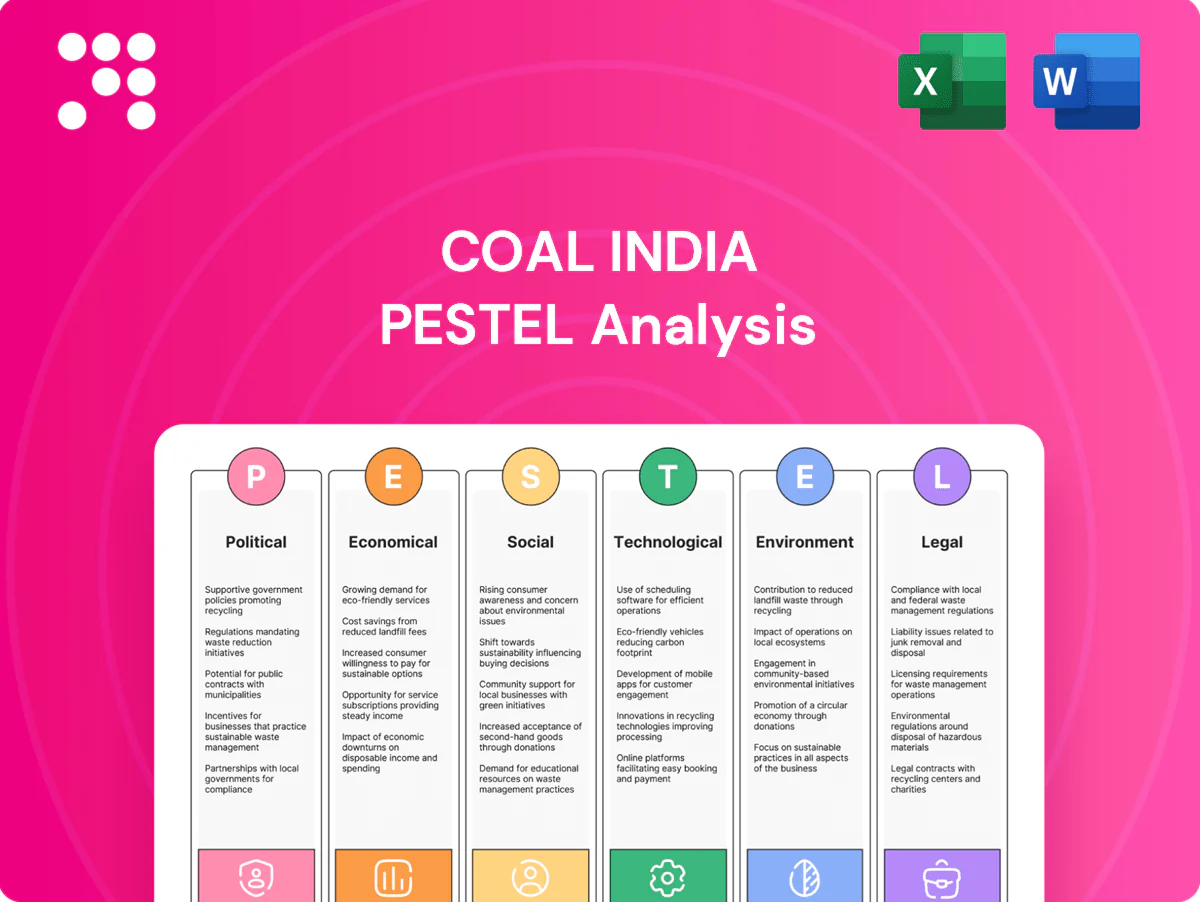
Coal India PESTLE Analysis

Make Smarter Strategic Decisions with a Complete PESTEL View
Unlock strategic clarity with our concise PESTLE Analysis of Coal India—three to five focused insights on political, economic, social, technological, legal, and environmental forces shaping its trajectory. Ideal for investors and strategists seeking actionable context. Purchase the full report to access the complete, editable breakdown and make informed decisions today.
Political factors

Government ownership and control
As a Maharatna PSU under the Ministry of Coal, Coal India’s strategy, capex and pricing are shaped by policy directives and ministry oversight; it supplies roughly 80% of India’s domestic coal, so budget allocations and reform agendas materially affect modernization pace. Political priorities such as energy security often override pure commercial logic, and leadership changes can reorient operational focus across subsidiaries.
Energy policy and coal allocation
National energy targets such as 500 GW non-fossil capacity by 2030 and ongoing linkage rationalization directly shape Coal India offtake, with CIL supplying roughly 80% of India’s domestic coal and about 70% historically going to power. Reforms in auctions and e-auction quotas have increased merchant sales volatility, pressuring revenue stability. Policy pivots toward gas, renewables or nuclear could progressively reduce coal’s share and pricing power.

Center–state dynamics and federal permits
Mines operated by Coal India span multiple states requiring coordination on land acquisition, royalties and central/state clearances while the company supplies over 80% of India’s domestic coal. State politics affect law and order, logistics and local approvals, creating operational variability. Royalty revisions at state level can materially reshape unit cost curves. Regional elections often delay or fast‑track project clearances and commissioning timelines.

Infrastructure and logistics initiatives
Government-backed rail corridors and evacuation projects under PM Gati Shakti (national investment plan ~Rs 100 lakh crore) shape Coal India throughput; Coal India supplies roughly 80% of India’s domestic coal, so rail capacity directly affects costs and delivery. Public investment in ports and multimodal hubs reduces bottlenecks, while delays in public works raise inventory carrying and demurrage exposures; first- and last-mile policy support improves dispatch reliability.
- rail corridors: affect throughput and cost
- ports/multimodal hubs: ease bottlenecks
- delays: inflate inventory and demurrage
- first/last-mile policy: boosts dispatch reliability
International climate diplomacy
India’s COP commitments—net‑zero by 2070 and a 500 GW non‑fossil target by 2030—are feeding domestic policies that constrain thermal coal demand and push cleaner fuels, directly impacting Coal India’s long‑term sales. Access to multilateral/climate finance conditions project-level decarbonization choices and capital availability. EU Carbon Border Adjustment Mechanism and post‑2022 geopolitics have raised export and import price risks, shifting industrial coal demand patterns.
- NDCs/targets: net‑zero 2070; 500 GW non‑fossil by 2030
- Multilateral finance links to decarbonization eligibility
- CBAM and post‑2022 geopolitics raise coal price/competitiveness risk
~80% domestic coal; policy, royalty & logistics risks
As a Maharatna PSU under the Ministry of Coal, Coal India’s strategy, capex and pricing are shaped by policy directives and oversight; it supplies ~80% of India’s domestic coal, with ~70% historically to power. State politics, royalty revisions and PM Gati Shakti investments (nationwide plan ~Rs 100 lakh crore) materially affect logistics, costs and dispatch reliability.
| Metric | Value |
|---|---|
| Domestic share | ~80% |
| Power offtake | ~70% |
| Net‑zero target | 2070 |
| Non‑fossil target | 500 GW by 2030 |
What is included in the product
 Detailed Word Document
Explores how macro-environmental forces uniquely impact Coal India across Political, Economic, Social, Technological, Environmental, and Legal dimensions, with data-backed trends and forward-looking insights. Designed for executives and investors to identify risks, opportunities, and strategy actions tailored to India’s coal sector.

 Customizable Excel Spreadsheet
A concise, PESTLE-segmented brief on Coal India that distills regulatory, environmental, economic and geopolitical risks into an easily shareable summary for quick alignment in meetings and strategy decks.
Economic factors

Power sector demand elasticity
Electricity generation drives Coal India volumes—coal supplied ~75% of India’s power in 2024 and Coal India accounts for roughly 80% of domestic thermal coal to utilities, with peak demand (~240 GW in 2024) guiding offtake and stock draws. Procyclical demand from steel and cement raises volatility in dispatch, while hydropower variability and weather swings can shift coal burn rates markedly. Slower load growth and weak DISCOM finances, with outstanding dues above INR 1.5 lakh crore in 2024, tighten payment cycles and force cautious inventory planning.
Price realization and e-auction premiums
E-auction premiums have historically expanded margins in tight markets (peaks exceeding 100% in 2021–22) but compress sharply in softer cycles, directly swinging Coal India’s realizations; Coal India supplies about 80% of India’s domestic coal, so regulated linkage volumes cap upside while stabilizing base demand. Global seaborne Newcastle thermal prices, which fell from peaks near US$400/t in 2022 to under US$150/t by 2024, drive substitution pressures and customer bargaining. Product mix shifts between lower-ASP G grades and higher-value washed coal materially affect average selling prices and margin profile.

Input costs and productivity
Wage revisions and inflation in inputs such as diesel (retail ~₹95–110/litre in 2024–25), explosives and overburden removal are key drivers of Coal India’s unit costs, pressuring margins. Stripping ratios and mine geology set productivity levers, with steeper ratios raising per-tonne costs. Automation, dispatch optimization and belt/SHOVEL efficiencies can offset input inflation, while contractor rates and seasonal availability constrain peak-season output.

Logistics and evacuation economics
Rail freight rates materially shape Coal India’s delivered cost, with rail accounting for roughly 75% of bulk coal dispatches and contributing the largest variable in landed cost to power plants.
Wagon availability and rake turnaround (typically multi-day) directly affect revenue recognition and sales cycle timing; delays raise working-capital needs.
First-mile connectivity projects cut handling losses and demurrage; modal shifts to conveyors and MGRs (often lowering unit transport cost by double digits) improve cost predictability.
- Rail share ~75%
- Wagon/rake delays raise working capital
- First-mile projects reduce demurrage
- Conveyors/MGRs lower unit transport cost
Capital expenditure and returns
New mines, washeries and evacuation projects require sustained capex; Coal India announced a capex plan of about Rs 12,000 crore for 2024-25 to back expansion and logistics upgrades, while execution delays inflate costs and erode IRRs by compressing volumes and extending payback timelines.
- Delays → cost overruns, lost volumes, lower IRR
- PSU procurement norms → slower vendor selection, project pacing
- Cash generation funds high dividends yet competes with reinvestment needs
~80% domestic coal; policy, royalty & logistics risks
Coal drives volumes—coal ~75% of India’s power in 2024 and Coal India supplies ~80% of domestic thermal coal, with DISCOM dues ~₹1.5 lakh crore pressuring cashflows. Rail freight/wagon constraints (rail ~75% modal share) and diesel ~₹95–110/l in 2024–25 shape delivered cost and working-capital. Capex planned ~₹12,000 crore for 2024–25 to expand mines, washeries and evacuation.
| Metric | 2024/25 |
|---|---|
| Coal share in power | ~75% |
| Coal India market share | ~80% |
| DISCOM dues | ₹1.5 lakh cr |
| Capex | ₹12,000 cr |
| Rail modal share | ~75% |
Full Version Awaits
Coal India PESTLE Analysis
The Coal India PESTLE Analysis you see here is the exact, fully formatted document you’ll receive after purchase—professionally structured and ready to use. It contains the complete political, economic, social, technological, legal, and environmental assessment for Coal India. No placeholders or teasers—what’s previewed is the final file available for immediate download after checkout.

Original: $10.00
-65%$10.00
$3.50Product Information
Product Information
Shipping & Returns
Shipping & Returns
Description
Make Smarter Strategic Decisions with a Complete PESTEL View
Unlock strategic clarity with our concise PESTLE Analysis of Coal India—three to five focused insights on political, economic, social, technological, legal, and environmental forces shaping its trajectory. Ideal for investors and strategists seeking actionable context. Purchase the full report to access the complete, editable breakdown and make informed decisions today.
Political factors
Government ownership and control
As a Maharatna PSU under the Ministry of Coal, Coal India’s strategy, capex and pricing are shaped by policy directives and ministry oversight; it supplies roughly 80% of India’s domestic coal, so budget allocations and reform agendas materially affect modernization pace. Political priorities such as energy security often override pure commercial logic, and leadership changes can reorient operational focus across subsidiaries.
Energy policy and coal allocation
National energy targets such as 500 GW non-fossil capacity by 2030 and ongoing linkage rationalization directly shape Coal India offtake, with CIL supplying roughly 80% of India’s domestic coal and about 70% historically going to power. Reforms in auctions and e-auction quotas have increased merchant sales volatility, pressuring revenue stability. Policy pivots toward gas, renewables or nuclear could progressively reduce coal’s share and pricing power.
Center–state dynamics and federal permits
Mines operated by Coal India span multiple states requiring coordination on land acquisition, royalties and central/state clearances while the company supplies over 80% of India’s domestic coal. State politics affect law and order, logistics and local approvals, creating operational variability. Royalty revisions at state level can materially reshape unit cost curves. Regional elections often delay or fast‑track project clearances and commissioning timelines.
Infrastructure and logistics initiatives
Government-backed rail corridors and evacuation projects under PM Gati Shakti (national investment plan ~Rs 100 lakh crore) shape Coal India throughput; Coal India supplies roughly 80% of India’s domestic coal, so rail capacity directly affects costs and delivery. Public investment in ports and multimodal hubs reduces bottlenecks, while delays in public works raise inventory carrying and demurrage exposures; first- and last-mile policy support improves dispatch reliability.
- rail corridors: affect throughput and cost
- ports/multimodal hubs: ease bottlenecks
- delays: inflate inventory and demurrage
- first/last-mile policy: boosts dispatch reliability
International climate diplomacy
India’s COP commitments—net‑zero by 2070 and a 500 GW non‑fossil target by 2030—are feeding domestic policies that constrain thermal coal demand and push cleaner fuels, directly impacting Coal India’s long‑term sales. Access to multilateral/climate finance conditions project-level decarbonization choices and capital availability. EU Carbon Border Adjustment Mechanism and post‑2022 geopolitics have raised export and import price risks, shifting industrial coal demand patterns.
- NDCs/targets: net‑zero 2070; 500 GW non‑fossil by 2030
- Multilateral finance links to decarbonization eligibility
- CBAM and post‑2022 geopolitics raise coal price/competitiveness risk
~80% domestic coal; policy, royalty & logistics risks
As a Maharatna PSU under the Ministry of Coal, Coal India’s strategy, capex and pricing are shaped by policy directives and oversight; it supplies ~80% of India’s domestic coal, with ~70% historically to power. State politics, royalty revisions and PM Gati Shakti investments (nationwide plan ~Rs 100 lakh crore) materially affect logistics, costs and dispatch reliability.
| Metric | Value |
|---|---|
| Domestic share | ~80% |
| Power offtake | ~70% |
| Net‑zero target | 2070 |
| Non‑fossil target | 500 GW by 2030 |
What is included in the product
Detailed Word Document
Explores how macro-environmental forces uniquely impact Coal India across Political, Economic, Social, Technological, Environmental, and Legal dimensions, with data-backed trends and forward-looking insights. Designed for executives and investors to identify risks, opportunities, and strategy actions tailored to India’s coal sector.
Customizable Excel Spreadsheet
A concise, PESTLE-segmented brief on Coal India that distills regulatory, environmental, economic and geopolitical risks into an easily shareable summary for quick alignment in meetings and strategy decks.
Economic factors
Power sector demand elasticity
Electricity generation drives Coal India volumes—coal supplied ~75% of India’s power in 2024 and Coal India accounts for roughly 80% of domestic thermal coal to utilities, with peak demand (~240 GW in 2024) guiding offtake and stock draws. Procyclical demand from steel and cement raises volatility in dispatch, while hydropower variability and weather swings can shift coal burn rates markedly. Slower load growth and weak DISCOM finances, with outstanding dues above INR 1.5 lakh crore in 2024, tighten payment cycles and force cautious inventory planning.
Price realization and e-auction premiums
E-auction premiums have historically expanded margins in tight markets (peaks exceeding 100% in 2021–22) but compress sharply in softer cycles, directly swinging Coal India’s realizations; Coal India supplies about 80% of India’s domestic coal, so regulated linkage volumes cap upside while stabilizing base demand. Global seaborne Newcastle thermal prices, which fell from peaks near US$400/t in 2022 to under US$150/t by 2024, drive substitution pressures and customer bargaining. Product mix shifts between lower-ASP G grades and higher-value washed coal materially affect average selling prices and margin profile.
Input costs and productivity
Wage revisions and inflation in inputs such as diesel (retail ~₹95–110/litre in 2024–25), explosives and overburden removal are key drivers of Coal India’s unit costs, pressuring margins. Stripping ratios and mine geology set productivity levers, with steeper ratios raising per-tonne costs. Automation, dispatch optimization and belt/SHOVEL efficiencies can offset input inflation, while contractor rates and seasonal availability constrain peak-season output.
Logistics and evacuation economics
Rail freight rates materially shape Coal India’s delivered cost, with rail accounting for roughly 75% of bulk coal dispatches and contributing the largest variable in landed cost to power plants.
Wagon availability and rake turnaround (typically multi-day) directly affect revenue recognition and sales cycle timing; delays raise working-capital needs.
First-mile connectivity projects cut handling losses and demurrage; modal shifts to conveyors and MGRs (often lowering unit transport cost by double digits) improve cost predictability.
- Rail share ~75%
- Wagon/rake delays raise working capital
- First-mile projects reduce demurrage
- Conveyors/MGRs lower unit transport cost
Capital expenditure and returns
New mines, washeries and evacuation projects require sustained capex; Coal India announced a capex plan of about Rs 12,000 crore for 2024-25 to back expansion and logistics upgrades, while execution delays inflate costs and erode IRRs by compressing volumes and extending payback timelines.
- Delays → cost overruns, lost volumes, lower IRR
- PSU procurement norms → slower vendor selection, project pacing
- Cash generation funds high dividends yet competes with reinvestment needs
~80% domestic coal; policy, royalty & logistics risks
Coal drives volumes—coal ~75% of India’s power in 2024 and Coal India supplies ~80% of domestic thermal coal, with DISCOM dues ~₹1.5 lakh crore pressuring cashflows. Rail freight/wagon constraints (rail ~75% modal share) and diesel ~₹95–110/l in 2024–25 shape delivered cost and working-capital. Capex planned ~₹12,000 crore for 2024–25 to expand mines, washeries and evacuation.
| Metric | 2024/25 |
|---|---|
| Coal share in power | ~75% |
| Coal India market share | ~80% |
| DISCOM dues | ₹1.5 lakh cr |
| Capex | ₹12,000 cr |
| Rail modal share | ~75% |
Full Version Awaits
Coal India PESTLE Analysis
The Coal India PESTLE Analysis you see here is the exact, fully formatted document you’ll receive after purchase—professionally structured and ready to use. It contains the complete political, economic, social, technological, legal, and environmental assessment for Coal India. No placeholders or teasers—what’s previewed is the final file available for immediate download after checkout.