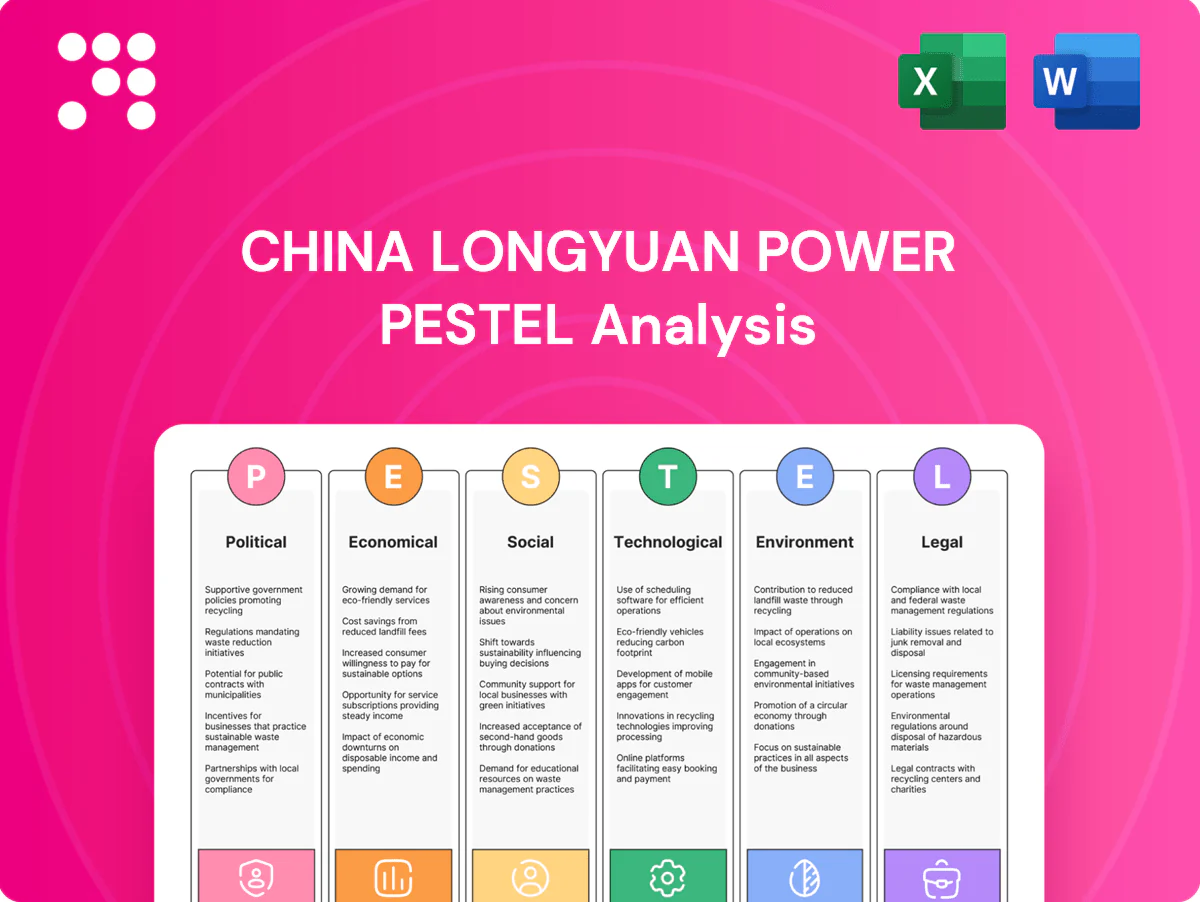
China Longyuan Power PESTLE Analysis

Plan Smarter. Present Sharper. Compete Stronger.
Unlock strategic clarity with our PESTLE Analysis of China Longyuan Power—spot regulatory shifts, economic drivers, and tech trends shaping its renewables strategy. Ideal for investors and strategists, this concise briefing reveals risks and growth levers you can act on now. Purchase the full report for the complete, editable deep-dive and make informed decisions with confidence.
Political factors

National renewable targets and Five-Year Plans
China’s 14th Five-Year Plan (2021–25) and national pledges to peak CO2 before 2030 and achieve carbon neutrality by 2060 prioritize large-scale wind and solar capacity additions, shaping Longyuan’s growth runway. Five-Year Plan targets and central approvals drive project permits and capital allocation, with non-fossil energy share aimed near 20% by 2025. Policy continuity reduces demand risk, but shifts in emphasis can reallocate resources regionally or toward storage and offshore wind. Close alignment with state-owned stakeholders remains a competitive necessity.
Subsidy transition and grid-parity policies
Feed-in tariffs have been phasing down toward competitive auctions and grid-parity since 2024, pressuring project IRRs and favoring cost leadership and scale.
Longyuan’s integrated blade manufacturing can mitigate margin compression by reducing procurement and transport costs and improving unit economics.
Policy execution speed affects timing of legacy receivables collection, with slower implementation prolonging cash conversion and raising working capital needs.

Power market reforms and dispatch priorities
Power market reforms accelerating spot markets and green power trading are reshaping China Longyuan Power’s revenue mix as Beijing pursues peak carbon by 2030 and carbon neutrality by 2060. Priority dispatch for renewables has meaningfully cut curtailment in many provinces, though local grid constraints still cause regional variation. Participation in national green certificate schemes and pilot carbon trading expands monetization channels. Marketization also increases exposure to short‑term price volatility.

Provincial permitting and local government alignment
Site approvals, land/sea-use rights and grid connection for China Longyuan (a subsidiary of China Energy Investment Corporation) are provincially mediated, so strong local relations accelerate timelines and reduce soft costs, while inconsistent local enforcement can delay construction or constrain operations.
- Provincial mediation: 31 provincial-level divisions
- Local relations cut permitting time and soft costs
- Inconsistent enforcement = construction/operational delays
- Cross-province diversification mitigates permitting risk
Geopolitical dynamics and industrial policy
Trade tensions since 2022 have tightened export controls on advanced energy tech, affecting component supply, export opportunities and access to high-end turbines; China’s 14th Five-Year Plan (2021–25) and 2023 industrial policies promote local content and supply-chain resilience. Longyuan benefits from national-champion status with preferential financing and grid access but must navigate export controls and increased scrutiny on global collaborations.
- trade-controls
- local-content
- preferential-finance
- export-scrutiny
China’s 2025 non-fossil target and auction shift tighten renewable margins, speed regional rollout
China’s net-zero timeline (peak CO2 before 2030, carbon neutrality by 2060) and 14th Five‑Year Plan target of ~20% non‑fossil energy by 2025 drive Longyuan’s project pipeline and state support, while feed‑in tariffs shifted to auctions since 2024 pressuring margins. Provincial permitting (31 units) and preferential finance for national champions speed deployment but create regional execution risk. Trade controls and local‑content rules boost domestic supply resilience.
| Metric | Value |
|---|---|
| Non‑fossil share target (2025) | ~20% |
| Provincial divisions | 31 |
| Policy milestones | Peak CO2 <2030; neutrality 2060 |
What is included in the product
 Detailed Word Document
Explores how Political, Economic, Social, Technological, Environmental and Legal forces uniquely impact China Longyuan Power, with data-backed insights and forward-looking scenarios to identify risks and opportunities for executives, investors and strategists; formatted for direct use in reports and presentations.

 Customizable Excel Spreadsheet
A concise, visually segmented PESTLE summary of China Longyuan Power that streamlines external risk assessment and market positioning, ready to drop into presentations or share across teams for faster, aligned decision-making.
Economic factors

Electricity demand and macro growth
Power demand in China closely tracks industrial output and urbanization; GDP slowed to about 5.2% in 2024 and national electricity consumption rose roughly 5–6% that year, moderating urgent new-builds while electrification trends (NEV sales near 10 million in 2024) support steady load growth. Longyuan’s diversified renewable-coal portfolio helps buffer cyclical swings, and regional load growth metrics now drive siting and investment priorities.
Capital intensity and interest rate environment
Wind and solar need high upfront capex (China onshore wind ~1,300 USD/kW; utility PV ~400 USD/kW) and paybacks typically 8–12 years. Financing costs materially sway project NPV and auction competitiveness—a 100 bps rise can cut NPV ~5–10%. Access to state-affiliated funding (often 100–200 bps cheaper) is an advantage but not guaranteed. Rising rates can delay FIDs or push developers toward repowering.

Commodity and equipment cost cycles
Steel (~CNY 4,200/t in 2024), copper (~USD 9,000/t LME end-2024), resin (~CNY 15,000/t) and rare-earths (NdPr ~CNY 350,000/t in 2024) directly lift turbine and blade costs, while supply-chain tightness has pushed EPC budgets higher and lead times longer in 2024. Longyuan’s in-house blade capability (GW-scale manufacturing) partially hedges swings. Standardization and scale have lowered LCOE by an estimated 5–10% for recent projects.

Carbon pricing and green certificates
China’s ETS expansion reshapes merit-order economics as the national carbon price averaged about CNY 60/ton in 2024, pushing higher-cost coal plants out of dispatch; carbon costs thus enhance renewable competitiveness while increasing merchant price volatility. Green power trading and certificates create premiums that improve revenue certainty for Longyuan, but policy clarity will drive offtake contract structures and bankability.
- 2024 carbon price ~CNY 60/ton
- Coal share of power ~61% (2023)
- Green trading premiums boost revenue predictability
FX exposure and import dependencies
Imported turbines and offshore electrical equipment expose China Longyuan Power to currency risk as procurement and any foreign-currency debt create RMB/USD and RMB/EUR sensitivity. Yuan volatility can raise capex and servicing costs; localization of supply chains has been pursued to lower FX exposure. Robust hedging policies and favourable supplier payment terms are pivotal to manage these risks.
- FX channels: procurement, capex, debt
- Mitigants: localization, FX hedges
- Key controls: hedging policy, supplier NPV terms
China’s 2025 non-fossil target and auction shift tighten renewable margins, speed regional rollout
GDP ~5.2% (2024); electricity demand +5–6% (2024) supporting steady load growth; NEV sales ~10m (2024) lift electrification. Capex: onshore wind ~USD1,300/kW, utility PV ~USD400/kW; commodity pressures (steel CNY4,200/t; NdPr CNY350,000/t) raise costs. Carbon price ~CNY60/t (2024) improves renewables' dispatch; coal share ~61% (2023) keeps market volatility.
| Metric | Value |
|---|---|
| GDP (2024) | 5.2% |
| Elec demand (2024) | +5–6% |
| Onshore wind capex | USD1,300/kW |
| Carbon price | CNY60/t |
Preview Before You Purchase
China Longyuan Power PESTLE Analysis
This China Longyuan Power PESTLE Analysis preview is the exact document you’ll receive after purchase—fully formatted and ready to use. The content, layout and structure shown here are identical to the downloadable file. No placeholders or teasers—this is the final, professional report you’ll own immediately after checkout.

Product Information
Product Information
Shipping & Returns
Shipping & Returns
Description
Plan Smarter. Present Sharper. Compete Stronger.
Unlock strategic clarity with our PESTLE Analysis of China Longyuan Power—spot regulatory shifts, economic drivers, and tech trends shaping its renewables strategy. Ideal for investors and strategists, this concise briefing reveals risks and growth levers you can act on now. Purchase the full report for the complete, editable deep-dive and make informed decisions with confidence.
Political factors
National renewable targets and Five-Year Plans
China’s 14th Five-Year Plan (2021–25) and national pledges to peak CO2 before 2030 and achieve carbon neutrality by 2060 prioritize large-scale wind and solar capacity additions, shaping Longyuan’s growth runway. Five-Year Plan targets and central approvals drive project permits and capital allocation, with non-fossil energy share aimed near 20% by 2025. Policy continuity reduces demand risk, but shifts in emphasis can reallocate resources regionally or toward storage and offshore wind. Close alignment with state-owned stakeholders remains a competitive necessity.
Subsidy transition and grid-parity policies
Feed-in tariffs have been phasing down toward competitive auctions and grid-parity since 2024, pressuring project IRRs and favoring cost leadership and scale.
Longyuan’s integrated blade manufacturing can mitigate margin compression by reducing procurement and transport costs and improving unit economics.
Policy execution speed affects timing of legacy receivables collection, with slower implementation prolonging cash conversion and raising working capital needs.
Power market reforms and dispatch priorities
Power market reforms accelerating spot markets and green power trading are reshaping China Longyuan Power’s revenue mix as Beijing pursues peak carbon by 2030 and carbon neutrality by 2060. Priority dispatch for renewables has meaningfully cut curtailment in many provinces, though local grid constraints still cause regional variation. Participation in national green certificate schemes and pilot carbon trading expands monetization channels. Marketization also increases exposure to short‑term price volatility.
Provincial permitting and local government alignment
Site approvals, land/sea-use rights and grid connection for China Longyuan (a subsidiary of China Energy Investment Corporation) are provincially mediated, so strong local relations accelerate timelines and reduce soft costs, while inconsistent local enforcement can delay construction or constrain operations.
- Provincial mediation: 31 provincial-level divisions
- Local relations cut permitting time and soft costs
- Inconsistent enforcement = construction/operational delays
- Cross-province diversification mitigates permitting risk
Geopolitical dynamics and industrial policy
Trade tensions since 2022 have tightened export controls on advanced energy tech, affecting component supply, export opportunities and access to high-end turbines; China’s 14th Five-Year Plan (2021–25) and 2023 industrial policies promote local content and supply-chain resilience. Longyuan benefits from national-champion status with preferential financing and grid access but must navigate export controls and increased scrutiny on global collaborations.
- trade-controls
- local-content
- preferential-finance
- export-scrutiny
China’s 2025 non-fossil target and auction shift tighten renewable margins, speed regional rollout
China’s net-zero timeline (peak CO2 before 2030, carbon neutrality by 2060) and 14th Five‑Year Plan target of ~20% non‑fossil energy by 2025 drive Longyuan’s project pipeline and state support, while feed‑in tariffs shifted to auctions since 2024 pressuring margins. Provincial permitting (31 units) and preferential finance for national champions speed deployment but create regional execution risk. Trade controls and local‑content rules boost domestic supply resilience.
| Metric | Value |
|---|---|
| Non‑fossil share target (2025) | ~20% |
| Provincial divisions | 31 |
| Policy milestones | Peak CO2 <2030; neutrality 2060 |
What is included in the product
Detailed Word Document
Explores how Political, Economic, Social, Technological, Environmental and Legal forces uniquely impact China Longyuan Power, with data-backed insights and forward-looking scenarios to identify risks and opportunities for executives, investors and strategists; formatted for direct use in reports and presentations.
Customizable Excel Spreadsheet
A concise, visually segmented PESTLE summary of China Longyuan Power that streamlines external risk assessment and market positioning, ready to drop into presentations or share across teams for faster, aligned decision-making.
Economic factors
Electricity demand and macro growth
Power demand in China closely tracks industrial output and urbanization; GDP slowed to about 5.2% in 2024 and national electricity consumption rose roughly 5–6% that year, moderating urgent new-builds while electrification trends (NEV sales near 10 million in 2024) support steady load growth. Longyuan’s diversified renewable-coal portfolio helps buffer cyclical swings, and regional load growth metrics now drive siting and investment priorities.
Capital intensity and interest rate environment
Wind and solar need high upfront capex (China onshore wind ~1,300 USD/kW; utility PV ~400 USD/kW) and paybacks typically 8–12 years. Financing costs materially sway project NPV and auction competitiveness—a 100 bps rise can cut NPV ~5–10%. Access to state-affiliated funding (often 100–200 bps cheaper) is an advantage but not guaranteed. Rising rates can delay FIDs or push developers toward repowering.
Commodity and equipment cost cycles
Steel (~CNY 4,200/t in 2024), copper (~USD 9,000/t LME end-2024), resin (~CNY 15,000/t) and rare-earths (NdPr ~CNY 350,000/t in 2024) directly lift turbine and blade costs, while supply-chain tightness has pushed EPC budgets higher and lead times longer in 2024. Longyuan’s in-house blade capability (GW-scale manufacturing) partially hedges swings. Standardization and scale have lowered LCOE by an estimated 5–10% for recent projects.
Carbon pricing and green certificates
China’s ETS expansion reshapes merit-order economics as the national carbon price averaged about CNY 60/ton in 2024, pushing higher-cost coal plants out of dispatch; carbon costs thus enhance renewable competitiveness while increasing merchant price volatility. Green power trading and certificates create premiums that improve revenue certainty for Longyuan, but policy clarity will drive offtake contract structures and bankability.
- 2024 carbon price ~CNY 60/ton
- Coal share of power ~61% (2023)
- Green trading premiums boost revenue predictability
FX exposure and import dependencies
Imported turbines and offshore electrical equipment expose China Longyuan Power to currency risk as procurement and any foreign-currency debt create RMB/USD and RMB/EUR sensitivity. Yuan volatility can raise capex and servicing costs; localization of supply chains has been pursued to lower FX exposure. Robust hedging policies and favourable supplier payment terms are pivotal to manage these risks.
- FX channels: procurement, capex, debt
- Mitigants: localization, FX hedges
- Key controls: hedging policy, supplier NPV terms
China’s 2025 non-fossil target and auction shift tighten renewable margins, speed regional rollout
GDP ~5.2% (2024); electricity demand +5–6% (2024) supporting steady load growth; NEV sales ~10m (2024) lift electrification. Capex: onshore wind ~USD1,300/kW, utility PV ~USD400/kW; commodity pressures (steel CNY4,200/t; NdPr CNY350,000/t) raise costs. Carbon price ~CNY60/t (2024) improves renewables' dispatch; coal share ~61% (2023) keeps market volatility.
| Metric | Value |
|---|---|
| GDP (2024) | 5.2% |
| Elec demand (2024) | +5–6% |
| Onshore wind capex | USD1,300/kW |
| Carbon price | CNY60/t |
Preview Before You Purchase
China Longyuan Power PESTLE Analysis
This China Longyuan Power PESTLE Analysis preview is the exact document you’ll receive after purchase—fully formatted and ready to use. The content, layout and structure shown here are identical to the downloadable file. No placeholders or teasers—this is the final, professional report you’ll own immediately after checkout.