CLPS PESTLE Analysis

Your Shortcut to Market Insight Starts Here
Unlock how political shifts, economic trends, and tech disruption are reshaping CLPS’s growth prospects with our targeted PESTLE analysis. This concise, insight-driven brief highlights risks and opportunities you can act on immediately. Purchase the full report to access the complete, editable analysis and make smarter strategic or investment decisions today.
Political factors

Geopolitics and cross‑border delivery
Heightened geopolitical tensions can disrupt offshore and nearshore delivery centers and restrict travel for onsite work, with global FDI flows falling 12% to about 1.1 trillion USD in 2023 (UNCTAD), underscoring vulnerability. CLPS must diversify delivery locations and build contingency plans to ensure continuity. Robust government relations and local partnerships help navigate sudden policy shifts. Scenario planning reduces interruption risk for global financial clients.
Government digital finance agendas
National fintech and digital payments pushes shape CLPS client demand, with over 114 jurisdictions reported as engaged in central bank digital currency work (BIS, 2023), increasing demand for CBDC-ready platforms. Public funding and incentives accelerate transformation programs CLPS supports. Alignment with government roadmaps improves bid relevance and monitoring policy cycles times offerings to priority areas.

Data localization and sovereignty
Over 60 countries had enacted data localization requirements by 2024, forcing in‑country storage that shapes architecture and vendor selection. CLPS must build region‑specific solutions and partner with compliant cloud providers, raising delivery complexity and costs but strengthening client trust. Early compliance planning can shorten procurement cycles and has been shown to accelerate approvals in many enterprises.

Trade policy, tariffs, and export rules
Restrictions on technology exports and components—intensified by 2024 export‑control updates—can delay delivery timelines and disrupt toolchains; CLPS must maintain approved alternatives and multi‑vendor stacks to preserve uptime. Transparent supply‑chain documentation accelerates client risk reviews and audits, and proactive compliance lowers the chance of project pauses and contract penalties.
- Maintain approved alternates
- Multi‑vendor stacks
- Transparent supply‑chain docs
- Proactive compliance to avoid pauses
Immigration and work‑visa regimes
- Mitigate: expand local hires
- Remote pods: preserve service SLAs
- Rotate staff: reduce location risk
- Documenting: simplifies audits
Geo risk cuts FDI -12% to 1.1T; diversify sites, hires
Heightened geopolitical risk cut global FDI 12% to about 1.1 trillion USD in 2023 (UNCTAD), threatening offshore delivery continuity; CLPS must diversify sites and contingency-plan. National CBDC and fintech pushes (114 jurisdictions, BIS 2023) and 60+ data‑localization laws by 2024 reshape offerings and increase compliance costs. US H‑1B cap at 85,000 tightens onsite staffing; expand local hires and remote pods.
| Metric | Value |
|---|---|
| Global FDI (2023) | ~1.1T USD (−12%) |
| CBDC jurisdictions | 114 (BIS 2023) |
| Data localization laws | 60+ (by 2024) |
| US H‑1B cap | 85,000 |
What is included in the product
 Detailed Word Document
Explores how Political, Economic, Social, Technological, Environmental and Legal forces uniquely affect CLPS, with data-backed insights and trend analysis to identify risks and opportunities; designed for executives and investors, formatted for easy insertion into plans and decks and including forward-looking scenarios to support strategic decisions.

 Customizable Excel Spreadsheet
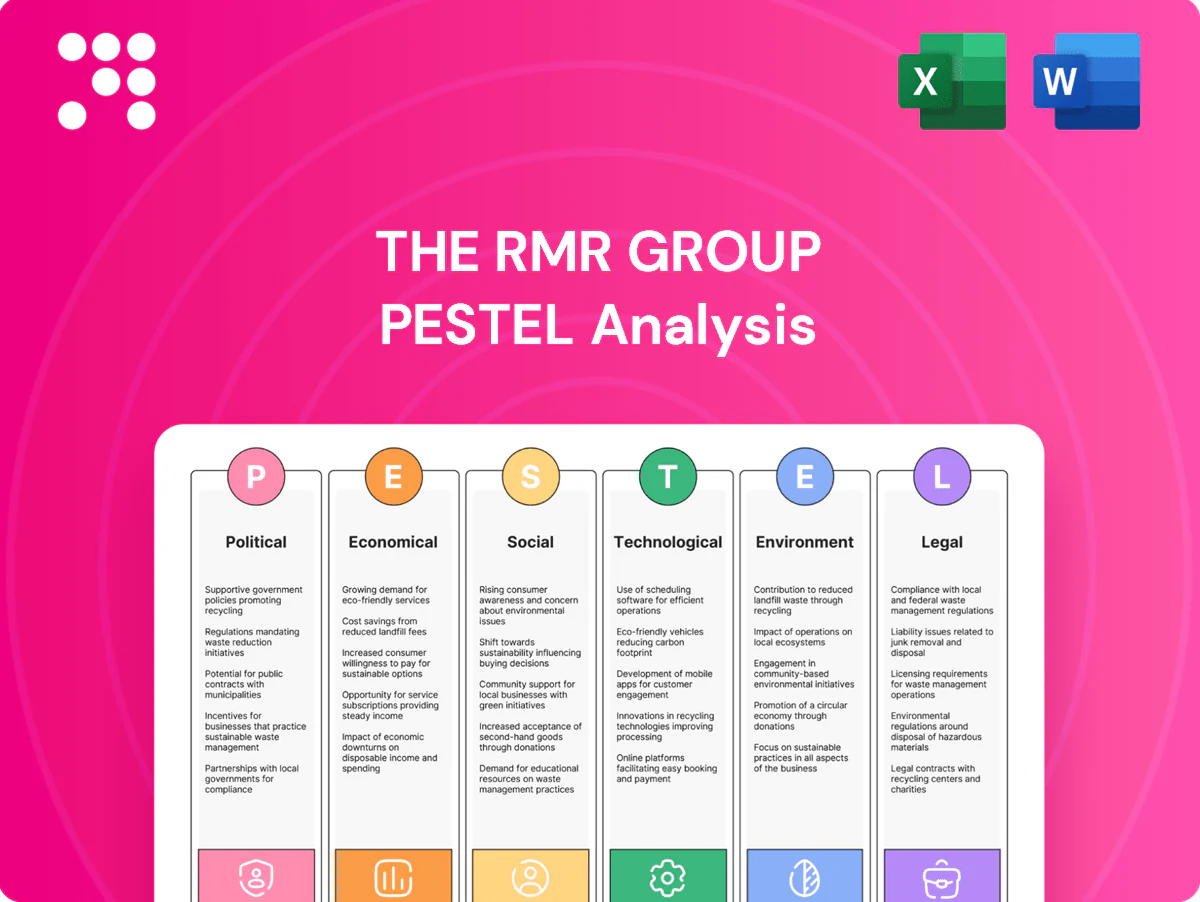
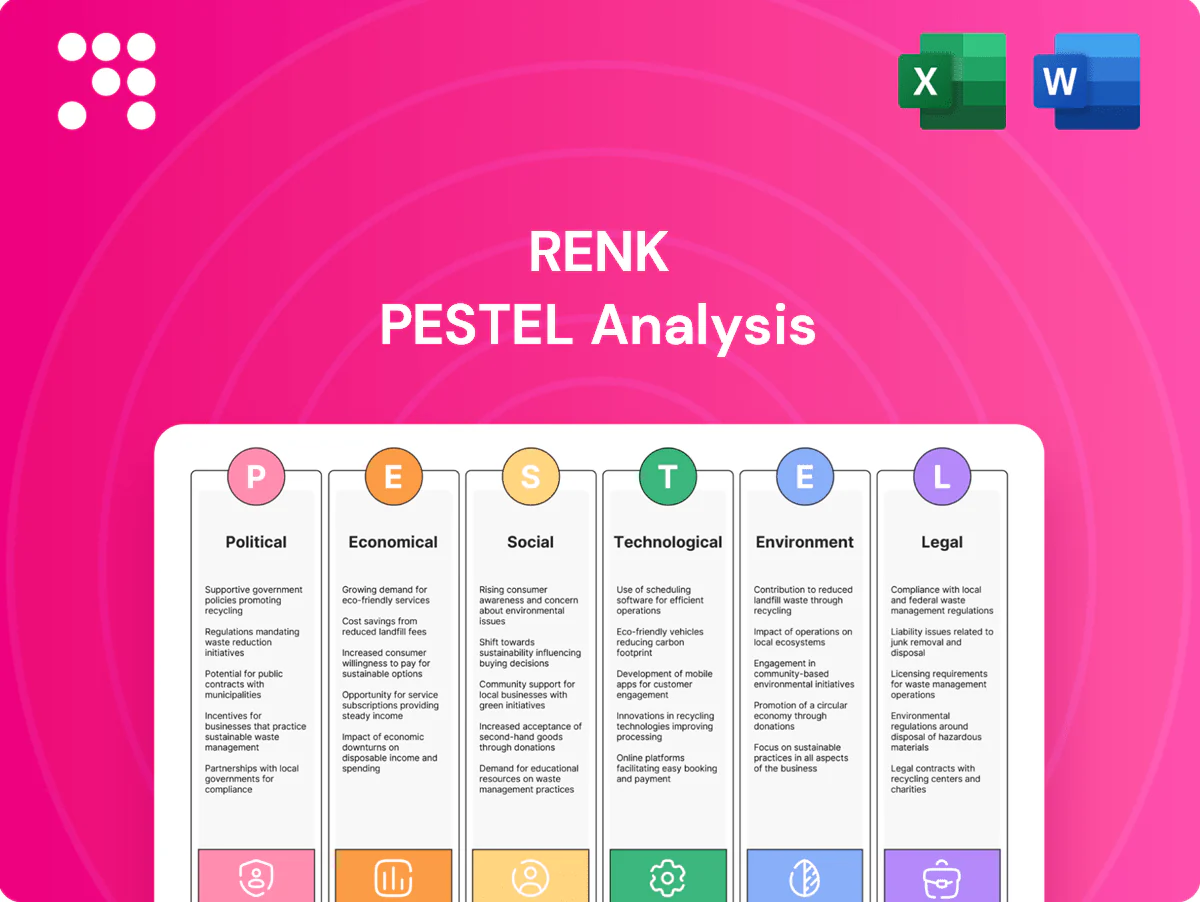
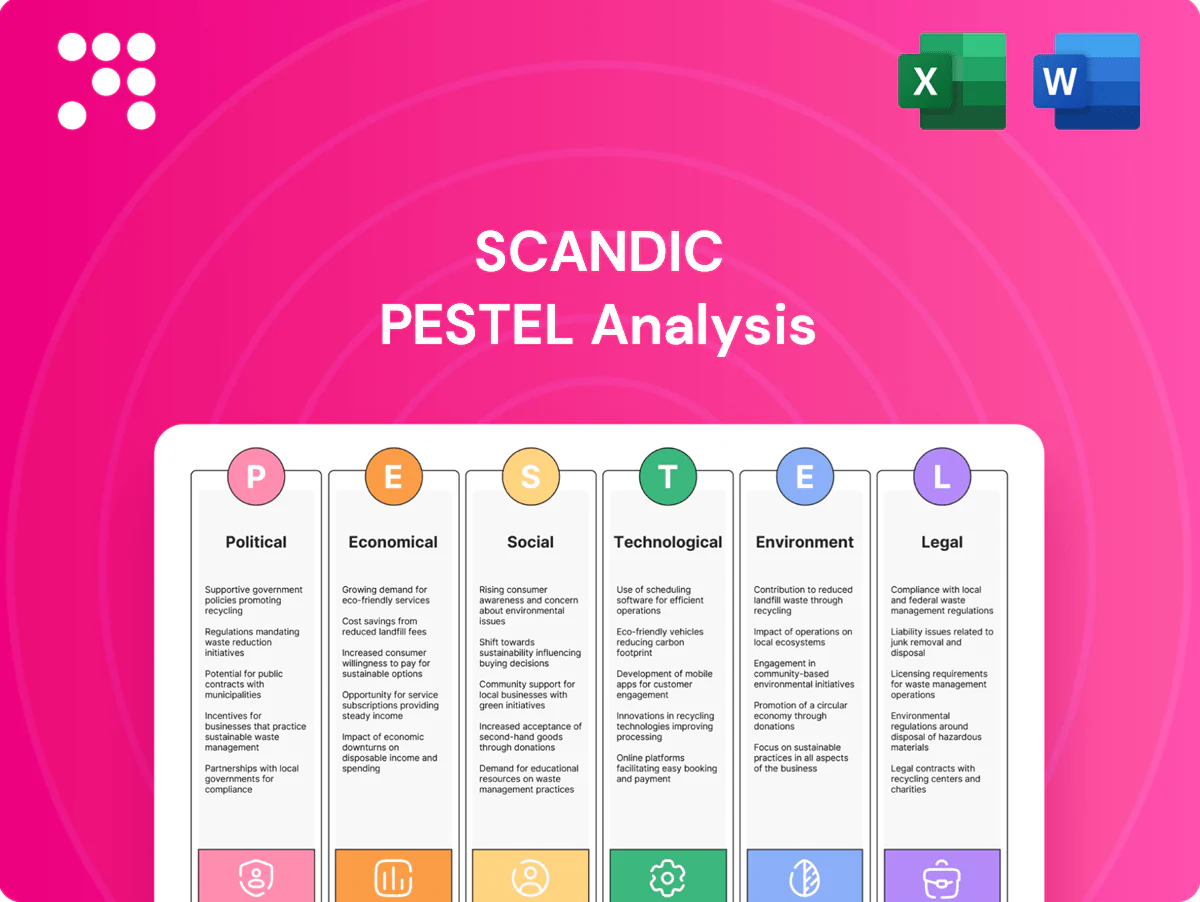
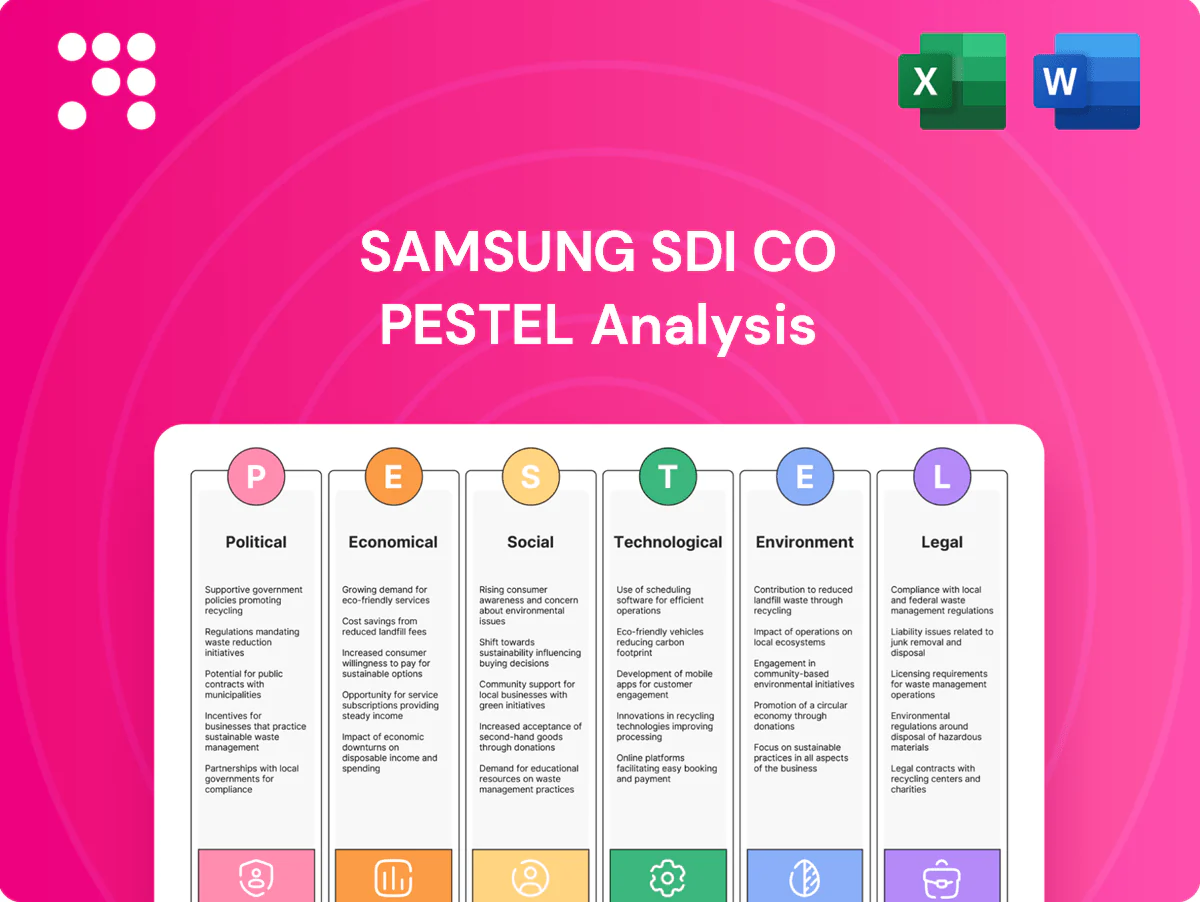
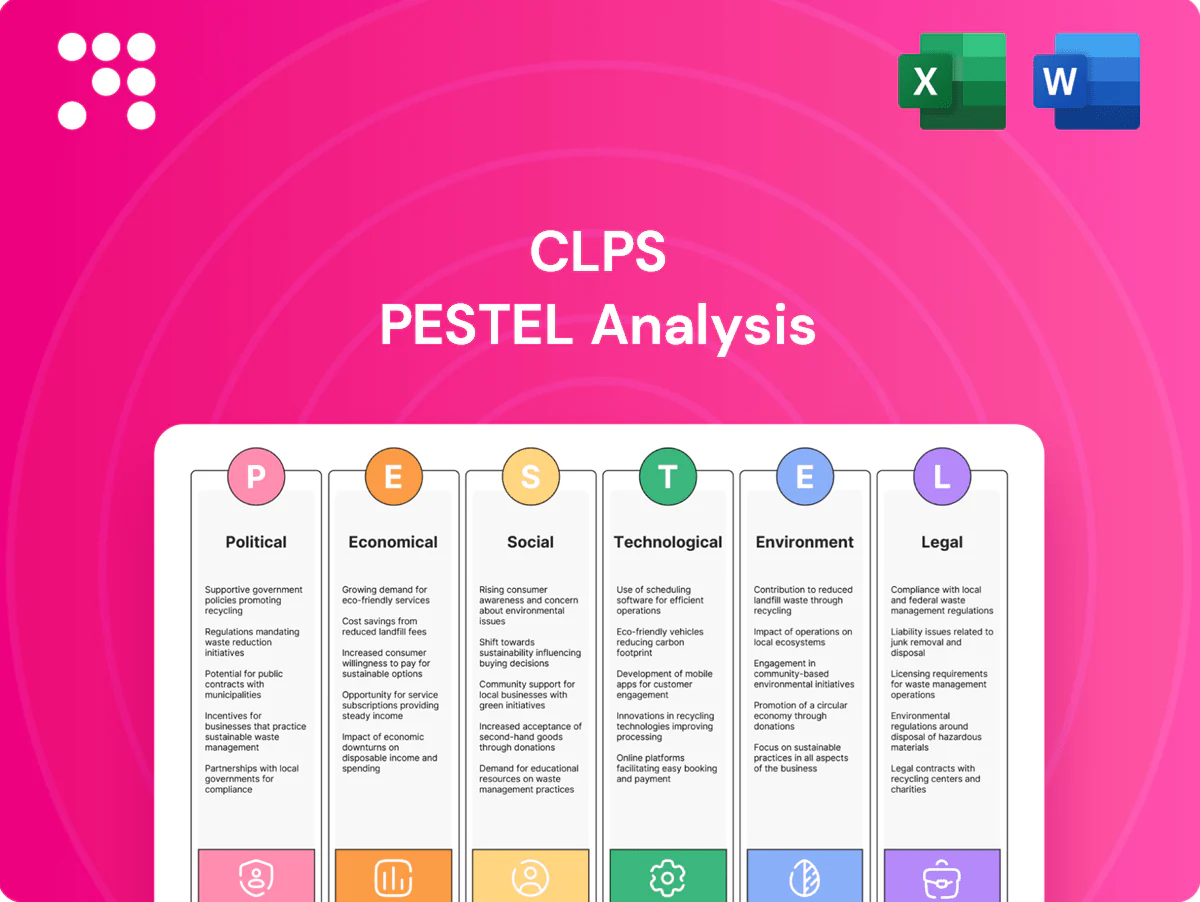
CLPS PESTLE Analysis condenses complex external factors into a clear, visually segmented summary that’s easily editable and shareable, enabling fast alignment in meetings and strategic planning while reducing prep time and clarification back-and-forth.
Economic factors

Bank IT spending tied to rate cycles
Interest rate shifts materially affect bank profitability and IT budgets: 2024 industry surveys show roughly 60% of banks reallocated IT spend toward cost reduction and compliance during rate softening, while upcycles drove a 10–15% expansion in discretionary digital programs. CLPS must balance innovation and run‑the‑bank services to capture both growth projects and steady maintenance revenue. Flexible pricing and consumption models help preserve utilization and revenue across cycles.
Currency volatility and margins
Multi-currency revenues and costs expose CLPS to FX swings as contracts billed in USD, EUR and JPY while delivery and payroll are often in VND, INR and PHP, creating margin pressure when local currencies strengthen. Natural hedges from matched billing and payroll in the same currency can stabilize margins. Contract clauses with indexation or FX pass-through protect against rapid moves. Treasury policies should align with delivery geography mix and tenor of contracts.

Talent wage inflation
Competition for senior engineers and domain specialists has pushed delivery costs higher, with senior US software engineer medians exceeding $120,000 in 2024 and global tech salary inflation roughly 8% year-over-year. Upskilling pipelines and tiered delivery models protect project economics by shifting routine work to lower-cost tiers. Nearshore diversification eases pressure from overheated hubs, while transparent value articulation supports rate discipline with clients.

M&A and consolidation in financial services
M&A and consolidation in financial services drive strong demand for system integration, data migration, and platform rationalization—global banking M&A deal value topped 250 billion USD in 2024, fueling integrated IT project pipelines. CLPS can sell post‑merger integration playbooks and run sprints; cross‑selling rises as clients consolidate vendor rosters, and repeatable accelerators can shorten timelines and boost win rates.
- Tag: integration — high demand for data migration
- Tag: playbooks — post‑merger sprint offerings
- Tag: cross‑sell — vendor consolidation upsells
- Tag: accelerators — faster delivery, higher win rates
Macro slowdowns and cost optimization
Macro slowdowns force firms to prioritize automation, cloud cost control and legacy decommissioning; IMF projected global growth ~3.0% in 2024, tightening budgets. Outcome‑based contracts gain traction in budget‑tight environments, so CLPS must spotlight measurable ROI and payback within ~12 months. Pipeline should favor resilience categories like compliance and risk.
- Tag: automation — focus on cost reduction and efficiency
- Tag: cloud — emphasize cost optimization and FinOps
- Tag: legacy — accelerate decommissioning for savings
- Tag: outcomes — ROI/payback metrics under 12 months
Geo risk cuts FDI -12% to 1.1T; diversify sites, hires
Interest-rate cycles shift IT spend; 2024 surveys show ~60% of banks cut discretionary IT in softenings while upcycles lift digital spend 10–15%. FX exposure from USD/EUR/JPY billing vs VND/INR/PHP payroll compresses margins without hedges. Senior engineer pay >$120,000 (US median 2024) and 8% tech wage inflation raise delivery costs. Global banking M&A >$250B in 2024 fuels integration demand.
| Tag | Metric |
|---|---|
| Growth | IMF GDP 2024 ~3.0% |
| Salaries | US senior dev median >$120k |
| M&A | $250B+ banking deals 2024 |
Preview the Actual Deliverable
CLPS PESTLE Analysis
The preview shown here is the exact CLPS PESTLE Analysis document you’ll receive after purchase—fully formatted and ready to use. This screenshot reflects the final content, structure, and layout with no placeholders or edits. You’ll download this same file immediately after checkout.

Original: $10.00
-65%$10.00
$3.50Product Information
Product Information
Shipping & Returns
Shipping & Returns
Description
Your Shortcut to Market Insight Starts Here
Unlock how political shifts, economic trends, and tech disruption are reshaping CLPS’s growth prospects with our targeted PESTLE analysis. This concise, insight-driven brief highlights risks and opportunities you can act on immediately. Purchase the full report to access the complete, editable analysis and make smarter strategic or investment decisions today.
Political factors
Geopolitics and cross‑border delivery
Heightened geopolitical tensions can disrupt offshore and nearshore delivery centers and restrict travel for onsite work, with global FDI flows falling 12% to about 1.1 trillion USD in 2023 (UNCTAD), underscoring vulnerability. CLPS must diversify delivery locations and build contingency plans to ensure continuity. Robust government relations and local partnerships help navigate sudden policy shifts. Scenario planning reduces interruption risk for global financial clients.
Government digital finance agendas
National fintech and digital payments pushes shape CLPS client demand, with over 114 jurisdictions reported as engaged in central bank digital currency work (BIS, 2023), increasing demand for CBDC-ready platforms. Public funding and incentives accelerate transformation programs CLPS supports. Alignment with government roadmaps improves bid relevance and monitoring policy cycles times offerings to priority areas.
Data localization and sovereignty
Over 60 countries had enacted data localization requirements by 2024, forcing in‑country storage that shapes architecture and vendor selection. CLPS must build region‑specific solutions and partner with compliant cloud providers, raising delivery complexity and costs but strengthening client trust. Early compliance planning can shorten procurement cycles and has been shown to accelerate approvals in many enterprises.
Trade policy, tariffs, and export rules
Restrictions on technology exports and components—intensified by 2024 export‑control updates—can delay delivery timelines and disrupt toolchains; CLPS must maintain approved alternatives and multi‑vendor stacks to preserve uptime. Transparent supply‑chain documentation accelerates client risk reviews and audits, and proactive compliance lowers the chance of project pauses and contract penalties.
- Maintain approved alternates
- Multi‑vendor stacks
- Transparent supply‑chain docs
- Proactive compliance to avoid pauses
Immigration and work‑visa regimes
- Mitigate: expand local hires
- Remote pods: preserve service SLAs
- Rotate staff: reduce location risk
- Documenting: simplifies audits
Geo risk cuts FDI -12% to 1.1T; diversify sites, hires
Heightened geopolitical risk cut global FDI 12% to about 1.1 trillion USD in 2023 (UNCTAD), threatening offshore delivery continuity; CLPS must diversify sites and contingency-plan. National CBDC and fintech pushes (114 jurisdictions, BIS 2023) and 60+ data‑localization laws by 2024 reshape offerings and increase compliance costs. US H‑1B cap at 85,000 tightens onsite staffing; expand local hires and remote pods.
| Metric | Value |
|---|---|
| Global FDI (2023) | ~1.1T USD (−12%) |
| CBDC jurisdictions | 114 (BIS 2023) |
| Data localization laws | 60+ (by 2024) |
| US H‑1B cap | 85,000 |
What is included in the product
Detailed Word Document
Explores how Political, Economic, Social, Technological, Environmental and Legal forces uniquely affect CLPS, with data-backed insights and trend analysis to identify risks and opportunities; designed for executives and investors, formatted for easy insertion into plans and decks and including forward-looking scenarios to support strategic decisions.
Customizable Excel Spreadsheet
CLPS PESTLE Analysis condenses complex external factors into a clear, visually segmented summary that’s easily editable and shareable, enabling fast alignment in meetings and strategic planning while reducing prep time and clarification back-and-forth.
Economic factors
Bank IT spending tied to rate cycles
Interest rate shifts materially affect bank profitability and IT budgets: 2024 industry surveys show roughly 60% of banks reallocated IT spend toward cost reduction and compliance during rate softening, while upcycles drove a 10–15% expansion in discretionary digital programs. CLPS must balance innovation and run‑the‑bank services to capture both growth projects and steady maintenance revenue. Flexible pricing and consumption models help preserve utilization and revenue across cycles.
Currency volatility and margins
Multi-currency revenues and costs expose CLPS to FX swings as contracts billed in USD, EUR and JPY while delivery and payroll are often in VND, INR and PHP, creating margin pressure when local currencies strengthen. Natural hedges from matched billing and payroll in the same currency can stabilize margins. Contract clauses with indexation or FX pass-through protect against rapid moves. Treasury policies should align with delivery geography mix and tenor of contracts.
Talent wage inflation
Competition for senior engineers and domain specialists has pushed delivery costs higher, with senior US software engineer medians exceeding $120,000 in 2024 and global tech salary inflation roughly 8% year-over-year. Upskilling pipelines and tiered delivery models protect project economics by shifting routine work to lower-cost tiers. Nearshore diversification eases pressure from overheated hubs, while transparent value articulation supports rate discipline with clients.
M&A and consolidation in financial services
M&A and consolidation in financial services drive strong demand for system integration, data migration, and platform rationalization—global banking M&A deal value topped 250 billion USD in 2024, fueling integrated IT project pipelines. CLPS can sell post‑merger integration playbooks and run sprints; cross‑selling rises as clients consolidate vendor rosters, and repeatable accelerators can shorten timelines and boost win rates.
- Tag: integration — high demand for data migration
- Tag: playbooks — post‑merger sprint offerings
- Tag: cross‑sell — vendor consolidation upsells
- Tag: accelerators — faster delivery, higher win rates
Macro slowdowns and cost optimization
Macro slowdowns force firms to prioritize automation, cloud cost control and legacy decommissioning; IMF projected global growth ~3.0% in 2024, tightening budgets. Outcome‑based contracts gain traction in budget‑tight environments, so CLPS must spotlight measurable ROI and payback within ~12 months. Pipeline should favor resilience categories like compliance and risk.
- Tag: automation — focus on cost reduction and efficiency
- Tag: cloud — emphasize cost optimization and FinOps
- Tag: legacy — accelerate decommissioning for savings
- Tag: outcomes — ROI/payback metrics under 12 months
Geo risk cuts FDI -12% to 1.1T; diversify sites, hires
Interest-rate cycles shift IT spend; 2024 surveys show ~60% of banks cut discretionary IT in softenings while upcycles lift digital spend 10–15%. FX exposure from USD/EUR/JPY billing vs VND/INR/PHP payroll compresses margins without hedges. Senior engineer pay >$120,000 (US median 2024) and 8% tech wage inflation raise delivery costs. Global banking M&A >$250B in 2024 fuels integration demand.
| Tag | Metric |
|---|---|
| Growth | IMF GDP 2024 ~3.0% |
| Salaries | US senior dev median >$120k |
| M&A | $250B+ banking deals 2024 |
Preview the Actual Deliverable
CLPS PESTLE Analysis
The preview shown here is the exact CLPS PESTLE Analysis document you’ll receive after purchase—fully formatted and ready to use. This screenshot reflects the final content, structure, and layout with no placeholders or edits. You’ll download this same file immediately after checkout.