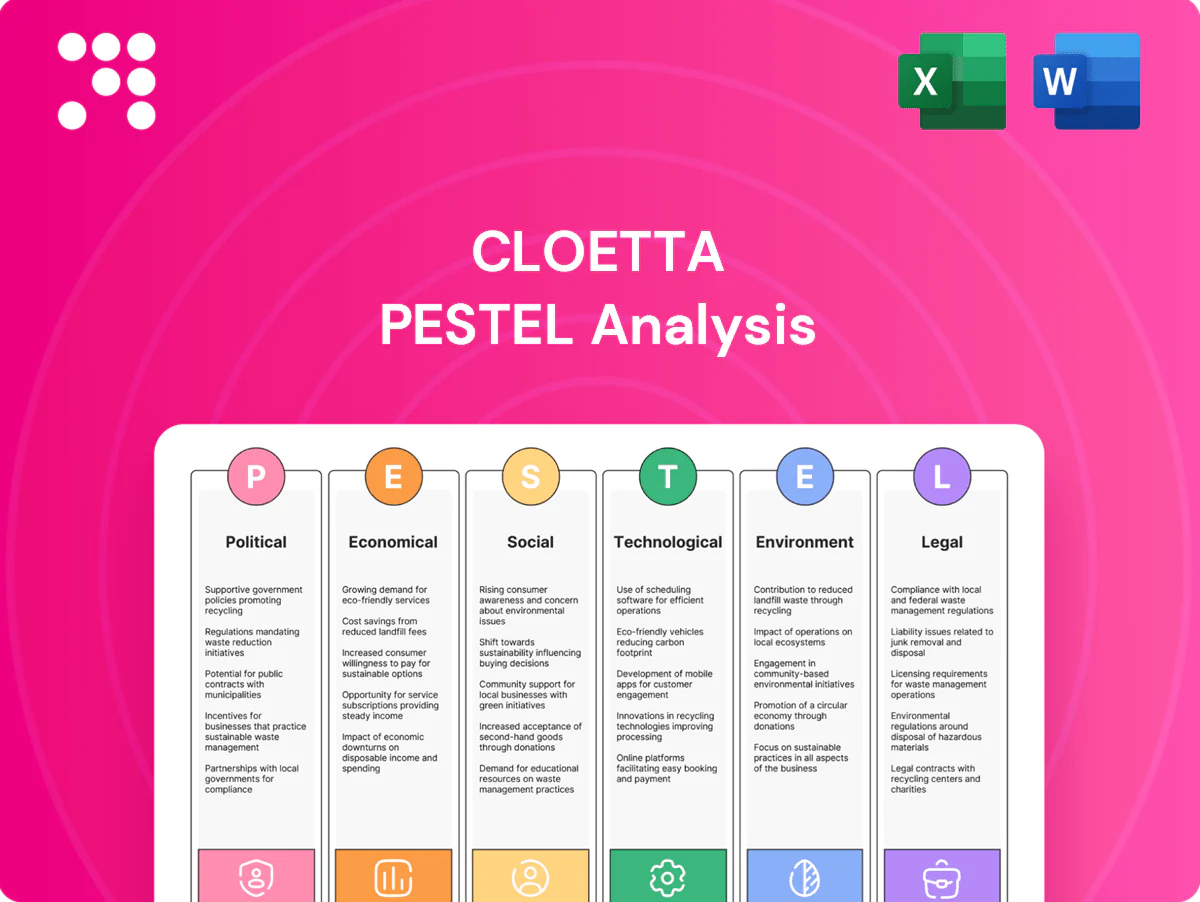
Cloetta PESTLE Analysis

Skip the Research. Get the Strategy.
Unlock strategic clarity with our PESTLE Analysis of Cloetta—three concise sentences revealing how political, economic, social, technological, legal, and environmental trends shape its prospects. Ideal for investors, consultants, and strategists, this ready-made report turns complex external forces into practical insights you can act on. Purchase the full analysis now for the complete, editable breakdown and immediate strategic value.
Political factors

EU and Nordic policy stability
Cloetta operates in Sweden, Finland, Denmark, the Netherlands and Italy and benefits from generally stable pro-business policies and strong institutions, with Nordic states ranking among the top five in Transparency International's 2024 CPI. Consistent taxation, subsidies and infrastructure planning support long-term investment in production and logistics. Political shifts can reprioritise public health and agriculture, and Italy's public debt near 139% of GDP (IMF 2024) increases fiscal sensitivity, so monitoring national budgets and coalition changes is essential for regulatory forecasting.
Sugar taxes and public health agendas
Governments are tightening sugar/HFSS policy—more than 40 jurisdictions now levy sugar/SSB taxes and the UK’s HFSS advertising and promotions restrictions have been phased in since 2022; Mexico’s 10% SSB tax cut purchases by 7.6% in early years. Cloetta must model pricing, pack-size and portfolio-mix shifts and actively engage policymakers to promote pragmatic, evidence-based measures.

Trade, tariffs, and customs frictions
EU trade policy keeps tariffs low, but post-Brexit customs formalities between UK and EU have added persistent border complexity for exporters like Cloetta; the company reported net sales of SEK 9.0bn in 2023 and cites cross‑border friction as a cost pressure. Tariffs and rules‑of‑origin on inputs such as cocoa and packaging can raise input costs and limit sourcing flexibility; global cocoa prices averaged about $4,200/tonne in 2024. Sanctions regimes constrain some export markets, so Cloetta uses diversified suppliers and bonded logistics to reduce disruption and working capital exposure.

Agricultural policy and commodity support
Political decisions on farming subsidies and import quotas shape sugar beet and cane markets: the EU Common Agricultural Policy allocates about €386.5bn for 2021–2027 and the EU sugar quota regime ended in 2017, increasing market volatility; globally roughly 80% of sugar comes from cane. Policy-driven moves toward sustainability certifications (eg Bonsucro, Rainforest Alliance) are raising acceptable sourcing standards, forcing Cloetta to adjust supplier selection and long-term contracts to remain compliant and reduce disruption risk.
- CAP budget: €386.5bn (2021–2027)
- EU sugar quota ended: 2017
- Global sugar from cane: ~80%
- Align with certified suppliers to lower regulatory and supply risks
Government procurement and local content
Public-sector procurement standards on nutrition and sustainability shape vending and institutional channels; EU public procurement totals about €2 trillion annually (≈14% of GDP), making these contracts strategically important. Regions increasingly prefer local production or ingredients, and compliance with responsible sourcing and clear labeling can unlock stable volumes in schools, hospitals and transport hubs.
- Procurement scale: EU ≈ €2tn/yr (14% GDP)
- Channels: schools, hospitals, transport hubs = stable, long-term volumes
- Competitive edge: local content preferences
- Bid strength: responsible sourcing + clear labeling
Nordic stability vs Italian debt and EU policy squeeze on confectionery margins
Cloetta benefits from stable Nordic pro‑business settings (Transparency Int. CPI 2024: Nordic states top 5) but Italy’s public debt ~139% of GDP (IMF 2024) raises fiscal/regulatory risk. Sugar/HFSS policies and UK post‑Brexit frictions affect pricing, costs and logistics (Cloetta net sales SEK 9.0bn 2023). EU CAP €386.5bn (2021–27) and EU procurement ≈€2tn/yr shape sourcing and institutional demand.
| Metric | Value |
|---|---|
| Cloetta net sales (2023) | SEK 9.0bn |
| Italy public debt (2024) | ~139% GDP |
| EU CAP (2021–27) | €386.5bn |
| EU public procurement | ≈€2tn/yr |
What is included in the product
 Detailed Word Document
Explores how macro-environmental factors uniquely affect Cloetta across Political, Economic, Social, Technological, Environmental and Legal dimensions, with data-backed insights, forward-looking scenarios and detailed sub-points tailored to the confectionery sector and regional markets to support executives, investors and consultants in strategy, risk mitigation and opportunity identification.

 Customizable Excel Spreadsheet
A concise, visually segmented Cloetta PESTLE summary that distills regulatory, economic, social and supply‑chain risks for quick inclusion in presentations and planning sessions, easily editable for regional or product‑line notes and sharable across teams.
Economic factors

Input cost volatility (cocoa, sugar, energy)
Cocoa and sugar futures remain cyclical and weather- and geopolitics-sensitive, often swinging more than 20% year-on-year; 2024 saw renewed volatility across soft-commodity markets. Energy (EU industrial power ~€90–120/MWh in 2024) directly raises manufacturing and transport margins. Cloetta must balance commodity hedging with selective price passes to protect EBITDA, while long-term supplier contracts help smooth shocks.
Consumer spending and trading-down risk
Macroeconomic slowdowns—Nordics GDP ~0.8% (2024), Netherlands ~1.3%, Italy ~0.5% (IMF/WEO 2024)—shift demand to value packs and private labels; premium sub-brands exhibit higher elasticity while affordable treats stay resilient. Portfolio architecture and promo cadence are key levers; monitoring basket data and SKU-level price elasticity guides price-pack optimisation.

FX exposure (SEK, EUR, GBP, USD)
Revenues and costs span SEK, EUR, GBP and USD across production, sourcing and sales; EUR/SEK ~11.5 and USD/SEK ~10.5 (mid‑2025) mean exchange swings materially affect reported margins and input costs. A robust FX policy plus natural hedges (currency‑matched invoicing, local sourcing) are vital to stabilize P&L. Transparent pricing corridors tied to EUR/SEK and USD/SEK trends improve contract negotiations and pass‑through clarity.

Channel mix and retail consolidation
Modern trade and discounters wield strong negotiation power in core markets; Cloetta reported net sales ~SEK 6.6bn in 2023. E-commerce and convenience channels are growing (online FMCG ~10% share in Nordics 2024) with different, generally lower margin profiles. Cloetta must optimise trade terms and assortment by channel and use efficient route-to-market to defend shelf space and visibility.
- Trade power: modern trade/discounters strong
- Channels: e-commerce/convenience growing, lower margins
- Action: optimise terms & assortment
- Defence: efficient route-to-market for shelf visibility
Wage inflation and productivity
Tight labor markets in Northern Europe pushed base wage growth to roughly 3–4% in 2024, increasing labor cost pressure for Cloetta while demand remained stable. Increased automation and lean practices can offset unit cost rises by improving throughput and reducing labor hours per unit. Flexible staffing, multi-skilled teams and incentive systems tied to OEE support resilience and measurable efficiency gains.
- Wage growth: ~3–4% (Nordic 2024)
- Automation/lean: lowers unit labor cost
- Flexible staffing: boosts resilience
- OEE-linked incentives: align productivity with pay
Nordic stability vs Italian debt and EU policy squeeze on confectionery margins
Cocoa/sugar volatility >20% y/y (2024) and energy €90–120/MWh (2024) squeeze margins; hedging plus selective pass‑through protect EBITDA. Nordic GDP ~0.8% (2024) and value-pack shift raise promo intensity; e‑commerce ~10% FMCG (2024) changes channel mix. EUR/SEK ~11.5, USD/SEK ~10.5 (mid‑2025) make FX policy critical.
| Tag | Metric | Value |
|---|---|---|
| Commodities | Cocoa/sugar vol | >20% y/y (2024) |
| Energy | EU industrial power | €90–120/MWh (2024) |
| Macro | Nordics GDP | ~0.8% (2024) |
| FX | EUR/SEK | ~11.5 (mid‑2025) |
What You See Is What You Get
Cloetta PESTLE Analysis
The Cloetta PESTLE Analysis preview shown here is the exact document you’ll receive after purchase—fully formatted and ready to use. This is a real snapshot of the product you’re buying, with no placeholders or teasers. The content, layout, and structure visible now are exactly what you’ll download immediately after payment.

Original: $10.00
-65%$10.00
$3.50Product Information
Product Information
Shipping & Returns
Shipping & Returns
Description
Skip the Research. Get the Strategy.
Unlock strategic clarity with our PESTLE Analysis of Cloetta—three concise sentences revealing how political, economic, social, technological, legal, and environmental trends shape its prospects. Ideal for investors, consultants, and strategists, this ready-made report turns complex external forces into practical insights you can act on. Purchase the full analysis now for the complete, editable breakdown and immediate strategic value.
Political factors
EU and Nordic policy stability
Cloetta operates in Sweden, Finland, Denmark, the Netherlands and Italy and benefits from generally stable pro-business policies and strong institutions, with Nordic states ranking among the top five in Transparency International's 2024 CPI. Consistent taxation, subsidies and infrastructure planning support long-term investment in production and logistics. Political shifts can reprioritise public health and agriculture, and Italy's public debt near 139% of GDP (IMF 2024) increases fiscal sensitivity, so monitoring national budgets and coalition changes is essential for regulatory forecasting.
Sugar taxes and public health agendas
Governments are tightening sugar/HFSS policy—more than 40 jurisdictions now levy sugar/SSB taxes and the UK’s HFSS advertising and promotions restrictions have been phased in since 2022; Mexico’s 10% SSB tax cut purchases by 7.6% in early years. Cloetta must model pricing, pack-size and portfolio-mix shifts and actively engage policymakers to promote pragmatic, evidence-based measures.
Trade, tariffs, and customs frictions
EU trade policy keeps tariffs low, but post-Brexit customs formalities between UK and EU have added persistent border complexity for exporters like Cloetta; the company reported net sales of SEK 9.0bn in 2023 and cites cross‑border friction as a cost pressure. Tariffs and rules‑of‑origin on inputs such as cocoa and packaging can raise input costs and limit sourcing flexibility; global cocoa prices averaged about $4,200/tonne in 2024. Sanctions regimes constrain some export markets, so Cloetta uses diversified suppliers and bonded logistics to reduce disruption and working capital exposure.
Agricultural policy and commodity support
Political decisions on farming subsidies and import quotas shape sugar beet and cane markets: the EU Common Agricultural Policy allocates about €386.5bn for 2021–2027 and the EU sugar quota regime ended in 2017, increasing market volatility; globally roughly 80% of sugar comes from cane. Policy-driven moves toward sustainability certifications (eg Bonsucro, Rainforest Alliance) are raising acceptable sourcing standards, forcing Cloetta to adjust supplier selection and long-term contracts to remain compliant and reduce disruption risk.
- CAP budget: €386.5bn (2021–2027)
- EU sugar quota ended: 2017
- Global sugar from cane: ~80%
- Align with certified suppliers to lower regulatory and supply risks
Government procurement and local content
Public-sector procurement standards on nutrition and sustainability shape vending and institutional channels; EU public procurement totals about €2 trillion annually (≈14% of GDP), making these contracts strategically important. Regions increasingly prefer local production or ingredients, and compliance with responsible sourcing and clear labeling can unlock stable volumes in schools, hospitals and transport hubs.
- Procurement scale: EU ≈ €2tn/yr (14% GDP)
- Channels: schools, hospitals, transport hubs = stable, long-term volumes
- Competitive edge: local content preferences
- Bid strength: responsible sourcing + clear labeling
Nordic stability vs Italian debt and EU policy squeeze on confectionery margins
Cloetta benefits from stable Nordic pro‑business settings (Transparency Int. CPI 2024: Nordic states top 5) but Italy’s public debt ~139% of GDP (IMF 2024) raises fiscal/regulatory risk. Sugar/HFSS policies and UK post‑Brexit frictions affect pricing, costs and logistics (Cloetta net sales SEK 9.0bn 2023). EU CAP €386.5bn (2021–27) and EU procurement ≈€2tn/yr shape sourcing and institutional demand.
| Metric | Value |
|---|---|
| Cloetta net sales (2023) | SEK 9.0bn |
| Italy public debt (2024) | ~139% GDP |
| EU CAP (2021–27) | €386.5bn |
| EU public procurement | ≈€2tn/yr |
What is included in the product
Detailed Word Document
Explores how macro-environmental factors uniquely affect Cloetta across Political, Economic, Social, Technological, Environmental and Legal dimensions, with data-backed insights, forward-looking scenarios and detailed sub-points tailored to the confectionery sector and regional markets to support executives, investors and consultants in strategy, risk mitigation and opportunity identification.
Customizable Excel Spreadsheet
A concise, visually segmented Cloetta PESTLE summary that distills regulatory, economic, social and supply‑chain risks for quick inclusion in presentations and planning sessions, easily editable for regional or product‑line notes and sharable across teams.
Economic factors
Input cost volatility (cocoa, sugar, energy)
Cocoa and sugar futures remain cyclical and weather- and geopolitics-sensitive, often swinging more than 20% year-on-year; 2024 saw renewed volatility across soft-commodity markets. Energy (EU industrial power ~€90–120/MWh in 2024) directly raises manufacturing and transport margins. Cloetta must balance commodity hedging with selective price passes to protect EBITDA, while long-term supplier contracts help smooth shocks.
Consumer spending and trading-down risk
Macroeconomic slowdowns—Nordics GDP ~0.8% (2024), Netherlands ~1.3%, Italy ~0.5% (IMF/WEO 2024)—shift demand to value packs and private labels; premium sub-brands exhibit higher elasticity while affordable treats stay resilient. Portfolio architecture and promo cadence are key levers; monitoring basket data and SKU-level price elasticity guides price-pack optimisation.
FX exposure (SEK, EUR, GBP, USD)
Revenues and costs span SEK, EUR, GBP and USD across production, sourcing and sales; EUR/SEK ~11.5 and USD/SEK ~10.5 (mid‑2025) mean exchange swings materially affect reported margins and input costs. A robust FX policy plus natural hedges (currency‑matched invoicing, local sourcing) are vital to stabilize P&L. Transparent pricing corridors tied to EUR/SEK and USD/SEK trends improve contract negotiations and pass‑through clarity.
Channel mix and retail consolidation
Modern trade and discounters wield strong negotiation power in core markets; Cloetta reported net sales ~SEK 6.6bn in 2023. E-commerce and convenience channels are growing (online FMCG ~10% share in Nordics 2024) with different, generally lower margin profiles. Cloetta must optimise trade terms and assortment by channel and use efficient route-to-market to defend shelf space and visibility.
- Trade power: modern trade/discounters strong
- Channels: e-commerce/convenience growing, lower margins
- Action: optimise terms & assortment
- Defence: efficient route-to-market for shelf visibility
Wage inflation and productivity
Tight labor markets in Northern Europe pushed base wage growth to roughly 3–4% in 2024, increasing labor cost pressure for Cloetta while demand remained stable. Increased automation and lean practices can offset unit cost rises by improving throughput and reducing labor hours per unit. Flexible staffing, multi-skilled teams and incentive systems tied to OEE support resilience and measurable efficiency gains.
- Wage growth: ~3–4% (Nordic 2024)
- Automation/lean: lowers unit labor cost
- Flexible staffing: boosts resilience
- OEE-linked incentives: align productivity with pay
Nordic stability vs Italian debt and EU policy squeeze on confectionery margins
Cocoa/sugar volatility >20% y/y (2024) and energy €90–120/MWh (2024) squeeze margins; hedging plus selective pass‑through protect EBITDA. Nordic GDP ~0.8% (2024) and value-pack shift raise promo intensity; e‑commerce ~10% FMCG (2024) changes channel mix. EUR/SEK ~11.5, USD/SEK ~10.5 (mid‑2025) make FX policy critical.
| Tag | Metric | Value |
|---|---|---|
| Commodities | Cocoa/sugar vol | >20% y/y (2024) |
| Energy | EU industrial power | €90–120/MWh (2024) |
| Macro | Nordics GDP | ~0.8% (2024) |
| FX | EUR/SEK | ~11.5 (mid‑2025) |
What You See Is What You Get
Cloetta PESTLE Analysis
The Cloetta PESTLE Analysis preview shown here is the exact document you’ll receive after purchase—fully formatted and ready to use. This is a real snapshot of the product you’re buying, with no placeholders or teasers. The content, layout, and structure visible now are exactly what you’ll download immediately after payment.