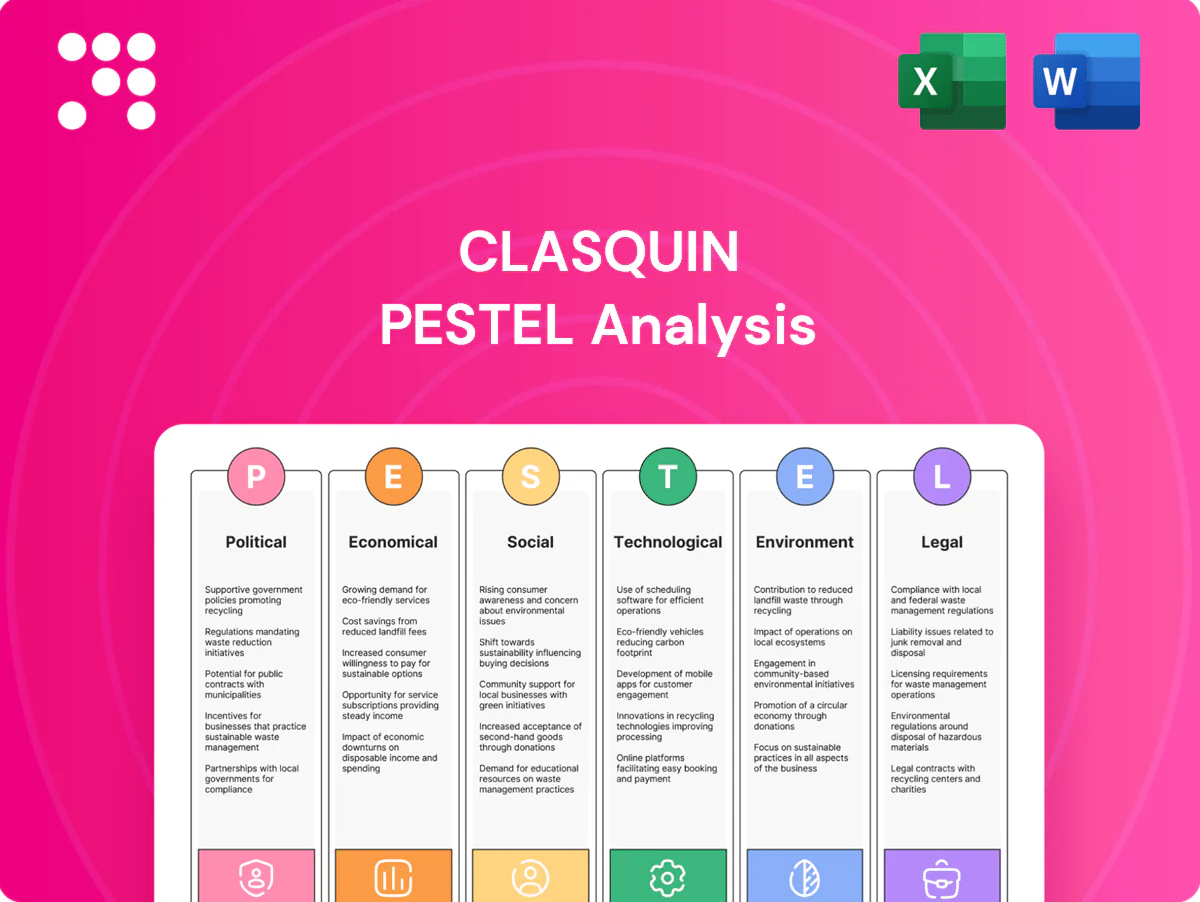
Clasquin PESTLE Analysis

Make Smarter Strategic Decisions with a Complete PESTEL View
Gain a strategic edge with our PESTLE Analysis of Clasquin. We map political, economic, social, technological, legal and environmental forces shaping its logistics operations. Ideal for investors and strategists, it's fully researched and ready to use. Buy the full report to access deep, actionable insights instantly.
Political factors

Trade policy volatility
Trade policy volatility—with over 300 regional trade agreements notified to the WTO as of 2024—shifts tariffs and FTAs, altering routing choices and potentially adding 10–20% to landed costs on affected goods. Clasquin must reconfigure networks quickly to protect margins and service levels. Proactive scenario planning and multi-origin sourcing reduce exposure. Advocacy through industry bodies helps shape practical implementation timelines.
Geopolitical tensions and sanctions
Geopolitical conflicts and sanctions since 2022 have closed or restricted key lanes, carriers and counterparties, forcing Clasquin to intensify compliance screening and use alternative corridors to keep flows moving; Marsh reported 20–30% rises in marine insurance and war-risk premiums on high-risk routes in 2023–24. Sudden insurance and security cost spikes increase operating expense; diversifying gateways and partners reduces interruption risk.

Customs and border regimes
Differing customs rules increase documentation complexity and clearance times, with many jurisdictions enforcing 24-hour pre-arrival or e-manifest filing windows that force rapid data updates.
Clasquin’s brokerage expertise accelerates throughput and helps avoid demurrage, which in practice can exceed USD 1,000 per container per day in congested ports.
Adoption of e-manifest mandates requires fast IT and process changes; strong local agency networks measurably lift first-time clearance rates and reduce rework and storage penalties.

Public infrastructure investment
Ports, airports and road funding directly shape transit times and reliability; over 90% of global trade by volume moves through ports, making port investment critical. The EU Connecting Europe Facility allocates €33.7bn (2021–27) to transport, influencing hub capacity and congestion. Bottlenecks at key hubs increase schedule risk and costs, so monitoring national infrastructure projects and engaging in public-private logistics initiatives helps Clasquin secure capacity.
- Port dependency: >90% global trade by volume
- EU transport funding: €33.7bn (CEF 2021–27)
- Risk: hub bottlenecks → higher delay costs
- Mitigation: track national projects; pursue PPPs
Government incentives for decarbonization
Subsidies, tax signals and the EU ETS extension to shipping in 2024 reshape fleet and modal choices, while Fit for 55 targets a 55% emissions cut by 2030, pushing modal shift and low-emission assets. Grants such as the EU Connecting Europe Facility (≈€33.7bn 2021–2027) and Innovation Fund reduce green tech and digitalization costs, enabling Clasquin to pilot low-carbon lanes and offer clients long-term sustainability programs.
- Influence: taxes/subsidies drive modal mix
- Funding: CEF ≈€33.7bn, Innovation Fund support
- Action: pilot low-carbon lanes
- Signal: stronger client commitment
Volatile trade and sanctions drive rapid routing shifts and low-carbon modal push
Trade policy volatility (300+ RTAs by 2024) forces rapid routing and sourcing shifts to protect margins.
Geopolitical conflicts and sanctions raised insurance/war-premiums ~20–30% in 2023–24, driving lane diversification.
Customs e-manifest mandates and port dependency (>90% trade vol) require IT and local agency strength to cut delays.
EU signals—ETS to shipping (2024) and CEF ≈€33.7bn—push modal shift and low-carbon pilots.
| Metric | Value |
|---|---|
| RTAs | 300+ |
| Port share | >90% |
| CEF | €33.7bn |
| Insurance rise | 20–30% |
What is included in the product
 Detailed Word Document
Explores how external macro-environmental factors uniquely affect Clasquin across Political, Economic, Social, Technological, Environmental and Legal dimensions, with data-backed trends and region/industry-specific examples. Designed to help executives and investors identify threats, opportunities and scenario-ready strategic insights.

 Customizable Excel Spreadsheet
A concise, visually segmented Clasquin PESTLE summary for quick referencing in meetings or presentations, easily shared across teams and dropped into slide decks.
Economic factors

Global trade cycles
Global trade cycles drive import-export volumes—goods trade plunged about 8.5% in 2020 then rebounded strongly in 2021—showing sensitivity to GDP and inventory swings that directly affect Clasquin’s regional sectoral revenues. Clasquin’s flexible cost base and variable network capacity help cushion downturns. Cross-selling of warehousing and value-added services stabilizes utilization and revenue per shipment during soft patches.
Fuel price volatility
Fuel price volatility drives bunker and airfreight surcharges that clients closely scrutinize; Brent crude averaged about 83 USD/bbl in 2024, pushing marine bunker and jet fuel costs higher. Transparent pass-through mechanisms protect Clasquin margins by linking surcharges directly to fuel indices. Hedging programs and carrier-mix optimization reduce exposure to spot spikes. Encouraging modal shifts toward rail/short-sea can lower total transport cost and fuel sensitivity.

Currency fluctuations
Multi-currency billing and cross-border costs expose Clasquin to FX risk, a market with $7.5 trillion average daily turnover according to the BIS 2022 survey. Matching revenues and expenses provides natural hedging to reduce translation and transaction exposure. Automated pricing engines can incorporate live FX via provider APIs to update rates in real time. Clear contract clauses on currency adjustments prevent billing disputes.

Capacity and freight rates
Carrier capacity cycles drove spot and contract rate dynamics through 2024–25 as carriers reactivated capacity after demand swings; space guarantees and long-term agreements gave Clasquin stability during peak disruptions. Data-led forecasting, using Xeneta and Drewry trend signals in 2024, sharpened procurement timing, while a balanced air–ocean–road portfolio smoothed volatility and protected margins.
- Capacity-cycles: 2024–25 impact
- Contracts: space guarantees for stability
- Forecasting: Xeneta/Drewry signals
- Portfolio: air/ocean/road volatility hedge
Client sector diversification
Diversification across retail, automotive, pharma and tech spreads demand risk and smooths revenue volatility for Clasquin; sector mixes helped logistics peers limit downturn exposure during 2023–24 supply shocks. Sector-specific solutions and vertical expertise increase wallet share and improve tender win rates, while monitoring KPI trends—order fill, lead time, inventory turns—guides dynamic resource allocation.
- Retail: consumer demand smoothing
- Automotive: long-term contracts, cyclical risk
- Pharma: high margin, strict compliance
- Tech: rapid growth, inventory agility
Volatile trade and sanctions drive rapid routing shifts and low-carbon modal push
Global trade swings (goods trade -8.5% in 2020; strong 2021 rebound) drive Clasquin volumes and revenue sensitivity. Brent averaged 83 USD/bbl in 2024, raising fuel surcharges mitigated by pass-throughs and hedging. FX exposure (7.5 trillion USD daily BIS turnover) and carrier capacity cycles 2024–25 require dynamic pricing and long-term space agreements.
| Factor | Metric | Implication |
|---|---|---|
| Trade | -8.5% (2020) | Volume risk |
| Fuel | Brent 83 USD/bbl (2024) | Higher surcharges |
| FX | 7.5T USD/day | Hedge need |
Preview Before You Purchase
Clasquin PESTLE Analysis
The preview shown here is the exact Clasquin PESTLE Analysis document you’ll receive after purchase—fully formatted and ready to use. This is the real file with complete content, structure, and professional layout. No placeholders or teasers; you can download the final document instantly after checkout.

Original: $10.00
-65%$10.00
$3.50Product Information
Product Information
Shipping & Returns
Shipping & Returns
Description
Make Smarter Strategic Decisions with a Complete PESTEL View
Gain a strategic edge with our PESTLE Analysis of Clasquin. We map political, economic, social, technological, legal and environmental forces shaping its logistics operations. Ideal for investors and strategists, it's fully researched and ready to use. Buy the full report to access deep, actionable insights instantly.
Political factors
Trade policy volatility
Trade policy volatility—with over 300 regional trade agreements notified to the WTO as of 2024—shifts tariffs and FTAs, altering routing choices and potentially adding 10–20% to landed costs on affected goods. Clasquin must reconfigure networks quickly to protect margins and service levels. Proactive scenario planning and multi-origin sourcing reduce exposure. Advocacy through industry bodies helps shape practical implementation timelines.
Geopolitical tensions and sanctions
Geopolitical conflicts and sanctions since 2022 have closed or restricted key lanes, carriers and counterparties, forcing Clasquin to intensify compliance screening and use alternative corridors to keep flows moving; Marsh reported 20–30% rises in marine insurance and war-risk premiums on high-risk routes in 2023–24. Sudden insurance and security cost spikes increase operating expense; diversifying gateways and partners reduces interruption risk.
Customs and border regimes
Differing customs rules increase documentation complexity and clearance times, with many jurisdictions enforcing 24-hour pre-arrival or e-manifest filing windows that force rapid data updates.
Clasquin’s brokerage expertise accelerates throughput and helps avoid demurrage, which in practice can exceed USD 1,000 per container per day in congested ports.
Adoption of e-manifest mandates requires fast IT and process changes; strong local agency networks measurably lift first-time clearance rates and reduce rework and storage penalties.
Public infrastructure investment
Ports, airports and road funding directly shape transit times and reliability; over 90% of global trade by volume moves through ports, making port investment critical. The EU Connecting Europe Facility allocates €33.7bn (2021–27) to transport, influencing hub capacity and congestion. Bottlenecks at key hubs increase schedule risk and costs, so monitoring national infrastructure projects and engaging in public-private logistics initiatives helps Clasquin secure capacity.
- Port dependency: >90% global trade by volume
- EU transport funding: €33.7bn (CEF 2021–27)
- Risk: hub bottlenecks → higher delay costs
- Mitigation: track national projects; pursue PPPs
Government incentives for decarbonization
Subsidies, tax signals and the EU ETS extension to shipping in 2024 reshape fleet and modal choices, while Fit for 55 targets a 55% emissions cut by 2030, pushing modal shift and low-emission assets. Grants such as the EU Connecting Europe Facility (≈€33.7bn 2021–2027) and Innovation Fund reduce green tech and digitalization costs, enabling Clasquin to pilot low-carbon lanes and offer clients long-term sustainability programs.
- Influence: taxes/subsidies drive modal mix
- Funding: CEF ≈€33.7bn, Innovation Fund support
- Action: pilot low-carbon lanes
- Signal: stronger client commitment
Volatile trade and sanctions drive rapid routing shifts and low-carbon modal push
Trade policy volatility (300+ RTAs by 2024) forces rapid routing and sourcing shifts to protect margins.
Geopolitical conflicts and sanctions raised insurance/war-premiums ~20–30% in 2023–24, driving lane diversification.
Customs e-manifest mandates and port dependency (>90% trade vol) require IT and local agency strength to cut delays.
EU signals—ETS to shipping (2024) and CEF ≈€33.7bn—push modal shift and low-carbon pilots.
| Metric | Value |
|---|---|
| RTAs | 300+ |
| Port share | >90% |
| CEF | €33.7bn |
| Insurance rise | 20–30% |
What is included in the product
Detailed Word Document
Explores how external macro-environmental factors uniquely affect Clasquin across Political, Economic, Social, Technological, Environmental and Legal dimensions, with data-backed trends and region/industry-specific examples. Designed to help executives and investors identify threats, opportunities and scenario-ready strategic insights.
Customizable Excel Spreadsheet
A concise, visually segmented Clasquin PESTLE summary for quick referencing in meetings or presentations, easily shared across teams and dropped into slide decks.
Economic factors
Global trade cycles
Global trade cycles drive import-export volumes—goods trade plunged about 8.5% in 2020 then rebounded strongly in 2021—showing sensitivity to GDP and inventory swings that directly affect Clasquin’s regional sectoral revenues. Clasquin’s flexible cost base and variable network capacity help cushion downturns. Cross-selling of warehousing and value-added services stabilizes utilization and revenue per shipment during soft patches.
Fuel price volatility
Fuel price volatility drives bunker and airfreight surcharges that clients closely scrutinize; Brent crude averaged about 83 USD/bbl in 2024, pushing marine bunker and jet fuel costs higher. Transparent pass-through mechanisms protect Clasquin margins by linking surcharges directly to fuel indices. Hedging programs and carrier-mix optimization reduce exposure to spot spikes. Encouraging modal shifts toward rail/short-sea can lower total transport cost and fuel sensitivity.
Currency fluctuations
Multi-currency billing and cross-border costs expose Clasquin to FX risk, a market with $7.5 trillion average daily turnover according to the BIS 2022 survey. Matching revenues and expenses provides natural hedging to reduce translation and transaction exposure. Automated pricing engines can incorporate live FX via provider APIs to update rates in real time. Clear contract clauses on currency adjustments prevent billing disputes.
Capacity and freight rates
Carrier capacity cycles drove spot and contract rate dynamics through 2024–25 as carriers reactivated capacity after demand swings; space guarantees and long-term agreements gave Clasquin stability during peak disruptions. Data-led forecasting, using Xeneta and Drewry trend signals in 2024, sharpened procurement timing, while a balanced air–ocean–road portfolio smoothed volatility and protected margins.
- Capacity-cycles: 2024–25 impact
- Contracts: space guarantees for stability
- Forecasting: Xeneta/Drewry signals
- Portfolio: air/ocean/road volatility hedge
Client sector diversification
Diversification across retail, automotive, pharma and tech spreads demand risk and smooths revenue volatility for Clasquin; sector mixes helped logistics peers limit downturn exposure during 2023–24 supply shocks. Sector-specific solutions and vertical expertise increase wallet share and improve tender win rates, while monitoring KPI trends—order fill, lead time, inventory turns—guides dynamic resource allocation.
- Retail: consumer demand smoothing
- Automotive: long-term contracts, cyclical risk
- Pharma: high margin, strict compliance
- Tech: rapid growth, inventory agility
Volatile trade and sanctions drive rapid routing shifts and low-carbon modal push
Global trade swings (goods trade -8.5% in 2020; strong 2021 rebound) drive Clasquin volumes and revenue sensitivity. Brent averaged 83 USD/bbl in 2024, raising fuel surcharges mitigated by pass-throughs and hedging. FX exposure (7.5 trillion USD daily BIS turnover) and carrier capacity cycles 2024–25 require dynamic pricing and long-term space agreements.
| Factor | Metric | Implication |
|---|---|---|
| Trade | -8.5% (2020) | Volume risk |
| Fuel | Brent 83 USD/bbl (2024) | Higher surcharges |
| FX | 7.5T USD/day | Hedge need |
Preview Before You Purchase
Clasquin PESTLE Analysis
The preview shown here is the exact Clasquin PESTLE Analysis document you’ll receive after purchase—fully formatted and ready to use. This is the real file with complete content, structure, and professional layout. No placeholders or teasers; you can download the final document instantly after checkout.











