CK Life Sciences Int’l. PESTLE Analysis

Skip the Research. Get the Strategy.
Gain a strategic edge with our PESTLE analysis of CK Life Sciences Int’l., revealing how political, economic, social, technological, legal and environmental forces shape its prospects. Actionable insights identify risks and growth levers for investors and strategists. Purchase the full report to access the complete, downloadable breakdown and turn insight into impact.
Political factors

Regulatory approval landscapes
Regulatory approval timelines differ widely: US FDA standard review targets 10 months (6 months priority), EMA centralized review ~210 days, and China NMPA median review ~12 months; ASEAN national registrations often add 18–36 months. Alignment with Hong Kong, Mainland China, US, EU, and ASEAN regulators is critical: China’s pharma market was about $198B in 2024 and ASEAN ~$43B, so policy shifts that speed or delay trials, imports, and market access materially affect time-to-market; proactive regulator engagement reduces uncertainty and shortens launch timelines.
Healthcare and agricultural policy priorities
Government funding and incentives under national plans (eg China’s 14th Five-Year Plan 2021–25) boost biotech, food-security and preventive health demand, with public procurement often privileging local crop and health innovations. WHO estimates malnutrition contributes to about 45% of child deaths, underpinning large public nutrition programs that expand addressable markets. Policy reversals or subsidy cuts can rapidly reduce revenue visibility for CK Life Sciences.

Geopolitical trade and supply-chain exposure
CK Life Sciences faces tariffs up to 25% and tightening export controls that raise costs for inputs, reagents and cross‑border sales; global container freight rates, which plunged ~70% from 2021 to 2023, show volatility but disruptions persist. China–US/EU tensions risk biotech collaboration and data sharing, while diversified sourcing and regional manufacturing reduce interruption risk. Diplomatic shifts can rapidly unlock or constrain licensing and JV opportunities.

Public R&D funding and partnerships
Public R&D funding and university partnerships lower CK Life Sciences’ marginal R&D costs and increase innovation throughput by enabling access to shared facilities, talent pipelines and translational grants; national biotech roadmaps in China and Hong Kong shape research focus and clinical priorities, aligning company pipelines with public health targets. Participation in multi‑institution consortia speeds validation and adoption, while funding cycles and election outcomes affect program continuity and milestone timing.
- Access to grants and university ties: reduces capex and time-to-proof
- National biotech roadmaps: align pipeline priorities
- Consortia participation: accelerates validation/adoption
- Funding cycles/elections: drive continuity risk
Food and biosecurity oversight
Stricter GMO, pesticide and biohazard controls force CK Life Sciences to redesign products and extend testing timelines, increasing R&D and regulatory costs.
Phytosanitary rules shape registration and exports, especially under international frameworks such as the Cartagena Protocol (173 Parties as of 2024), affecting market access.
Robust compliance enhances credibility with regulators and farmers, while breaches risk bans, fines and lasting reputational damage.
- Regulatory redesign: higher R&D/testing costs
- Market access: influenced by 173‑party Cartagena Protocol (2024)
- Compliance = credibility with regulators/farmers
- Non-compliance = bans, fines, reputational loss
Regulatory timelines, tariffs and geopolitics reshape pharma time-to-market and revenues
Regulatory timelines (US FDA 10 months/6 priority; EMA ~210 days; China NMPA ~12 months) and market size (China pharma $198B 2024; ASEAN ~$43B) critically affect CK Life Sciences’ time‑to‑market and revenues. Tariffs/export controls, China–US/EU tensions and Cartagena (173 parties, 2024) shape access, costs and JV/licensing opportunities.
| Metric | Value |
|---|---|
| FDA review | 10 mo (6 priority) |
| EMA review | ~210 days |
| NMPA review | ~12 mo |
| China pharma market | $198B (2024) |
| ASEAN market | $43B (2024) |
| Cartagena signatories | 173 (2024) |
What is included in the product
 Detailed Word Document
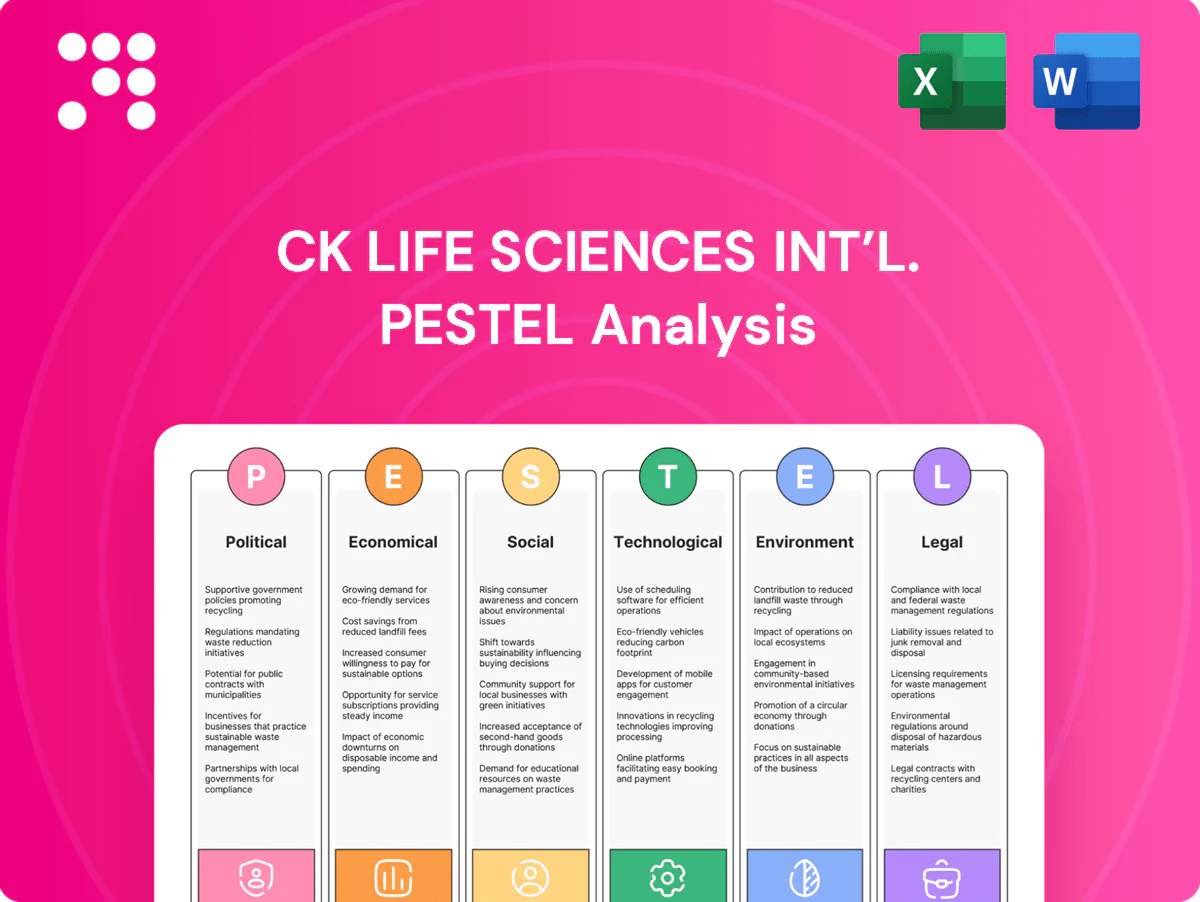
Explores how external macro-environmental factors uniquely affect CK Life Sciences Int’l across six dimensions—Political, Economic, Social, Technological, Environmental, and Legal—backed by current data and forward-looking insights to support executives, investors, and strategists with actionable risks and opportunities.

 Customizable Excel Spreadsheet
A concise, visually segmented PESTLE summary of CK Life Sciences Int’l. that’s easily dropped into presentations, shared across teams, and annotated for local context—helping streamline external risk discussions and accelerate strategic planning.
Economic factors

Macro growth and consumer spending
Asia-Pacific GDP cycles—China growth 5.2% and India 6.8% in 2024 (IMF)—directly drive demand for nutraceuticals and healthcare products, boosting volume in expansion phases.
Rising incomes support premium wellness categories, while episodic slowdowns push consumers toward value offerings and generics.
CK Life Sciences should flex its portfolio mix between premium and value lines in line with consumer sentiment and regional GDP signals.
Pricing, reimbursement, and farmer economics
Drug pricing and insurance coverage drive clinical uptake and time-to-market for CK Life Sciences' therapeutics, while farm input affordability hinges on crop prices and credit access; the World Bank fertilizer price index fell about 30% from the 2022 peak to 2024, easing input costs for growers. Demonstrated ROI is vital for agricultural adoption, and value‑based propositions can materially reduce customer churn during downcycles.

FX, interest rates, and capital costs
Revenue and cost currencies for CK Life Sciences can diverge across R&D (often USD/EUR), manufacturing (USD/CNY) and sales hubs (HKD pegged to USD within the 7.75–7.85 band), creating FX translation risk. US policy rates around 5.25–5.50% (July 2025) lift discount rates, raising WACC and compressing DCF valuations for pipelines. Active hedging of FX and interest exposure stabilises margins and capex plans. Sharp volatility can materially reprice licensing deals and M&A premiums.

Input costs and bioprocess efficiency
Rising inflation and episodic scarcity pushed bioreactor media, APIs and specialty chemicals up roughly 12–18% between 2021–2024, tightening CK Life Sciences’ input cost base.
Even modest yield gains materially expand gross margins in biologics: industry data show CMO utilization near 80–85% in 2023–24, making yield improvements highly leverageable.
Contract manufacturing rates swing with capacity cycles, while multi‑year supply contracts have been shown to cut unit cost volatility and procurement spend by double digits.
- Input inflation: 12–18% (2021–2024)
- CMO utilization: ~80–85% (2023–2024)
- Yield sensitivity: direct gross‑margin leverage
- Long‑term contracts: reduce unit cost volatility
Market structure and competition
CK Life Sciences faces intensified price pressure from big pharma, large generics and agri-input majors driving commoditization; the global generics market was roughly $300–350bn in 2024 and agrochemicals saw 5–10% annual price deflation in key segments. Strong IP and clinically superior efficacy allow premium pricing—top-tier biologics still command >30% price premiums. Ongoing consolidation shifts channel bargaining power toward larger distributors, while niche R&D focus sustains margins in crowded markets.
- Market size: generics ~300–350bn (2024)
- Price pressure: agrochemical deflation 5–10% pa
- Premiums: biologics >30% price premium
- Strategy: niche/IP protects margins
Regulatory timelines, tariffs and geopolitics reshape pharma time-to-market and revenues
Asia‑Pacific GDP (China 5.2%, India 6.8% in 2024) drives nutraceutical demand; CKLS should shift between premium and value lines with GDP signals.
Input inflation rose 12–18% (2021–24) while fertilizer prices fell ~30% (2022–24), easing some agri costs; CMO utilization ~80–85% (2023–24) magnifies yield gains.
US rates 5.25–5.50% (Jul 2025) raise WACC, FX and interest hedging critical; global generics ~$300–350bn (2024).
| Metric | Value |
|---|---|
| China GDP 2024 | 5.2% |
| India GDP 2024 | 6.8% |
| Input inflation (2021–24) | 12–18% |
| Fertilizer index change | −30% |
| CMO utilization | 80–85% |
| US policy rate (Jul 2025) | 5.25–5.50% |
| Generics market 2024 | $300–350bn |
What You See Is What You Get
CK Life Sciences Int’l. PESTLE Analysis
This preview of the CK Life Sciences Int’l. PESTLE Analysis is the exact document you’ll receive after purchase. It’s fully formatted, professionally structured, and ready to use. The content and layout shown here are identical to the file available for instant download after checkout.

Original: $10.00
-65%$10.00
$3.50Product Information
Product Information
Shipping & Returns
Shipping & Returns
Description
Skip the Research. Get the Strategy.
Gain a strategic edge with our PESTLE analysis of CK Life Sciences Int’l., revealing how political, economic, social, technological, legal and environmental forces shape its prospects. Actionable insights identify risks and growth levers for investors and strategists. Purchase the full report to access the complete, downloadable breakdown and turn insight into impact.
Political factors
Regulatory approval landscapes
Regulatory approval timelines differ widely: US FDA standard review targets 10 months (6 months priority), EMA centralized review ~210 days, and China NMPA median review ~12 months; ASEAN national registrations often add 18–36 months. Alignment with Hong Kong, Mainland China, US, EU, and ASEAN regulators is critical: China’s pharma market was about $198B in 2024 and ASEAN ~$43B, so policy shifts that speed or delay trials, imports, and market access materially affect time-to-market; proactive regulator engagement reduces uncertainty and shortens launch timelines.
Healthcare and agricultural policy priorities
Government funding and incentives under national plans (eg China’s 14th Five-Year Plan 2021–25) boost biotech, food-security and preventive health demand, with public procurement often privileging local crop and health innovations. WHO estimates malnutrition contributes to about 45% of child deaths, underpinning large public nutrition programs that expand addressable markets. Policy reversals or subsidy cuts can rapidly reduce revenue visibility for CK Life Sciences.
Geopolitical trade and supply-chain exposure
CK Life Sciences faces tariffs up to 25% and tightening export controls that raise costs for inputs, reagents and cross‑border sales; global container freight rates, which plunged ~70% from 2021 to 2023, show volatility but disruptions persist. China–US/EU tensions risk biotech collaboration and data sharing, while diversified sourcing and regional manufacturing reduce interruption risk. Diplomatic shifts can rapidly unlock or constrain licensing and JV opportunities.
Public R&D funding and partnerships
Public R&D funding and university partnerships lower CK Life Sciences’ marginal R&D costs and increase innovation throughput by enabling access to shared facilities, talent pipelines and translational grants; national biotech roadmaps in China and Hong Kong shape research focus and clinical priorities, aligning company pipelines with public health targets. Participation in multi‑institution consortia speeds validation and adoption, while funding cycles and election outcomes affect program continuity and milestone timing.
- Access to grants and university ties: reduces capex and time-to-proof
- National biotech roadmaps: align pipeline priorities
- Consortia participation: accelerates validation/adoption
- Funding cycles/elections: drive continuity risk
Food and biosecurity oversight
Stricter GMO, pesticide and biohazard controls force CK Life Sciences to redesign products and extend testing timelines, increasing R&D and regulatory costs.
Phytosanitary rules shape registration and exports, especially under international frameworks such as the Cartagena Protocol (173 Parties as of 2024), affecting market access.
Robust compliance enhances credibility with regulators and farmers, while breaches risk bans, fines and lasting reputational damage.
- Regulatory redesign: higher R&D/testing costs
- Market access: influenced by 173‑party Cartagena Protocol (2024)
- Compliance = credibility with regulators/farmers
- Non-compliance = bans, fines, reputational loss
Regulatory timelines, tariffs and geopolitics reshape pharma time-to-market and revenues
Regulatory timelines (US FDA 10 months/6 priority; EMA ~210 days; China NMPA ~12 months) and market size (China pharma $198B 2024; ASEAN ~$43B) critically affect CK Life Sciences’ time‑to‑market and revenues. Tariffs/export controls, China–US/EU tensions and Cartagena (173 parties, 2024) shape access, costs and JV/licensing opportunities.
| Metric | Value |
|---|---|
| FDA review | 10 mo (6 priority) |
| EMA review | ~210 days |
| NMPA review | ~12 mo |
| China pharma market | $198B (2024) |
| ASEAN market | $43B (2024) |
| Cartagena signatories | 173 (2024) |
What is included in the product
Detailed Word Document
Explores how external macro-environmental factors uniquely affect CK Life Sciences Int’l across six dimensions—Political, Economic, Social, Technological, Environmental, and Legal—backed by current data and forward-looking insights to support executives, investors, and strategists with actionable risks and opportunities.
Customizable Excel Spreadsheet
A concise, visually segmented PESTLE summary of CK Life Sciences Int’l. that’s easily dropped into presentations, shared across teams, and annotated for local context—helping streamline external risk discussions and accelerate strategic planning.
Economic factors
Macro growth and consumer spending
Asia-Pacific GDP cycles—China growth 5.2% and India 6.8% in 2024 (IMF)—directly drive demand for nutraceuticals and healthcare products, boosting volume in expansion phases.
Rising incomes support premium wellness categories, while episodic slowdowns push consumers toward value offerings and generics.
CK Life Sciences should flex its portfolio mix between premium and value lines in line with consumer sentiment and regional GDP signals.
Pricing, reimbursement, and farmer economics
Drug pricing and insurance coverage drive clinical uptake and time-to-market for CK Life Sciences' therapeutics, while farm input affordability hinges on crop prices and credit access; the World Bank fertilizer price index fell about 30% from the 2022 peak to 2024, easing input costs for growers. Demonstrated ROI is vital for agricultural adoption, and value‑based propositions can materially reduce customer churn during downcycles.
FX, interest rates, and capital costs
Revenue and cost currencies for CK Life Sciences can diverge across R&D (often USD/EUR), manufacturing (USD/CNY) and sales hubs (HKD pegged to USD within the 7.75–7.85 band), creating FX translation risk. US policy rates around 5.25–5.50% (July 2025) lift discount rates, raising WACC and compressing DCF valuations for pipelines. Active hedging of FX and interest exposure stabilises margins and capex plans. Sharp volatility can materially reprice licensing deals and M&A premiums.
Input costs and bioprocess efficiency
Rising inflation and episodic scarcity pushed bioreactor media, APIs and specialty chemicals up roughly 12–18% between 2021–2024, tightening CK Life Sciences’ input cost base.
Even modest yield gains materially expand gross margins in biologics: industry data show CMO utilization near 80–85% in 2023–24, making yield improvements highly leverageable.
Contract manufacturing rates swing with capacity cycles, while multi‑year supply contracts have been shown to cut unit cost volatility and procurement spend by double digits.
- Input inflation: 12–18% (2021–2024)
- CMO utilization: ~80–85% (2023–2024)
- Yield sensitivity: direct gross‑margin leverage
- Long‑term contracts: reduce unit cost volatility
Market structure and competition
CK Life Sciences faces intensified price pressure from big pharma, large generics and agri-input majors driving commoditization; the global generics market was roughly $300–350bn in 2024 and agrochemicals saw 5–10% annual price deflation in key segments. Strong IP and clinically superior efficacy allow premium pricing—top-tier biologics still command >30% price premiums. Ongoing consolidation shifts channel bargaining power toward larger distributors, while niche R&D focus sustains margins in crowded markets.
- Market size: generics ~300–350bn (2024)
- Price pressure: agrochemical deflation 5–10% pa
- Premiums: biologics >30% price premium
- Strategy: niche/IP protects margins
Regulatory timelines, tariffs and geopolitics reshape pharma time-to-market and revenues
Asia‑Pacific GDP (China 5.2%, India 6.8% in 2024) drives nutraceutical demand; CKLS should shift between premium and value lines with GDP signals.
Input inflation rose 12–18% (2021–24) while fertilizer prices fell ~30% (2022–24), easing some agri costs; CMO utilization ~80–85% (2023–24) magnifies yield gains.
US rates 5.25–5.50% (Jul 2025) raise WACC, FX and interest hedging critical; global generics ~$300–350bn (2024).
| Metric | Value |
|---|---|
| China GDP 2024 | 5.2% |
| India GDP 2024 | 6.8% |
| Input inflation (2021–24) | 12–18% |
| Fertilizer index change | −30% |
| CMO utilization | 80–85% |
| US policy rate (Jul 2025) | 5.25–5.50% |
| Generics market 2024 | $300–350bn |
What You See Is What You Get
CK Life Sciences Int’l. PESTLE Analysis
This preview of the CK Life Sciences Int’l. PESTLE Analysis is the exact document you’ll receive after purchase. It’s fully formatted, professionally structured, and ready to use. The content and layout shown here are identical to the file available for instant download after checkout.