City Union Bank PESTLE Analysis

Skip the Research. Get the Strategy.
Unlock strategic clarity with our PESTLE Analysis of City Union Bank—concise, current, and crafted for decision-makers. See how political, economic, social, technological, legal, and environmental forces reshape the bank’s outlook. Purchase the full report for deep, actionable intelligence you can use immediately.
Political factors

RBI policy direction and oversight
RBI policy—with the repo rate at 6.50% and system credit growth near 15.6% (FY24)—shapes interest rates, liquidity and prudential norms that directly affect City Union Bank margins and growth. Tightening cycles raise funding costs and can slow loan expansion, pressuring NIMs. City Union Bank must keep capital/liquidity buffers and align strategy to RBI signals. Active engagement with RBI initiatives (financial inclusion, UPI/digital rails >100bn transactions FY24) can unlock growth.
Government financial inclusion priorities
Schemes like PMJDY (over 465 million accounts with deposits >Rs 1.4 lakh crore as of 2024) plus DBT (platform covering 1,100+ schemes and channeling subsidies in the order of Rs 10+ lakh crore annually) and PM credit programs expand low-cost deposits and priority-lending flows. Participation can deepen City Union Bank’s semi-urban and rural reach where it is strong. Caps on fees and mandated product features compress margins, so strategic product design is needed to balance inclusion with returns.

Public sector banking dominance and reforms
Public sector banks still command roughly 60% of system deposits and about 58% of advances (RBI 2023-24), and ongoing recapitalisation and liquidity support have intensified price competition in retail and MSME lending. Consolidation into 12 PSBs has altered local dynamics, enabling scale pricing and footprint overlap in many CUB markets. Reform-driven efficiency gains in PSBs can compress spreads, so City Union Bank must compete on faster turnaround, superior service and niche SME/retail expertise.

Trade, agriculture, and rural development policies
Support for agriculture and MSMEs drives loan demand and credit mix in City Union Bank’s Tamil Nadu heartland; India's agriculture credit target of 20.5 lakh crore for 2024-25 boosts origination but concentrates risk. Subsidies, MSPs and credit guarantees (eg, CGTMSE) reduce borrower default probability while increasing compliance and operational costs. Policy volatility such as input subsidy changes or export restrictions can abruptly hit borrower cash flows; portfolio diversification and tighter underwriting are the bank's key mitigants.
- Geography: high agrarian exposure
- Credit target: 20.5 lakh crore (2024-25)
- Mitigants: diversification, stricter underwriting
- Headwind: subsidy/MSP volatility, compliance burden
State-level political stability
City Union Bank's branch-heavy model makes it sensitive to state-level policy and execution risks; local infrastructure spending, taxation and law-and-order shape collections and SME growth, with the 2024 election cycle having slowed some approvals and payments for SME clients.
- Concentration risk: regional branch density
- State capex and tax policy impact collections
- Election cycle delays in 2024 affected SME approvals
- Mitigation: geographic diversification and stakeholder engagement
RBI policy, inclusion and agri targets squeeze margins; repo 6.50%, deposits ~60%
RBI policy (repo 6.50%, system credit growth 15.6% FY24) and inclusion initiatives (UPI >100bn txns FY24) shape CUB margins, liquidity and product rules. PMJDY (465m accounts) and DBT expand low-cost deposits but compress fees; agriculture credit target 20.5 lakh crore (2024-25) boosts origination and concentration risk. PSBs hold ~60% deposits, intensifying price competition; geographic concentration in TN raises state-policy exposure.
| Indicator | Value |
|---|---|
| Repo rate | 6.50% |
| Credit growth FY24 | 15.6% |
| PMJDY accounts | 465m |
| Agriculture credit target 2024-25 | 20.5 lakh crore |
| PSB deposit share | ~60% |
What is included in the product
 Detailed Word Document
Explores how Political, Economic, Social, Technological, Environmental and Legal forces uniquely impact City Union Bank, combining data-driven insights and current trends to identify threats and opportunities, reflect regional market and regulatory dynamics, and deliver forward-looking guidance for executives, investors and strategists.

 Customizable Excel Spreadsheet
A concise City Union Bank PESTLE snapshot that relieves research pain by summarizing regulatory, economic, social, technological, environmental and political impacts for quick decisioning and easy inclusion in meetings or client reports.
Economic factors

Interest rate cycle and NIM sensitivity
Rate hikes (RBI repo 6.50% as of mid‑2025) lift lending yields but often lag deposit repricing, squeezing City Union Bank’s NIM (around 4.1% reported recently), while easing cycles can expand NIMs even as prepayments rise and lower loan yields. Strong ALM discipline and a granular deposit mix (CASA ~41%) are critical to limit repricing gaps. Active hedging and dynamic pricing of loans/deposits help stabilize earnings and protect margins.
GDP growth, MSME health, and credit demand
RBI projected India’s real GDP growth at about 7.0% for 2024–25, supporting retail and MSME lending that account for roughly 30% of GDP and employ ~120 million people; economic slowdowns quickly hit loan growth and raise delinquencies, so sectoral mix (trading, services, agri-linked) affects resilience, and countercyclical provisioning smooths profitability.

Inflation and household savings behavior
Surging inflation (CPI ~5.4% in FY2024-25) has pushed households toward higher-yield FDs and market alternatives, forcing banks to lift term deposit rates to around 7–8% and increasing deposit costs for City Union Bank. Higher funding costs compress NIMs as customers demand better rates while real income pressure raises credit repayment stress and asset quality risk. Strategic product bundling and loyalty incentives can help preserve low-cost CASA and stabilize spreads.

Credit quality and NPA cycles
MSME and agri loans at City Union Bank are highly sensitive to macro shocks and supply‑chain disruptions, driving slippages during downturns and raising credit costs; CUB reported GNPA around 1.0% and PCR about 74% in FY2024, supporting ROA stability through provisioning.
- High MSME/agri exposure increases cyclical slippages
- Early‑warning systems and collection efficiency sustain ROA
- Faster legal resolution improves recoveries and lowers credit cost
Forex flows and remittance trends
City Union Bank earns steady fee income from FX services and remittances as India received about 111 billion USD in remittances in 2023 (World Bank); INR volatility (USD/INR ~82 in 2024) drives treasury mark-to-market gains/losses and raises hedging costs, while import-export clients’ working capital needs shift with trade cycles; prudent FX risk management preserves non-interest income.
- Remittances scale: 111bn USD (2023)
- USD/INR ~82 (2024)
- FX fees support NII and non-interest income
- Hedging/treasury risk affects profitability
RBI policy, inclusion and agri targets squeeze margins; repo 6.50%, deposits ~60%
Rate hikes (RBI repo 6.50% mid‑2025) lift yields but squeeze NIM (~4.1%) as deposit repricing lags; CASA ~41% and strong ALM/hedging protect margins. India GDP ~7.0% (2024–25) supports retail/MSME lending but high CPI ~5.4% raises deposit costs (term rates ~7–8%) and asset‑quality risk (GNPA ~1.0%, PCR ~74%). Remittances 111bn USD (2023), USD/INR ~82 add FX volatility and fee income.
| Metric | Value |
|---|---|
| RBI repo | 6.50% |
| NIM | ~4.1% |
| CASA | ~41% |
| GDP growth | ~7.0% |
| CPI | ~5.4% |
| GNPA/PCR | 1.0% / 74% |
| Remittances | 111bn USD |
| USD/INR | ~82 |
Full Version Awaits
City Union Bank PESTLE Analysis
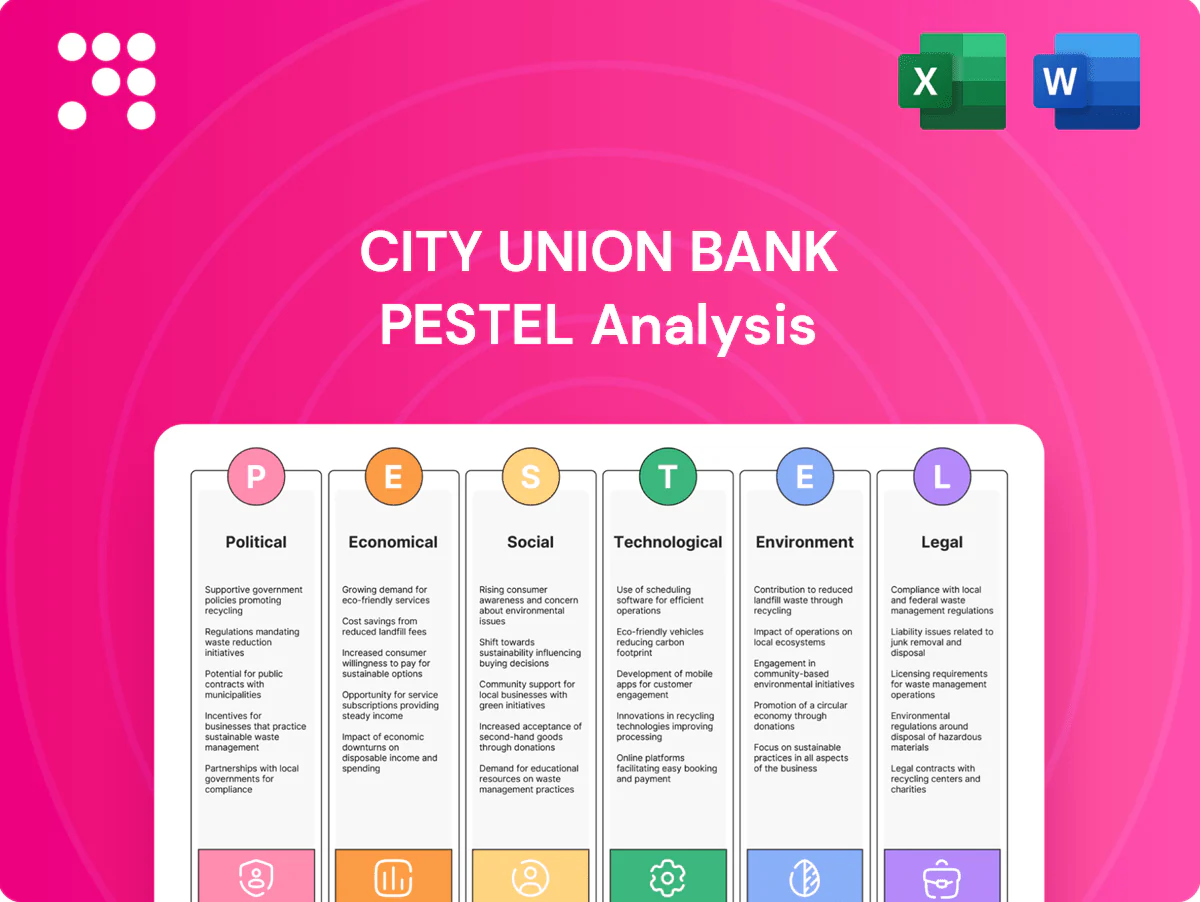
The City Union Bank PESTLE Analysis preview shown here is the exact document you’ll receive after purchase—fully formatted and ready to use. It covers political, economic, social, technological, legal, and environmental factors impacting the bank. No placeholders or surprises; the content and structure match the downloadable file. Use it immediately after checkout.

Original: $10.00
-65%$10.00
$3.50Product Information
Product Information
Shipping & Returns
Shipping & Returns
Description
Skip the Research. Get the Strategy.
Unlock strategic clarity with our PESTLE Analysis of City Union Bank—concise, current, and crafted for decision-makers. See how political, economic, social, technological, legal, and environmental forces reshape the bank’s outlook. Purchase the full report for deep, actionable intelligence you can use immediately.
Political factors
RBI policy direction and oversight
RBI policy—with the repo rate at 6.50% and system credit growth near 15.6% (FY24)—shapes interest rates, liquidity and prudential norms that directly affect City Union Bank margins and growth. Tightening cycles raise funding costs and can slow loan expansion, pressuring NIMs. City Union Bank must keep capital/liquidity buffers and align strategy to RBI signals. Active engagement with RBI initiatives (financial inclusion, UPI/digital rails >100bn transactions FY24) can unlock growth.
Government financial inclusion priorities
Schemes like PMJDY (over 465 million accounts with deposits >Rs 1.4 lakh crore as of 2024) plus DBT (platform covering 1,100+ schemes and channeling subsidies in the order of Rs 10+ lakh crore annually) and PM credit programs expand low-cost deposits and priority-lending flows. Participation can deepen City Union Bank’s semi-urban and rural reach where it is strong. Caps on fees and mandated product features compress margins, so strategic product design is needed to balance inclusion with returns.
Public sector banking dominance and reforms
Public sector banks still command roughly 60% of system deposits and about 58% of advances (RBI 2023-24), and ongoing recapitalisation and liquidity support have intensified price competition in retail and MSME lending. Consolidation into 12 PSBs has altered local dynamics, enabling scale pricing and footprint overlap in many CUB markets. Reform-driven efficiency gains in PSBs can compress spreads, so City Union Bank must compete on faster turnaround, superior service and niche SME/retail expertise.
Trade, agriculture, and rural development policies
Support for agriculture and MSMEs drives loan demand and credit mix in City Union Bank’s Tamil Nadu heartland; India's agriculture credit target of 20.5 lakh crore for 2024-25 boosts origination but concentrates risk. Subsidies, MSPs and credit guarantees (eg, CGTMSE) reduce borrower default probability while increasing compliance and operational costs. Policy volatility such as input subsidy changes or export restrictions can abruptly hit borrower cash flows; portfolio diversification and tighter underwriting are the bank's key mitigants.
- Geography: high agrarian exposure
- Credit target: 20.5 lakh crore (2024-25)
- Mitigants: diversification, stricter underwriting
- Headwind: subsidy/MSP volatility, compliance burden
State-level political stability
City Union Bank's branch-heavy model makes it sensitive to state-level policy and execution risks; local infrastructure spending, taxation and law-and-order shape collections and SME growth, with the 2024 election cycle having slowed some approvals and payments for SME clients.
- Concentration risk: regional branch density
- State capex and tax policy impact collections
- Election cycle delays in 2024 affected SME approvals
- Mitigation: geographic diversification and stakeholder engagement
RBI policy, inclusion and agri targets squeeze margins; repo 6.50%, deposits ~60%
RBI policy (repo 6.50%, system credit growth 15.6% FY24) and inclusion initiatives (UPI >100bn txns FY24) shape CUB margins, liquidity and product rules. PMJDY (465m accounts) and DBT expand low-cost deposits but compress fees; agriculture credit target 20.5 lakh crore (2024-25) boosts origination and concentration risk. PSBs hold ~60% deposits, intensifying price competition; geographic concentration in TN raises state-policy exposure.
| Indicator | Value |
|---|---|
| Repo rate | 6.50% |
| Credit growth FY24 | 15.6% |
| PMJDY accounts | 465m |
| Agriculture credit target 2024-25 | 20.5 lakh crore |
| PSB deposit share | ~60% |
What is included in the product
Detailed Word Document
Explores how Political, Economic, Social, Technological, Environmental and Legal forces uniquely impact City Union Bank, combining data-driven insights and current trends to identify threats and opportunities, reflect regional market and regulatory dynamics, and deliver forward-looking guidance for executives, investors and strategists.
Customizable Excel Spreadsheet
A concise City Union Bank PESTLE snapshot that relieves research pain by summarizing regulatory, economic, social, technological, environmental and political impacts for quick decisioning and easy inclusion in meetings or client reports.
Economic factors
Interest rate cycle and NIM sensitivity
Rate hikes (RBI repo 6.50% as of mid‑2025) lift lending yields but often lag deposit repricing, squeezing City Union Bank’s NIM (around 4.1% reported recently), while easing cycles can expand NIMs even as prepayments rise and lower loan yields. Strong ALM discipline and a granular deposit mix (CASA ~41%) are critical to limit repricing gaps. Active hedging and dynamic pricing of loans/deposits help stabilize earnings and protect margins.
GDP growth, MSME health, and credit demand
RBI projected India’s real GDP growth at about 7.0% for 2024–25, supporting retail and MSME lending that account for roughly 30% of GDP and employ ~120 million people; economic slowdowns quickly hit loan growth and raise delinquencies, so sectoral mix (trading, services, agri-linked) affects resilience, and countercyclical provisioning smooths profitability.
Inflation and household savings behavior
Surging inflation (CPI ~5.4% in FY2024-25) has pushed households toward higher-yield FDs and market alternatives, forcing banks to lift term deposit rates to around 7–8% and increasing deposit costs for City Union Bank. Higher funding costs compress NIMs as customers demand better rates while real income pressure raises credit repayment stress and asset quality risk. Strategic product bundling and loyalty incentives can help preserve low-cost CASA and stabilize spreads.
Credit quality and NPA cycles
MSME and agri loans at City Union Bank are highly sensitive to macro shocks and supply‑chain disruptions, driving slippages during downturns and raising credit costs; CUB reported GNPA around 1.0% and PCR about 74% in FY2024, supporting ROA stability through provisioning.
- High MSME/agri exposure increases cyclical slippages
- Early‑warning systems and collection efficiency sustain ROA
- Faster legal resolution improves recoveries and lowers credit cost
Forex flows and remittance trends
City Union Bank earns steady fee income from FX services and remittances as India received about 111 billion USD in remittances in 2023 (World Bank); INR volatility (USD/INR ~82 in 2024) drives treasury mark-to-market gains/losses and raises hedging costs, while import-export clients’ working capital needs shift with trade cycles; prudent FX risk management preserves non-interest income.
- Remittances scale: 111bn USD (2023)
- USD/INR ~82 (2024)
- FX fees support NII and non-interest income
- Hedging/treasury risk affects profitability
RBI policy, inclusion and agri targets squeeze margins; repo 6.50%, deposits ~60%
Rate hikes (RBI repo 6.50% mid‑2025) lift yields but squeeze NIM (~4.1%) as deposit repricing lags; CASA ~41% and strong ALM/hedging protect margins. India GDP ~7.0% (2024–25) supports retail/MSME lending but high CPI ~5.4% raises deposit costs (term rates ~7–8%) and asset‑quality risk (GNPA ~1.0%, PCR ~74%). Remittances 111bn USD (2023), USD/INR ~82 add FX volatility and fee income.
| Metric | Value |
|---|---|
| RBI repo | 6.50% |
| NIM | ~4.1% |
| CASA | ~41% |
| GDP growth | ~7.0% |
| CPI | ~5.4% |
| GNPA/PCR | 1.0% / 74% |
| Remittances | 111bn USD |
| USD/INR | ~82 |
Full Version Awaits
City Union Bank PESTLE Analysis
The City Union Bank PESTLE Analysis preview shown here is the exact document you’ll receive after purchase—fully formatted and ready to use. It covers political, economic, social, technological, legal, and environmental factors impacting the bank. No placeholders or surprises; the content and structure match the downloadable file. Use it immediately after checkout.