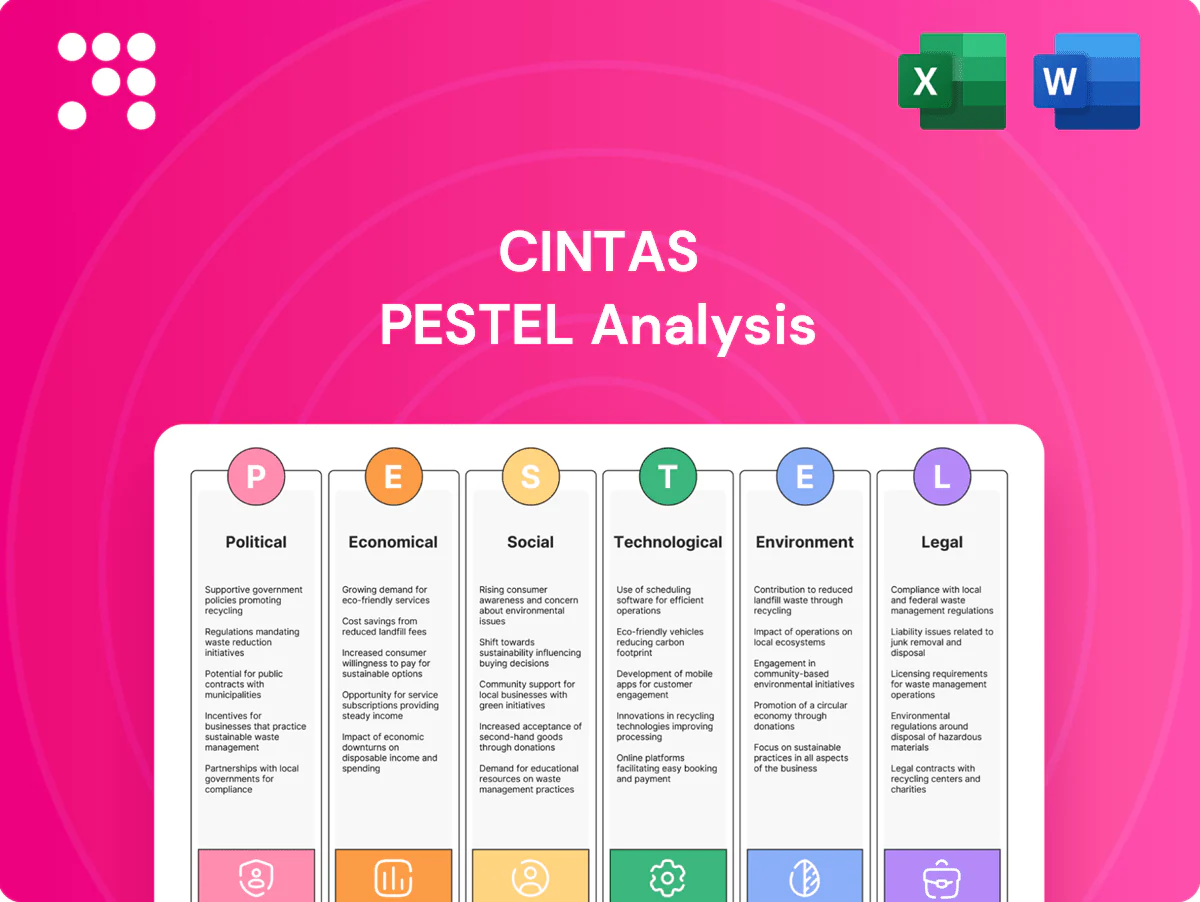
Cintas PESTLE Analysis

Your Competitive Advantage Starts with This Report
Unlock how political, economic, social, technological, legal and environmental forces are reshaping Cintas’s competitive edge, operational risks, and growth opportunities. Our PESTLE distills these trends into strategic insights you can act on today. Purchase the full analysis for the complete, editable report and immediate intelligence for investment or strategy decisions.
Political factors

Regulatory climate for workplace safety
Government emphasis on occupational safety—reflected in OSHA budget rises (about $1.4B in recent appropriations) and stronger rulemaking—boosts demand for first aid, PPE and compliance services, increasing addressable market (global PPE market ~62B in 2023). Changes in inspections and standards can expand or contract opportunities; political shifts favoring enforcement raise recurring revenue potential across Cintas’ safety and fire-protection lines, while reduced enforcement pressures pricing and growth, impacting Cintas’ ~8.7B FY2024 revenue base.
Trade policy and textile tariffs
Tariffs on textiles and garments, including US Section 301 measures that have imposed duties up to 25%, directly raise uniform input costs and compress margins for Cintas. USMCA, in force since July 1, 2020, supports stable North American sourcing and nearshoring, but rising geopolitical tensions (e.g., supply disruptions from Asia) can still interrupt supply. Federal policy incentives encouraging reshoring increase the case for domestic manufacturing investment. This volatility requires diversified sourcing and agile pricing to protect margins.

Public sector procurement and infrastructure spend
Government budgets for infrastructure, healthcare, and public safety directly drive uniform and safety service volumes; Cintas reported fiscal 2024 revenue of about 8.9 billion, showing sensitivity to public-sector demand. The Bipartisan Infrastructure Law commits roughly 550 billion in new investments through 2026, boosting demand for mats, restroom supplies, first aid and fire protection. Strong Buy American procurement rules force domestic sourcing and shape bidding strategies, while project delays or budget cuts quickly dampen municipal and federal order pipelines.

Minimum wage and labor policy
- Federal min wage: 7.25 USD (since 2009)
- Higher local wages increase route & plant labor costs
- Overtime/scheduling mandates raise operating complexity
- Lower turnover from better labor policies boosts service quality
Environmental policy incentives
Clean energy credits and water-use rules are reshaping Cintas plant utilities and fleet strategy; Cintas reported fiscal 2024 revenue of about $8.84 billion, so efficiency and fuel savings materially affect margins. Policy support from the Inflation Reduction Act lowers long-term operating costs for fleet electrification and reduces scope 1 emissions. Stricter wastewater and chemical discharge rules force investments in advanced laundry technology, creating compliance costs but also potential competitive differentiation.
- IRA incentives accelerate fleet EV adoption, lowering lifetime fuel/O&M
- US transport sector ~29% of GHGs, increasing regulatory focus
- Water-use and discharge limits drive capital spend on water-saving washers
- Compliance = cost + differentiation opportunity
OSHA enforcement, $1.4B safety budgets boost PPE demand amid tariffs
Stronger OSHA enforcement and rising safety budgets (~$1.4B) boost demand for PPE and compliance services (global PPE market ~$62B in 2023), supporting Cintas’ ~$8.84B FY2024 revenue. Tariffs (up to 25%) and USMCA/reshoring incentives shift sourcing costs and margin risk. Infrastructure spending (~$550B) and Buy American rules lift public-sector demand; state wage hikes raise labor costs, pressuring pricing and productivity.
| Metric | Value |
|---|---|
| FY2024 revenue | $8.84B |
| OSHA budget | $1.4B |
| Global PPE market (2023) | $62B |
| Infrastructure funding | $550B |
What is included in the product
 Detailed Word Document
Explores how external macro-environmental factors uniquely affect Cintas across Political, Economic, Social, Technological, Environmental and Legal dimensions, with data-backed trends, practical implications for strategy, and forward-looking insights to support executives and investors.

 Customizable Excel Spreadsheet
A concise, visually segmented Cintas PESTLE that’s easily shared and editable for meetings, presentations, or client reports—helping teams quickly align on external risks, market positioning, and action plans.
Economic factors

Business cycle sensitivity
Uniform rentals and facility services track employment and new business openings; Cintas (CTAS) reported about $8.8 billion in revenue in FY2024, reflecting this sensitivity. Recessions typically cut wearer counts and visit frequency, while expansions lift volumes. Cintas’ mix—uniforms, facility services, first aid/safety—buffers downturns but cannot fully offset broad slowdowns. Regional differences drive route density and asset utilization variability.
Input costs: textiles, chemicals, and fuel
Cotton futures near $0.90/lb and polyester feedstock around $1.20/lb in mid-2025, while detergent chemical input costs remain elevated after post-pandemic supply tightness, directly pressuring unit economics. U.S. diesel averaged about $3.80/gal mid-2025 and industrial electricity rose roughly 6% YoY in 2024, squeezing route and plant margins. Fuel surcharges and contract repricing offset spikes but timing lags can compress quarterly profits. Hedging programs and efficiency investments (route optimization, wash-tech) mitigate volatility.

Interest rates and capital intensity
Higher policy rates (~5.25% in mid‑2025) increase financing costs for Cintas fleet leases, facility debt and M&A, and force capital projects and plant automation to clear higher hurdle rates. With FY2024 revenue ≈ $8.8B and trailing free cash flow above $1B, Cintas’ pricing power supports continued reinvestment despite rate headwinds. If rates fall, valuation multiples and expansion optionality for bolt‑on M&A materially improve.

SMB formation and churn
Cintas depends heavily on small and mid-sized customers for recurring revenue, reporting $8.98 billion in FY2024 while serving over one million businesses; rising new SMB formation increases demand for uniform and facility service contracts. SBA data show about 20% of small businesses fail within year one and roughly 50% by year five, raising churn and bad-debt risk. Flexible contract terms and cross-selling (uniforms, mats, PPE, first aid) boost customer lifetime value.
- SMB reliance: >1M customers
- FY2024 revenue: $8.98B
- SMB failure: ~20% year‑1, ~50% year‑5 (SBA)
- Mitigants: flexible terms, cross-sell
Labor market tightness
Tight US labor markets (unemployment ~3.7% in 2024) push up wages and recruiting costs for Cintas route drivers and plant staff, while average hourly earnings rose roughly 4% year-over-year in 2024, making productivity tools and automation more economically attractive. Customers facing labor scarcity outsource more non-core tasks, supporting demand for Cintas services; easing tightness would help normalize cost pressures.
- Higher wages: rising payroll costs
- Automation: capex/ROI improves
- Outsourcing: demand tailwind
- Easing labor: cost normalization
OSHA enforcement, $1.4B safety budgets boost PPE demand amid tariffs
Cintas (FY2024 revenue: $8.98B) is cyclical with demand tied to employment and SMB formation; >1M customers concentrate SMB churn risk. Input pressure: cotton ~$0.90/lb, polyester ~$1.20/lb, diesel ~$3.80/gal (mid‑2025). Policy rates ~5.25% raise financing costs but pricing power and >$1B FCF support reinvestment.
| Metric | Value |
|---|---|
| FY2024 revenue | $8.98B |
| Customers | >1M |
| Unemployment (2024) | ~3.7% |
| Fed funds (mid‑2025) | ~5.25% |
| Cotton (mid‑2025) | ~$0.90/lb |
| Diesel (mid‑2025) | ~$3.80/gal |
| SMB failure | ~20% yr1 / ~50% yr5 |
Same Document Delivered
Cintas PESTLE Analysis
This Cintas PESTLE Analysis preview is the exact document you’ll receive after purchase — fully formatted, professionally structured, and ready to use. The content, layout, and insights shown here are the final version with no placeholders. After checkout you’ll instantly download this same file.

Original: $10.00
-65%$10.00
$3.50Product Information
Product Information
Shipping & Returns
Shipping & Returns
Description
Your Competitive Advantage Starts with This Report
Unlock how political, economic, social, technological, legal and environmental forces are reshaping Cintas’s competitive edge, operational risks, and growth opportunities. Our PESTLE distills these trends into strategic insights you can act on today. Purchase the full analysis for the complete, editable report and immediate intelligence for investment or strategy decisions.
Political factors
Regulatory climate for workplace safety
Government emphasis on occupational safety—reflected in OSHA budget rises (about $1.4B in recent appropriations) and stronger rulemaking—boosts demand for first aid, PPE and compliance services, increasing addressable market (global PPE market ~62B in 2023). Changes in inspections and standards can expand or contract opportunities; political shifts favoring enforcement raise recurring revenue potential across Cintas’ safety and fire-protection lines, while reduced enforcement pressures pricing and growth, impacting Cintas’ ~8.7B FY2024 revenue base.
Trade policy and textile tariffs
Tariffs on textiles and garments, including US Section 301 measures that have imposed duties up to 25%, directly raise uniform input costs and compress margins for Cintas. USMCA, in force since July 1, 2020, supports stable North American sourcing and nearshoring, but rising geopolitical tensions (e.g., supply disruptions from Asia) can still interrupt supply. Federal policy incentives encouraging reshoring increase the case for domestic manufacturing investment. This volatility requires diversified sourcing and agile pricing to protect margins.
Public sector procurement and infrastructure spend
Government budgets for infrastructure, healthcare, and public safety directly drive uniform and safety service volumes; Cintas reported fiscal 2024 revenue of about 8.9 billion, showing sensitivity to public-sector demand. The Bipartisan Infrastructure Law commits roughly 550 billion in new investments through 2026, boosting demand for mats, restroom supplies, first aid and fire protection. Strong Buy American procurement rules force domestic sourcing and shape bidding strategies, while project delays or budget cuts quickly dampen municipal and federal order pipelines.
Minimum wage and labor policy
- Federal min wage: 7.25 USD (since 2009)
- Higher local wages increase route & plant labor costs
- Overtime/scheduling mandates raise operating complexity
- Lower turnover from better labor policies boosts service quality
Environmental policy incentives
Clean energy credits and water-use rules are reshaping Cintas plant utilities and fleet strategy; Cintas reported fiscal 2024 revenue of about $8.84 billion, so efficiency and fuel savings materially affect margins. Policy support from the Inflation Reduction Act lowers long-term operating costs for fleet electrification and reduces scope 1 emissions. Stricter wastewater and chemical discharge rules force investments in advanced laundry technology, creating compliance costs but also potential competitive differentiation.
- IRA incentives accelerate fleet EV adoption, lowering lifetime fuel/O&M
- US transport sector ~29% of GHGs, increasing regulatory focus
- Water-use and discharge limits drive capital spend on water-saving washers
- Compliance = cost + differentiation opportunity
OSHA enforcement, $1.4B safety budgets boost PPE demand amid tariffs
Stronger OSHA enforcement and rising safety budgets (~$1.4B) boost demand for PPE and compliance services (global PPE market ~$62B in 2023), supporting Cintas’ ~$8.84B FY2024 revenue. Tariffs (up to 25%) and USMCA/reshoring incentives shift sourcing costs and margin risk. Infrastructure spending (~$550B) and Buy American rules lift public-sector demand; state wage hikes raise labor costs, pressuring pricing and productivity.
| Metric | Value |
|---|---|
| FY2024 revenue | $8.84B |
| OSHA budget | $1.4B |
| Global PPE market (2023) | $62B |
| Infrastructure funding | $550B |
What is included in the product
Detailed Word Document
Explores how external macro-environmental factors uniquely affect Cintas across Political, Economic, Social, Technological, Environmental and Legal dimensions, with data-backed trends, practical implications for strategy, and forward-looking insights to support executives and investors.
Customizable Excel Spreadsheet
A concise, visually segmented Cintas PESTLE that’s easily shared and editable for meetings, presentations, or client reports—helping teams quickly align on external risks, market positioning, and action plans.
Economic factors
Business cycle sensitivity
Uniform rentals and facility services track employment and new business openings; Cintas (CTAS) reported about $8.8 billion in revenue in FY2024, reflecting this sensitivity. Recessions typically cut wearer counts and visit frequency, while expansions lift volumes. Cintas’ mix—uniforms, facility services, first aid/safety—buffers downturns but cannot fully offset broad slowdowns. Regional differences drive route density and asset utilization variability.
Input costs: textiles, chemicals, and fuel
Cotton futures near $0.90/lb and polyester feedstock around $1.20/lb in mid-2025, while detergent chemical input costs remain elevated after post-pandemic supply tightness, directly pressuring unit economics. U.S. diesel averaged about $3.80/gal mid-2025 and industrial electricity rose roughly 6% YoY in 2024, squeezing route and plant margins. Fuel surcharges and contract repricing offset spikes but timing lags can compress quarterly profits. Hedging programs and efficiency investments (route optimization, wash-tech) mitigate volatility.
Interest rates and capital intensity
Higher policy rates (~5.25% in mid‑2025) increase financing costs for Cintas fleet leases, facility debt and M&A, and force capital projects and plant automation to clear higher hurdle rates. With FY2024 revenue ≈ $8.8B and trailing free cash flow above $1B, Cintas’ pricing power supports continued reinvestment despite rate headwinds. If rates fall, valuation multiples and expansion optionality for bolt‑on M&A materially improve.
SMB formation and churn
Cintas depends heavily on small and mid-sized customers for recurring revenue, reporting $8.98 billion in FY2024 while serving over one million businesses; rising new SMB formation increases demand for uniform and facility service contracts. SBA data show about 20% of small businesses fail within year one and roughly 50% by year five, raising churn and bad-debt risk. Flexible contract terms and cross-selling (uniforms, mats, PPE, first aid) boost customer lifetime value.
- SMB reliance: >1M customers
- FY2024 revenue: $8.98B
- SMB failure: ~20% year‑1, ~50% year‑5 (SBA)
- Mitigants: flexible terms, cross-sell
Labor market tightness
Tight US labor markets (unemployment ~3.7% in 2024) push up wages and recruiting costs for Cintas route drivers and plant staff, while average hourly earnings rose roughly 4% year-over-year in 2024, making productivity tools and automation more economically attractive. Customers facing labor scarcity outsource more non-core tasks, supporting demand for Cintas services; easing tightness would help normalize cost pressures.
- Higher wages: rising payroll costs
- Automation: capex/ROI improves
- Outsourcing: demand tailwind
- Easing labor: cost normalization
OSHA enforcement, $1.4B safety budgets boost PPE demand amid tariffs
Cintas (FY2024 revenue: $8.98B) is cyclical with demand tied to employment and SMB formation; >1M customers concentrate SMB churn risk. Input pressure: cotton ~$0.90/lb, polyester ~$1.20/lb, diesel ~$3.80/gal (mid‑2025). Policy rates ~5.25% raise financing costs but pricing power and >$1B FCF support reinvestment.
| Metric | Value |
|---|---|
| FY2024 revenue | $8.98B |
| Customers | >1M |
| Unemployment (2024) | ~3.7% |
| Fed funds (mid‑2025) | ~5.25% |
| Cotton (mid‑2025) | ~$0.90/lb |
| Diesel (mid‑2025) | ~$3.80/gal |
| SMB failure | ~20% yr1 / ~50% yr5 |
Same Document Delivered
Cintas PESTLE Analysis
This Cintas PESTLE Analysis preview is the exact document you’ll receive after purchase — fully formatted, professionally structured, and ready to use. The content, layout, and insights shown here are the final version with no placeholders. After checkout you’ll instantly download this same file.