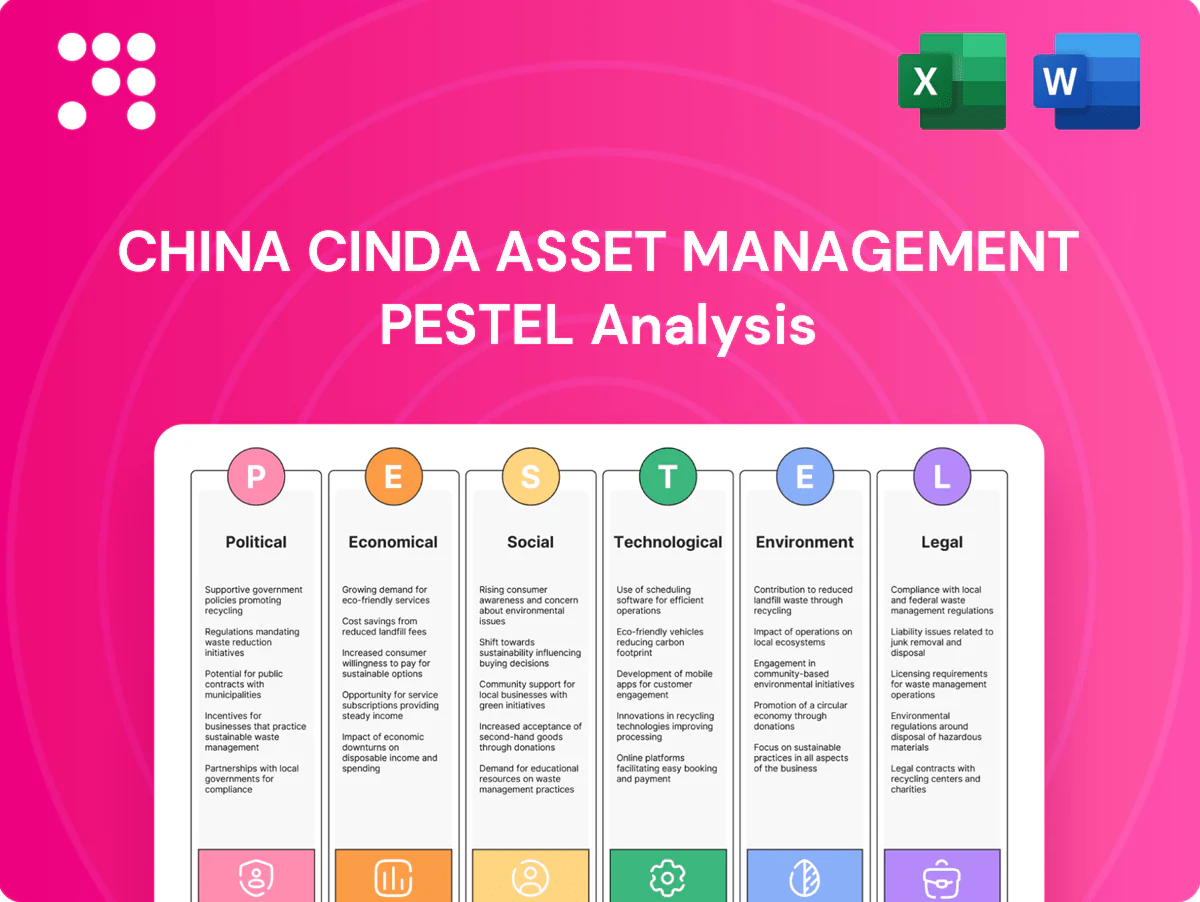
China Cinda Asset Management PESTLE Analysis

Skip the Research. Get the Strategy.
Discover how political shifts, economic cycles, social trends, technological advances, legal changes, and environmental pressures are reshaping China Cinda Asset Management’s prospects in our concise PESTLE overview. This snapshot highlights key risks and opportunities for investors and strategists. Purchase the full PESTLE analysis to access detailed, actionable intelligence and downloadable templates.
Political factors

State ownership and policy mandate
As a centrally originated AMC (one of four national AMCs established in 1999 and listed in Hong Kong in 2013), Cinda aligns with Beijing’s priority of financial risk prevention and avoiding disorderly defaults. Policy backing unlocks deal flow and state-linked funding channels but imposes quasi-policy tasks and return constraints. Execution speed often follows political timetables, and shifts in central directives can rapidly reweight sector focus and workout strategies.
Deleveraging and risk rectification cycles
Macro‑prudential deleveraging since 2020 has driven waves of NPL disposals across banks, property firms and LGFVs, with banks' reported NPL ratio near 1.7% and LGFV debts estimated around RMB 50 trillion shaping supply. Campaign intensity dictates asset flow, pricing power and resolution timelines; peak campaigns flood markets, widening opportunity sets but compressing margins via policy pricing. When cycles ease inventory falls and recoveries improve, raising realized recovery rates for managers like Cinda.

Property rescue and local government debt policy
Central-local housing-stabilization and LGFV liability-restructuring programs directly shape Cinda’s deal pipeline, given China’s LGFV debt estimated at RMB 50–60 trillion by end-2023. Government-backed restructuring frameworks piloted in 2023–24 can standardize terms and shorten negotiation timelines. Political sensitivity over housing and employment caps hard enforcement, while regional fiscal disparities create heterogeneous asset outcomes.

Geopolitics and foreign capital sentiment
US-China tensions and expanded 2023–24 export controls raise sanctions risk and tighten outbound/inbound investment rules, lifting funding costs and narrowing exit options for China Cinda; lower foreign participation—foreign holdings of onshore equities roughly 6% in 2024—can widen bid-ask spreads for distressed assets, while China’s $3.1tn FX reserves and state funds create potential state-linked exit routes; external shocks spawn new distress cohorts.
- Sanctions risk: tighter export controls 2023–24
- Foreign participation: ~6% A-share ownership (2024)
- Sovereign capacity: $3.1tn FX reserves (end-2024)
- Impact: wider spreads, constrained exits, state-backed routes
Regulatory coordination and supervision intensity
Coordination among CBIRC, the NFRA (established 2023), PBOC and NDRC directs workout tools and capital rules, with PBOC macroprudential levers and NDRC industrial priorities shaping recoveries. Heightened scrutiny on shadow finance tightened counterparties’ liquidity, contributing to China's banking NPL ratio of 1.59% at end-2023 and raising NPL inflows to AMCs. Supervisory guidance broadening AMC scope has enabled Cinda to pursue diversified special-situations plays, while abrupt rule recalibrations have stranded partially executed deals and increased execution risk.
State-linked status secures policy deal flow and funding amid rising NPLs and LGFV stress
Cinda’s state-linked status secures policy deal flow and state funding but enforces quasi-policy mandates and timing constraints. Macro‑prudential deleveraging since 2020 increased NPL supply (bank NPL 1.59% end‑2023) and LGFV stress (RMB 50–60tn), widening opportunities but compressing margins during peak campaigns. External pressures—US export controls, ~6% foreign A‑share ownership (2024), $3.1tn FX reserves (end‑2024)—tighten exits yet enable state‑backed routes.
| Indicator | Value |
|---|---|
| Bank NPL ratio (end‑2023) | 1.59% |
| LGFV debt (est. end‑2023) | RMB 50–60tn |
| Foreign A‑share ownership (2024) | ~6% |
| FX reserves (end‑2024) | $3.1tn |
What is included in the product
 Detailed Word Document
Explores how macro-environmental forces shape China Cinda Asset Management across Political, Economic, Social, Technological, Environmental, and Legal dimensions, with data-driven trends, practical sub-points, forward-looking insights and scenario implications to help executives, investors and strategists identify risks and opportunities in China’s distressed-asset and financial services landscape.

 Customizable Excel Spreadsheet
A concise, visually segmented PESTLE summary of China Cinda that can be dropped into presentations, annotated for local context, and quickly shared across teams to support external risk discussions and strategic planning.
Economic factors

Growth moderation and cyclical stress
Slower GDP growth (about 4.5% in 2024) and weak private fixed‑investment (down roughly 1% y/y) elevate default risk across manufacturing, property and SMEs, pushing distress supply higher while recovery values compress in downcycles. Distressed asset inventory rose in 2024 as property investment fell near 6% y/y, requiring sector rotation and agile underwriting models to manage shifting loss severities. Macro stabilization in 2025 has begun to improve exit pricing and shorten holding periods, raising recovery prospects.
Property market correction
Developers’ liquidity crunch has driven a surge of land and project collateral into Cinda’s books, with distressed asset intake rising sharply in 2024 H1 as financing tightened after the 2021–23 defaults wave; illiquid inventory and localized price declines—often exceeding 10–20% in weaker lower‑tier markets—have materially impaired collateral coverage ratios. Government completion guarantees and directed funding have reprioritized cash flow waterfalls toward project completion, while stabilization in first‑tier cities versus deep corrections in third/fourth tiers makes micro‑location asset selection critical.

Local government and LGFV refinancing
Ballooning LGFV maturities—with outstanding LGFV debt estimated at over CNY 40 trillion—plus weakened land-sale revenues have tightened refinancing, forcing exchanges, extensions and haircut negotiations across multi‑creditor deals. Cinda can intermediate via debt‑to‑equity swaps or asset transfers to restructure paper. Variance in local fiscal capacity dictates which workouts succeed.

Interest rate and liquidity conditions
Policy-rate moves and targeted relending have kept funding costs low—1-year LPR ~3.65% and 5-year LPR ~4.30% (H1 2025), supporting carry; ample liquidity (M2 growth ~8–9% in 2024) enables securitization exits, while tighter windows enforce loan-on-loan pricing discipline. RMB swings (USD/CNY ~6.9–7.2 in 2024–H1 2025) change cross-border exit economics. Flatter/steeper yield curve (10y gov bond ~2.9%) shifts NPV of long-tail recoveries.
- Funding cost: 1y LPR ~3.65%
- Carry/liquidity: M2 growth ~8–9%
- FX risk: USD/CNY ~6.9–7.2
- Valuation: 10y yield ~2.9% affects long-tail NPV
Private sector confidence and consumption
Muted private-sector confidence reduces operating cash flows of obligors and slows recoveries, while improving consumption and capex in 2024–2025 has revived restructuring plans and IPO exit pipelines. SMEs, which generate roughly 60% of GDP and about 80% of urban employment, directly affect small-ticket NPL pools. Confidence swings also shift auction absorption rates materially.
- Muted demand → weaker cash flow, slower recoveries
- 2024–25 capex/consumption rebound supports restructurings and IPOs
- SMEs ~60% GDP, ~80% employment → small-ticket NPL sensitivity
- Confidence volatility alters auction absorption rates
State-linked status secures policy deal flow and funding amid rising NPLs and LGFV stress
Slower GDP (~4.5% in 2024) and property investment down ~6% raise default risk and distress supply; LGFV stock >CNY40tn tightens local refinancing. Low policy funding (1y LPR ~3.65%, 5y ~4.30%) and M2 ~8–9% support carry but compress recovery values; RMB ~6.9–7.2 and 10y yield ~2.9% alter exit economics; SMEs (~60% GDP, ~80% employment) drive small‑ticket NPL flows.
| Metric | 2024–H1 2025 |
|---|---|
| GDP growth | ~4.5% |
| Property investment | -6% y/y |
| LGFV debt | >CNY40tn |
| 1y / 5y LPR | 3.65% / 4.30% |
| M2 | ~8–9% |
| USD/CNY | 6.9–7.2 |
| 10y gov yield | ~2.9% |
| SME share | ~60% GDP; ~80% employment |
Same Document Delivered
China Cinda Asset Management PESTLE Analysis
The China Cinda Asset Management PESTLE Analysis examines political, economic, social, technological, legal and environmental forces shaping the firm and its sector. The preview shown here is the exact document you’ll receive after purchase—fully formatted and ready to use. It includes concise insights, risk implications and strategic recommendations for investors and managers.

Product Information
Product Information
Shipping & Returns
Shipping & Returns
Description
Skip the Research. Get the Strategy.
Discover how political shifts, economic cycles, social trends, technological advances, legal changes, and environmental pressures are reshaping China Cinda Asset Management’s prospects in our concise PESTLE overview. This snapshot highlights key risks and opportunities for investors and strategists. Purchase the full PESTLE analysis to access detailed, actionable intelligence and downloadable templates.
Political factors
State ownership and policy mandate
As a centrally originated AMC (one of four national AMCs established in 1999 and listed in Hong Kong in 2013), Cinda aligns with Beijing’s priority of financial risk prevention and avoiding disorderly defaults. Policy backing unlocks deal flow and state-linked funding channels but imposes quasi-policy tasks and return constraints. Execution speed often follows political timetables, and shifts in central directives can rapidly reweight sector focus and workout strategies.
Deleveraging and risk rectification cycles
Macro‑prudential deleveraging since 2020 has driven waves of NPL disposals across banks, property firms and LGFVs, with banks' reported NPL ratio near 1.7% and LGFV debts estimated around RMB 50 trillion shaping supply. Campaign intensity dictates asset flow, pricing power and resolution timelines; peak campaigns flood markets, widening opportunity sets but compressing margins via policy pricing. When cycles ease inventory falls and recoveries improve, raising realized recovery rates for managers like Cinda.
Property rescue and local government debt policy
Central-local housing-stabilization and LGFV liability-restructuring programs directly shape Cinda’s deal pipeline, given China’s LGFV debt estimated at RMB 50–60 trillion by end-2023. Government-backed restructuring frameworks piloted in 2023–24 can standardize terms and shorten negotiation timelines. Political sensitivity over housing and employment caps hard enforcement, while regional fiscal disparities create heterogeneous asset outcomes.
Geopolitics and foreign capital sentiment
US-China tensions and expanded 2023–24 export controls raise sanctions risk and tighten outbound/inbound investment rules, lifting funding costs and narrowing exit options for China Cinda; lower foreign participation—foreign holdings of onshore equities roughly 6% in 2024—can widen bid-ask spreads for distressed assets, while China’s $3.1tn FX reserves and state funds create potential state-linked exit routes; external shocks spawn new distress cohorts.
- Sanctions risk: tighter export controls 2023–24
- Foreign participation: ~6% A-share ownership (2024)
- Sovereign capacity: $3.1tn FX reserves (end-2024)
- Impact: wider spreads, constrained exits, state-backed routes
Regulatory coordination and supervision intensity
Coordination among CBIRC, the NFRA (established 2023), PBOC and NDRC directs workout tools and capital rules, with PBOC macroprudential levers and NDRC industrial priorities shaping recoveries. Heightened scrutiny on shadow finance tightened counterparties’ liquidity, contributing to China's banking NPL ratio of 1.59% at end-2023 and raising NPL inflows to AMCs. Supervisory guidance broadening AMC scope has enabled Cinda to pursue diversified special-situations plays, while abrupt rule recalibrations have stranded partially executed deals and increased execution risk.
State-linked status secures policy deal flow and funding amid rising NPLs and LGFV stress
Cinda’s state-linked status secures policy deal flow and state funding but enforces quasi-policy mandates and timing constraints. Macro‑prudential deleveraging since 2020 increased NPL supply (bank NPL 1.59% end‑2023) and LGFV stress (RMB 50–60tn), widening opportunities but compressing margins during peak campaigns. External pressures—US export controls, ~6% foreign A‑share ownership (2024), $3.1tn FX reserves (end‑2024)—tighten exits yet enable state‑backed routes.
| Indicator | Value |
|---|---|
| Bank NPL ratio (end‑2023) | 1.59% |
| LGFV debt (est. end‑2023) | RMB 50–60tn |
| Foreign A‑share ownership (2024) | ~6% |
| FX reserves (end‑2024) | $3.1tn |
What is included in the product
Detailed Word Document
Explores how macro-environmental forces shape China Cinda Asset Management across Political, Economic, Social, Technological, Environmental, and Legal dimensions, with data-driven trends, practical sub-points, forward-looking insights and scenario implications to help executives, investors and strategists identify risks and opportunities in China’s distressed-asset and financial services landscape.
Customizable Excel Spreadsheet
A concise, visually segmented PESTLE summary of China Cinda that can be dropped into presentations, annotated for local context, and quickly shared across teams to support external risk discussions and strategic planning.
Economic factors
Growth moderation and cyclical stress
Slower GDP growth (about 4.5% in 2024) and weak private fixed‑investment (down roughly 1% y/y) elevate default risk across manufacturing, property and SMEs, pushing distress supply higher while recovery values compress in downcycles. Distressed asset inventory rose in 2024 as property investment fell near 6% y/y, requiring sector rotation and agile underwriting models to manage shifting loss severities. Macro stabilization in 2025 has begun to improve exit pricing and shorten holding periods, raising recovery prospects.
Property market correction
Developers’ liquidity crunch has driven a surge of land and project collateral into Cinda’s books, with distressed asset intake rising sharply in 2024 H1 as financing tightened after the 2021–23 defaults wave; illiquid inventory and localized price declines—often exceeding 10–20% in weaker lower‑tier markets—have materially impaired collateral coverage ratios. Government completion guarantees and directed funding have reprioritized cash flow waterfalls toward project completion, while stabilization in first‑tier cities versus deep corrections in third/fourth tiers makes micro‑location asset selection critical.
Local government and LGFV refinancing
Ballooning LGFV maturities—with outstanding LGFV debt estimated at over CNY 40 trillion—plus weakened land-sale revenues have tightened refinancing, forcing exchanges, extensions and haircut negotiations across multi‑creditor deals. Cinda can intermediate via debt‑to‑equity swaps or asset transfers to restructure paper. Variance in local fiscal capacity dictates which workouts succeed.
Interest rate and liquidity conditions
Policy-rate moves and targeted relending have kept funding costs low—1-year LPR ~3.65% and 5-year LPR ~4.30% (H1 2025), supporting carry; ample liquidity (M2 growth ~8–9% in 2024) enables securitization exits, while tighter windows enforce loan-on-loan pricing discipline. RMB swings (USD/CNY ~6.9–7.2 in 2024–H1 2025) change cross-border exit economics. Flatter/steeper yield curve (10y gov bond ~2.9%) shifts NPV of long-tail recoveries.
- Funding cost: 1y LPR ~3.65%
- Carry/liquidity: M2 growth ~8–9%
- FX risk: USD/CNY ~6.9–7.2
- Valuation: 10y yield ~2.9% affects long-tail NPV
Private sector confidence and consumption
Muted private-sector confidence reduces operating cash flows of obligors and slows recoveries, while improving consumption and capex in 2024–2025 has revived restructuring plans and IPO exit pipelines. SMEs, which generate roughly 60% of GDP and about 80% of urban employment, directly affect small-ticket NPL pools. Confidence swings also shift auction absorption rates materially.
- Muted demand → weaker cash flow, slower recoveries
- 2024–25 capex/consumption rebound supports restructurings and IPOs
- SMEs ~60% GDP, ~80% employment → small-ticket NPL sensitivity
- Confidence volatility alters auction absorption rates
State-linked status secures policy deal flow and funding amid rising NPLs and LGFV stress
Slower GDP (~4.5% in 2024) and property investment down ~6% raise default risk and distress supply; LGFV stock >CNY40tn tightens local refinancing. Low policy funding (1y LPR ~3.65%, 5y ~4.30%) and M2 ~8–9% support carry but compress recovery values; RMB ~6.9–7.2 and 10y yield ~2.9% alter exit economics; SMEs (~60% GDP, ~80% employment) drive small‑ticket NPL flows.
| Metric | 2024–H1 2025 |
|---|---|
| GDP growth | ~4.5% |
| Property investment | -6% y/y |
| LGFV debt | >CNY40tn |
| 1y / 5y LPR | 3.65% / 4.30% |
| M2 | ~8–9% |
| USD/CNY | 6.9–7.2 |
| 10y gov yield | ~2.9% |
| SME share | ~60% GDP; ~80% employment |
Same Document Delivered
China Cinda Asset Management PESTLE Analysis
The China Cinda Asset Management PESTLE Analysis examines political, economic, social, technological, legal and environmental forces shaping the firm and its sector. The preview shown here is the exact document you’ll receive after purchase—fully formatted and ready to use. It includes concise insights, risk implications and strategic recommendations for investors and managers.