China Gas Holdings PESTLE Analysis

Your Shortcut to Market Insight Starts Here
Our concise PESTLE highlights political, economic, social, technological, legal and environmental forces shaping China Gas Holdings, revealing regulatory risks and growth opportunities. Ideal for investors and strategists, this briefing speeds decision-making. Buy the full, downloadable PESTLE for detailed, actionable insights.
Political factors

State clean-energy push
China’s coal-to-gas and clean-heating mandates, aligned with the 14th Five-Year Plan and the national goals to peak CO2 before 2030 and achieve carbon neutrality by 2060, underpin continued city-gas connection demand.
Central prioritization of air quality and energy security (non-fossil share target 20% by 2025) sustains long-term pipeline buildout and volume growth.
Policy continuity supports expansion but may force social-tariff obligations; execution hinges on provincial funding and winter-heating priorities.
Municipal concessions
City-level exclusive concessions (China Gas, HKEX: 384) — over 100 city-level projects — determine market access, pricing bands and service standards, shaping revenue catchment. Renewal clauses and KPI-linked targets drive capex and O&M commitments and can affect cash flow timelines. Strong local-government ties speed household connections and receivables recovery. Policy shifts could open competition or tighten regulatory oversight.

Energy security geopolitics
China Gas relies on a mix of pipeline gas and LNG, leaving it exposed to geopolitics across Russia, Central Asia and maritime LNG routes; Beijing targets raising gas to about 15% of primary energy by 2030. National reserve policies and long‑term import contracts (backbones of city networks) reduce volatility. Supply shocks prompt administrative allocations and price interventions. Diversification mandates push new terminal and storage investments to bolster security.

Subsidies and fiscal support
Targeted subsidies for low-income households and winter heating expand urban gas volumes and usage intensity, boosting China Gas Holdings’ network utilization; however, local fiscal stress can delay subsidy reimbursements, straining working capital. Government-backed financing through policy banks reduces financing costs for pipeline rollout, shortening project payback, while changes in subsidy design or targeting can lengthen payback periods and alter ROI.
- Subsidies raise volumes but can delay cash receipts
- Local fiscal stress risks reimbursement timing
- Policy-bank financing lowers cost of capital
- Subsidy redesigns change payback horizons
Decarbonization roadmaps
China's carbon peak by 2030 and neutrality by 2060 position gas as a short-to-medium‑term transition fuel while its long‑run share is expected to decline; natural gas demand was about 360 bcm in 2023. Policymakers are increasing methane controls and may require abatement and efficiency upgrades for transmission and distribution assets. Hydrogen co‑firing pilots (reports of up to 20% blending in pilots) are politically encouraged. Strategic alignment with national roadmaps speeds project approvals and improves investor signaling.
- Targets: peak 2030, neutrality 2060
- Demand: ~360 bcm (2023)
- Methane/efficiency mandates likely
- H2 pilots: up to ~20% blending
- Alignment reduces regulatory and financing risk
Five-Year Plan boosts city gas: ~360 bcm, gas ~15% by 2030
Five‑Year Plan and carbon targets (peak by 2030, neutrality by 2060) underpin steady city‑gas expansion and policy continuity. National goals (non‑fossil 20% by 2025; gas ~15% of primary energy by 2030) and subsidies drive volumes but can delay reimbursements. City concessions (>100) and policy‑bank financing lower capex costs; supply/import contracts and storage buildout mitigate geopolitics.
| Metric | Value |
|---|---|
| 2023 gas demand | ~360 bcm |
| Gas share target | ~15% by 2030 |
| Non‑fossil target | 20% by 2025 |
| City projects (China Gas) | >100 |
What is included in the product
 Detailed Word Document
Explores how Political, Economic, Social, Technological, Environmental and Legal forces uniquely impact China Gas Holdings, with data-driven trends, specific sub-points and forward-looking insights to support executives, investors and strategists in scenario planning, risk mitigation and opportunity identification, ready for decks and reports.

 Customizable Excel Spreadsheet
A compact, visually segmented PESTLE summary of China Gas Holdings that’s editable for regional notes, PPT-ready and Excel/tablet-compatible—ideal for quick team alignment, risk discussions and consultant reports in plain language.
Economic factors

Industrial demand cyclicality
Industrial gas volumes track manufacturing PMI, with PMI below 50 signaling contraction that compresses throughput and slows new connections; chemicals, ceramics and power peaking drive notable spikes. Slowdowns cut midstream utilization, while recovery and export cycles restore capacity utilization. A diversified city portfolio smooths regional volatility.
Tariff and pass-through
City-gate price reforms directly affect retail margins and pass-through speed, with slower adjustment windows historically creating lagged pass-through that exposes distributors to basis risk during volatile spot swings; China Gas reported ROA around 3.5% in FY2024, highlighting sensitivity. A transparent, formulaic pass-through mechanism helps stabilize cash flows and credit metrics by reducing margin compression. Active negotiation with regulators remains essential to secure reasonable ROA and predictable returns.

Commodity and FX exposure
China Gas faces LNG-linked prices and USD-denominated cargos—China imported roughly 80 million tonnes of LNG in 2024 and the RMB averaged about 7.2 per USD—adding FX and price risk to margins. Hedging programs and diversified sourcing (pipeline, spot, long‑term) have reduced volatility exposure. Sudden spot spikes historically cut C&I consumption and push up receivables. Contract floors/ceilings and tariff bands help protect end-user affordability.

Capex and financing costs
Network expansion, storage and digital upgrades require sustained capex; China’s onshore bond market exceeded RMB 140 trillion by end-2023, shaping access to long-term funding while 10-year China government bond yields hovered around 2.8% in mid-2024, influencing WACC. Phased capex linked to connection growth preserves leverage headroom; asset recycling and green finance (growing in China’s bond market) can optimize funding costs and tenor.
- Capex: phased to match connections
- Financing: onshore bonds >RMB 140tn
- Yield signal: 10y CGB ~2.8%
- Funding tools: asset recycling, green bonds
Urbanization and stimulus
Urban redevelopment and RMB-trillion infrastructure stimulus have accelerated trunk and city-gas pipeline projects, supporting China Gas Holdings’ network expansion; China urbanization reached 66.8% in 2023 (NBS) and continued moving toward lower-tier cities, where connection density and industrial park policies create anchor loads. Slower property markets can delay residential hookups but regional rebalancing shifts demand to lower-tier cities and industrial parks.
- Urbanization 66.8% (2023, NBS)
- Infrastructure special bonds supporting pipeline build-out
- Industrial parks = stable anchor gas demand
- Property slowdown risks residential hookup timing
Five-Year Plan boosts city gas: ~360 bcm, gas ~15% by 2030
Industrial demand tracks manufacturing PMI swings, with throughput and new connections falling when PMI <50 and recovering with export cycles; China Gas’ FY2024 ROA ~3.5% shows margin sensitivity.
City-gate reform speed and LNG/USD exposure (China LNG ~80mt in 2024; RMB ~7.2/USD) create pass-through and FX risks mitigated by hedging and diversified sourcing.
Large capex needs link to onshore funding (onshore bond market >RMB140tn; 10y CGB ~2.8%) while urbanization (66.8% in 2023) and infrastructure bonds support network growth.
| Metric | Value |
|---|---|
| ROA (FY2024) | ~3.5% |
| LNG imports (2024) | ~80 mt |
| RMB/USD (avg) | ~7.2 |
| Onshore bond market | >RMB 140tn |
| 10y CGB (mid‑2024) | ~2.8% |
| Urbanization (2023) | 66.8% |
What You See Is What You Get
China Gas Holdings PESTLE Analysis
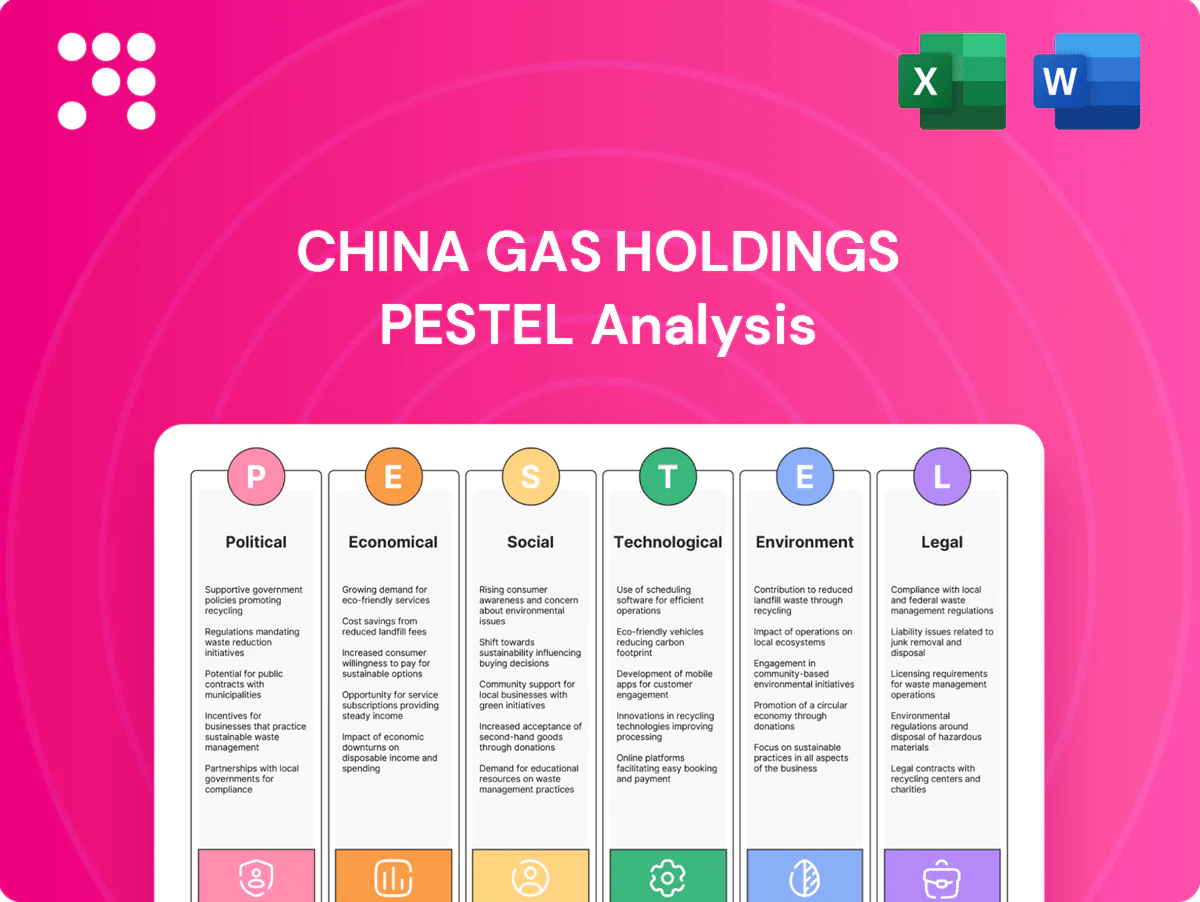
The China Gas Holdings PESTLE Analysis preview shown here is the exact document you’ll receive after purchase—fully formatted and ready to use. It contains the final, professionally structured assessment of political, economic, social, technological, legal and environmental factors. No placeholders or teasers; what you see is what you’ll download immediately after checkout.

Original: $10.00
-65%$10.00
$3.50Product Information
Product Information
Shipping & Returns
Shipping & Returns
Description
Your Shortcut to Market Insight Starts Here
Our concise PESTLE highlights political, economic, social, technological, legal and environmental forces shaping China Gas Holdings, revealing regulatory risks and growth opportunities. Ideal for investors and strategists, this briefing speeds decision-making. Buy the full, downloadable PESTLE for detailed, actionable insights.
Political factors
State clean-energy push
China’s coal-to-gas and clean-heating mandates, aligned with the 14th Five-Year Plan and the national goals to peak CO2 before 2030 and achieve carbon neutrality by 2060, underpin continued city-gas connection demand.
Central prioritization of air quality and energy security (non-fossil share target 20% by 2025) sustains long-term pipeline buildout and volume growth.
Policy continuity supports expansion but may force social-tariff obligations; execution hinges on provincial funding and winter-heating priorities.
Municipal concessions
City-level exclusive concessions (China Gas, HKEX: 384) — over 100 city-level projects — determine market access, pricing bands and service standards, shaping revenue catchment. Renewal clauses and KPI-linked targets drive capex and O&M commitments and can affect cash flow timelines. Strong local-government ties speed household connections and receivables recovery. Policy shifts could open competition or tighten regulatory oversight.
Energy security geopolitics
China Gas relies on a mix of pipeline gas and LNG, leaving it exposed to geopolitics across Russia, Central Asia and maritime LNG routes; Beijing targets raising gas to about 15% of primary energy by 2030. National reserve policies and long‑term import contracts (backbones of city networks) reduce volatility. Supply shocks prompt administrative allocations and price interventions. Diversification mandates push new terminal and storage investments to bolster security.
Subsidies and fiscal support
Targeted subsidies for low-income households and winter heating expand urban gas volumes and usage intensity, boosting China Gas Holdings’ network utilization; however, local fiscal stress can delay subsidy reimbursements, straining working capital. Government-backed financing through policy banks reduces financing costs for pipeline rollout, shortening project payback, while changes in subsidy design or targeting can lengthen payback periods and alter ROI.
- Subsidies raise volumes but can delay cash receipts
- Local fiscal stress risks reimbursement timing
- Policy-bank financing lowers cost of capital
- Subsidy redesigns change payback horizons
Decarbonization roadmaps
China's carbon peak by 2030 and neutrality by 2060 position gas as a short-to-medium‑term transition fuel while its long‑run share is expected to decline; natural gas demand was about 360 bcm in 2023. Policymakers are increasing methane controls and may require abatement and efficiency upgrades for transmission and distribution assets. Hydrogen co‑firing pilots (reports of up to 20% blending in pilots) are politically encouraged. Strategic alignment with national roadmaps speeds project approvals and improves investor signaling.
- Targets: peak 2030, neutrality 2060
- Demand: ~360 bcm (2023)
- Methane/efficiency mandates likely
- H2 pilots: up to ~20% blending
- Alignment reduces regulatory and financing risk
Five-Year Plan boosts city gas: ~360 bcm, gas ~15% by 2030
Five‑Year Plan and carbon targets (peak by 2030, neutrality by 2060) underpin steady city‑gas expansion and policy continuity. National goals (non‑fossil 20% by 2025; gas ~15% of primary energy by 2030) and subsidies drive volumes but can delay reimbursements. City concessions (>100) and policy‑bank financing lower capex costs; supply/import contracts and storage buildout mitigate geopolitics.
| Metric | Value |
|---|---|
| 2023 gas demand | ~360 bcm |
| Gas share target | ~15% by 2030 |
| Non‑fossil target | 20% by 2025 |
| City projects (China Gas) | >100 |
What is included in the product
Detailed Word Document
Explores how Political, Economic, Social, Technological, Environmental and Legal forces uniquely impact China Gas Holdings, with data-driven trends, specific sub-points and forward-looking insights to support executives, investors and strategists in scenario planning, risk mitigation and opportunity identification, ready for decks and reports.
Customizable Excel Spreadsheet
A compact, visually segmented PESTLE summary of China Gas Holdings that’s editable for regional notes, PPT-ready and Excel/tablet-compatible—ideal for quick team alignment, risk discussions and consultant reports in plain language.
Economic factors
Industrial demand cyclicality
Industrial gas volumes track manufacturing PMI, with PMI below 50 signaling contraction that compresses throughput and slows new connections; chemicals, ceramics and power peaking drive notable spikes. Slowdowns cut midstream utilization, while recovery and export cycles restore capacity utilization. A diversified city portfolio smooths regional volatility.
Tariff and pass-through
City-gate price reforms directly affect retail margins and pass-through speed, with slower adjustment windows historically creating lagged pass-through that exposes distributors to basis risk during volatile spot swings; China Gas reported ROA around 3.5% in FY2024, highlighting sensitivity. A transparent, formulaic pass-through mechanism helps stabilize cash flows and credit metrics by reducing margin compression. Active negotiation with regulators remains essential to secure reasonable ROA and predictable returns.
Commodity and FX exposure
China Gas faces LNG-linked prices and USD-denominated cargos—China imported roughly 80 million tonnes of LNG in 2024 and the RMB averaged about 7.2 per USD—adding FX and price risk to margins. Hedging programs and diversified sourcing (pipeline, spot, long‑term) have reduced volatility exposure. Sudden spot spikes historically cut C&I consumption and push up receivables. Contract floors/ceilings and tariff bands help protect end-user affordability.
Capex and financing costs
Network expansion, storage and digital upgrades require sustained capex; China’s onshore bond market exceeded RMB 140 trillion by end-2023, shaping access to long-term funding while 10-year China government bond yields hovered around 2.8% in mid-2024, influencing WACC. Phased capex linked to connection growth preserves leverage headroom; asset recycling and green finance (growing in China’s bond market) can optimize funding costs and tenor.
- Capex: phased to match connections
- Financing: onshore bonds >RMB 140tn
- Yield signal: 10y CGB ~2.8%
- Funding tools: asset recycling, green bonds
Urbanization and stimulus
Urban redevelopment and RMB-trillion infrastructure stimulus have accelerated trunk and city-gas pipeline projects, supporting China Gas Holdings’ network expansion; China urbanization reached 66.8% in 2023 (NBS) and continued moving toward lower-tier cities, where connection density and industrial park policies create anchor loads. Slower property markets can delay residential hookups but regional rebalancing shifts demand to lower-tier cities and industrial parks.
- Urbanization 66.8% (2023, NBS)
- Infrastructure special bonds supporting pipeline build-out
- Industrial parks = stable anchor gas demand
- Property slowdown risks residential hookup timing
Five-Year Plan boosts city gas: ~360 bcm, gas ~15% by 2030
Industrial demand tracks manufacturing PMI swings, with throughput and new connections falling when PMI <50 and recovering with export cycles; China Gas’ FY2024 ROA ~3.5% shows margin sensitivity.
City-gate reform speed and LNG/USD exposure (China LNG ~80mt in 2024; RMB ~7.2/USD) create pass-through and FX risks mitigated by hedging and diversified sourcing.
Large capex needs link to onshore funding (onshore bond market >RMB140tn; 10y CGB ~2.8%) while urbanization (66.8% in 2023) and infrastructure bonds support network growth.
| Metric | Value |
|---|---|
| ROA (FY2024) | ~3.5% |
| LNG imports (2024) | ~80 mt |
| RMB/USD (avg) | ~7.2 |
| Onshore bond market | >RMB 140tn |
| 10y CGB (mid‑2024) | ~2.8% |
| Urbanization (2023) | 66.8% |
What You See Is What You Get
China Gas Holdings PESTLE Analysis
The China Gas Holdings PESTLE Analysis preview shown here is the exact document you’ll receive after purchase—fully formatted and ready to use. It contains the final, professionally structured assessment of political, economic, social, technological, legal and environmental factors. No placeholders or teasers; what you see is what you’ll download immediately after checkout.