Cemex Business Model Canvas

Business Model Canvas: Strategic Roadmap for a Leading Global Cement Company
Unlock the strategic blueprint behind Cemex with our concise Business Model Canvas that maps its value propositions, key partners, cost structure and growth levers. Ideal for investors, consultants and founders seeking actionable insights. Purchase the full downloadable Canvas (Word & Excel) to access a detailed, section-by-section roadmap and apply it to your strategy.
Partnerships

Alternative fuels and raw material suppliers
Partnerships with waste management firms and biomass providers secure refuse-derived fuel and alternative raw materials to lower clinker factor and fuel use. Industry alternative fuel substitution averaged about 20% in 2024, helping reduce energy costs and carbon intensity. Long-term offtake agreements stabilize input availability and pricing, while joint programs drive circularity and regulatory compliance.
Equipment, technology, and automation vendors
OEMs and digital providers supply kilns, crushers, emission controls, process automation and predictive maintenance tools; co-development with Cemex speeds efficiency and decarbonization aligned with Cemex’s net-zero by 2050 commitment. Service agreements cut downtime and optimize throughput, while data-sharing improves quality control and energy performance in a sector responsible for roughly 7% of global CO2 emissions.

Logistics and distribution partners
Rail, marine and trucking carriers underpin Cemex logistics across 50+ countries, enabling reliable, cost-effective delivery of cement, concrete and aggregates. Terminal operators and last-mile distributors expand market reach and density, improving service in urban and coastal hubs. Coordinated scheduling reduces lead times and stockouts, while joint visibility platforms boost on-time performance and operational transparency.

Construction firms and EPC contractors
Strategic alliances with large contractors align product specs, delivery windows and on-site services, improving logistics efficiency and reducing delays; CEMEX reported 2024 net sales of US$14.4 billion, underpinning scale for such partnerships. Early-involvement collaboration refines mix design and boosts project outcomes; framework agreements lock in volume and pricing, while shared planning mitigates risk on complex infrastructure builds.
- align-specs
- early-collab
- framework-volume-pricing
- shared-planning-risk
Academic, industry, and government alliances
Academic, industry, and government alliances accelerate development of low-carbon cements and carbon capture to tackle the cement sector’s roughly 7% share of global CO2 emissions (≈2.8 Gt CO2/yr); pilots leverage grants and regulatory pathways, while standards bodies (EN, ASTM) validate performance and certification; EU policy and carbon pricing (EU ETS ~€90/t CO2 in 2024) shape supportive frameworks.
- Partnerships: universities, consortia, agencies
- Pilots: grant-funded, regulatory pilots
- Standards: EN/ASTM certification
- Policy: engagement on EU ETS, taxonomy
Cement firm uses 20% alternative fuels, digital kilns cut emissions
Cemex leverages waste managers and biomass suppliers for ~20% alternative fuel substitution (2024), cutting clinker and emissions. OEMs and digital partners supply kiln/automation and predictive maintenance to boost efficiency toward net-zero by 2050. Logistics, contractors and research alliances secure delivery, volumes and low-carbon innovation across 50+ countries and US$14.4B 2024 sales.
| Partner type | Role | 2024 metric |
|---|---|---|
| Waste/biomass | AF/raw materials | 20% AF substitution |
| OEMs/digital | Efficiency/decay | Predictive maintenance |
| Logistics | Distribution | 50+ countries |
What is included in the product
 Detailed Word Document
A comprehensive, pre-written business model tailored to Cemex’s strategy, reflecting real-world operations and growth plans. Organized into the 9 classic BMC blocks with detailed customer segments, channels, value propositions, revenue/cost structures, key partners/activities/resources, plus SWOT-linked competitive analysis and actionable insights for investors and managers.

 Customizable Excel Spreadsheet
High-level, editable Cemex Business Model Canvas that condenses strategy into a one-page snapshot, saving hours of formatting and helping teams quickly identify core components for boardrooms, comparisons, or fast deliverables.
Activities

Quarrying and raw material processing
Extraction and preparation of limestone, clay and aggregates supply the feedstock that underpins Cemex cement and concrete output, with precise crushing and sizing at source. Blending at the quarry and plant level optimizes chemical composition for clinker efficiency and performance. Continuous monitoring and laboratory testing ensure resource quality and regulatory compliance. Rehabilitation plans restore sites and support Cemexs 2030 ambition to cut CO2 intensity by about 35%.
Clinker and cement manufacturing
High-temperature kiln operations (around 1,450°C) convert raw meal to clinker, then grinding with additives produces cement; clinker heat and grinding are the largest cost drivers. The cement sector accounts for about 7% of global CO2, so energy optimization and alternative fuels (industry AFRs range ~5–40%) cut costs and emissions. Tight process control ensures consistency and strength, while preventive maintenance maximizes plant availability.

Ready-mix production and on-site services
Batching produces tailored mixes for diverse applications across Cemex operations in over 50 countries, meeting project-specific strength, slump and durability requirements per standards such as ASTM C94/EN 206. Mobile plants and on-site coordination improve pour reliability and cut truck transit time variability. Routine quality testing and precise admixture dosing secure performance and early-age strength. Scheduling is synced with contractor timelines to reduce delays and rework.

Integrated logistics and terminal management
Cemex coordinates trucks, rail and vessels across its network in 50+ countries to move bulk cement and aggregates efficiently; terminal storage smooths regional demand volatility and enables buffer inventory near key markets. Route optimization reduces transport costs and cuts emissions (international shipping ≈3% of global CO2 per IMO), while real-time tracking enhances on-time delivery and customer visibility.
- Integrated modal routing
- Terminal buffer management
- Route optimization — lower cost & emissions
- Real-time tracking — better delivery experience
R&D and sustainability initiatives
Cemex R&D advances low-clinker cements, supplementary cementitious materials, and CCUS to meet its 35% CO2 reduction target by 2030 and net-zero by 2050; digital quality tools optimize mix design and yield performance gains. Life-cycle assessments align products with customer ESG metrics, while pilot projects de-risk scale-up across markets.
- Low-clinker cements, SCMs, CCUS — decarbonization
- Digital mix-design — quality & efficiency
- LCA — customer ESG alignment
- Pilots — technology scale-up
Kilns ≈1,450°C, AFR 5–40%, ≈35% CO2 cut — global ops in 50+ countries
Extraction, kiln ops and grinding convert quarried limestone/clays to cement and ready-mix, with kilns at ≈1,450°C and AFR use varying ~5–40% to cut fuel costs. Logistics across 50+ countries combine trucks, rail and ports with real-time tracking and terminals. R&D (low-clinker cements, CCUS, digital mix-design) supports Cemexs 2030 target: ~35% CO2 intensity reduction.
| Metric | Value |
|---|---|
| Countries | 50+ |
| Kiln temp | ≈1,450°C |
| AFR range | 5–40% |
| 2030 CO2 goal | ≈35% intensity cut |
What You See Is What You Get
Business Model Canvas
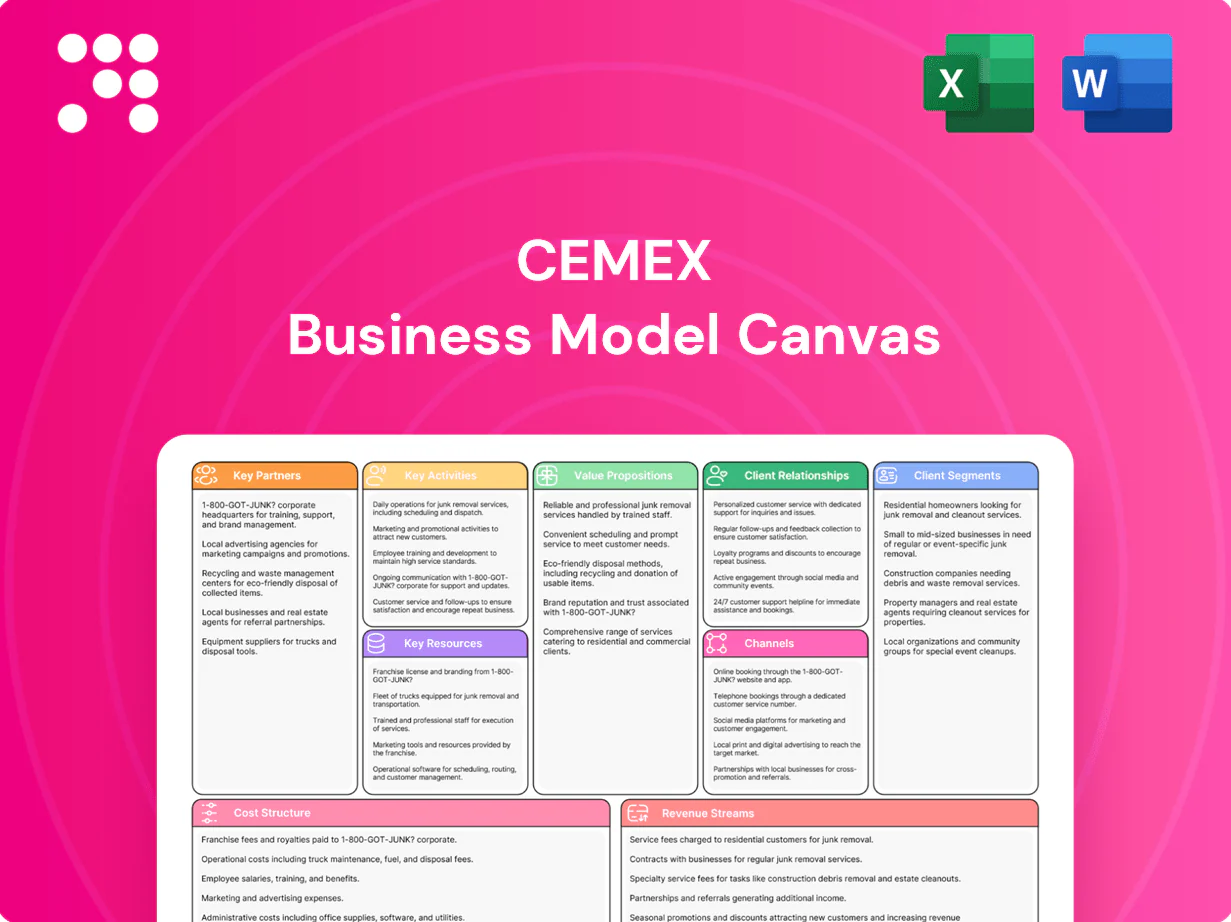
The Cemex Business Model Canvas you’re previewing is the actual deliverable, not a mockup, and reflects the same content and layout you’ll receive after purchase. Upon completing your order you’ll download this exact document—ready-to-edit in Word and Excel. No placeholders, no surprises—what you see is what you’ll own.

Original: $10.00
-65%$10.00
$3.50Product Information
Product Information
Shipping & Returns
Shipping & Returns
Description
Business Model Canvas: Strategic Roadmap for a Leading Global Cement Company
Unlock the strategic blueprint behind Cemex with our concise Business Model Canvas that maps its value propositions, key partners, cost structure and growth levers. Ideal for investors, consultants and founders seeking actionable insights. Purchase the full downloadable Canvas (Word & Excel) to access a detailed, section-by-section roadmap and apply it to your strategy.
Partnerships
Alternative fuels and raw material suppliers
Partnerships with waste management firms and biomass providers secure refuse-derived fuel and alternative raw materials to lower clinker factor and fuel use. Industry alternative fuel substitution averaged about 20% in 2024, helping reduce energy costs and carbon intensity. Long-term offtake agreements stabilize input availability and pricing, while joint programs drive circularity and regulatory compliance.
Equipment, technology, and automation vendors
OEMs and digital providers supply kilns, crushers, emission controls, process automation and predictive maintenance tools; co-development with Cemex speeds efficiency and decarbonization aligned with Cemex’s net-zero by 2050 commitment. Service agreements cut downtime and optimize throughput, while data-sharing improves quality control and energy performance in a sector responsible for roughly 7% of global CO2 emissions.
Logistics and distribution partners
Rail, marine and trucking carriers underpin Cemex logistics across 50+ countries, enabling reliable, cost-effective delivery of cement, concrete and aggregates. Terminal operators and last-mile distributors expand market reach and density, improving service in urban and coastal hubs. Coordinated scheduling reduces lead times and stockouts, while joint visibility platforms boost on-time performance and operational transparency.
Construction firms and EPC contractors
Strategic alliances with large contractors align product specs, delivery windows and on-site services, improving logistics efficiency and reducing delays; CEMEX reported 2024 net sales of US$14.4 billion, underpinning scale for such partnerships. Early-involvement collaboration refines mix design and boosts project outcomes; framework agreements lock in volume and pricing, while shared planning mitigates risk on complex infrastructure builds.
- align-specs
- early-collab
- framework-volume-pricing
- shared-planning-risk
Academic, industry, and government alliances
Academic, industry, and government alliances accelerate development of low-carbon cements and carbon capture to tackle the cement sector’s roughly 7% share of global CO2 emissions (≈2.8 Gt CO2/yr); pilots leverage grants and regulatory pathways, while standards bodies (EN, ASTM) validate performance and certification; EU policy and carbon pricing (EU ETS ~€90/t CO2 in 2024) shape supportive frameworks.
- Partnerships: universities, consortia, agencies
- Pilots: grant-funded, regulatory pilots
- Standards: EN/ASTM certification
- Policy: engagement on EU ETS, taxonomy
Cement firm uses 20% alternative fuels, digital kilns cut emissions
Cemex leverages waste managers and biomass suppliers for ~20% alternative fuel substitution (2024), cutting clinker and emissions. OEMs and digital partners supply kiln/automation and predictive maintenance to boost efficiency toward net-zero by 2050. Logistics, contractors and research alliances secure delivery, volumes and low-carbon innovation across 50+ countries and US$14.4B 2024 sales.
| Partner type | Role | 2024 metric |
|---|---|---|
| Waste/biomass | AF/raw materials | 20% AF substitution |
| OEMs/digital | Efficiency/decay | Predictive maintenance |
| Logistics | Distribution | 50+ countries |
What is included in the product
Detailed Word Document
A comprehensive, pre-written business model tailored to Cemex’s strategy, reflecting real-world operations and growth plans. Organized into the 9 classic BMC blocks with detailed customer segments, channels, value propositions, revenue/cost structures, key partners/activities/resources, plus SWOT-linked competitive analysis and actionable insights for investors and managers.
Customizable Excel Spreadsheet
High-level, editable Cemex Business Model Canvas that condenses strategy into a one-page snapshot, saving hours of formatting and helping teams quickly identify core components for boardrooms, comparisons, or fast deliverables.
Activities
Quarrying and raw material processing
Extraction and preparation of limestone, clay and aggregates supply the feedstock that underpins Cemex cement and concrete output, with precise crushing and sizing at source. Blending at the quarry and plant level optimizes chemical composition for clinker efficiency and performance. Continuous monitoring and laboratory testing ensure resource quality and regulatory compliance. Rehabilitation plans restore sites and support Cemexs 2030 ambition to cut CO2 intensity by about 35%.
Clinker and cement manufacturing
High-temperature kiln operations (around 1,450°C) convert raw meal to clinker, then grinding with additives produces cement; clinker heat and grinding are the largest cost drivers. The cement sector accounts for about 7% of global CO2, so energy optimization and alternative fuels (industry AFRs range ~5–40%) cut costs and emissions. Tight process control ensures consistency and strength, while preventive maintenance maximizes plant availability.
Ready-mix production and on-site services
Batching produces tailored mixes for diverse applications across Cemex operations in over 50 countries, meeting project-specific strength, slump and durability requirements per standards such as ASTM C94/EN 206. Mobile plants and on-site coordination improve pour reliability and cut truck transit time variability. Routine quality testing and precise admixture dosing secure performance and early-age strength. Scheduling is synced with contractor timelines to reduce delays and rework.
Integrated logistics and terminal management
Cemex coordinates trucks, rail and vessels across its network in 50+ countries to move bulk cement and aggregates efficiently; terminal storage smooths regional demand volatility and enables buffer inventory near key markets. Route optimization reduces transport costs and cuts emissions (international shipping ≈3% of global CO2 per IMO), while real-time tracking enhances on-time delivery and customer visibility.
- Integrated modal routing
- Terminal buffer management
- Route optimization — lower cost & emissions
- Real-time tracking — better delivery experience
R&D and sustainability initiatives
Cemex R&D advances low-clinker cements, supplementary cementitious materials, and CCUS to meet its 35% CO2 reduction target by 2030 and net-zero by 2050; digital quality tools optimize mix design and yield performance gains. Life-cycle assessments align products with customer ESG metrics, while pilot projects de-risk scale-up across markets.
- Low-clinker cements, SCMs, CCUS — decarbonization
- Digital mix-design — quality & efficiency
- LCA — customer ESG alignment
- Pilots — technology scale-up
Kilns ≈1,450°C, AFR 5–40%, ≈35% CO2 cut — global ops in 50+ countries
Extraction, kiln ops and grinding convert quarried limestone/clays to cement and ready-mix, with kilns at ≈1,450°C and AFR use varying ~5–40% to cut fuel costs. Logistics across 50+ countries combine trucks, rail and ports with real-time tracking and terminals. R&D (low-clinker cements, CCUS, digital mix-design) supports Cemexs 2030 target: ~35% CO2 intensity reduction.
| Metric | Value |
|---|---|
| Countries | 50+ |
| Kiln temp | ≈1,450°C |
| AFR range | 5–40% |
| 2030 CO2 goal | ≈35% intensity cut |
What You See Is What You Get
Business Model Canvas
The Cemex Business Model Canvas you’re previewing is the actual deliverable, not a mockup, and reflects the same content and layout you’ll receive after purchase. Upon completing your order you’ll download this exact document—ready-to-edit in Word and Excel. No placeholders, no surprises—what you see is what you’ll own.