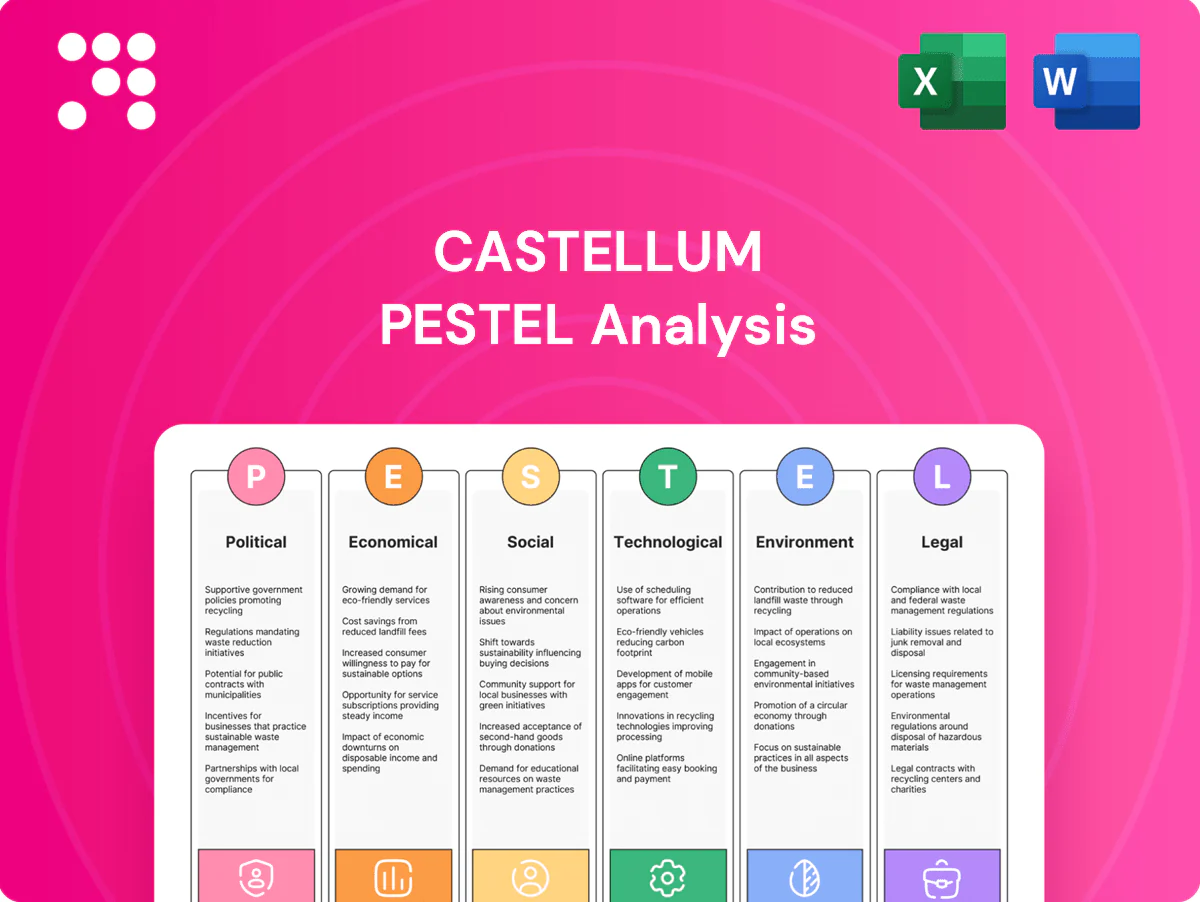
Castellum PESTLE Analysis

Your Competitive Advantage Starts with This Report
Our PESTLE Analysis of Castellum reveals how political shifts, economic cycles, social trends, technological advances, legal changes, and environmental pressures shape its strategic outlook and asset value. Packed with actionable insights, this concise report helps investors and strategists identify risks and growth levers fast. Buy the full analysis to access the complete, editable breakdown and make data-driven decisions with confidence.
Political factors

Nordic political stability
Sweden, Denmark and Finland provide highly stable political environments—2024 EIU Democracy Index scores: Finland 9.37, Denmark 9.22, Sweden 9.09—supporting long-horizon real estate investment and lowering planning and permitting risk for Castellum’s development pipeline. Policy continuity reduces regulatory uncertainty, though coalition governments can slow reforms that might accelerate commercial real estate activity. Cross-border stability strengthens portfolio diversification across Stockholm, Copenhagen and Helsinki.
Municipal planning and zoning control
Local municipal planning across Sweden’s 290 municipalities directly shapes zoning, density and building rights, affecting Castellum’s asset repositioning for its >1,000-property portfolio; strong dialogue with city planners can unlock value in adaptable workplaces and logistics hubs, while approval delays of months to years can defer cash flows and capex scheduling; designated growth areas often receive faster permits and targeted infrastructure support.

Public infrastructure investment
Government spending on transport and logistics corridors, supported at EU level by the €806.9 billion NextGenerationEU recovery package, boosts demand for last‑mile and regional distribution assets. Rail, port and metro upgrades in growth regions tend to lift occupancy and rental growth for logistics landlords. Conversely, fiscal tightening can postpone projects and temper absorption. Castellum’s Swedish and Nordic footprint can be aligned with planned nodes to capture spillover benefits.

Energy and sustainability policy direction
- National net‑zero 2045
- EU neutrality 2050, Fit for 55
- Higher ROI for early green capex
- Stricter standards pressure older stock
- Alignment improves subsidy/green financing access
Geopolitical and security considerations
Geopolitical shifts such as Finland joining NATO in 2023 and higher regional defence readiness have raised investor risk awareness in the Nordics, influencing capital allocation toward lower-risk assets and logistics hubs near secure nodes. EU and national supply-chain resilience policies since 2022 incentivize localized logistics and industrial tenants, affecting Castellum’s leasing demand mix. Sanctions-driven trade realignments have already shifted tenant exposure in energy and trade-facing sectors, so stable Nordic institutions lower sovereign shock risk but contingency planning remains essential.
- Nordic NATO accession: Finland 2023
- Policy trend: EU supply-chain resilience programs since 2022
- Implication: increased demand for localized logistics and contingency leasing
Nordic political stability and green targets drive secure logistics and CRE retrofit demand
Sweden, Denmark, Finland show high political stability (2024 EIU Democracy Index: FI 9.37, DK 9.22, SE 9.09), lowering permitting risk and supporting long‑term CRE. Net‑zero targets (Sweden 2045; EU neutrality 2050) and Fit for 55 (55% 2030) drive retrofit capex and green finance. Finland NATO accession 2023 and EU supply‑chain resilience (post‑2022) boost localized logistics demand.
| Indicator | Value | Implication |
|---|---|---|
| EIU Democracy 2024 | FI 9.37, DK 9.22, SE 9.09 | Lower sovereign/political risk |
| Green targets | SE 2045, EU 2050; 55% by 2030 | Higher green capex ROI |
| Geopolitics | Finland NATO 2023 | Shift to secure logistics |
What is included in the product
 Detailed Word Document
Explores how Political, Economic, Social, Technological, Environmental and Legal forces uniquely affect Castellum, with each dimension expanded into detailed, example-driven subpoints and forward-looking insights. Backed by current data and regional market/regulatory context, the analysis is formatted for executives, investors and strategists to identify risks, opportunities and support scenario planning.

 Customizable Excel Spreadsheet
Condensed Castellum PESTLE provides a visually segmented, easily shareable summary that fits presentations and strategy sessions, enabling quick alignment, editable notes for regional or business-specific context, and focused discussion on external risks and market positioning.
Economic factors

Interest rate and yield dynamics
Policy rates in the Nordics and euro area (ECB deposit rate ~4.00% in July 2025; Riksbank ~4.00%; Norges Bank ~4.25%) directly lift capitalization rates, valuations and refinancing costs. Rising 10y yields (~3.0–3.5% H1 2025) compress book values and slow transaction volumes, while rate stabilization tends to re-open deal flow. Castellum’s CPI-linked rental indexation provides partial offset to financing headwinds. Active liability management (refinancing, hedging) is a key value lever.
GDP growth and occupier demand
Commercial leasing in Sweden, Denmark and Finland mirrors macro momentum: Sweden GDP growth ~0.9% in 2024, Denmark ~1.2% and Finland ~0.6%, slowing office absorption while resilient trade (e-commerce up ~8% in EU 2024) supports logistics demand. Castellum’s geographic diversification across these markets smooths cyclical swings, and targeting sectors with structural tailwinds—logistics, life science, data centres—helps protect NOI.

E‑commerce and logistics expansion
Rising e‑commerce penetration—about 24% of Swedish retail sales in 2024—underpins demand for modern, well‑located logistics. Tenants prize proximity to urban nodes within Castellum’s Nordic footprint, driving higher throughput that supported roughly 6% prime logistics rent growth in Sweden in 2024 and low vacancy rates. Spec‑to‑lease risk is managed through pre‑lets and strong tenant covenants to protect cashflow.

Inflation and lease indexation
Indexed leases linked to CPI allow Castellum to pass inflation into rents, supporting topline, while operating costs and service charges also rise and can compress margins if not contractually recovered; timing lags between CPI and rent resets reduce cash flow predictability. Transparent escalation clauses and clear indexation mechanics strengthen tenant credit quality and debt service resilience.
- Indexation: CPI-linked leases support revenue
- Cost pressure: service charges inflate margins
- Timing lag: rent reset delays cash flows
- Escalation clarity: improves credit strength
Capital markets access and liquidity
REIT-like companies such as Castellum depend on efficient debt and equity markets for growth capex and refinancing; market volatility widens credit spreads and can close issuance windows, making asset disposals a common tool to recycle capital at acceptable yields.
Castellum’s strong ESG credentials support access to green funding and often lower funding costs via labelled bonds.
- Market access: dependent on debt/equity liquidity
- Volatility: wider spreads, constrained issuance
- Capital recycling: disposals to meet yield targets
- ESG: green bonds reduce funding costs
Nordic political stability and green targets drive secure logistics and CRE retrofit demand
Higher Nordics/EUR policy rates (ECB dep ~4.00% Jul 2025; Riksbank ~4.00%; Norges ~4.25%) raise cap rates and refinancing costs, though CPI‑linked leases partially offset. GDP growth slowed (Sweden 0.9% 2024; Denmark 1.2%; Finland 0.6%) reducing office absorption; logistics supported by e‑commerce (~24% SE retail 2024) and ~6% prime logistics rent growth 2024.
| Metric | Value |
|---|---|
| ECB deposit Jul 2025 | ~4.00% |
| Sweden GDP 2024 | 0.9% |
| SE e‑commerce 2024 | 24% |
| Prime logistics rent growth 2024 | ~6% |
Same Document Delivered
Castellum PESTLE Analysis
The preview shown here is the exact Castellum PESTLE Analysis document you’ll receive after purchase—fully formatted and ready to use. The layout, content, and structure visible are identical to the downloadable file, with no placeholders or teasers. After payment you’ll instantly get this final, professionally structured report.

Product Information
Product Information
Shipping & Returns
Shipping & Returns
Description
Your Competitive Advantage Starts with This Report
Our PESTLE Analysis of Castellum reveals how political shifts, economic cycles, social trends, technological advances, legal changes, and environmental pressures shape its strategic outlook and asset value. Packed with actionable insights, this concise report helps investors and strategists identify risks and growth levers fast. Buy the full analysis to access the complete, editable breakdown and make data-driven decisions with confidence.
Political factors
Nordic political stability
Sweden, Denmark and Finland provide highly stable political environments—2024 EIU Democracy Index scores: Finland 9.37, Denmark 9.22, Sweden 9.09—supporting long-horizon real estate investment and lowering planning and permitting risk for Castellum’s development pipeline. Policy continuity reduces regulatory uncertainty, though coalition governments can slow reforms that might accelerate commercial real estate activity. Cross-border stability strengthens portfolio diversification across Stockholm, Copenhagen and Helsinki.
Municipal planning and zoning control
Local municipal planning across Sweden’s 290 municipalities directly shapes zoning, density and building rights, affecting Castellum’s asset repositioning for its >1,000-property portfolio; strong dialogue with city planners can unlock value in adaptable workplaces and logistics hubs, while approval delays of months to years can defer cash flows and capex scheduling; designated growth areas often receive faster permits and targeted infrastructure support.
Public infrastructure investment
Government spending on transport and logistics corridors, supported at EU level by the €806.9 billion NextGenerationEU recovery package, boosts demand for last‑mile and regional distribution assets. Rail, port and metro upgrades in growth regions tend to lift occupancy and rental growth for logistics landlords. Conversely, fiscal tightening can postpone projects and temper absorption. Castellum’s Swedish and Nordic footprint can be aligned with planned nodes to capture spillover benefits.
Energy and sustainability policy direction
- National net‑zero 2045
- EU neutrality 2050, Fit for 55
- Higher ROI for early green capex
- Stricter standards pressure older stock
- Alignment improves subsidy/green financing access
Geopolitical and security considerations
Geopolitical shifts such as Finland joining NATO in 2023 and higher regional defence readiness have raised investor risk awareness in the Nordics, influencing capital allocation toward lower-risk assets and logistics hubs near secure nodes. EU and national supply-chain resilience policies since 2022 incentivize localized logistics and industrial tenants, affecting Castellum’s leasing demand mix. Sanctions-driven trade realignments have already shifted tenant exposure in energy and trade-facing sectors, so stable Nordic institutions lower sovereign shock risk but contingency planning remains essential.
- Nordic NATO accession: Finland 2023
- Policy trend: EU supply-chain resilience programs since 2022
- Implication: increased demand for localized logistics and contingency leasing
Nordic political stability and green targets drive secure logistics and CRE retrofit demand
Sweden, Denmark, Finland show high political stability (2024 EIU Democracy Index: FI 9.37, DK 9.22, SE 9.09), lowering permitting risk and supporting long‑term CRE. Net‑zero targets (Sweden 2045; EU neutrality 2050) and Fit for 55 (55% 2030) drive retrofit capex and green finance. Finland NATO accession 2023 and EU supply‑chain resilience (post‑2022) boost localized logistics demand.
| Indicator | Value | Implication |
|---|---|---|
| EIU Democracy 2024 | FI 9.37, DK 9.22, SE 9.09 | Lower sovereign/political risk |
| Green targets | SE 2045, EU 2050; 55% by 2030 | Higher green capex ROI |
| Geopolitics | Finland NATO 2023 | Shift to secure logistics |
What is included in the product
Detailed Word Document
Explores how Political, Economic, Social, Technological, Environmental and Legal forces uniquely affect Castellum, with each dimension expanded into detailed, example-driven subpoints and forward-looking insights. Backed by current data and regional market/regulatory context, the analysis is formatted for executives, investors and strategists to identify risks, opportunities and support scenario planning.
Customizable Excel Spreadsheet
Condensed Castellum PESTLE provides a visually segmented, easily shareable summary that fits presentations and strategy sessions, enabling quick alignment, editable notes for regional or business-specific context, and focused discussion on external risks and market positioning.
Economic factors
Interest rate and yield dynamics
Policy rates in the Nordics and euro area (ECB deposit rate ~4.00% in July 2025; Riksbank ~4.00%; Norges Bank ~4.25%) directly lift capitalization rates, valuations and refinancing costs. Rising 10y yields (~3.0–3.5% H1 2025) compress book values and slow transaction volumes, while rate stabilization tends to re-open deal flow. Castellum’s CPI-linked rental indexation provides partial offset to financing headwinds. Active liability management (refinancing, hedging) is a key value lever.
GDP growth and occupier demand
Commercial leasing in Sweden, Denmark and Finland mirrors macro momentum: Sweden GDP growth ~0.9% in 2024, Denmark ~1.2% and Finland ~0.6%, slowing office absorption while resilient trade (e-commerce up ~8% in EU 2024) supports logistics demand. Castellum’s geographic diversification across these markets smooths cyclical swings, and targeting sectors with structural tailwinds—logistics, life science, data centres—helps protect NOI.
E‑commerce and logistics expansion
Rising e‑commerce penetration—about 24% of Swedish retail sales in 2024—underpins demand for modern, well‑located logistics. Tenants prize proximity to urban nodes within Castellum’s Nordic footprint, driving higher throughput that supported roughly 6% prime logistics rent growth in Sweden in 2024 and low vacancy rates. Spec‑to‑lease risk is managed through pre‑lets and strong tenant covenants to protect cashflow.
Inflation and lease indexation
Indexed leases linked to CPI allow Castellum to pass inflation into rents, supporting topline, while operating costs and service charges also rise and can compress margins if not contractually recovered; timing lags between CPI and rent resets reduce cash flow predictability. Transparent escalation clauses and clear indexation mechanics strengthen tenant credit quality and debt service resilience.
- Indexation: CPI-linked leases support revenue
- Cost pressure: service charges inflate margins
- Timing lag: rent reset delays cash flows
- Escalation clarity: improves credit strength
Capital markets access and liquidity
REIT-like companies such as Castellum depend on efficient debt and equity markets for growth capex and refinancing; market volatility widens credit spreads and can close issuance windows, making asset disposals a common tool to recycle capital at acceptable yields.
Castellum’s strong ESG credentials support access to green funding and often lower funding costs via labelled bonds.
- Market access: dependent on debt/equity liquidity
- Volatility: wider spreads, constrained issuance
- Capital recycling: disposals to meet yield targets
- ESG: green bonds reduce funding costs
Nordic political stability and green targets drive secure logistics and CRE retrofit demand
Higher Nordics/EUR policy rates (ECB dep ~4.00% Jul 2025; Riksbank ~4.00%; Norges ~4.25%) raise cap rates and refinancing costs, though CPI‑linked leases partially offset. GDP growth slowed (Sweden 0.9% 2024; Denmark 1.2%; Finland 0.6%) reducing office absorption; logistics supported by e‑commerce (~24% SE retail 2024) and ~6% prime logistics rent growth 2024.
| Metric | Value |
|---|---|
| ECB deposit Jul 2025 | ~4.00% |
| Sweden GDP 2024 | 0.9% |
| SE e‑commerce 2024 | 24% |
| Prime logistics rent growth 2024 | ~6% |
Same Document Delivered
Castellum PESTLE Analysis
The preview shown here is the exact Castellum PESTLE Analysis document you’ll receive after purchase—fully formatted and ready to use. The layout, content, and structure visible are identical to the downloadable file, with no placeholders or teasers. After payment you’ll instantly get this final, professionally structured report.