Carr's Group PESTLE Analysis

Make Smarter Strategic Decisions with a Complete PESTEL View
Uncover how political shifts, economic cycles, social trends, and environmental rules are shaping Carr's Group today. This concise PESTLE snapshot highlights risks and opportunities investors and strategists can act on immediately. Purchase the full analysis to access detailed, ready-to-use insights and forecasts.
Political factors

Agricultural subsidies and rural policy
Shifts in farm support schemes alter demand for feed, supplements and machinery; the EU CAP 2021–27 budget of about €387bn influences input markets across supply chains. UK post-CAP frameworks and devolved rural grants can reweight product mix and margins for firms like Carr's. Targeted payments for productivity or sustainability boost premium nutrition and precision equipment uptake. Policy uncertainty complicates inventory and capex planning.
Trade policy, tariffs, and market access
Tariffs on grains, vitamins and machinery components can raise input costs by roughly 5–20% across markets, directly pressuring Carrs Group margins and pricing strategies; grain and feed ingredient tariffs remain a volatile cost factor in 2024. SPS rules and enhanced border checks post‑2020 add clearance times commonly of 24–72 hours, slowing feed additive approvals and deliveries. Trade agreements, such as the UK-EU TCA and other FTAs, materially alter duty-free access to key export markets and can either enable or constrain volumes. Sanctions regimes since 2022 have curtailed engineering sales to Russia and Belarus, removing those markets from available export channels.

Government procurement in nuclear and infrastructure
National nuclear strategies create multi-decade visibility via projects like Hinkley Point C (£25–26bn) and Sizewell C (est. £20–25bn), offering specialist engineering pipelines. Public funding and NDA decommissioning budgets around £3bn p.a. drive timing and scale of orders. Local content targets have sought c.60% UK supply-chain share, shaping sourcing and site presence. Procurement enforces nuclear QA/ISO 19443, ISO 9001, full documentation and traceability.

Energy and food security agendas
Government food security policies since 2022 have strengthened support for resilient agricultural-input suppliers, benefiting firms like Carrs through procurement preferences and grant schemes that prioritise domestic supply chains.
Strategic energy plans influence timing and scale of oil, gas maintenance and nuclear investment, affecting operational costs and capex scheduling for energy-dependent manufacturing.
In crises governments may prioritise critical manufacturers and impose stockpiling or emergency production directives, disrupting normal production schedules and inventory management.
- policy-support: domestic procurement & grants
- energy-planning: maintenance windows, nuclear capex
- crisis-priority: critical manufacturer protection
- stockpiling: emergency directives alter scheduling
Geopolitical stability and sanctions risk
Geopolitical shocks disrupt grain flows, fertilizer markets and industrial supply chains; Russia historically supplied about 15% of global fertilizer exports, amplifying risk to Carrs Group inputs and margins. Export controls on high-spec components constrain engineering deliveries and can delay equipment, while currency and commodity volatility often spikes after shocks, stressing working capital. Multi-region scenario planning is required for resilience.
- Supply disruption: Black Sea routing risk
- Input risk: ~15% global fertilizer exposure
- Trade controls: export bans on tech components
- Financial: post-shock FX/commodity volatility
- Mitigation: multi-region scenario planning
EU CAP €387bn, tariffs 5–20% shift feed/machinery demand
UK/EU farm support shifts (EU CAP €387bn 2021–27) and post‑CAP UK grants reshape feed, feed‑additive and machinery demand, affecting Carrs’ product mix and margins. Tariffs and trade controls raise input costs c.5–20% and post‑shock FX/commodity volatility strains working capital; Russia accounted for ~15% of global fertilizer exports pre‑2022. Nuclear and decommissioning budgets (~£3bn p.a.) create engineering demand windows.
| Factor | Key metric |
|---|---|
| CAP influence | €387bn (2021–27) |
| Tariff impact | ~5–20% cost rise |
| Fertilizer risk | ~15% supply exposure |
| Nuclear spend | ~£3bn p.a. |
What is included in the product
 Detailed Word Document
Explores how Political, Economic, Social, Technological, Environmental and Legal forces uniquely impact Carr's Group, combining data-driven trends and region-specific regulation. Designed for executives and investors, it highlights risks, opportunities and forward-looking scenarios to inform strategic decisions.

 Customizable Excel Spreadsheet
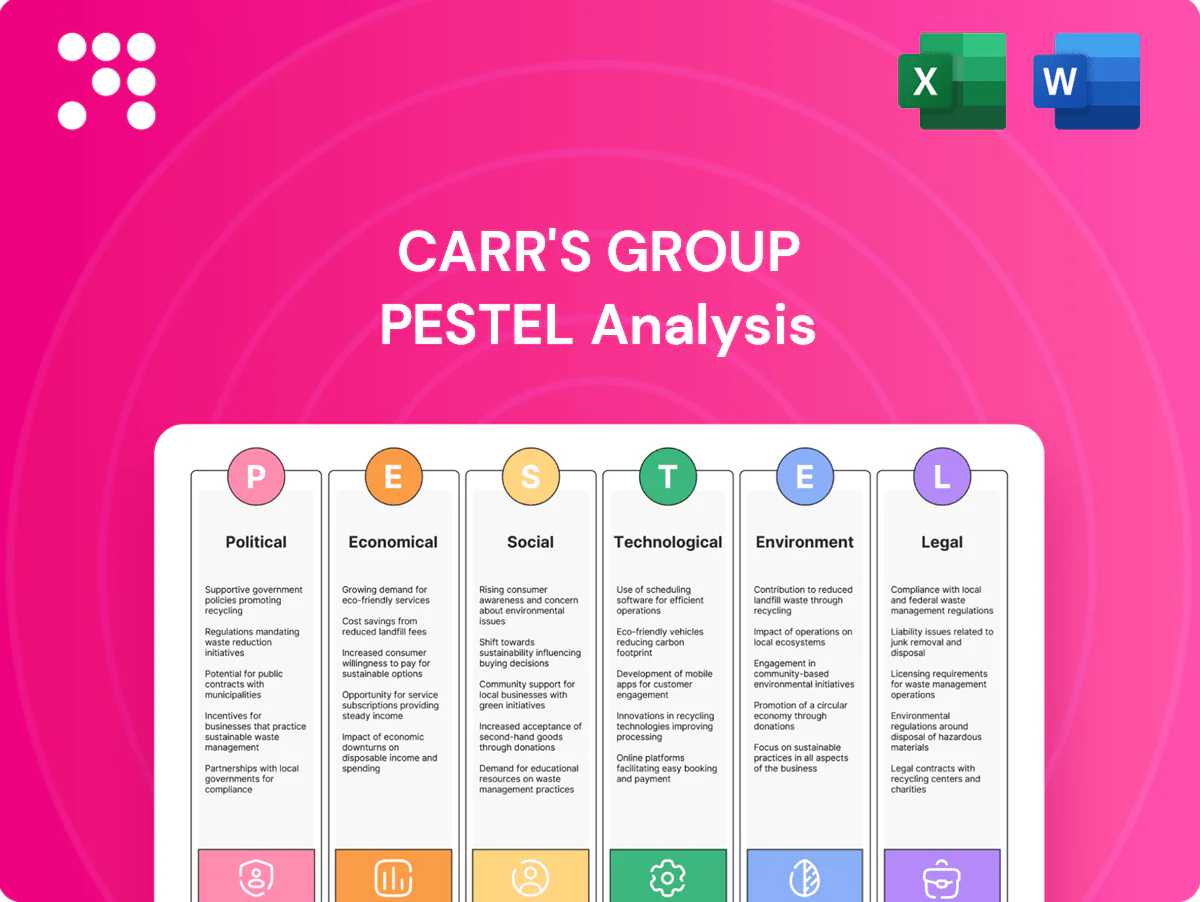
A concise, visually segmented PESTLE summary of Carr's Group that streamlines meetings and planning, supports external risk and market-position discussions, is easily dropped into presentations or shared across teams, and allows editable notes for specific regions or business lines.
Economic factors

Commodity and input price volatility
Grain, oilseed, vitamins and minerals form the bulk of feed cost bases, with feed commonly accounting for around 70% of livestock production costs (FAO). Fertilizer and energy price swings erode farm purchasing power and can lift crop input bills materially. Hedging and formula pricing are used to stabilise Carrs’ feed margins, while severe supply shocks can strain customer loyalty and working capital.
Interest rates and capital investment cycles
Elevated policy rates — US federal funds 5.25–5.50% and Bank of England base ~5.25% (mid‑2025) — are dampening farm machinery purchases and engineering capex, with project deferrals in oil & gas and process industries eroding order books; higher financing costs constrain inventory and receivables strategies, while counter‑cyclical service revenues provide a partial buffer against downturns.

FX movements on revenues and costs
GBP swings (c.15% decline vs USD in 2022–23) and EUR/USD volatility reshape Carr’s export competitiveness and cost of imported inputs, with weaker GBP improving exports but raising EUR/USD‑priced input costs; natural hedges from local sales and sourcing reduce but do not remove translation and transaction risk. Rigorous pricing discipline, FX pass‑through clauses and treasury limits tied to geographic revenue mix are essential.

Farm income and producer confidence
Industrial demand across sectors
- Oil & gas maintenance: diversification
- Nuclear lifecycle: long-term projects
- Process upgrades: capex-driven demand
- Backlog visibility: staffing & supply planning
- Aftermarket/spares: recurring revenue
EU CAP €387bn, tariffs 5–20% shift feed/machinery demand
Feed inputs (grain, oilseed, vitamins) drive ~70% of livestock costs, making margins highly input-price sensitive.
Higher policy rates (Fed 5.25–5.50%, BoE ~5.25% mid‑2025) curb capex and tighten working capital.
GBP volatility (≈15% slide vs USD 2022–23) alters export competitiveness and import costs despite local hedges.
Fertilizer prices fell ~45% from 2022 peaks by mid‑2024, easing some input pressure.
| Metric | Value |
|---|---|
| Feed share | ~70% |
| Policy rates | Fed 5.25–5.50%, BoE ~5.25% |
| GBP move | ~‑15% vs USD |
| Fertilizer | ‑45% from 2022 peak |
Full Version Awaits
Carr's Group PESTLE Analysis
The Carr's Group PESTLE Analysis provides a concise evaluation of political, economic, social, technological, legal and environmental factors affecting the business. The preview shown here is the exact document you’ll receive after purchase—fully formatted and ready to use. No placeholders or teasers: the layout, content and structure visible are the final file you’ll download immediately after payment.

Product Information
Product Information
Shipping & Returns
Shipping & Returns
Description
Make Smarter Strategic Decisions with a Complete PESTEL View
Uncover how political shifts, economic cycles, social trends, and environmental rules are shaping Carr's Group today. This concise PESTLE snapshot highlights risks and opportunities investors and strategists can act on immediately. Purchase the full analysis to access detailed, ready-to-use insights and forecasts.
Political factors
Agricultural subsidies and rural policy
Shifts in farm support schemes alter demand for feed, supplements and machinery; the EU CAP 2021–27 budget of about €387bn influences input markets across supply chains. UK post-CAP frameworks and devolved rural grants can reweight product mix and margins for firms like Carr's. Targeted payments for productivity or sustainability boost premium nutrition and precision equipment uptake. Policy uncertainty complicates inventory and capex planning.
Trade policy, tariffs, and market access
Tariffs on grains, vitamins and machinery components can raise input costs by roughly 5–20% across markets, directly pressuring Carrs Group margins and pricing strategies; grain and feed ingredient tariffs remain a volatile cost factor in 2024. SPS rules and enhanced border checks post‑2020 add clearance times commonly of 24–72 hours, slowing feed additive approvals and deliveries. Trade agreements, such as the UK-EU TCA and other FTAs, materially alter duty-free access to key export markets and can either enable or constrain volumes. Sanctions regimes since 2022 have curtailed engineering sales to Russia and Belarus, removing those markets from available export channels.
Government procurement in nuclear and infrastructure
National nuclear strategies create multi-decade visibility via projects like Hinkley Point C (£25–26bn) and Sizewell C (est. £20–25bn), offering specialist engineering pipelines. Public funding and NDA decommissioning budgets around £3bn p.a. drive timing and scale of orders. Local content targets have sought c.60% UK supply-chain share, shaping sourcing and site presence. Procurement enforces nuclear QA/ISO 19443, ISO 9001, full documentation and traceability.
Energy and food security agendas
Government food security policies since 2022 have strengthened support for resilient agricultural-input suppliers, benefiting firms like Carrs through procurement preferences and grant schemes that prioritise domestic supply chains.
Strategic energy plans influence timing and scale of oil, gas maintenance and nuclear investment, affecting operational costs and capex scheduling for energy-dependent manufacturing.
In crises governments may prioritise critical manufacturers and impose stockpiling or emergency production directives, disrupting normal production schedules and inventory management.
- policy-support: domestic procurement & grants
- energy-planning: maintenance windows, nuclear capex
- crisis-priority: critical manufacturer protection
- stockpiling: emergency directives alter scheduling
Geopolitical stability and sanctions risk
Geopolitical shocks disrupt grain flows, fertilizer markets and industrial supply chains; Russia historically supplied about 15% of global fertilizer exports, amplifying risk to Carrs Group inputs and margins. Export controls on high-spec components constrain engineering deliveries and can delay equipment, while currency and commodity volatility often spikes after shocks, stressing working capital. Multi-region scenario planning is required for resilience.
- Supply disruption: Black Sea routing risk
- Input risk: ~15% global fertilizer exposure
- Trade controls: export bans on tech components
- Financial: post-shock FX/commodity volatility
- Mitigation: multi-region scenario planning
EU CAP €387bn, tariffs 5–20% shift feed/machinery demand
UK/EU farm support shifts (EU CAP €387bn 2021–27) and post‑CAP UK grants reshape feed, feed‑additive and machinery demand, affecting Carrs’ product mix and margins. Tariffs and trade controls raise input costs c.5–20% and post‑shock FX/commodity volatility strains working capital; Russia accounted for ~15% of global fertilizer exports pre‑2022. Nuclear and decommissioning budgets (~£3bn p.a.) create engineering demand windows.
| Factor | Key metric |
|---|---|
| CAP influence | €387bn (2021–27) |
| Tariff impact | ~5–20% cost rise |
| Fertilizer risk | ~15% supply exposure |
| Nuclear spend | ~£3bn p.a. |
What is included in the product
Detailed Word Document
Explores how Political, Economic, Social, Technological, Environmental and Legal forces uniquely impact Carr's Group, combining data-driven trends and region-specific regulation. Designed for executives and investors, it highlights risks, opportunities and forward-looking scenarios to inform strategic decisions.
Customizable Excel Spreadsheet
A concise, visually segmented PESTLE summary of Carr's Group that streamlines meetings and planning, supports external risk and market-position discussions, is easily dropped into presentations or shared across teams, and allows editable notes for specific regions or business lines.
Economic factors
Commodity and input price volatility
Grain, oilseed, vitamins and minerals form the bulk of feed cost bases, with feed commonly accounting for around 70% of livestock production costs (FAO). Fertilizer and energy price swings erode farm purchasing power and can lift crop input bills materially. Hedging and formula pricing are used to stabilise Carrs’ feed margins, while severe supply shocks can strain customer loyalty and working capital.
Interest rates and capital investment cycles
Elevated policy rates — US federal funds 5.25–5.50% and Bank of England base ~5.25% (mid‑2025) — are dampening farm machinery purchases and engineering capex, with project deferrals in oil & gas and process industries eroding order books; higher financing costs constrain inventory and receivables strategies, while counter‑cyclical service revenues provide a partial buffer against downturns.
FX movements on revenues and costs
GBP swings (c.15% decline vs USD in 2022–23) and EUR/USD volatility reshape Carr’s export competitiveness and cost of imported inputs, with weaker GBP improving exports but raising EUR/USD‑priced input costs; natural hedges from local sales and sourcing reduce but do not remove translation and transaction risk. Rigorous pricing discipline, FX pass‑through clauses and treasury limits tied to geographic revenue mix are essential.
Farm income and producer confidence
Industrial demand across sectors
- Oil & gas maintenance: diversification
- Nuclear lifecycle: long-term projects
- Process upgrades: capex-driven demand
- Backlog visibility: staffing & supply planning
- Aftermarket/spares: recurring revenue
EU CAP €387bn, tariffs 5–20% shift feed/machinery demand
Feed inputs (grain, oilseed, vitamins) drive ~70% of livestock costs, making margins highly input-price sensitive.
Higher policy rates (Fed 5.25–5.50%, BoE ~5.25% mid‑2025) curb capex and tighten working capital.
GBP volatility (≈15% slide vs USD 2022–23) alters export competitiveness and import costs despite local hedges.
Fertilizer prices fell ~45% from 2022 peaks by mid‑2024, easing some input pressure.
| Metric | Value |
|---|---|
| Feed share | ~70% |
| Policy rates | Fed 5.25–5.50%, BoE ~5.25% |
| GBP move | ~‑15% vs USD |
| Fertilizer | ‑45% from 2022 peak |
Full Version Awaits
Carr's Group PESTLE Analysis
The Carr's Group PESTLE Analysis provides a concise evaluation of political, economic, social, technological, legal and environmental factors affecting the business. The preview shown here is the exact document you’ll receive after purchase—fully formatted and ready to use. No placeholders or teasers: the layout, content and structure visible are the final file you’ll download immediately after payment.