Capita PESTLE Analysis

Your Shortcut to Market Insight Starts Here
Discover how political, economic, social, technological, legal and environmental forces are shaping Capita’s strategic outlook in our concise PESTLE brief. Perfect for investors and strategists, it highlights risks and opportunities you can act on now. Purchase the full analysis for the complete, editable report and data-driven recommendations.
Political factors

UK public-sector spending priorities
Capita’s revenue is tightly linked to UK government outsourcing and transformation budgets, which are set through three-year spending reviews that shape pipeline visibility and contract timing. Shifts after elections or fiscal reviews can accelerate or delay major programs, increasing revenue volatility. Diversification across Whitehall departments and devolved administrations (Scotland, Wales, Northern Ireland) helps mitigate concentration risk.
Regulatory-driven transformation mandates
Policy initiatives in health, defence, justice and local government increasingly mandate digital modernization, driving consulting and delivery pipelines worth hundreds of millions to billions in UK public-sector contracts.
Compliance deadlines—often tied to national roadmaps—create concentrated demand spikes for Capita’s consulting and digital services, while reversals or deferrals can pause multi‑£100m programmes.
Proactive alignment with published policy roadmaps improves bid success and helps capture a larger share of these realised contract opportunities.

Geopolitical and security considerations
Work in defence, critical infrastructure and citizen services ties Capita directly to national security priorities, where onshore delivery and data sovereignty are increasingly mandated; Capita employs c.50,000 staff, positioning it as a vetted provider for UK public-sector contracts.

Procurement reforms and vendor rationalization
Procurement reforms in 2024 reshaped evaluation criteria and contract structures across UK public services, with government annual procurement spend around 300bn GBP and an active 33% SME spend target pressuring large suppliers like Capita to prove scale plus SME partnerships.
- Favor larger vendors with accreditations
- 33% SME target increases competition
- Framework consolidation raises entry thresholds
- Agile procurement shortens sales cycles, requires delivery flexibility
Devolution and local policy variation
Regional authorities set distinct digital agendas and budgets, with 16 mayoral combined authorities driving local strategies; variation creates fragmented demand but multiple entry points for Capita. Tailored propositions and local partnerships are vital as the UK Shared Prosperity Fund (£2.6bn, 2022–25) and Levelling Up Fund (£4.8bn) unlock targeted procurement opportunities. Local procurement cycles and grant timing require flexible delivery models.
- Fragmented demand → multiple local entry points
- 16 mayoral combined authorities shaping tech spend
- £7.4bn combined UKSPF + Levelling Up funding → targeted contracts
2024 UK procurement reforms and outsourcing cycles unlock multi-£100m digital pipelines
Capita’s revenue depends on UK outsourcing cycles and three‑year spending reviews; UK procurement is ~£300bn and 2024 reforms raise thresholds and a 33% SME target. Digitalisation in health, defence, justice and local government creates multi‑£100m pipelines. Onshore delivery and data‑sovereignty needs, plus c.50,000 staff, favour Capita for security‑sensitive work.
| Metric | Value |
|---|---|
| UK procurement spend | £300bn |
| SME target | 33% |
| UKSPF+Levelling Up | £7.4bn |
| Capita staff | c.50,000 |
What is included in the product
 Detailed Word Document
Explores how macro-environmental factors uniquely affect Capita across Political, Economic, Social, Technological, Environmental and Legal dimensions, with data-driven trends and region-specific regulatory context. Designed to help executives and advisors identify threats, opportunities and forward-looking scenarios for strategic planning.

 Customizable Excel Spreadsheet
Provides a concise, visually segmented PESTLE summary of Capita that can be dropped into presentations or shared across teams, enabling quick alignment on external risks, market positioning and regional notes during planning sessions.
Economic factors

Macroeconomic cycles and client cost-cutting
In downturns clients shift to efficiency, outsourcing and automation, supporting Capita’s core value proposition; Capita is listed on the LSE as LON: CPI. Discretionary consulting spend can be deferred, reducing short-term revenue from change programs. Pricing pressure rises as budgets tighten, squeezing margins. A balanced mix of run-the-business contracts and change programmes improves resilience against cyclical swings.
Inflation, wage dynamics, and margin pressure
High wage inflation in tech and consulting—regular pay growth around 6% in 2024—raises Capita's delivery costs and compresses margins amid UK CPI near 3% in 2024. Indexation clauses and outcome-based pricing help preserve revenue realism and margin protection. Productivity gains from automation and offshore delivery can offset cost pressure, while strict rate-card discipline and contract governance remain critical to safeguard operating margins.

Currency and offshore delivery economics
FX swings, exemplified by sterling's 1.03 USD low in Sept 2022, materially erode nearshore/offshore cost arbitrage and translate revenues for Capita. Strategic hedging of multi-year contracts can stabilize gross margins and limit currency translation losses. Geographical delivery mix should be optimized to favor currencies appreciating versus the pound or hedged locales. In volatile periods clients increasingly demand cost-stable fixed-price models.

Interest rates and balance sheet flexibility
- Higher rate: Bank Rate ~5.25% (Jul 2025)
- Client behaviour: staging programmes → delayed revenue
- Advantage: superior working-capital metrics
- Strategy: asset-light partnerships reduce capex
Sectoral demand divergence
Sectoral demand is diverging: public services remain relatively steady compared with cyclical private sectors, supporting Capita's core outsourcing contracts.
Financial services, utilities and telecoms continue to invest in digitization and cloud migration, while retail and discretionary clients are slowing transformation spend.
Capita's broad portfolio across these end-markets helps smooth revenue volatility and preserve margin resilience.
- Public services: steady demand, lower cyclicality
- Financials/Utilities/Telecoms: ongoing digitization spend
- Retail/Discretionary: slower transformation
- Portfolio breadth: volatility smoothing
2024 UK procurement reforms and outsourcing cycles unlock multi-£100m digital pipelines
Higher UK Bank Rate ~5.25% (Jul 2025) raises financing costs and delays client programmes; wage inflation ~6% in 2024 and UK CPI ~3% squeeze margins; sterling volatility (USD 1.03 low Sep 2022) harms cost arbitrage; public-sector steadiness offsets private-sector cyclicality, while automation and offshore delivery boost resilience.
| Metric | Value |
|---|---|
| Bank Rate | 5.25% (Jul 2025) |
| Wage inflation | ~6% (2024) |
| UK CPI | ~3% (2024) |
Preview the Actual Deliverable
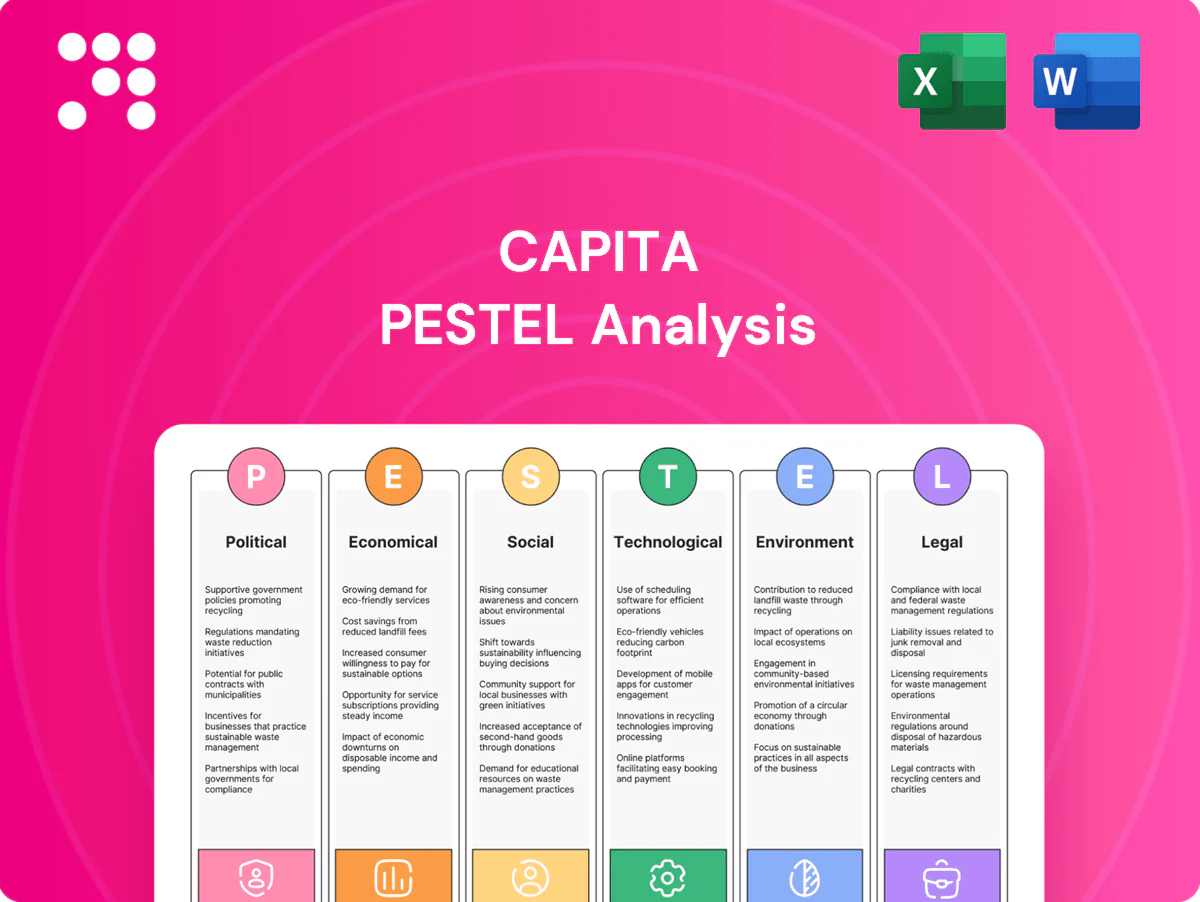
Capita PESTLE Analysis
The preview shown here is the exact Capita PESTLE Analysis you’ll receive after purchase—fully formatted and ready to use. It contains the same structure, content and professional formatting as the downloadable file with no placeholders or edits required. After payment you’ll instantly receive this final document, ready for analysis and presentation.

Product Information
Product Information
Shipping & Returns
Shipping & Returns
Description
Your Shortcut to Market Insight Starts Here
Discover how political, economic, social, technological, legal and environmental forces are shaping Capita’s strategic outlook in our concise PESTLE brief. Perfect for investors and strategists, it highlights risks and opportunities you can act on now. Purchase the full analysis for the complete, editable report and data-driven recommendations.
Political factors
UK public-sector spending priorities
Capita’s revenue is tightly linked to UK government outsourcing and transformation budgets, which are set through three-year spending reviews that shape pipeline visibility and contract timing. Shifts after elections or fiscal reviews can accelerate or delay major programs, increasing revenue volatility. Diversification across Whitehall departments and devolved administrations (Scotland, Wales, Northern Ireland) helps mitigate concentration risk.
Regulatory-driven transformation mandates
Policy initiatives in health, defence, justice and local government increasingly mandate digital modernization, driving consulting and delivery pipelines worth hundreds of millions to billions in UK public-sector contracts.
Compliance deadlines—often tied to national roadmaps—create concentrated demand spikes for Capita’s consulting and digital services, while reversals or deferrals can pause multi‑£100m programmes.
Proactive alignment with published policy roadmaps improves bid success and helps capture a larger share of these realised contract opportunities.
Geopolitical and security considerations
Work in defence, critical infrastructure and citizen services ties Capita directly to national security priorities, where onshore delivery and data sovereignty are increasingly mandated; Capita employs c.50,000 staff, positioning it as a vetted provider for UK public-sector contracts.
Procurement reforms and vendor rationalization
Procurement reforms in 2024 reshaped evaluation criteria and contract structures across UK public services, with government annual procurement spend around 300bn GBP and an active 33% SME spend target pressuring large suppliers like Capita to prove scale plus SME partnerships.
- Favor larger vendors with accreditations
- 33% SME target increases competition
- Framework consolidation raises entry thresholds
- Agile procurement shortens sales cycles, requires delivery flexibility
Devolution and local policy variation
Regional authorities set distinct digital agendas and budgets, with 16 mayoral combined authorities driving local strategies; variation creates fragmented demand but multiple entry points for Capita. Tailored propositions and local partnerships are vital as the UK Shared Prosperity Fund (£2.6bn, 2022–25) and Levelling Up Fund (£4.8bn) unlock targeted procurement opportunities. Local procurement cycles and grant timing require flexible delivery models.
- Fragmented demand → multiple local entry points
- 16 mayoral combined authorities shaping tech spend
- £7.4bn combined UKSPF + Levelling Up funding → targeted contracts
2024 UK procurement reforms and outsourcing cycles unlock multi-£100m digital pipelines
Capita’s revenue depends on UK outsourcing cycles and three‑year spending reviews; UK procurement is ~£300bn and 2024 reforms raise thresholds and a 33% SME target. Digitalisation in health, defence, justice and local government creates multi‑£100m pipelines. Onshore delivery and data‑sovereignty needs, plus c.50,000 staff, favour Capita for security‑sensitive work.
| Metric | Value |
|---|---|
| UK procurement spend | £300bn |
| SME target | 33% |
| UKSPF+Levelling Up | £7.4bn |
| Capita staff | c.50,000 |
What is included in the product
Detailed Word Document
Explores how macro-environmental factors uniquely affect Capita across Political, Economic, Social, Technological, Environmental and Legal dimensions, with data-driven trends and region-specific regulatory context. Designed to help executives and advisors identify threats, opportunities and forward-looking scenarios for strategic planning.
Customizable Excel Spreadsheet
Provides a concise, visually segmented PESTLE summary of Capita that can be dropped into presentations or shared across teams, enabling quick alignment on external risks, market positioning and regional notes during planning sessions.
Economic factors
Macroeconomic cycles and client cost-cutting
In downturns clients shift to efficiency, outsourcing and automation, supporting Capita’s core value proposition; Capita is listed on the LSE as LON: CPI. Discretionary consulting spend can be deferred, reducing short-term revenue from change programs. Pricing pressure rises as budgets tighten, squeezing margins. A balanced mix of run-the-business contracts and change programmes improves resilience against cyclical swings.
Inflation, wage dynamics, and margin pressure
High wage inflation in tech and consulting—regular pay growth around 6% in 2024—raises Capita's delivery costs and compresses margins amid UK CPI near 3% in 2024. Indexation clauses and outcome-based pricing help preserve revenue realism and margin protection. Productivity gains from automation and offshore delivery can offset cost pressure, while strict rate-card discipline and contract governance remain critical to safeguard operating margins.
Currency and offshore delivery economics
FX swings, exemplified by sterling's 1.03 USD low in Sept 2022, materially erode nearshore/offshore cost arbitrage and translate revenues for Capita. Strategic hedging of multi-year contracts can stabilize gross margins and limit currency translation losses. Geographical delivery mix should be optimized to favor currencies appreciating versus the pound or hedged locales. In volatile periods clients increasingly demand cost-stable fixed-price models.
Interest rates and balance sheet flexibility
- Higher rate: Bank Rate ~5.25% (Jul 2025)
- Client behaviour: staging programmes → delayed revenue
- Advantage: superior working-capital metrics
- Strategy: asset-light partnerships reduce capex
Sectoral demand divergence
Sectoral demand is diverging: public services remain relatively steady compared with cyclical private sectors, supporting Capita's core outsourcing contracts.
Financial services, utilities and telecoms continue to invest in digitization and cloud migration, while retail and discretionary clients are slowing transformation spend.
Capita's broad portfolio across these end-markets helps smooth revenue volatility and preserve margin resilience.
- Public services: steady demand, lower cyclicality
- Financials/Utilities/Telecoms: ongoing digitization spend
- Retail/Discretionary: slower transformation
- Portfolio breadth: volatility smoothing
2024 UK procurement reforms and outsourcing cycles unlock multi-£100m digital pipelines
Higher UK Bank Rate ~5.25% (Jul 2025) raises financing costs and delays client programmes; wage inflation ~6% in 2024 and UK CPI ~3% squeeze margins; sterling volatility (USD 1.03 low Sep 2022) harms cost arbitrage; public-sector steadiness offsets private-sector cyclicality, while automation and offshore delivery boost resilience.
| Metric | Value |
|---|---|
| Bank Rate | 5.25% (Jul 2025) |
| Wage inflation | ~6% (2024) |
| UK CPI | ~3% (2024) |
Preview the Actual Deliverable
Capita PESTLE Analysis
The preview shown here is the exact Capita PESTLE Analysis you’ll receive after purchase—fully formatted and ready to use. It contains the same structure, content and professional formatting as the downloadable file with no placeholders or edits required. After payment you’ll instantly receive this final document, ready for analysis and presentation.