Canon PESTLE Analysis

Skip the Research. Get the Strategy.
Discover how political shifts, economic trends, and technological advances are shaping Canon’s future in our concise PESTLE snapshot. This expert analysis highlights risks and opportunities you can act on today. Purchase the full PESTLE for the complete, ready-to-use report and strategic insights.
Political factors

Trade policy and tariffs
Canon’s margins and pricing are sensitive to import/export duties across the US, EU, China and Japan; RCEP (effective 2022) and CPTPP can lower component tariffs while US Section 301 measures (up to 25% on selected Chinese goods) raise costs. Tariff swings on cameras, printers or semiconductors can prompt production shifts among Japan, Philippines, Malaysia and Vietnam. Ongoing supply-chain diversification hedges policy volatility.
Geopolitical tensions and export controls
Semiconductor and advanced imaging tools face strict export controls, with the US and allies expanding China-related licensing measures from 2022 through 2024, shrinking addressable markets and prompting multi-month order delays for affected vendors. Canon must strengthen compliance programs and reallocate sales to approved regions, while using political risk insurance and scenario planning to mitigate shocks and preserve supply-chain continuity.

Government procurement and public spending
Policy-driven public demand for printers, MFPs, secure imaging and medical systems is significant given OECD public procurement equals roughly 12% of GDP and the EU public procurement market is about €2 trillion annually (2024). Budget cycles and stimulus packages such as NextGenerationEU (≈€807bn) shape timing and order size. Localization and cybersecurity standards, often mandating local content thresholds (commonly >30%), determine tender eligibility; strong local partnerships materially boost win rates.

Industrial policy and subsidies
Japan and EU industrial incentives — EU Chips Act mobilizing about €43 billion and Japan offering multiyear subsidies near ¥2 trillion for semiconductors and green tech — can materially support Canon’s R&D and FY2024 capex (~¥220 billion); grants and tax credits reduce effective costs and policy focus on domestic production strengthens supply resilience, but capturing benefits requires tracking eligibility and timelines.
- EU_chips: €43bn
- Japan_subsidies: ~¥2T
- Canon_capex_FY2024: ~¥220bn
- Action: monitor eligibility
Regulatory alignment across markets
Divergent standards across regions complicate product certification and rollout for Canon, which operates in 200+ countries (2024), increasing time-to-market and compliance costs. Harmonizing models to meet multiple regulatory regimes reduces complexity and unit costs, while early engagement with regulators accelerates approvals. Continuous regulatory monitoring prevents costly redesigns and recalls.
- regulatory divergence: slows rollouts
- harmonization: lowers complexity
- early engagement: speeds approvals
- continuous monitoring: avoids redesign costs
Tariff swings, export controls shift Asia production; >30% local content reshapes chip tenders
Tariff and trade-policy swings (RCEP/CPTPP vs US Section 301) pressure margins and prompt production shifts across Japan, Philippines, Malaysia and Vietnam. Tight export controls (2022–24) shrink China addressable markets, elevating compliance, reallocation and political-risk insurance needs. Public procurement (EU ≈€2tn; OECD ≈12% GDP), EU Chips €43bn, Japan ≈¥2T and Canon FY2024 capex ≈¥220bn; local-content thresholds (>30%) dictate tender wins.
| Metric | Value |
|---|---|
| EU public market | ≈€2tn (2024) |
| OECD public proc. | ≈12% GDP |
| EU Chips | €43bn |
| Japan subsidies | ≈¥2T |
| Canon capex FY2024 | ≈¥220bn |
What is included in the product
 Detailed Word Document
Explores how external macro-environmental factors uniquely affect the Canon across Political, Economic, Social, Technological, Environmental, and Legal dimensions, with data-driven insights, forward-looking scenarios, and actionable implications to help executives and investors identify risks, opportunities, and strategic moves.

 Customizable Excel Spreadsheet
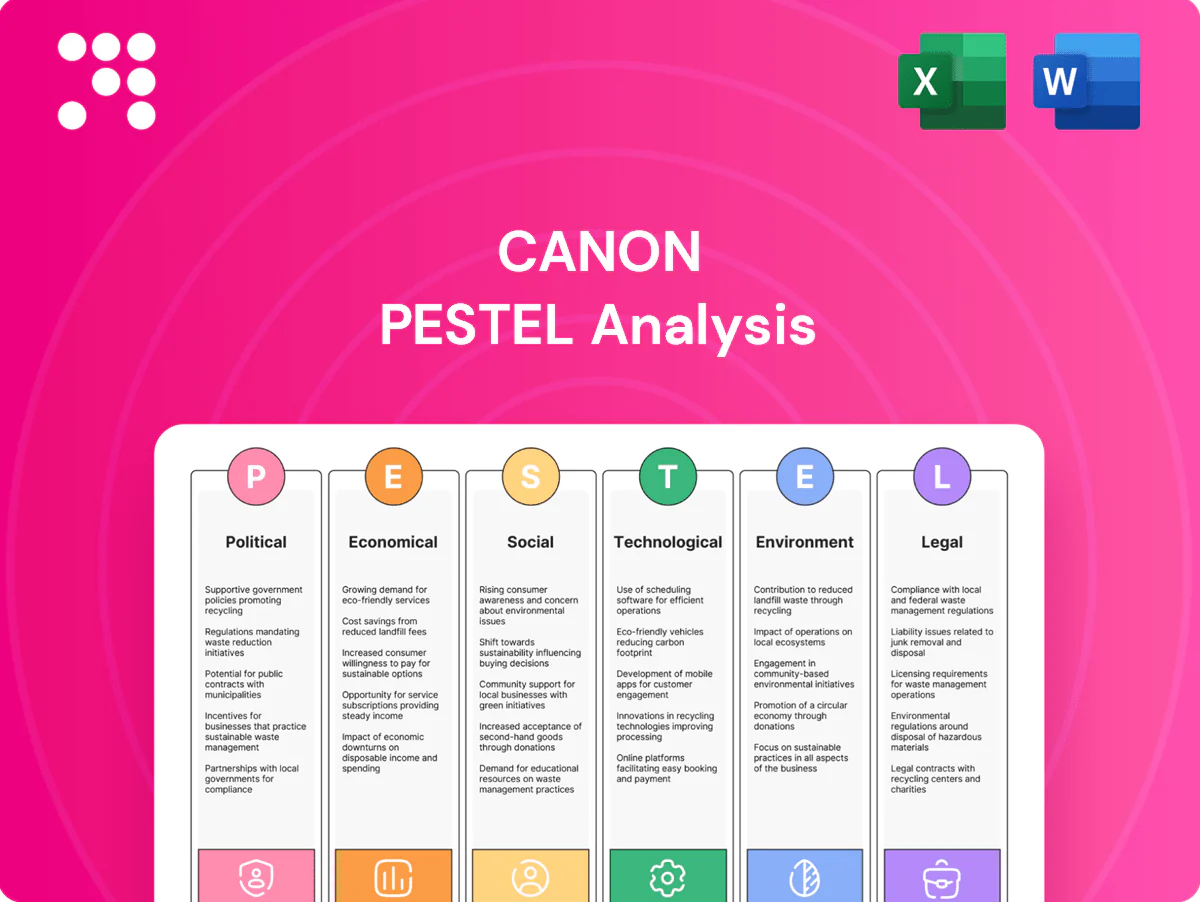
Visually segmented by PESTLE categories for Canon, allowing quick interpretation at a glance to streamline decision-making and surface external risks during planning sessions.
Economic factors

Currency fluctuations (JPY, USD, EUR, CNY)
Canon earns roughly 75% of sales overseas, so FX is a major earnings driver; the yen's slide to about 150–155 per USD in 2023–24 lifted translated revenue but increased import/component costs. Hedging via forwards reduces volatility but cannot remove translation risk entirely. Sustained FX moves force adjustments in pricing and regional sourcing.
Consumer and corporate demand cycles
Camera and printer sales closely follow discretionary spending and office activity; with global GDP growth around 3.1% in 2024 (IMF) economic slowdowns depress upgrade cycles while recoveries lift unit volumes. Subscription and service models boost recurring revenue and can reduce cyclicality. Tight channel inventory management preserves pricing power and margins during downturns.

Semiconductor capital expenditure cycles
Industrial lithography and related tools track chipmakers’ multi-billion-dollar capex cycles: downcycles defer orders while upcycles produce large, lumpy bookings that concentrate revenue into a few quarters. Canon’s backlog and recurring service revenues provide a financial buffer against order volatility, stabilising cash flow across cycles. Close coordination with fabs improves forecast accuracy and shortens response times during both 2024–25 down and up phases.

Inflation, input costs, and logistics
Inflation in 2024 continued to pressure component, freight and labor costs, squeezing margins after 2022–23 spikes; container freight rates fell over 50% from 2021 peaks but remain volatile, while wage inflation persists in key markets. Canon offsets via value engineering and supplier consolidation to lower BOM costs. Dynamic pricing and tiered product portfolios protect product mix and ASPs. Nearshoring and higher inventory buffers cut logistics risk.
- Component inflation pressure
- Freight volatility down >50% vs 2021
- Value engineering & supplier consolidation
- Dynamic pricing & tiered portfolios
- Nearshoring & inventory strategies
Interest rates and financing conditions
- Leasing sensitivity: higher rates ↑ monthly rents
- Customer finance availability → deal closure rates
- Canon funding costs → investment pace
- Vendor financing partnerships → sales resilience
Tariff swings, export controls shift Asia production; >30% local content reshapes chip tenders
Canon earns ~75% of sales overseas so FX (yen ~150–155/USD in 2023–24) materially alters translated revenue and input costs; hedges curb but do not eliminate translation risk. Camera/printer demand tracks global GDP (~3.1% IMF 2024) and discretionary spend; subscription/service growth smooths cyclicality. Higher rates (US 5.25–5.50%; ECB ~4.0% in 2024–25) raise leasing costs and delay capex.
| Metric | Value |
|---|---|
| Overseas sales | ~75% |
| Yen (2023–24) | ¥150–155/USD |
| Global GDP (2024) | 3.1% (IMF) |
| US Fed funds | 5.25–5.50% |
| Freight vs 2021 | ↓>50% |
Preview the Actual Deliverable
Canon PESTLE Analysis
The preview shown here is the exact Canon PESTLE Analysis document you’ll receive after purchase—fully formatted and ready to use. The layout, content, and structure visible are identical to the downloadable file, with no placeholders or edits. After checkout you’ll instantly get this finished, professionally structured report.

Product Information
Product Information
Shipping & Returns
Shipping & Returns
Description
Skip the Research. Get the Strategy.
Discover how political shifts, economic trends, and technological advances are shaping Canon’s future in our concise PESTLE snapshot. This expert analysis highlights risks and opportunities you can act on today. Purchase the full PESTLE for the complete, ready-to-use report and strategic insights.
Political factors
Trade policy and tariffs
Canon’s margins and pricing are sensitive to import/export duties across the US, EU, China and Japan; RCEP (effective 2022) and CPTPP can lower component tariffs while US Section 301 measures (up to 25% on selected Chinese goods) raise costs. Tariff swings on cameras, printers or semiconductors can prompt production shifts among Japan, Philippines, Malaysia and Vietnam. Ongoing supply-chain diversification hedges policy volatility.
Geopolitical tensions and export controls
Semiconductor and advanced imaging tools face strict export controls, with the US and allies expanding China-related licensing measures from 2022 through 2024, shrinking addressable markets and prompting multi-month order delays for affected vendors. Canon must strengthen compliance programs and reallocate sales to approved regions, while using political risk insurance and scenario planning to mitigate shocks and preserve supply-chain continuity.
Government procurement and public spending
Policy-driven public demand for printers, MFPs, secure imaging and medical systems is significant given OECD public procurement equals roughly 12% of GDP and the EU public procurement market is about €2 trillion annually (2024). Budget cycles and stimulus packages such as NextGenerationEU (≈€807bn) shape timing and order size. Localization and cybersecurity standards, often mandating local content thresholds (commonly >30%), determine tender eligibility; strong local partnerships materially boost win rates.
Industrial policy and subsidies
Japan and EU industrial incentives — EU Chips Act mobilizing about €43 billion and Japan offering multiyear subsidies near ¥2 trillion for semiconductors and green tech — can materially support Canon’s R&D and FY2024 capex (~¥220 billion); grants and tax credits reduce effective costs and policy focus on domestic production strengthens supply resilience, but capturing benefits requires tracking eligibility and timelines.
- EU_chips: €43bn
- Japan_subsidies: ~¥2T
- Canon_capex_FY2024: ~¥220bn
- Action: monitor eligibility
Regulatory alignment across markets
Divergent standards across regions complicate product certification and rollout for Canon, which operates in 200+ countries (2024), increasing time-to-market and compliance costs. Harmonizing models to meet multiple regulatory regimes reduces complexity and unit costs, while early engagement with regulators accelerates approvals. Continuous regulatory monitoring prevents costly redesigns and recalls.
- regulatory divergence: slows rollouts
- harmonization: lowers complexity
- early engagement: speeds approvals
- continuous monitoring: avoids redesign costs
Tariff swings, export controls shift Asia production; >30% local content reshapes chip tenders
Tariff and trade-policy swings (RCEP/CPTPP vs US Section 301) pressure margins and prompt production shifts across Japan, Philippines, Malaysia and Vietnam. Tight export controls (2022–24) shrink China addressable markets, elevating compliance, reallocation and political-risk insurance needs. Public procurement (EU ≈€2tn; OECD ≈12% GDP), EU Chips €43bn, Japan ≈¥2T and Canon FY2024 capex ≈¥220bn; local-content thresholds (>30%) dictate tender wins.
| Metric | Value |
|---|---|
| EU public market | ≈€2tn (2024) |
| OECD public proc. | ≈12% GDP |
| EU Chips | €43bn |
| Japan subsidies | ≈¥2T |
| Canon capex FY2024 | ≈¥220bn |
What is included in the product
Detailed Word Document
Explores how external macro-environmental factors uniquely affect the Canon across Political, Economic, Social, Technological, Environmental, and Legal dimensions, with data-driven insights, forward-looking scenarios, and actionable implications to help executives and investors identify risks, opportunities, and strategic moves.
Customizable Excel Spreadsheet
Visually segmented by PESTLE categories for Canon, allowing quick interpretation at a glance to streamline decision-making and surface external risks during planning sessions.
Economic factors
Currency fluctuations (JPY, USD, EUR, CNY)
Canon earns roughly 75% of sales overseas, so FX is a major earnings driver; the yen's slide to about 150–155 per USD in 2023–24 lifted translated revenue but increased import/component costs. Hedging via forwards reduces volatility but cannot remove translation risk entirely. Sustained FX moves force adjustments in pricing and regional sourcing.
Consumer and corporate demand cycles
Camera and printer sales closely follow discretionary spending and office activity; with global GDP growth around 3.1% in 2024 (IMF) economic slowdowns depress upgrade cycles while recoveries lift unit volumes. Subscription and service models boost recurring revenue and can reduce cyclicality. Tight channel inventory management preserves pricing power and margins during downturns.
Semiconductor capital expenditure cycles
Industrial lithography and related tools track chipmakers’ multi-billion-dollar capex cycles: downcycles defer orders while upcycles produce large, lumpy bookings that concentrate revenue into a few quarters. Canon’s backlog and recurring service revenues provide a financial buffer against order volatility, stabilising cash flow across cycles. Close coordination with fabs improves forecast accuracy and shortens response times during both 2024–25 down and up phases.
Inflation, input costs, and logistics
Inflation in 2024 continued to pressure component, freight and labor costs, squeezing margins after 2022–23 spikes; container freight rates fell over 50% from 2021 peaks but remain volatile, while wage inflation persists in key markets. Canon offsets via value engineering and supplier consolidation to lower BOM costs. Dynamic pricing and tiered product portfolios protect product mix and ASPs. Nearshoring and higher inventory buffers cut logistics risk.
- Component inflation pressure
- Freight volatility down >50% vs 2021
- Value engineering & supplier consolidation
- Dynamic pricing & tiered portfolios
- Nearshoring & inventory strategies
Interest rates and financing conditions
- Leasing sensitivity: higher rates ↑ monthly rents
- Customer finance availability → deal closure rates
- Canon funding costs → investment pace
- Vendor financing partnerships → sales resilience
Tariff swings, export controls shift Asia production; >30% local content reshapes chip tenders
Canon earns ~75% of sales overseas so FX (yen ~150–155/USD in 2023–24) materially alters translated revenue and input costs; hedges curb but do not eliminate translation risk. Camera/printer demand tracks global GDP (~3.1% IMF 2024) and discretionary spend; subscription/service growth smooths cyclicality. Higher rates (US 5.25–5.50%; ECB ~4.0% in 2024–25) raise leasing costs and delay capex.
| Metric | Value |
|---|---|
| Overseas sales | ~75% |
| Yen (2023–24) | ¥150–155/USD |
| Global GDP (2024) | 3.1% (IMF) |
| US Fed funds | 5.25–5.50% |
| Freight vs 2021 | ↓>50% |
Preview the Actual Deliverable
Canon PESTLE Analysis
The preview shown here is the exact Canon PESTLE Analysis document you’ll receive after purchase—fully formatted and ready to use. The layout, content, and structure visible are identical to the downloadable file, with no placeholders or edits. After checkout you’ll instantly get this finished, professionally structured report.