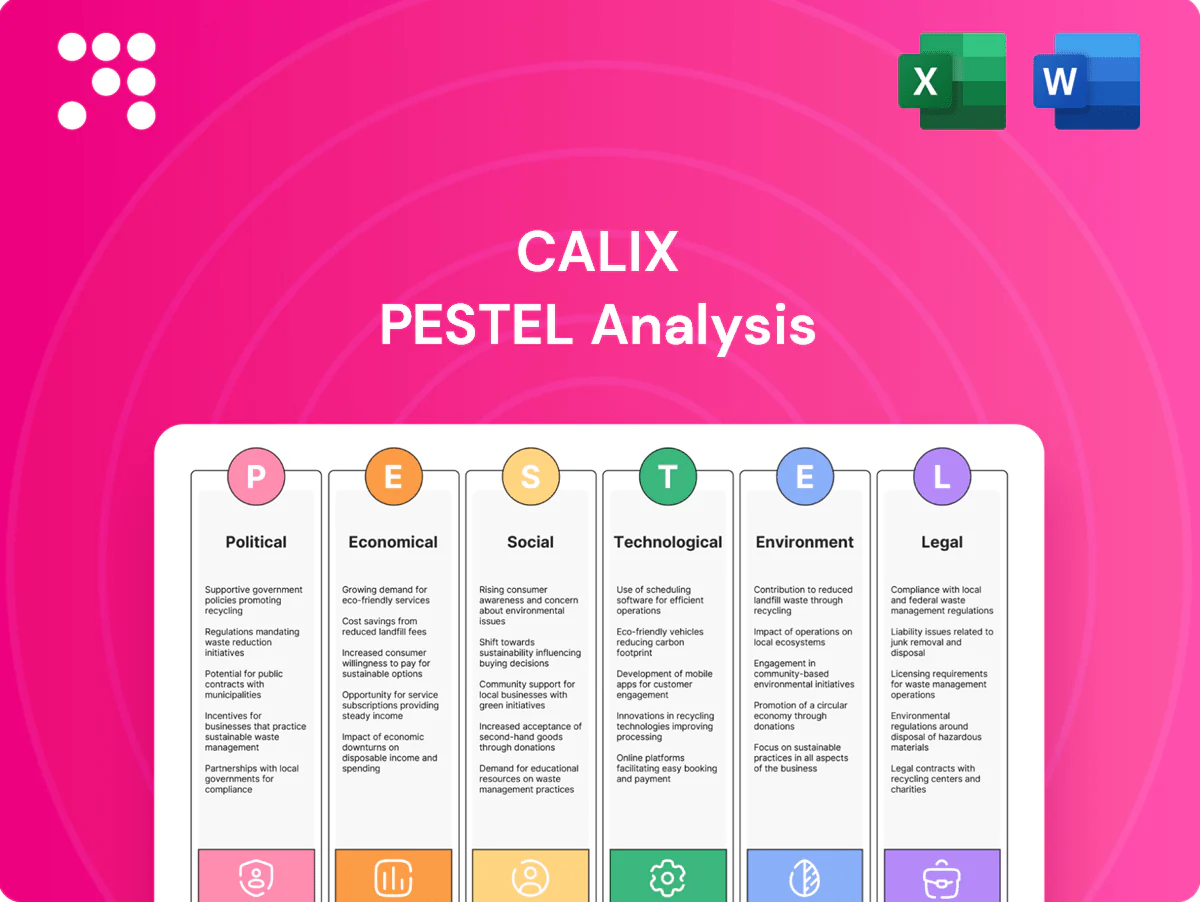
Calix PESTLE Analysis

Your Competitive Advantage Starts with This Report
Unlock strategic clarity with our PESTLE Analysis of Calix — concise insights into political, economic, social, technological, legal, and environmental forces shaping its future. Ideal for investors and strategists, this ready-made report highlights risks and growth levers. Purchase the full version to access the complete, actionable breakdown for immediate use.
Political factors

Broadband subsidies and public funding
Government broadband programs shape CSP capex and platform adoption, driving demand for Calix cloud and access systems. BEAD's $42.45B, RDOF legacy awards and EU/APAC public funds can materially accelerate Calix sales cycles. Allocation rules, buy America provisions and compliance reporting affect eligibility and product mix, while shifts in administrations or budget timing can redirect funding or slow disbursements.
Telecom regulation and net neutrality
Policy on net neutrality, universal service, and open access — now in force in over 60 countries — directly affects CSP pricing and service differentiation, with favorable rules shown to accelerate fiber and managed-service rollouts. Clear, pro‑investment regulation spurs deployments of fiber, Wi‑Fi and cloud‑managed services that Calix supplies, while regulatory uncertainty commonly delays capital expenditures. Regional divergence forces adaptable product and go‑to‑market strategies.

Geopolitics and supply chain resilience
Tariffs from US Section 301 covering roughly $360 billion of Chinese goods and levies of 10-25% plus export controls and geopolitical tensions have materially increased component costs and lead times for network hardware. Diversified sourcing and regional manufacturing help mitigate risk for systems hardware and shorten replenishment cycles. Sanctions (OFAC SDN list >12,000 by 2024) and vendor‑of‑record policies shape CSP procurement decisions. Calix must keep tested continuity plans to handle sudden trade restrictions.

Rural and digital inclusion agendas
Political commitments to close the digital divide, notably the IIJA/BEAD $42.45B program and FCC estimates of ~14.5M Americans unserved (2023), create targeted opportunities for Calix; turnkey platforms fit the procurement profiles of smaller CSPs and co-ops. Funding rounds often require stringent reporting and KPIs, so success hinges on tight alignment with local authorities and community stakeholders.
- Opportunity: BEAD $42.45B targets underserved regions—aligns with Calix SMB/co-op offerings
- Risk: strict reporting/KPIs increase implementation overhead
- Requirement: local authority & stakeholder alignment critical for project awards
Municipal broadband and public-private models
City and utility-led networks are politically sensitive but expanding amid federal funding, notably the BEAD program’s $42.45 billion allocation, driving more public-private partnerships. Procurement rules, open-bid processes, and local content preferences materially shape competitive access and vendor selection. Calix can benefit by offering interoperable, standards-based solutions that meet municipal procurement criteria. Changes in local leadership frequently alter project timelines and scope, raising execution risk.
BEAD $42.45B spurs fiber demand; open-access and tariffs raise CSP execution risk
BEAD $42.45B and open‑access rules boost Calix demand while regulatory uncertainty can delay CSP capex. Tariffs on ~$360B of Chinese goods and export controls raise component costs; diversified sourcing mitigates risk. Local procurement rules and political changes heighten execution risk for P3s.
| Metric | Value |
|---|---|
| BEAD | $42.45B |
| Unserved (FCC 2023) | ~14.5M |
| Tariff scope | ~$360B |
| OFAC SDNs (2024) | >12,000 |
What is included in the product
 Detailed Word Document
Explores how macro-environmental factors uniquely affect Calix across Political, Economic, Social, Technological, Environmental and Legal dimensions, with each section supported by current data, trends and business-specific examples. Designed for executives and investors, it delivers forward-looking insights to identify opportunities, risks and strategic responses.

 Customizable Excel Spreadsheet
Condenses Calix's full PESTLE into a clear, shareable summary that teams can drop into decks or planning sessions for faster decision-making. Visually segmented by factor for quick interpretation and editable so users can add region- or business-specific notes.
Economic factors

CSP capital spending cycles
Macro slowdowns and Fed rate hikes to about 5.25–5.50% have compressed CSP capex, delaying upgrades; U.S. BEAD funding of $42.45B and multi-year fiber/Wi‑Fi roadmaps through 2028 create pent-up demand that favors scalable cloud platforms when growth resumes. Calix’s subscription and managed-service models smooth cyclicality and improve revenue predictability as pipeline visibility ties to those multi-year builds.
Interest rates and financing costs
Higher rates — with US federal funds remaining above 5% in 2024–25 — raise network build costs for regional ISPs and co‑ops, slowing deployment. Calix's flexible financing, opex‑centred offers and ROI calculators help convert customers despite higher cost of capital. Even modest rate cuts of 25–50 bps can unlock deferred projects, while 5–10% currency swings materially affect international pricing and margins.

Subscriber growth and ARPU expansion
Rising household formation (+1.2 million US households in 2023, US Census) combined with persistent remote work (about 12% of workers teleworking in 2023, BLS) and heavy streaming (video >70% of downstream traffic, Cisco) is driving broadband demand. Calix enables differentiated managed services (managed Wi‑Fi, security, smart home) that can lift ARPU and reduce churn. Lower support costs and churn improve CSP profitability, while economic stress can pressure premiums and favor tiered offers.

Inflation and component costs
- Semiconductor pricing: -15% in 2024
- Logistics: ~60% below 2021 peaks
- Mitigants: design-for-cost, software-led value
- Pricing: indexation and value-based approaches
- Ops: inventory efficiency reduces working capital
Competitive dynamics among CSPs
Intense CSP competition—driven by roughly 50 million US homes passed by fiber in 2024, aggressive cable DOCSIS 4.0 upgrade roadmaps and rising 5G fixed wireless deployments—shifts spend toward speed-to-market and CX tools Calix supplies; consolidation raises purchasing concentration and deal sizes while moats move to software ecosystems and managed services.
- Fiber overbuilds: ~50M US homes passed (2024)
- Cable upgrades: DOCSIS 4.0 capex ramping
- Fixed wireless: growing FWA adoption
- Consolidation: larger, concentrated deals
BEAD $42.45B spurs fiber demand; open-access and tariffs raise CSP execution risk
Higher Fed rates (~5.25–5.50% 2024–25) raise ISP build costs and delay projects despite $42.45B BEAD funding; Calix’s subscription and financing soften cyclicality. Component costs eased (semiconductors -15% 2024; ocean freight ~60% below 2021) improving margins; fiber passes ~50M US homes (2024) and +1.2M US households (2023) sustain demand for managed services.
| Metric | Value |
|---|---|
| BEAD | $42.45B |
| Fed funds | 5.25–5.50% |
| Semiconductors (2024) | -15% |
| Fiber homes (2024) | ~50M |
What You See Is What You Get
Calix PESTLE Analysis
The Calix PESTLE Analysis provides a clear, professional examination of political, economic, social, technological, legal, and environmental factors affecting Calix. The preview shown here is the exact document you’ll receive after purchase—fully formatted and ready to use. Use it immediately for strategy, presentations, or research.

Product Information
Product Information
Shipping & Returns
Shipping & Returns
Description
Your Competitive Advantage Starts with This Report
Unlock strategic clarity with our PESTLE Analysis of Calix — concise insights into political, economic, social, technological, legal, and environmental forces shaping its future. Ideal for investors and strategists, this ready-made report highlights risks and growth levers. Purchase the full version to access the complete, actionable breakdown for immediate use.
Political factors
Broadband subsidies and public funding
Government broadband programs shape CSP capex and platform adoption, driving demand for Calix cloud and access systems. BEAD's $42.45B, RDOF legacy awards and EU/APAC public funds can materially accelerate Calix sales cycles. Allocation rules, buy America provisions and compliance reporting affect eligibility and product mix, while shifts in administrations or budget timing can redirect funding or slow disbursements.
Telecom regulation and net neutrality
Policy on net neutrality, universal service, and open access — now in force in over 60 countries — directly affects CSP pricing and service differentiation, with favorable rules shown to accelerate fiber and managed-service rollouts. Clear, pro‑investment regulation spurs deployments of fiber, Wi‑Fi and cloud‑managed services that Calix supplies, while regulatory uncertainty commonly delays capital expenditures. Regional divergence forces adaptable product and go‑to‑market strategies.
Geopolitics and supply chain resilience
Tariffs from US Section 301 covering roughly $360 billion of Chinese goods and levies of 10-25% plus export controls and geopolitical tensions have materially increased component costs and lead times for network hardware. Diversified sourcing and regional manufacturing help mitigate risk for systems hardware and shorten replenishment cycles. Sanctions (OFAC SDN list >12,000 by 2024) and vendor‑of‑record policies shape CSP procurement decisions. Calix must keep tested continuity plans to handle sudden trade restrictions.
Rural and digital inclusion agendas
Political commitments to close the digital divide, notably the IIJA/BEAD $42.45B program and FCC estimates of ~14.5M Americans unserved (2023), create targeted opportunities for Calix; turnkey platforms fit the procurement profiles of smaller CSPs and co-ops. Funding rounds often require stringent reporting and KPIs, so success hinges on tight alignment with local authorities and community stakeholders.
- Opportunity: BEAD $42.45B targets underserved regions—aligns with Calix SMB/co-op offerings
- Risk: strict reporting/KPIs increase implementation overhead
- Requirement: local authority & stakeholder alignment critical for project awards
Municipal broadband and public-private models
City and utility-led networks are politically sensitive but expanding amid federal funding, notably the BEAD program’s $42.45 billion allocation, driving more public-private partnerships. Procurement rules, open-bid processes, and local content preferences materially shape competitive access and vendor selection. Calix can benefit by offering interoperable, standards-based solutions that meet municipal procurement criteria. Changes in local leadership frequently alter project timelines and scope, raising execution risk.
BEAD $42.45B spurs fiber demand; open-access and tariffs raise CSP execution risk
BEAD $42.45B and open‑access rules boost Calix demand while regulatory uncertainty can delay CSP capex. Tariffs on ~$360B of Chinese goods and export controls raise component costs; diversified sourcing mitigates risk. Local procurement rules and political changes heighten execution risk for P3s.
| Metric | Value |
|---|---|
| BEAD | $42.45B |
| Unserved (FCC 2023) | ~14.5M |
| Tariff scope | ~$360B |
| OFAC SDNs (2024) | >12,000 |
What is included in the product
Detailed Word Document
Explores how macro-environmental factors uniquely affect Calix across Political, Economic, Social, Technological, Environmental and Legal dimensions, with each section supported by current data, trends and business-specific examples. Designed for executives and investors, it delivers forward-looking insights to identify opportunities, risks and strategic responses.
Customizable Excel Spreadsheet
Condenses Calix's full PESTLE into a clear, shareable summary that teams can drop into decks or planning sessions for faster decision-making. Visually segmented by factor for quick interpretation and editable so users can add region- or business-specific notes.
Economic factors
CSP capital spending cycles
Macro slowdowns and Fed rate hikes to about 5.25–5.50% have compressed CSP capex, delaying upgrades; U.S. BEAD funding of $42.45B and multi-year fiber/Wi‑Fi roadmaps through 2028 create pent-up demand that favors scalable cloud platforms when growth resumes. Calix’s subscription and managed-service models smooth cyclicality and improve revenue predictability as pipeline visibility ties to those multi-year builds.
Interest rates and financing costs
Higher rates — with US federal funds remaining above 5% in 2024–25 — raise network build costs for regional ISPs and co‑ops, slowing deployment. Calix's flexible financing, opex‑centred offers and ROI calculators help convert customers despite higher cost of capital. Even modest rate cuts of 25–50 bps can unlock deferred projects, while 5–10% currency swings materially affect international pricing and margins.
Subscriber growth and ARPU expansion
Rising household formation (+1.2 million US households in 2023, US Census) combined with persistent remote work (about 12% of workers teleworking in 2023, BLS) and heavy streaming (video >70% of downstream traffic, Cisco) is driving broadband demand. Calix enables differentiated managed services (managed Wi‑Fi, security, smart home) that can lift ARPU and reduce churn. Lower support costs and churn improve CSP profitability, while economic stress can pressure premiums and favor tiered offers.
Inflation and component costs
- Semiconductor pricing: -15% in 2024
- Logistics: ~60% below 2021 peaks
- Mitigants: design-for-cost, software-led value
- Pricing: indexation and value-based approaches
- Ops: inventory efficiency reduces working capital
Competitive dynamics among CSPs
Intense CSP competition—driven by roughly 50 million US homes passed by fiber in 2024, aggressive cable DOCSIS 4.0 upgrade roadmaps and rising 5G fixed wireless deployments—shifts spend toward speed-to-market and CX tools Calix supplies; consolidation raises purchasing concentration and deal sizes while moats move to software ecosystems and managed services.
- Fiber overbuilds: ~50M US homes passed (2024)
- Cable upgrades: DOCSIS 4.0 capex ramping
- Fixed wireless: growing FWA adoption
- Consolidation: larger, concentrated deals
BEAD $42.45B spurs fiber demand; open-access and tariffs raise CSP execution risk
Higher Fed rates (~5.25–5.50% 2024–25) raise ISP build costs and delay projects despite $42.45B BEAD funding; Calix’s subscription and financing soften cyclicality. Component costs eased (semiconductors -15% 2024; ocean freight ~60% below 2021) improving margins; fiber passes ~50M US homes (2024) and +1.2M US households (2023) sustain demand for managed services.
| Metric | Value |
|---|---|
| BEAD | $42.45B |
| Fed funds | 5.25–5.50% |
| Semiconductors (2024) | -15% |
| Fiber homes (2024) | ~50M |
What You See Is What You Get
Calix PESTLE Analysis
The Calix PESTLE Analysis provides a clear, professional examination of political, economic, social, technological, legal, and environmental factors affecting Calix. The preview shown here is the exact document you’ll receive after purchase—fully formatted and ready to use. Use it immediately for strategy, presentations, or research.