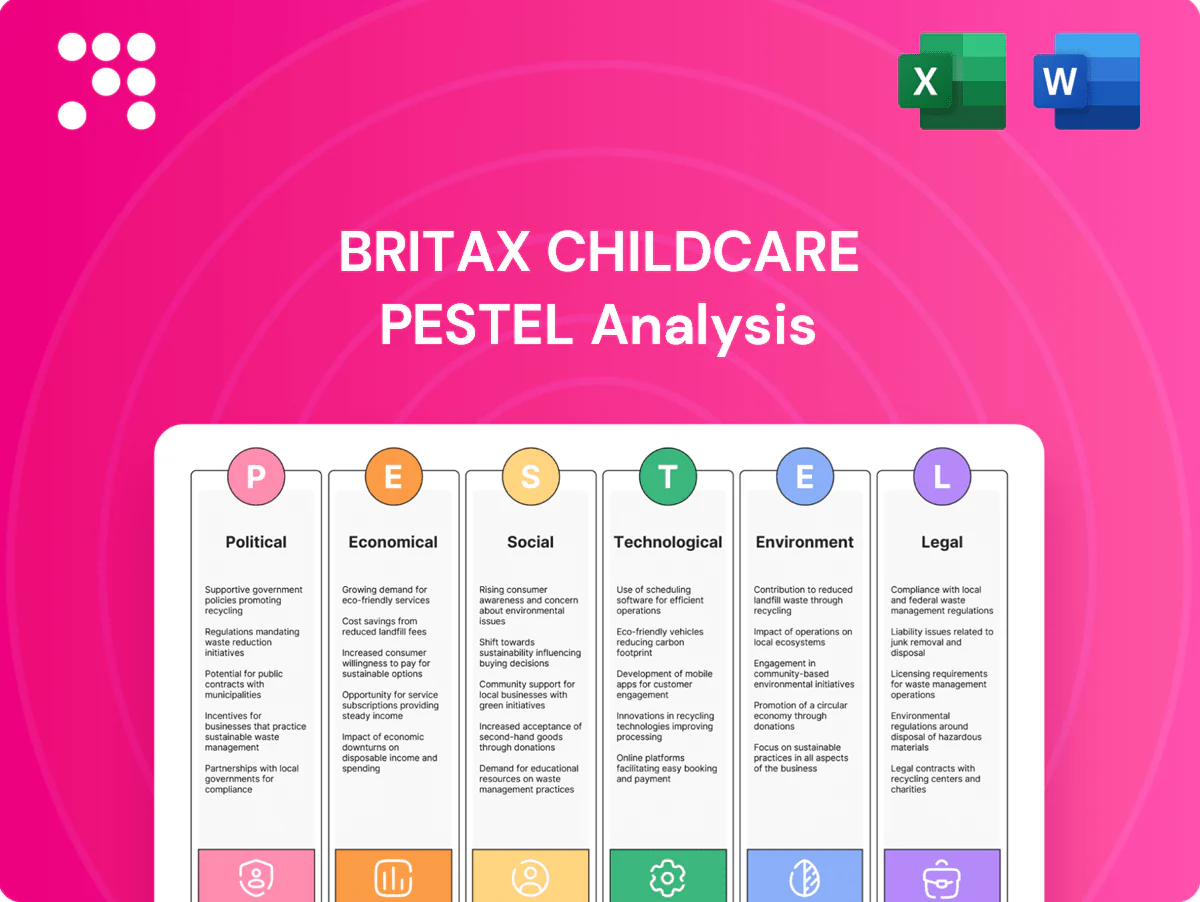
Britax Childcare PESTLE Analysis

Your Shortcut to Market Insight Starts Here
Discover how political, economic, social, technological, environmental and legal forces are shaping Britax Childcare's future. Our concise PESTLE highlights risks and opportunities across markets and supply chains. Perfect for investors and strategists. Buy the full analysis to access actionable, ready-to-use insights.
Political factors

Regulatory harmonization and trade policy
Child safety standards vary between the EU (new General Product Safety Regulation updates from 2023–24), the UK (CE/UKCA divergence), the US (CPSC rules) and Asian markets, forcing Britax to alter specs and approvals across regions. Harmonized rules or mutual recognition (CE/UKCA alignment or US-EU dialogues) shortens approvals and lowers compliance spend. Ongoing trade tensions—US tariffs on Chinese goods of 7.5–25%—raise input costs and complicate cross-border distribution.
Government road-safety initiatives
Public road‑safety programs raise child‑restraint category penetration; studies from IIHS show correct use of child seats reduces fatality risk for infants/toddlers by 71–82%, driving higher purchase rates. Strategic partnerships with transport ministries and NGOs amplify brand trust and accelerate standards adoption and training. Funding cycles and shifting policy priorities directly affect subsidy availability, enforcement and compliance checks, keeping uptake below 50% in many low‑/middle‑income markets.

Industrial policy and manufacturing incentives
Subsidies such as the US CHIPS Act (about $52bn for semiconductor manufacturing) and the Inflation Reduction Act (roughly $369bn for clean energy) illustrate how government incentives can lower capex and unit costs for advanced manufacturing that Britax could leverage for automation and reshoring. Localization incentives in regions like the US and EU encourage regional assembly to cut logistics and tariffs. Conversely, sudden withdrawal of such programs or political instability can upend multi‑year facility planning and increase risk.

Public procurement and institutional buying
Public procurement for hospitals, maternity programs and mobility schemes offers steady demand; public procurement represents about 12% of global GDP (World Bank). EU/EFTA tender thresholds (approx €139,000 for goods/services) and hospital procurement rules favor certified, high-safety products. Budget reallocations or elections regularly delay or cancel orders, creating timing risk.
- Demand source: hospitals, maternity, mobility
- Market scale: ~12% global GDP
- Tender rule: ≈€139,000 threshold
- Risk: budget/election delays
Geopolitical supply chain risks
Political conflicts and sanctions since 2022, notably following the Russia–Ukraine war, have interrupted flows of polymers, technical fabrics and electronic components crucial to Britax Childcare production, forcing order delays and component shortages.
Multi-sourcing and regional supplier development reduce exposure, with nearshoring shortening lead times and inventory days.
During geopolitical disruptions, cargo insurance and rerouting raise logistics costs and premiums, increasing operating expenses and COGS.
- Risk: sanctions and export controls after 2022 disrupted polymer/component supply
- Mitigation: multi-sourcing and regional suppliers shorten lead times
- Impact: higher insurance and rerouting increase logistics costs and COGS
Regulatory divergence, tariffs and sanctions spur nearshoring as procurement fuels safety demand
Regulatory divergence (CE/UKCA, EU GPSR 2023–24) and US tariffs (7.5–25%) raise compliance and input costs; public procurement (~12% global GDP) and road‑safety programs (IIHS: 71–82% fatality reduction) drive demand; sanctions since 2022 disrupted polymers/components, pushing nearshoring and higher logistics/insurance costs.
| Metric | Value |
|---|---|
| Public procurement | ~12% GDP |
| Tariffs | 7.5–25% |
| IIHS impact | 71–82% fatality ↓ |
What is included in the product
 Detailed Word Document
Explores how Political, Economic, Social, Technological, Environmental and Legal forces uniquely impact Britax Childcare, with data-driven trends and region-specific regulatory context; each category offers multiple actionable sub-points and forward-looking insights. Designed for executives, advisors and investors to identify threats, seize opportunities, and inform strategic planning, funding pitches, or operational adjustments.

 Customizable Excel Spreadsheet
A concise, visually segmented PESTLE summary for Britax Childcare that’s easy to drop into presentations, share across teams, and customize with region- or product-specific notes to streamline risk discussions and strategic planning.
Economic factors

Consumer income cycles
Childcare durables sit between necessity and discretionary: safety makes demand resilient but price-sensitive, with industry data showing premium penetration slipping by about 15% in downturns as buyers shift to mid-tier SKUs and promotions.
Input cost volatility
Prices for plastics, metals, textiles and energy directly compress Britax Childcare margins; Brent crude averaged about $86/barrel in 2024, keeping transportation and resin costs elevated. Hedging and multi‑year supply contracts can stabilize input costs but tie up purchasing flexibility. Design‑to‑cost, component modularity and platform sharing reduce exposure to raw‑material shocks while maintaining certified safety.

Exchange rate fluctuations
Global sales and multi-currency sourcing expose Britax Childcare to FX swings, amplified by a global FX market with average daily turnover of about $7.5 trillion (BIS, 2022). Strategic pricing corridors and natural hedges in supplier currencies can preserve margins and reduce translation risk. Sudden currency devaluations, however, may require list-price revisions and can quickly erode price competitiveness in key markets.

E-commerce and retail channel mix
Shift to online (global e‑commerce ~22% of retail sales in 2024; UK ~31%) boosts Britax Childcare’s direct margins but raises fulfillment and returns costs, with online return rates for consumer goods commonly reported in the mid‑teens to low‑twenties percent range. Brick‑and‑mortar partners offer fit testing and trust that drive higher conversion and lower post‑sale returns. An optimal channel mix improves inventory turns and reduces markdown risk, supporting gross margin resilience.
- e‑commerce share: ~22% global (2024)
- UK e‑commerce: ~31% (2024)
- online return rates: mid‑teens–low‑20s %
- benefit: higher conversion, fewer returns via in‑store fit
Demographic trends and birth rates
- Developed TFR ~1.59 (OECD)
- Global TFR 2.3 (UN 2022)
- China TFR ~1.09 (2022)
- Higher ASPs via accessories & refreshes
Regulatory divergence, tariffs and sanctions spur nearshoring as procurement fuels safety demand
Demand resilient but price‑sensitive; premium share falls ~15% in downturns. Input costs (Brent ~$86/barrel 2024) and FX volatility (daily turnover ~$7.5tn) compress margins; hedges and design‑to‑cost mitigate. E‑commerce (global ~22%, UK ~31% in 2024) raises margin but increases returns (15–22%). Low TFR in developed markets (OECD ~1.59; China ~1.09) limits unit growth.
| Metric | Value (2024) |
|---|---|
| Brent | $86/barrel |
| FX daily turnover | $7.5tn |
| Global e‑commerce | 22% |
| UK e‑commerce | 31% |
| Online returns | 15–22% |
| OECD TFR | 1.59 |
| China TFR | 1.09 |
Same Document Delivered
Britax Childcare PESTLE Analysis
The preview shown here is the exact document you’ll receive after purchase—fully formatted and ready to use. This Britax Childcare PESTLE Analysis provides comprehensive political, economic, social, technological, legal and environmental insights tailored for strategic decision-making. No placeholders or teasers—what you see is the finished file available for immediate download after payment.

Product Information
Product Information
Shipping & Returns
Shipping & Returns
Description
Your Shortcut to Market Insight Starts Here
Discover how political, economic, social, technological, environmental and legal forces are shaping Britax Childcare's future. Our concise PESTLE highlights risks and opportunities across markets and supply chains. Perfect for investors and strategists. Buy the full analysis to access actionable, ready-to-use insights.
Political factors
Regulatory harmonization and trade policy
Child safety standards vary between the EU (new General Product Safety Regulation updates from 2023–24), the UK (CE/UKCA divergence), the US (CPSC rules) and Asian markets, forcing Britax to alter specs and approvals across regions. Harmonized rules or mutual recognition (CE/UKCA alignment or US-EU dialogues) shortens approvals and lowers compliance spend. Ongoing trade tensions—US tariffs on Chinese goods of 7.5–25%—raise input costs and complicate cross-border distribution.
Government road-safety initiatives
Public road‑safety programs raise child‑restraint category penetration; studies from IIHS show correct use of child seats reduces fatality risk for infants/toddlers by 71–82%, driving higher purchase rates. Strategic partnerships with transport ministries and NGOs amplify brand trust and accelerate standards adoption and training. Funding cycles and shifting policy priorities directly affect subsidy availability, enforcement and compliance checks, keeping uptake below 50% in many low‑/middle‑income markets.
Industrial policy and manufacturing incentives
Subsidies such as the US CHIPS Act (about $52bn for semiconductor manufacturing) and the Inflation Reduction Act (roughly $369bn for clean energy) illustrate how government incentives can lower capex and unit costs for advanced manufacturing that Britax could leverage for automation and reshoring. Localization incentives in regions like the US and EU encourage regional assembly to cut logistics and tariffs. Conversely, sudden withdrawal of such programs or political instability can upend multi‑year facility planning and increase risk.
Public procurement and institutional buying
Public procurement for hospitals, maternity programs and mobility schemes offers steady demand; public procurement represents about 12% of global GDP (World Bank). EU/EFTA tender thresholds (approx €139,000 for goods/services) and hospital procurement rules favor certified, high-safety products. Budget reallocations or elections regularly delay or cancel orders, creating timing risk.
- Demand source: hospitals, maternity, mobility
- Market scale: ~12% global GDP
- Tender rule: ≈€139,000 threshold
- Risk: budget/election delays
Geopolitical supply chain risks
Political conflicts and sanctions since 2022, notably following the Russia–Ukraine war, have interrupted flows of polymers, technical fabrics and electronic components crucial to Britax Childcare production, forcing order delays and component shortages.
Multi-sourcing and regional supplier development reduce exposure, with nearshoring shortening lead times and inventory days.
During geopolitical disruptions, cargo insurance and rerouting raise logistics costs and premiums, increasing operating expenses and COGS.
- Risk: sanctions and export controls after 2022 disrupted polymer/component supply
- Mitigation: multi-sourcing and regional suppliers shorten lead times
- Impact: higher insurance and rerouting increase logistics costs and COGS
Regulatory divergence, tariffs and sanctions spur nearshoring as procurement fuels safety demand
Regulatory divergence (CE/UKCA, EU GPSR 2023–24) and US tariffs (7.5–25%) raise compliance and input costs; public procurement (~12% global GDP) and road‑safety programs (IIHS: 71–82% fatality reduction) drive demand; sanctions since 2022 disrupted polymers/components, pushing nearshoring and higher logistics/insurance costs.
| Metric | Value |
|---|---|
| Public procurement | ~12% GDP |
| Tariffs | 7.5–25% |
| IIHS impact | 71–82% fatality ↓ |
What is included in the product
Detailed Word Document
Explores how Political, Economic, Social, Technological, Environmental and Legal forces uniquely impact Britax Childcare, with data-driven trends and region-specific regulatory context; each category offers multiple actionable sub-points and forward-looking insights. Designed for executives, advisors and investors to identify threats, seize opportunities, and inform strategic planning, funding pitches, or operational adjustments.
Customizable Excel Spreadsheet
A concise, visually segmented PESTLE summary for Britax Childcare that’s easy to drop into presentations, share across teams, and customize with region- or product-specific notes to streamline risk discussions and strategic planning.
Economic factors
Consumer income cycles
Childcare durables sit between necessity and discretionary: safety makes demand resilient but price-sensitive, with industry data showing premium penetration slipping by about 15% in downturns as buyers shift to mid-tier SKUs and promotions.
Input cost volatility
Prices for plastics, metals, textiles and energy directly compress Britax Childcare margins; Brent crude averaged about $86/barrel in 2024, keeping transportation and resin costs elevated. Hedging and multi‑year supply contracts can stabilize input costs but tie up purchasing flexibility. Design‑to‑cost, component modularity and platform sharing reduce exposure to raw‑material shocks while maintaining certified safety.
Exchange rate fluctuations
Global sales and multi-currency sourcing expose Britax Childcare to FX swings, amplified by a global FX market with average daily turnover of about $7.5 trillion (BIS, 2022). Strategic pricing corridors and natural hedges in supplier currencies can preserve margins and reduce translation risk. Sudden currency devaluations, however, may require list-price revisions and can quickly erode price competitiveness in key markets.
E-commerce and retail channel mix
Shift to online (global e‑commerce ~22% of retail sales in 2024; UK ~31%) boosts Britax Childcare’s direct margins but raises fulfillment and returns costs, with online return rates for consumer goods commonly reported in the mid‑teens to low‑twenties percent range. Brick‑and‑mortar partners offer fit testing and trust that drive higher conversion and lower post‑sale returns. An optimal channel mix improves inventory turns and reduces markdown risk, supporting gross margin resilience.
- e‑commerce share: ~22% global (2024)
- UK e‑commerce: ~31% (2024)
- online return rates: mid‑teens–low‑20s %
- benefit: higher conversion, fewer returns via in‑store fit
Demographic trends and birth rates
- Developed TFR ~1.59 (OECD)
- Global TFR 2.3 (UN 2022)
- China TFR ~1.09 (2022)
- Higher ASPs via accessories & refreshes
Regulatory divergence, tariffs and sanctions spur nearshoring as procurement fuels safety demand
Demand resilient but price‑sensitive; premium share falls ~15% in downturns. Input costs (Brent ~$86/barrel 2024) and FX volatility (daily turnover ~$7.5tn) compress margins; hedges and design‑to‑cost mitigate. E‑commerce (global ~22%, UK ~31% in 2024) raises margin but increases returns (15–22%). Low TFR in developed markets (OECD ~1.59; China ~1.09) limits unit growth.
| Metric | Value (2024) |
|---|---|
| Brent | $86/barrel |
| FX daily turnover | $7.5tn |
| Global e‑commerce | 22% |
| UK e‑commerce | 31% |
| Online returns | 15–22% |
| OECD TFR | 1.59 |
| China TFR | 1.09 |
Same Document Delivered
Britax Childcare PESTLE Analysis
The preview shown here is the exact document you’ll receive after purchase—fully formatted and ready to use. This Britax Childcare PESTLE Analysis provides comprehensive political, economic, social, technological, legal and environmental insights tailored for strategic decision-making. No placeholders or teasers—what you see is the finished file available for immediate download after payment.