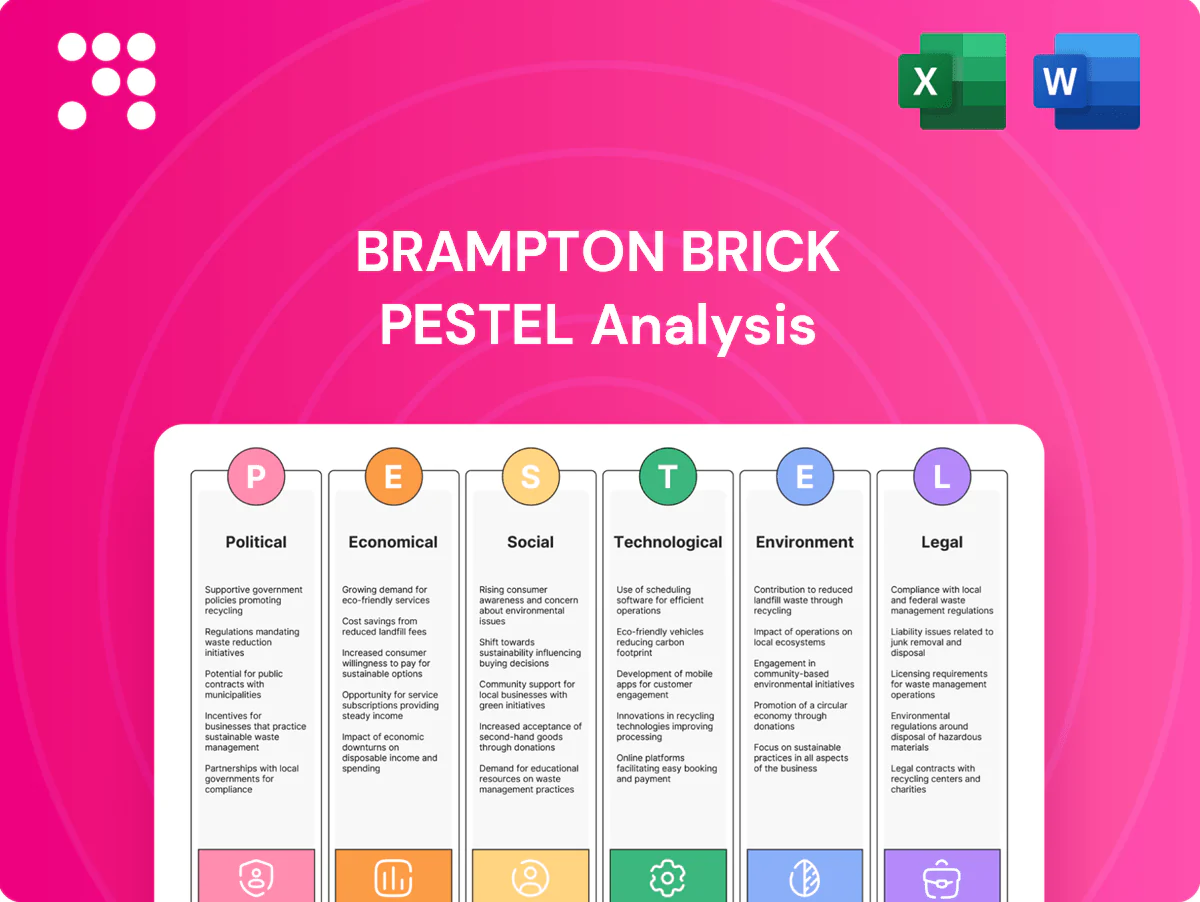
Brampton Brick PESTLE Analysis

Your Shortcut to Market Insight Starts Here
Our PESTLE Analysis for Brampton Brick reveals how political regulation, supply-chain economics, environmental standards and tech adoption are reshaping its prospects; concise, evidence-based insights help you assess risk and opportunity. Purchase the full report to access the complete breakdown and actionable recommendations instantly.
Political factors

Cross-border trade policy (USMCA, tariffs)
Serving Ontario/Quebec and the Northeastern/Midwestern U.S. exposes Brampton Brick to tariff, antidumping and Buy America shifts that can affect pricing and margins; USMCA (in force since July 1, 2020) lowers many tariff barriers but does not eliminate trade remedies.
Federal infrastructure laws like the 2021 IIJA (roughly $1.2 trillion) expanded Buy America content and procurement that can tilt demand toward domestic suppliers and raise compliance costs.
Any sectoral dispute over masonry or building materials could trigger duties or AD/CVD investigations, while diversified sourcing and dual-country production or warehousing help mitigate supply and margin shocks.
Infrastructure and housing stimulus priorities
Federal/provincial programs—Canada’s Investing in Canada Plan (about CAD 187 billion over 12 years) and the National Housing Strategy (roughly CAD 72 billion) plus the US Bipartisan Infrastructure Law (approximately USD 550 billion of new spending)—support non‑residential and residential demand that lifts brick and block volumes. Policy emphasis on affordable housing and provincial RFPs has driven higher residential starts, while delays or shifting appropriations create volatility. Active monitoring of RFP pipelines and state/provincial capital plans is essential to align production and capacity planning.

Provincial/municipal planning and zoning
Ontario and Quebec municipalities shape material choice through planning guidelines and façade requirements; Ontario's population grew 5.8% from 2016–2021 and Brampton reached 656,480 in 2021, intensifying development pressures. Brick-friendly design standards can support mixed-use schemes and price realization. Lengthy permitting cycles often span multiple months, so proactive engagement with planning bodies helps preserve brick’s role in urban design.

Energy and carbon policy direction
Canada’s rising carbon price (CAD 95/t in 2025, rising to CAD 170/t by 2030) and net‑zero by 2050 target materially increase kiln fuel and carbon costs, squeezing Brampton Brick margins unless efficiency or fuel‑switching occurs; federal 2030 emissions reduction target is 40–45% below 2005. Provincial incentives (e.g., Ontario/Alberta programs offering grants and tax credits covering up to 30–50% of retrofit capex) can offset capital needs. U.S. state energy and carbon standards vary widely (California LCFS and cap‑and‑trade vs states with no pricing), complicating cross‑border plant optimization. Predictable policy trajectories are essential to justify multi‑year kiln modernization and fuel‑switch investments.
- Canada carbon price: CAD 95/t (2025), CAD 170/t (2030)
- Net‑zero target: 2050; 2030 target: −40–45% vs 2005
- Provincial incentives: up to 30–50% of retrofit capex
- US state standards: high variability (e.g., CA strict, others lax)
- Policy predictability: critical for long‑lead kiln investments
Public procurement and local content
Government projects increasingly weight local content and sustainability scoring, advantaging masonry suppliers that can document emissions and reclaimed-content; meeting disclosure and environmental criteria often improves bid rankings in Canadian and provincial tenders.
Strict local sourcing rules can fragment supply chains and raise input costs for Brampton Brick, while robust documentation and certification capabilities strengthen competitiveness in public tenders.
- Local-content preference: favors certified regional suppliers
- Enviro disclosure: unlocks bid scoring advantages
- Risk: fragmented supply chains, higher costs
- Mitigation: invest in documentation and sustainability certification
Tariffs, Buy America and rising carbon costs reshape construction supply and decarbonization
Brampton Brick faces tariff/AD risk despite USMCA, and IIJA/Buy America (US new spending ~USD 550bn) raises compliance costs and favours domestic suppliers. Canadian federal programs (Investing in Canada ~CAD 187bn; NHS ~CAD 72bn) support demand but create RFP volatility. Rising carbon price (CAD 95/t 2025 → CAD 170/t 2030) and provincial incentives (up to 30–50% capex) drive decarbonization choices.
| Tag | Value |
|---|---|
| US IIJA | ~USD 550bn |
| Canada Invest | ~CAD 187bn |
| NHS | ~CAD 72bn |
| Carbon price | CAD 95/t (2025); CAD 170/t (2030) |
What is included in the product
 Detailed Word Document
Explores how Political, Economic, Social, Technological, Environmental and Legal forces uniquely affect Brampton Brick, with data-driven trends and region-specific regulatory context to reveal risks and growth levers. Designed for executives and investors, it delivers actionable, forward-looking insights ready for business plans and scenario planning.

 Customizable Excel Spreadsheet
A concise, visually segmented PESTLE summary of Brampton Brick that can be dropped into presentations, edited with regional notes, and shared across teams to simplify external risk discussions and align strategic planning.
Economic factors

Housing starts and construction cycles
Residential and non-residential cycles in Ontario/Quebec and core U.S. regions directly drive Brampton Brick volumes; Canadian housing starts averaged about 220,000 units in 2024 while U.S. starts ran near a 1.4 million annual rate, so downturns compress orders and pricing and upswings strain capacity. Monitoring permits and monthly starts provides near-term demand signals. Flexing production schedules helps manage inventory and working capital.
Interest rates and mortgage affordability
Higher rates—Canada's 5-year fixed mortgages averaged ~5.5% in 2024—have depressed affordability, delaying projects and cutting brick demand as housing starts fell to roughly 220,000 annualized in 2024. Rate cuts could unlock pent-up demand in single- and multi-family segments. Higher financing costs constrain developer pipelines and dealer inventories; hedging and cautious CAPEX pacing mitigate exposure to abrupt rate shifts.

Energy and fuel cost volatility
Natural gas (AECO averaged about C$3/GJ in 2024) and Ontario industrial electricity (~C$0.10/kWh in 2024) are major inputs for kilns and curing, so price spikes can quickly compress margins if customer surcharges lag. Long-term supply contracts and capital investments in kiln efficiency and waste-heat recovery have been shown to stabilize brickmakers’ cost structures. Geographic diversification of plants reduces concentration of regional energy risk exposure.

Labor availability and wage inflation
Skilled trades shortages slow jobsite progress and materials pull-through, while plant-labor tightness lifts wages and overtime, with Canadian average hourly wage growth near 4% in 2024. Immigration policy (Canada set a ~500,000 intake target for 2024) and apprenticeship pipelines materially affect supply. Automation investments can offset structural gaps over time.
- Skilled shortages
- Wage inflation ~4% (2024)
- Immigration ~500,000 target (2024)
- Automation mitigates long-term gap
Currency fluctuations (CAD/USD)
Serving Canadian and U.S. markets exposes Brampton Brick to CAD/USD swings; USD/CAD averaged ~1.35 in H1 2025 (CAD/USD ~0.74), so a stronger USD lifts translated U.S. sales but increases import and input costs for CAD-priced inputs. The company reports use of forward contracts and natural hedges to smooth quarterly earnings volatility, while regional pricing discipline preserves competitiveness and margin integrity.
- USD/CAD ~1.35 (H1 2025)
- CAD/USD ~0.74
- Hedging via forwards/natural hedges
- Regional pricing to protect margins
Tariffs, Buy America and rising carbon costs reshape construction supply and decarbonization
Brampton Brick volumes track Ontario/Quebec and U.S. residential cycles; Canadian starts ~220,000 (2024) vs U.S. ~1.4M, so demand swings hit utilization and pricing. Higher rates (5-year ~5.5% in 2024) and input energy (AECO ~C$3/GJ; electricity ~C$0.10/kWh) pressure margins; wage growth ~4% and immigration target ~500,000 affect labor. USD/CAD ~1.35 (H1 2025) adds FX exposure; hedging and efficiency investments mitigate risk.
| Metric | Value |
|---|---|
| Canada housing starts (2024) | ~220,000 |
| US housing starts (2024) | ~1.4M |
| 5-year mortgage (2024) | ~5.5% |
| AECO (2024) | C$3/GJ |
| Electricity (ON, 2024) | C$0.10/kWh |
| Wage growth (Canada, 2024) | ~4% |
| Immigration target (2024) | ~500,000 |
| USD/CAD (H1 2025) | ~1.35 |
Same Document Delivered
Brampton Brick PESTLE Analysis
The preview shown here is the exact Brampton Brick PESTLE Analysis document you’ll receive after purchase—fully formatted and ready to use. It contains the same political, economic, social, technological, legal and environmental insights, structure and visuals as the downloadable file. No placeholders, no surprises; this is the final, ready-to-download file.

Original: $10.00
-65%$10.00
$3.50Product Information
Product Information
Shipping & Returns
Shipping & Returns
Description
Your Shortcut to Market Insight Starts Here
Our PESTLE Analysis for Brampton Brick reveals how political regulation, supply-chain economics, environmental standards and tech adoption are reshaping its prospects; concise, evidence-based insights help you assess risk and opportunity. Purchase the full report to access the complete breakdown and actionable recommendations instantly.
Political factors
Cross-border trade policy (USMCA, tariffs)
Serving Ontario/Quebec and the Northeastern/Midwestern U.S. exposes Brampton Brick to tariff, antidumping and Buy America shifts that can affect pricing and margins; USMCA (in force since July 1, 2020) lowers many tariff barriers but does not eliminate trade remedies.
Federal infrastructure laws like the 2021 IIJA (roughly $1.2 trillion) expanded Buy America content and procurement that can tilt demand toward domestic suppliers and raise compliance costs.
Any sectoral dispute over masonry or building materials could trigger duties or AD/CVD investigations, while diversified sourcing and dual-country production or warehousing help mitigate supply and margin shocks.
Infrastructure and housing stimulus priorities
Federal/provincial programs—Canada’s Investing in Canada Plan (about CAD 187 billion over 12 years) and the National Housing Strategy (roughly CAD 72 billion) plus the US Bipartisan Infrastructure Law (approximately USD 550 billion of new spending)—support non‑residential and residential demand that lifts brick and block volumes. Policy emphasis on affordable housing and provincial RFPs has driven higher residential starts, while delays or shifting appropriations create volatility. Active monitoring of RFP pipelines and state/provincial capital plans is essential to align production and capacity planning.
Provincial/municipal planning and zoning
Ontario and Quebec municipalities shape material choice through planning guidelines and façade requirements; Ontario's population grew 5.8% from 2016–2021 and Brampton reached 656,480 in 2021, intensifying development pressures. Brick-friendly design standards can support mixed-use schemes and price realization. Lengthy permitting cycles often span multiple months, so proactive engagement with planning bodies helps preserve brick’s role in urban design.
Energy and carbon policy direction
Canada’s rising carbon price (CAD 95/t in 2025, rising to CAD 170/t by 2030) and net‑zero by 2050 target materially increase kiln fuel and carbon costs, squeezing Brampton Brick margins unless efficiency or fuel‑switching occurs; federal 2030 emissions reduction target is 40–45% below 2005. Provincial incentives (e.g., Ontario/Alberta programs offering grants and tax credits covering up to 30–50% of retrofit capex) can offset capital needs. U.S. state energy and carbon standards vary widely (California LCFS and cap‑and‑trade vs states with no pricing), complicating cross‑border plant optimization. Predictable policy trajectories are essential to justify multi‑year kiln modernization and fuel‑switch investments.
- Canada carbon price: CAD 95/t (2025), CAD 170/t (2030)
- Net‑zero target: 2050; 2030 target: −40–45% vs 2005
- Provincial incentives: up to 30–50% of retrofit capex
- US state standards: high variability (e.g., CA strict, others lax)
- Policy predictability: critical for long‑lead kiln investments
Public procurement and local content
Government projects increasingly weight local content and sustainability scoring, advantaging masonry suppliers that can document emissions and reclaimed-content; meeting disclosure and environmental criteria often improves bid rankings in Canadian and provincial tenders.
Strict local sourcing rules can fragment supply chains and raise input costs for Brampton Brick, while robust documentation and certification capabilities strengthen competitiveness in public tenders.
- Local-content preference: favors certified regional suppliers
- Enviro disclosure: unlocks bid scoring advantages
- Risk: fragmented supply chains, higher costs
- Mitigation: invest in documentation and sustainability certification
Tariffs, Buy America and rising carbon costs reshape construction supply and decarbonization
Brampton Brick faces tariff/AD risk despite USMCA, and IIJA/Buy America (US new spending ~USD 550bn) raises compliance costs and favours domestic suppliers. Canadian federal programs (Investing in Canada ~CAD 187bn; NHS ~CAD 72bn) support demand but create RFP volatility. Rising carbon price (CAD 95/t 2025 → CAD 170/t 2030) and provincial incentives (up to 30–50% capex) drive decarbonization choices.
| Tag | Value |
|---|---|
| US IIJA | ~USD 550bn |
| Canada Invest | ~CAD 187bn |
| NHS | ~CAD 72bn |
| Carbon price | CAD 95/t (2025); CAD 170/t (2030) |
What is included in the product
Detailed Word Document
Explores how Political, Economic, Social, Technological, Environmental and Legal forces uniquely affect Brampton Brick, with data-driven trends and region-specific regulatory context to reveal risks and growth levers. Designed for executives and investors, it delivers actionable, forward-looking insights ready for business plans and scenario planning.
Customizable Excel Spreadsheet
A concise, visually segmented PESTLE summary of Brampton Brick that can be dropped into presentations, edited with regional notes, and shared across teams to simplify external risk discussions and align strategic planning.
Economic factors
Housing starts and construction cycles
Residential and non-residential cycles in Ontario/Quebec and core U.S. regions directly drive Brampton Brick volumes; Canadian housing starts averaged about 220,000 units in 2024 while U.S. starts ran near a 1.4 million annual rate, so downturns compress orders and pricing and upswings strain capacity. Monitoring permits and monthly starts provides near-term demand signals. Flexing production schedules helps manage inventory and working capital.
Interest rates and mortgage affordability
Higher rates—Canada's 5-year fixed mortgages averaged ~5.5% in 2024—have depressed affordability, delaying projects and cutting brick demand as housing starts fell to roughly 220,000 annualized in 2024. Rate cuts could unlock pent-up demand in single- and multi-family segments. Higher financing costs constrain developer pipelines and dealer inventories; hedging and cautious CAPEX pacing mitigate exposure to abrupt rate shifts.
Energy and fuel cost volatility
Natural gas (AECO averaged about C$3/GJ in 2024) and Ontario industrial electricity (~C$0.10/kWh in 2024) are major inputs for kilns and curing, so price spikes can quickly compress margins if customer surcharges lag. Long-term supply contracts and capital investments in kiln efficiency and waste-heat recovery have been shown to stabilize brickmakers’ cost structures. Geographic diversification of plants reduces concentration of regional energy risk exposure.
Labor availability and wage inflation
Skilled trades shortages slow jobsite progress and materials pull-through, while plant-labor tightness lifts wages and overtime, with Canadian average hourly wage growth near 4% in 2024. Immigration policy (Canada set a ~500,000 intake target for 2024) and apprenticeship pipelines materially affect supply. Automation investments can offset structural gaps over time.
- Skilled shortages
- Wage inflation ~4% (2024)
- Immigration ~500,000 target (2024)
- Automation mitigates long-term gap
Currency fluctuations (CAD/USD)
Serving Canadian and U.S. markets exposes Brampton Brick to CAD/USD swings; USD/CAD averaged ~1.35 in H1 2025 (CAD/USD ~0.74), so a stronger USD lifts translated U.S. sales but increases import and input costs for CAD-priced inputs. The company reports use of forward contracts and natural hedges to smooth quarterly earnings volatility, while regional pricing discipline preserves competitiveness and margin integrity.
- USD/CAD ~1.35 (H1 2025)
- CAD/USD ~0.74
- Hedging via forwards/natural hedges
- Regional pricing to protect margins
Tariffs, Buy America and rising carbon costs reshape construction supply and decarbonization
Brampton Brick volumes track Ontario/Quebec and U.S. residential cycles; Canadian starts ~220,000 (2024) vs U.S. ~1.4M, so demand swings hit utilization and pricing. Higher rates (5-year ~5.5% in 2024) and input energy (AECO ~C$3/GJ; electricity ~C$0.10/kWh) pressure margins; wage growth ~4% and immigration target ~500,000 affect labor. USD/CAD ~1.35 (H1 2025) adds FX exposure; hedging and efficiency investments mitigate risk.
| Metric | Value |
|---|---|
| Canada housing starts (2024) | ~220,000 |
| US housing starts (2024) | ~1.4M |
| 5-year mortgage (2024) | ~5.5% |
| AECO (2024) | C$3/GJ |
| Electricity (ON, 2024) | C$0.10/kWh |
| Wage growth (Canada, 2024) | ~4% |
| Immigration target (2024) | ~500,000 |
| USD/CAD (H1 2025) | ~1.35 |
Same Document Delivered
Brampton Brick PESTLE Analysis
The preview shown here is the exact Brampton Brick PESTLE Analysis document you’ll receive after purchase—fully formatted and ready to use. It contains the same political, economic, social, technological, legal and environmental insights, structure and visuals as the downloadable file. No placeholders, no surprises; this is the final, ready-to-download file.