Bollore PESTLE Analysis

Skip the Research. Get the Strategy.
Explore how political shifts, economic cycles, social trends, technological advances, legal frameworks, and environmental pressures are shaping Bolloré’s strategy and risks in this concise PESTLE overview. Ideal for investors and strategists seeking a high-level edge—purchase the full PESTLE for detailed, actionable insights and ready-to-use analysis.
Political factors

Geopolitical stability risk
Operations span regions with varying political stability, with Bolloré present in over 100 countries as of 2024, exposing port concessions and logistics corridors to localized risk. Shifts in government priorities can reallocate infrastructure funding and public-private partnerships, altering concession terms. Electoral cycles and social unrest have caused multi-week throughput disruptions in some markets. Proactive country-risk monitoring and contingency routing are essential.
Trade policy and tariffs
Changes in trade agreements, tariffs and customs regimes directly reshape freight flows and forwarding margins, with protectionist episodes rerouting cargo and raising compliance costs; World Bank estimates full implementation of the WTO Trade Facilitation Agreement could boost global trade by about 9.7%. Regional integration like RCEP (covering ~30% of global GDP and ~28% of world trade) supports volume growth. Active policy advocacy and agile network design help Bollore absorb and reroute shocks.

Port concession politics
Concession awards and renewals for Bolloré hinge on government relations and transparency, especially after high-profile investigations since 2018 that increased scrutiny. Port concession terms typically run 20–30 years, and policy swings can change fees or localization rules abruptly. Risk of renegotiation or nationalization exists in some jurisdictions. Strong ESG delivery and community benefits—critical as seaborne trade moves over 80% of global cargo—help sustain political legitimacy.

Media regulation sensitivity
Broadcasting licenses and content quotas remain politically driven; Bolloré’s influence via a 27.6% Vivendi stake (2024) intersects with Canal+ (≈17.1m subscribers, 2023), so plurality scrutiny can constrain M&A and asset swaps. Changes in cultural policy affect programming windows and SVOD distribution, while proactive regulator engagement preserves operational flexibility and license renewal prospects.
- licenses: politically influenced
- stake: Vivendi 27.6% (2024)
- Canal+ reach: ≈17.1m subs (2023)
- need: active regulator engagement
Sanctions and foreign policy
Global sanctions constrain routes, partners and financing: UN maintains 14 active sanctions regimes and OFAC’s SDN list exceeded 6,000 entries in 2024, forcing route and counterparty changes for Bollore’s logistics operations.
Logistics networks must adapt to embargoes and dual-use controls; media distribution can face country-level bans impacting carriage and advertising revenues.
Robust screening, KYC and diversified markets limit exposure and preserve access to financing and ports.
- UN sanctions: 14 regimes
- OFAC SDN: >6,000 entries (2024)
- Mitigants: screening, KYC, market diversification
Operations in 100+ countries: sanctions, media scrutiny require KYC and network agility
Operations in 100+ countries (2024) face concession risk, political disruption and PPP shifts. Trade policy swings and sanctions (UN 14 regimes; OFAC SDN >6,000 in 2024) affect routing and compliance. Media exposure via Vivendi 27.6% (2024) and Canal+ ≈17.1m subs (2023) raises regulatory scrutiny. Robust KYC, advocacy and network agility mitigate risks.
| Issue | Metric | Impact |
|---|---|---|
| Geopolitical reach | 100+ countries (2024) | Concession & security risk |
| Sanctions | UN 14; OFAC >6,000 (2024) | Routing/financing constraints |
| Media stakes | Vivendi 27.6%; Canal+ 17.1m | Regulatory scrutiny |
What is included in the product
 Detailed Word Document
Explores how external macro-environmental factors uniquely affect Bollore across Political, Economic, Social, Technological, Environmental and Legal dimensions, with data-driven trends and region-specific regulatory insight. Designed for executives and investors, it provides forward-looking scenarios and report-ready findings to spot risks and opportunities.

 Customizable Excel Spreadsheet
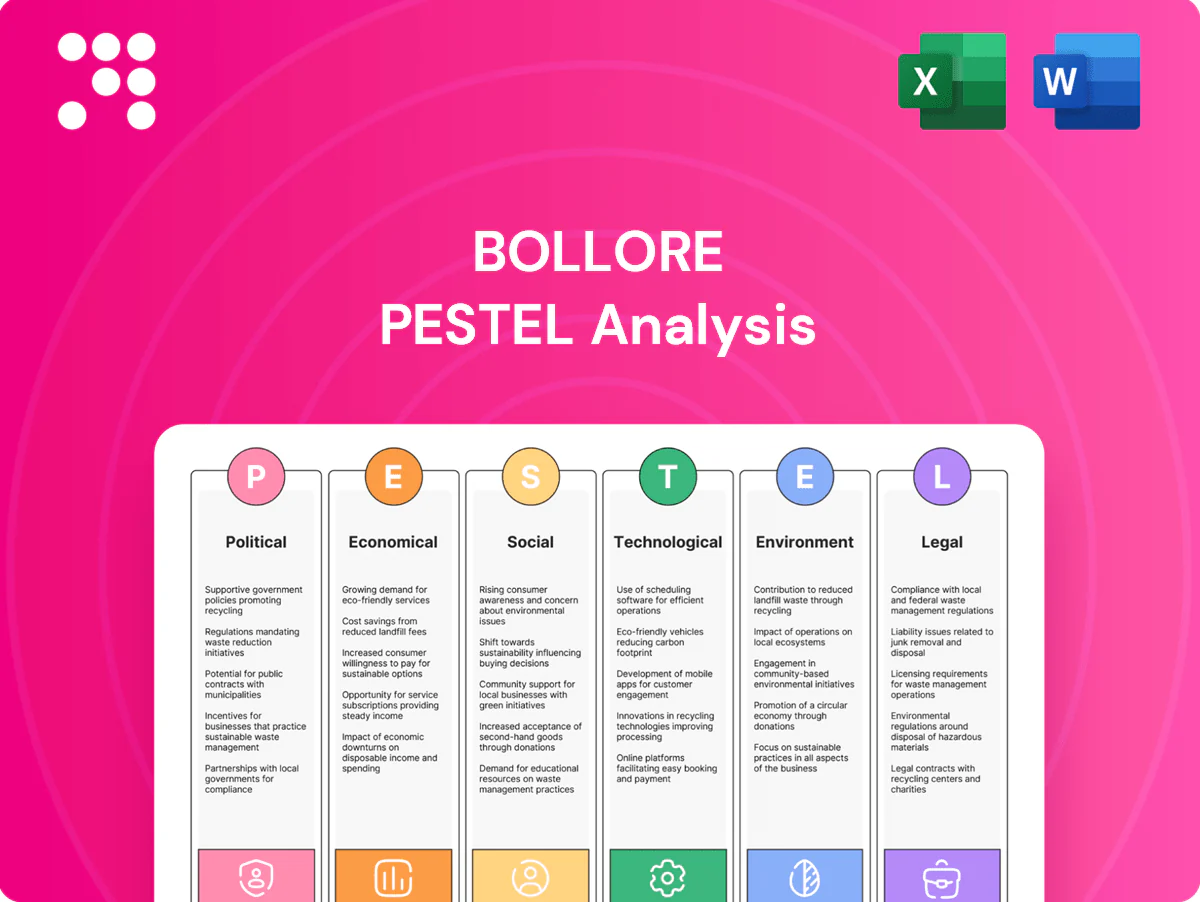
Clean, summarized Bolloré PESTLE analysis presented in visually segmented PESTLE categories for rapid interpretation, easily dropped into PowerPoints or shared across teams to align on external risks and market positioning.
Economic factors

Global trade cycles
Global trade cycles drive Bolloré's cargo volumes, which closely follow world GDP and industrial output (IMF WEO: global GDP 3.1% in 2024, 3.2% in 2025), making freight demand procyclical. Downturns compress freight rates and capacity utilization, while recoveries spike volumes, straining ports and warehouses, raising yields but requiring capex. Diversification across regions and sectors smooths volatility and stabilizes margins.
Inflation and interest rates
High inflation (euro area avg 2.4% in 2024) raises Bolloré Ports operating costs for fuels, materials and labor, squeezing margins on low-margin transshipment activities. Rising policy rates (ECB main rate ~4.00% end-2024) increase capex financing costs and lower valuations of long-dated concessions. Index-linked contracts and pricing power can pass through cost increases, while active liability management preserves returns.

FX exposure
Bolloré’s revenue and costs run across more than 100 countries, including operations in 46 African countries, creating multi-currency exposure across Africa and Europe. Currency depreciations—excluding CFA franc zones pegged to the euro—can compress margins and revalue balance-sheet items. The group uses hedging policies and local financing to cut translation risk, while currency-matched cash flows provide natural hedges in many African corridors.

Advertising and subscription demand
Media revenues remain cyclical with ad budgets and consumer spending; global ad spend reached about $720bn in 2024 (Zenith/WARC), pressuring Bolloré's advertising units during downturns. Streaming competition compresses ARPU and raises churn, while economic stress pushes consumers toward lower-cost bundles and ad-supported tiers. Data-driven pricing and content curation help defend margins and retention.
- Ad spend 2024 ~ $720bn
- Higher churn, lower ARPU
- Shift to cheaper bundles
- Data-led pricing/content = profitability defence
Energy storage market growth
Electrification and grid flexibility drive demand for batteries and systems, with global stationary storage deployments reaching roughly 60 GW/160 GWh in 2024. Policy incentives and declining cell costs (pack prices near $130/kWh in 2024) expand addressable markets across EU, US and China. Commodity price swings in nickel, cobalt and lithium increase input-cost volatility, while Bollore’s vertical partnerships and technology differentiation help sustain margins.
- 60 GW / 160 GWh global deployments (2024)
- $130/kWh average pack cost (2024)
- Commodity-driven input-cost volatility: Ni/Co/Li
- Vertical integration and tech scope preserve margins
Operations in 100+ countries: sanctions, media scrutiny require KYC and network agility
Global GDP growth (IMF WEO 3.1% 2024, 3.2% 2025) drives Bolloré’s freight volumes and ports capex needs; downturns hit rates and utilization. Euro-area inflation ~2.4% (2024) and ECB rate ~4.0% raise operating and financing costs; index-linked contracts and hedges mitigate. Media ad spend ~$720bn (2024) and battery market data (60 GW/160 GWh; $130/kWh) shape revenue mix and input-cost risks.
| Metric | 2024/2025 |
|---|---|
| Global GDP (IMF) | 3.1% (2024), 3.2% (2025) |
| Euro-area inflation | 2.4% (2024) |
| ECB rate | ~4.0% end-2024 |
| Global ad spend | $720bn (2024) |
| Storage deployments | 60 GW / 160 GWh (2024) |
| Battery pack price | $130/kWh (2024) |
Full Version Awaits
Bollore PESTLE Analysis
The Bollore PESTLE Analysis preview shown here is the exact document you’ll receive after purchase, fully formatted and ready to use. This is the real, finished file—no placeholders or teasers—and the layout, content, and structure match what you’ll download. After payment you’ll instantly get this same professionally structured analysis for immediate use.

Product Information
Product Information
Shipping & Returns
Shipping & Returns
Description
Skip the Research. Get the Strategy.
Explore how political shifts, economic cycles, social trends, technological advances, legal frameworks, and environmental pressures are shaping Bolloré’s strategy and risks in this concise PESTLE overview. Ideal for investors and strategists seeking a high-level edge—purchase the full PESTLE for detailed, actionable insights and ready-to-use analysis.
Political factors
Geopolitical stability risk
Operations span regions with varying political stability, with Bolloré present in over 100 countries as of 2024, exposing port concessions and logistics corridors to localized risk. Shifts in government priorities can reallocate infrastructure funding and public-private partnerships, altering concession terms. Electoral cycles and social unrest have caused multi-week throughput disruptions in some markets. Proactive country-risk monitoring and contingency routing are essential.
Trade policy and tariffs
Changes in trade agreements, tariffs and customs regimes directly reshape freight flows and forwarding margins, with protectionist episodes rerouting cargo and raising compliance costs; World Bank estimates full implementation of the WTO Trade Facilitation Agreement could boost global trade by about 9.7%. Regional integration like RCEP (covering ~30% of global GDP and ~28% of world trade) supports volume growth. Active policy advocacy and agile network design help Bollore absorb and reroute shocks.
Port concession politics
Concession awards and renewals for Bolloré hinge on government relations and transparency, especially after high-profile investigations since 2018 that increased scrutiny. Port concession terms typically run 20–30 years, and policy swings can change fees or localization rules abruptly. Risk of renegotiation or nationalization exists in some jurisdictions. Strong ESG delivery and community benefits—critical as seaborne trade moves over 80% of global cargo—help sustain political legitimacy.
Media regulation sensitivity
Broadcasting licenses and content quotas remain politically driven; Bolloré’s influence via a 27.6% Vivendi stake (2024) intersects with Canal+ (≈17.1m subscribers, 2023), so plurality scrutiny can constrain M&A and asset swaps. Changes in cultural policy affect programming windows and SVOD distribution, while proactive regulator engagement preserves operational flexibility and license renewal prospects.
- licenses: politically influenced
- stake: Vivendi 27.6% (2024)
- Canal+ reach: ≈17.1m subs (2023)
- need: active regulator engagement
Sanctions and foreign policy
Global sanctions constrain routes, partners and financing: UN maintains 14 active sanctions regimes and OFAC’s SDN list exceeded 6,000 entries in 2024, forcing route and counterparty changes for Bollore’s logistics operations.
Logistics networks must adapt to embargoes and dual-use controls; media distribution can face country-level bans impacting carriage and advertising revenues.
Robust screening, KYC and diversified markets limit exposure and preserve access to financing and ports.
- UN sanctions: 14 regimes
- OFAC SDN: >6,000 entries (2024)
- Mitigants: screening, KYC, market diversification
Operations in 100+ countries: sanctions, media scrutiny require KYC and network agility
Operations in 100+ countries (2024) face concession risk, political disruption and PPP shifts. Trade policy swings and sanctions (UN 14 regimes; OFAC SDN >6,000 in 2024) affect routing and compliance. Media exposure via Vivendi 27.6% (2024) and Canal+ ≈17.1m subs (2023) raises regulatory scrutiny. Robust KYC, advocacy and network agility mitigate risks.
| Issue | Metric | Impact |
|---|---|---|
| Geopolitical reach | 100+ countries (2024) | Concession & security risk |
| Sanctions | UN 14; OFAC >6,000 (2024) | Routing/financing constraints |
| Media stakes | Vivendi 27.6%; Canal+ 17.1m | Regulatory scrutiny |
What is included in the product
Detailed Word Document
Explores how external macro-environmental factors uniquely affect Bollore across Political, Economic, Social, Technological, Environmental and Legal dimensions, with data-driven trends and region-specific regulatory insight. Designed for executives and investors, it provides forward-looking scenarios and report-ready findings to spot risks and opportunities.
Customizable Excel Spreadsheet
Clean, summarized Bolloré PESTLE analysis presented in visually segmented PESTLE categories for rapid interpretation, easily dropped into PowerPoints or shared across teams to align on external risks and market positioning.
Economic factors
Global trade cycles
Global trade cycles drive Bolloré's cargo volumes, which closely follow world GDP and industrial output (IMF WEO: global GDP 3.1% in 2024, 3.2% in 2025), making freight demand procyclical. Downturns compress freight rates and capacity utilization, while recoveries spike volumes, straining ports and warehouses, raising yields but requiring capex. Diversification across regions and sectors smooths volatility and stabilizes margins.
Inflation and interest rates
High inflation (euro area avg 2.4% in 2024) raises Bolloré Ports operating costs for fuels, materials and labor, squeezing margins on low-margin transshipment activities. Rising policy rates (ECB main rate ~4.00% end-2024) increase capex financing costs and lower valuations of long-dated concessions. Index-linked contracts and pricing power can pass through cost increases, while active liability management preserves returns.
FX exposure
Bolloré’s revenue and costs run across more than 100 countries, including operations in 46 African countries, creating multi-currency exposure across Africa and Europe. Currency depreciations—excluding CFA franc zones pegged to the euro—can compress margins and revalue balance-sheet items. The group uses hedging policies and local financing to cut translation risk, while currency-matched cash flows provide natural hedges in many African corridors.
Advertising and subscription demand
Media revenues remain cyclical with ad budgets and consumer spending; global ad spend reached about $720bn in 2024 (Zenith/WARC), pressuring Bolloré's advertising units during downturns. Streaming competition compresses ARPU and raises churn, while economic stress pushes consumers toward lower-cost bundles and ad-supported tiers. Data-driven pricing and content curation help defend margins and retention.
- Ad spend 2024 ~ $720bn
- Higher churn, lower ARPU
- Shift to cheaper bundles
- Data-led pricing/content = profitability defence
Energy storage market growth
Electrification and grid flexibility drive demand for batteries and systems, with global stationary storage deployments reaching roughly 60 GW/160 GWh in 2024. Policy incentives and declining cell costs (pack prices near $130/kWh in 2024) expand addressable markets across EU, US and China. Commodity price swings in nickel, cobalt and lithium increase input-cost volatility, while Bollore’s vertical partnerships and technology differentiation help sustain margins.
- 60 GW / 160 GWh global deployments (2024)
- $130/kWh average pack cost (2024)
- Commodity-driven input-cost volatility: Ni/Co/Li
- Vertical integration and tech scope preserve margins
Operations in 100+ countries: sanctions, media scrutiny require KYC and network agility
Global GDP growth (IMF WEO 3.1% 2024, 3.2% 2025) drives Bolloré’s freight volumes and ports capex needs; downturns hit rates and utilization. Euro-area inflation ~2.4% (2024) and ECB rate ~4.0% raise operating and financing costs; index-linked contracts and hedges mitigate. Media ad spend ~$720bn (2024) and battery market data (60 GW/160 GWh; $130/kWh) shape revenue mix and input-cost risks.
| Metric | 2024/2025 |
|---|---|
| Global GDP (IMF) | 3.1% (2024), 3.2% (2025) |
| Euro-area inflation | 2.4% (2024) |
| ECB rate | ~4.0% end-2024 |
| Global ad spend | $720bn (2024) |
| Storage deployments | 60 GW / 160 GWh (2024) |
| Battery pack price | $130/kWh (2024) |
Full Version Awaits
Bollore PESTLE Analysis
The Bollore PESTLE Analysis preview shown here is the exact document you’ll receive after purchase, fully formatted and ready to use. This is the real, finished file—no placeholders or teasers—and the layout, content, and structure match what you’ll download. After payment you’ll instantly get this same professionally structured analysis for immediate use.