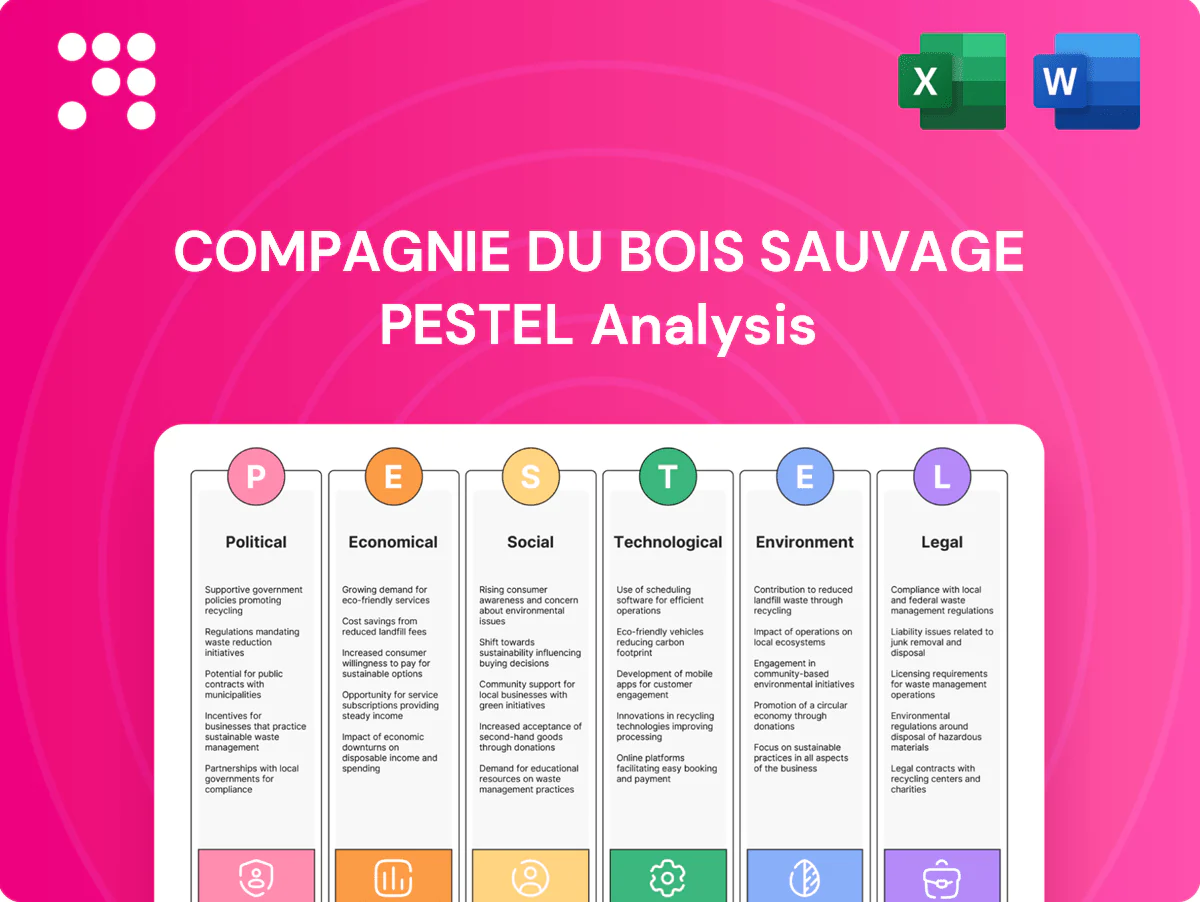
Compagnie du Bois Sauvage PESTLE Analysis

Plan Smarter. Present Sharper. Compete Stronger.
Our PESTLE Analysis of Compagnie du Bois Sauvage reveals how regulation, economic cycles, social trends, and sustainability pressures will shape its strategic path; actionable insights help you anticipate risks and spot growth opportunities. Ideal for investors, consultants, and managers, this ready-made report saves time and informs decisions. Purchase the full version now to access the complete, editable analysis and drive smarter strategy.
Political factors

EU policy direction and stability
As a Europe-focused holding, shifts in EU priorities—industrial strategy, capital markets union and the Fit for 55 energy transition—directly affect portfolio performance and capital allocation; the EU Recovery and Resilience Facility totals €723.8bn. Relative political stability supports long-term value creation, but coalition dynamics can slow reforms. Monitoring Commission agendas and member-state implementation timelines is crucial because policy delays can defer returns in regulated real estate and utilities.
Geopolitical risk and sanctions exposure
Global tensions, sanctions and trade restrictions raise input costs and disrupt supply chains for portfolio companies through higher tariffs, licensing delays and shipping volatility. Exposure is indirect but material via European customers and suppliers. Scenario planning for critical-material shocks is vital given the EU’s c.98% import dependency on rare earths. Diversification across sectors and geographies mitigates concentration risk.

Fiscal policy and public investment
National budgets, green subsidies and infrastructure programs create tailwinds for holdings in sustainable real estate and services, while higher taxes compress returns; Belgium’s headline corporate tax rate stands at 25%. Tracking NextGenerationEU (≈€750bn) and RRF allocations helps pinpoint co-investment opportunities across Belgium and neighbors. A policy shift toward deficit control could damp growth-sensitive assets and lower near-term yield prospects.

Local urban and housing policies
Municipal zoning, rent controls and permitting timelines directly affect Compagnie du Bois Sauvage development yields; Europe requires roughly 1.5 million new homes annually to meet demand, amplifying city-level policy impact. Permitting delays (commonly 6–24 months) and density caps raise holding periods and carrying costs, while proactive stakeholder engagement reduces entitlement risk.
- Municipal zoning: localized strategies
- Rent controls: compress returns
- Permitting timelines: 6–24 months
- Stakeholder engagement: de-risks entitlements
Energy security and industrial policy
European energy security and industrial policy—driven by Fit for 55 (55% emissions cut by 2030) and the NextGenerationEU €806.9bn recovery plan—reshapes Compagnie du Bois Sauvage cost structures as higher onshore production and resilience investments raise operating and capex requirements; industrial subsidies and tax incentives can accelerate upgrades, while past TTF gas spikes (peaked ~€340/MWh in 2022) illustrate cost volatility risk.
- Subsidies: NextGenerationEU €806.9bn
- Regulatory target: Fit for 55 (−55% GHG by 2030)
- Price risk: TTF gas peak ~€340/MWh (2022)
- Strategy: hedge regulatory volatility for capital-intensive assets
EU green funds reshape capex; Belgium 25% tax; rare-earth import ≈98%
EU industrial and green policy (Fit for 55, NextGenerationEU €806.9bn, RRF €723.8bn) reshapes capital allocation and capex timing; Belgium corporate tax 25% affects returns. Geopolitical tensions raise input costs — EU rare-earth import dependency ≈98% — while municipal zoning and 6–24 month permitting windows materially affect development yields.
| Factor | Metric | Impact |
|---|---|---|
| EU funds | €806.9bn | Co-investment opps |
| Permitting | 6–24 months | Holding costs |
| Rare earths | ≈98% import | Supply risk |
What is included in the product
 Detailed Word Document
Provides a concise PESTLE review of Compagnie du Bois Sauvage across Political, Economic, Social, Technological, Environmental and Legal dimensions, each tied to relevant data and regional industry trends. Designed for executives and investors, it highlights risks, opportunities and forward-looking implications for strategy and funding.

 Customizable Excel Spreadsheet
Clean, summarized PESTLE of Compagnie du Bois Sauvage for quick reference in meetings or presentations, visually segmented by category and editable for region- or business-specific notes; concise, shareable format supports external risk discussions, market positioning and consultant reports.
Economic factors

ECB rate cycle and credit conditions
ECB policy rate at 3.75% (June 2025) drives valuation multiples, refinancing costs and has pushed euro-area commercial real estate cap rates ~140bps higher since 2022, compressing leverage capacity. Easing would lift NAVs and deal activity; higher-for-longer keeps buy-and-build constrained. Monitor bank lending standards and corporate bond spreads (BBB ~120bps over Bunds) to time exits; active liability management can preserve equity returns.
Inflation and input cost dynamics
Sticky services inflation (euro area services inflation 4.6% in June 2025) pressures operating margins across Compagnie du Bois Sauvage holdings, particularly in labor‑intensive assets. Indexation clauses in Belgian leases tied to CPI can offset a portion of this pressure. Cost pass‑through capacity varies by sector, shaping cash‑flow resilience. Procurement optimization and energy‑efficiency projects historically cut operating costs by mid‑single digits, enhancing protection.

GDP growth and consumer demand
Slower European growth tempers revenue trajectories for cyclical assets, with euro area real GDP up just 0.6% in 2024 and IMF projecting ~0.8% in 2025. Defensive and nondiscretionary exposures such as waste and essentials stabilize portfolio cash flows, cushioning margins amid softer consumer demand. A geographic mix across BE, FR and NL plus active rotation into faster pockets (CEE, export markets) smooths earnings and targets ~2–3% higher growth.

Real estate market cycles
- Yield shift impact: lower valuations, higher capex risk
- Occupancy: vacancy swings drive cashflow volatility
- Construction costs: ~5% rise in 2024
- Prime vs secondary: ~200–300 bps spread
- Levers: leasing, repositioning, selective distressed buys
FX movements within Europe and beyond
FX movements shape Compagnie du Bois Sauvage: a EUR/USD ~1.09 in July 2025 and ~3% euro appreciation YTD affect translation of non-euro revenues and euro-priced inputs, altering competitiveness. Active hedging policies (forwards/options) materially reduce earnings volatility historically by cutting quarterly FX swings. Cross-border M&A returns hinge on currency basis; matching debt currency to cash flows mitigates refinancing and translation risk.
- EUR/USD ~1.09 (Jul 2025)
- ~3% euro YTD appreciation
- Hedging lowers quarterly FX volatility
- Match debt currency to revenue streams
EU green funds reshape capex; Belgium 25% tax; rare-earth import ≈98%
ECB rate 3.75% (Jun 2025) raises refinancing costs and caps buy‑and‑build; euro services inflation 4.6% (Jun 2025) and euro area GDP +0.6% (2024) pressure margins; construction costs +5% (2024) compress IRRs; prime vs secondary spreads ~200–300bps widen opportunities; EUR/USD ~1.09 (Jul 2025) and ~3% euro YTD affect returns.
| Metric | Value |
|---|---|
| ECB policy rate | 3.75% (Jun 2025) |
| Services inflation | 4.6% (Jun 2025) |
| Euro area GDP | +0.6% (2024) |
| Construction costs | +5% (2024) |
| Prime vs secondary | 200–300bps |
| EUR/USD | ~1.09 (Jul 2025) |
Full Version Awaits
Compagnie du Bois Sauvage PESTLE Analysis
The preview shown here is the exact Compagnie du Bois Sauvage PESTLE Analysis document you’ll receive after purchase—fully formatted and ready to use. It covers political, economic, social, technological, legal and environmental factors with concise insights and actionable implications. No placeholders or teasers; the file available after payment is identical to this preview.

Product Information
Product Information
Shipping & Returns
Shipping & Returns
Description
Plan Smarter. Present Sharper. Compete Stronger.
Our PESTLE Analysis of Compagnie du Bois Sauvage reveals how regulation, economic cycles, social trends, and sustainability pressures will shape its strategic path; actionable insights help you anticipate risks and spot growth opportunities. Ideal for investors, consultants, and managers, this ready-made report saves time and informs decisions. Purchase the full version now to access the complete, editable analysis and drive smarter strategy.
Political factors
EU policy direction and stability
As a Europe-focused holding, shifts in EU priorities—industrial strategy, capital markets union and the Fit for 55 energy transition—directly affect portfolio performance and capital allocation; the EU Recovery and Resilience Facility totals €723.8bn. Relative political stability supports long-term value creation, but coalition dynamics can slow reforms. Monitoring Commission agendas and member-state implementation timelines is crucial because policy delays can defer returns in regulated real estate and utilities.
Geopolitical risk and sanctions exposure
Global tensions, sanctions and trade restrictions raise input costs and disrupt supply chains for portfolio companies through higher tariffs, licensing delays and shipping volatility. Exposure is indirect but material via European customers and suppliers. Scenario planning for critical-material shocks is vital given the EU’s c.98% import dependency on rare earths. Diversification across sectors and geographies mitigates concentration risk.
Fiscal policy and public investment
National budgets, green subsidies and infrastructure programs create tailwinds for holdings in sustainable real estate and services, while higher taxes compress returns; Belgium’s headline corporate tax rate stands at 25%. Tracking NextGenerationEU (≈€750bn) and RRF allocations helps pinpoint co-investment opportunities across Belgium and neighbors. A policy shift toward deficit control could damp growth-sensitive assets and lower near-term yield prospects.
Local urban and housing policies
Municipal zoning, rent controls and permitting timelines directly affect Compagnie du Bois Sauvage development yields; Europe requires roughly 1.5 million new homes annually to meet demand, amplifying city-level policy impact. Permitting delays (commonly 6–24 months) and density caps raise holding periods and carrying costs, while proactive stakeholder engagement reduces entitlement risk.
- Municipal zoning: localized strategies
- Rent controls: compress returns
- Permitting timelines: 6–24 months
- Stakeholder engagement: de-risks entitlements
Energy security and industrial policy
European energy security and industrial policy—driven by Fit for 55 (55% emissions cut by 2030) and the NextGenerationEU €806.9bn recovery plan—reshapes Compagnie du Bois Sauvage cost structures as higher onshore production and resilience investments raise operating and capex requirements; industrial subsidies and tax incentives can accelerate upgrades, while past TTF gas spikes (peaked ~€340/MWh in 2022) illustrate cost volatility risk.
- Subsidies: NextGenerationEU €806.9bn
- Regulatory target: Fit for 55 (−55% GHG by 2030)
- Price risk: TTF gas peak ~€340/MWh (2022)
- Strategy: hedge regulatory volatility for capital-intensive assets
EU green funds reshape capex; Belgium 25% tax; rare-earth import ≈98%
EU industrial and green policy (Fit for 55, NextGenerationEU €806.9bn, RRF €723.8bn) reshapes capital allocation and capex timing; Belgium corporate tax 25% affects returns. Geopolitical tensions raise input costs — EU rare-earth import dependency ≈98% — while municipal zoning and 6–24 month permitting windows materially affect development yields.
| Factor | Metric | Impact |
|---|---|---|
| EU funds | €806.9bn | Co-investment opps |
| Permitting | 6–24 months | Holding costs |
| Rare earths | ≈98% import | Supply risk |
What is included in the product
Detailed Word Document
Provides a concise PESTLE review of Compagnie du Bois Sauvage across Political, Economic, Social, Technological, Environmental and Legal dimensions, each tied to relevant data and regional industry trends. Designed for executives and investors, it highlights risks, opportunities and forward-looking implications for strategy and funding.
Customizable Excel Spreadsheet
Clean, summarized PESTLE of Compagnie du Bois Sauvage for quick reference in meetings or presentations, visually segmented by category and editable for region- or business-specific notes; concise, shareable format supports external risk discussions, market positioning and consultant reports.
Economic factors
ECB rate cycle and credit conditions
ECB policy rate at 3.75% (June 2025) drives valuation multiples, refinancing costs and has pushed euro-area commercial real estate cap rates ~140bps higher since 2022, compressing leverage capacity. Easing would lift NAVs and deal activity; higher-for-longer keeps buy-and-build constrained. Monitor bank lending standards and corporate bond spreads (BBB ~120bps over Bunds) to time exits; active liability management can preserve equity returns.
Inflation and input cost dynamics
Sticky services inflation (euro area services inflation 4.6% in June 2025) pressures operating margins across Compagnie du Bois Sauvage holdings, particularly in labor‑intensive assets. Indexation clauses in Belgian leases tied to CPI can offset a portion of this pressure. Cost pass‑through capacity varies by sector, shaping cash‑flow resilience. Procurement optimization and energy‑efficiency projects historically cut operating costs by mid‑single digits, enhancing protection.
GDP growth and consumer demand
Slower European growth tempers revenue trajectories for cyclical assets, with euro area real GDP up just 0.6% in 2024 and IMF projecting ~0.8% in 2025. Defensive and nondiscretionary exposures such as waste and essentials stabilize portfolio cash flows, cushioning margins amid softer consumer demand. A geographic mix across BE, FR and NL plus active rotation into faster pockets (CEE, export markets) smooths earnings and targets ~2–3% higher growth.
Real estate market cycles
- Yield shift impact: lower valuations, higher capex risk
- Occupancy: vacancy swings drive cashflow volatility
- Construction costs: ~5% rise in 2024
- Prime vs secondary: ~200–300 bps spread
- Levers: leasing, repositioning, selective distressed buys
FX movements within Europe and beyond
FX movements shape Compagnie du Bois Sauvage: a EUR/USD ~1.09 in July 2025 and ~3% euro appreciation YTD affect translation of non-euro revenues and euro-priced inputs, altering competitiveness. Active hedging policies (forwards/options) materially reduce earnings volatility historically by cutting quarterly FX swings. Cross-border M&A returns hinge on currency basis; matching debt currency to cash flows mitigates refinancing and translation risk.
- EUR/USD ~1.09 (Jul 2025)
- ~3% euro YTD appreciation
- Hedging lowers quarterly FX volatility
- Match debt currency to revenue streams
EU green funds reshape capex; Belgium 25% tax; rare-earth import ≈98%
ECB rate 3.75% (Jun 2025) raises refinancing costs and caps buy‑and‑build; euro services inflation 4.6% (Jun 2025) and euro area GDP +0.6% (2024) pressure margins; construction costs +5% (2024) compress IRRs; prime vs secondary spreads ~200–300bps widen opportunities; EUR/USD ~1.09 (Jul 2025) and ~3% euro YTD affect returns.
| Metric | Value |
|---|---|
| ECB policy rate | 3.75% (Jun 2025) |
| Services inflation | 4.6% (Jun 2025) |
| Euro area GDP | +0.6% (2024) |
| Construction costs | +5% (2024) |
| Prime vs secondary | 200–300bps |
| EUR/USD | ~1.09 (Jul 2025) |
Full Version Awaits
Compagnie du Bois Sauvage PESTLE Analysis
The preview shown here is the exact Compagnie du Bois Sauvage PESTLE Analysis document you’ll receive after purchase—fully formatted and ready to use. It covers political, economic, social, technological, legal and environmental factors with concise insights and actionable implications. No placeholders or teasers; the file available after payment is identical to this preview.











