Bank Negara Indonesia PESTLE Analysis

Make Smarter Strategic Decisions with a Complete PESTEL View
Explore how regulatory shifts, macroeconomic volatility, and digital banking trends shape Bank Negara Indonesia’s strategic outlook in our concise PESTLE snapshot—highlighting risks and growth levers for investors and planners. Purchase the full PESTLE for exhaustive, actionable insights and ready-to-use analysis.
Political factors

State ownership dynamics
As a state-owned bank under the Ministry of SOEs, BNI aligns lending with government priorities on financial inclusion, MSMEs and infrastructure; Indonesian MSMEs contribute about 60% of GDP, making this focus material. Post-election policy shifts can redirect lending focus or capital allocation. Coordination with the Ministry of SOEs shapes governance, dividends and strategic initiatives. Political backing can ease funding costs but increases policy-execution obligations.
Regulatory oversight (BI & OJK)
Bank Indonesia (BI) and OJK jointly steer monetary, prudential and conduct standards for BNI, with BI 7-day reverse repo at 5.75% and OJK enforcing a minimum CAR of 8%.
Macroprudential tools—reserve requirements and lending caps—shape credit growth and risk appetite, while supervisory intensity on digital banking and consumer protection is rising.
Consistent compliance underpins license stability and potential expansion.

Public investment and nationalism
Large national projects—transport corridors, power plants and the Nusantara new capital, for which the government allocated about IDR 466 trillion through 2024—create lending and fee opportunities for BNI across project finance, syndications and transaction banking. Political preference for domestic champions and state-owned banks often positions BNI favorably for guarantees and lead roles in consortiums. However, directed lending and crowding-out risks can compress NIMs, while local-content mandates constrain supplier selection and increase procurement complexity.

Geopolitics and trade ties
Indonesia’s non-aligned stance lets Bank Negara Indonesia balance US–China tensions while courting FDI, supporting a domestic economy growing about 5.1% in 2024. Shifts in global commodity demand and reshaped supply chains (key for Indonesia’s miners and palm sectors) materially affect corporate clients’ cash flows and trade finance needs. Sanctions regimes force tighter AML/CFT screening for cross-border transactions as ASEAN integration (population ~680 million, GDP ~US$3.6 trillion) expands remittance and trade finance opportunities.
- Geopolitics: non-aligned diplomacy preserves investor access
- Supply shocks: commodity-driven cashflow volatility
- Compliance: enhanced sanctions screening required
- Regional growth: ASEAN opens remittance/trade finance upside
Subnational governance
Provincial policies across Indonesia’s 34 provinces shape BNI’s branch placement and public-sector relationships, with the bank leveraging its status as one of four state-owned commercial banks to win municipal and provincial deposits.
- 34 provinces — national scope
- One of four state-owned commercial banks — public-sector access
- Local elections — reallocation risk to municipal deposits
- Regional infrastructure plans — pipeline for project finance
SOE bank steers credit to MSMEs (~60% GDP), BI 5.75%
BNI’s SOE status ties lending to government priorities—MSMEs (~60% of GDP) and infrastructure (Nusantara IDR 466 trillion through 2024)—giving access to deposits and guarantees but raising directed-lending risk. BI policy rate 7-day RR 5.75% and OJK minimum CAR 8% shape funding costs and capital cushions. Geopolitics (non-aligned) preserves FDI access; sanctions and AML/CFT raise compliance costs.
| Factor | Metric | Value |
|---|---|---|
| MSME share | GDP contribution | ~60% |
| BI rate | 7-day RR | 5.75% |
| Nusantara | Govt allocation | IDR 466 tn |
| OJK | Min CAR | 8% |
What is included in the product
 Detailed Word Document
Explores how Political, Economic, Social, Technological, Environmental and Legal forces uniquely affect Bank Negara Indonesia, with data-driven, forward-looking insights and actionable implications for executives, investors and strategists—ready to drop into reports or pitch decks.

 Customizable Excel Spreadsheet
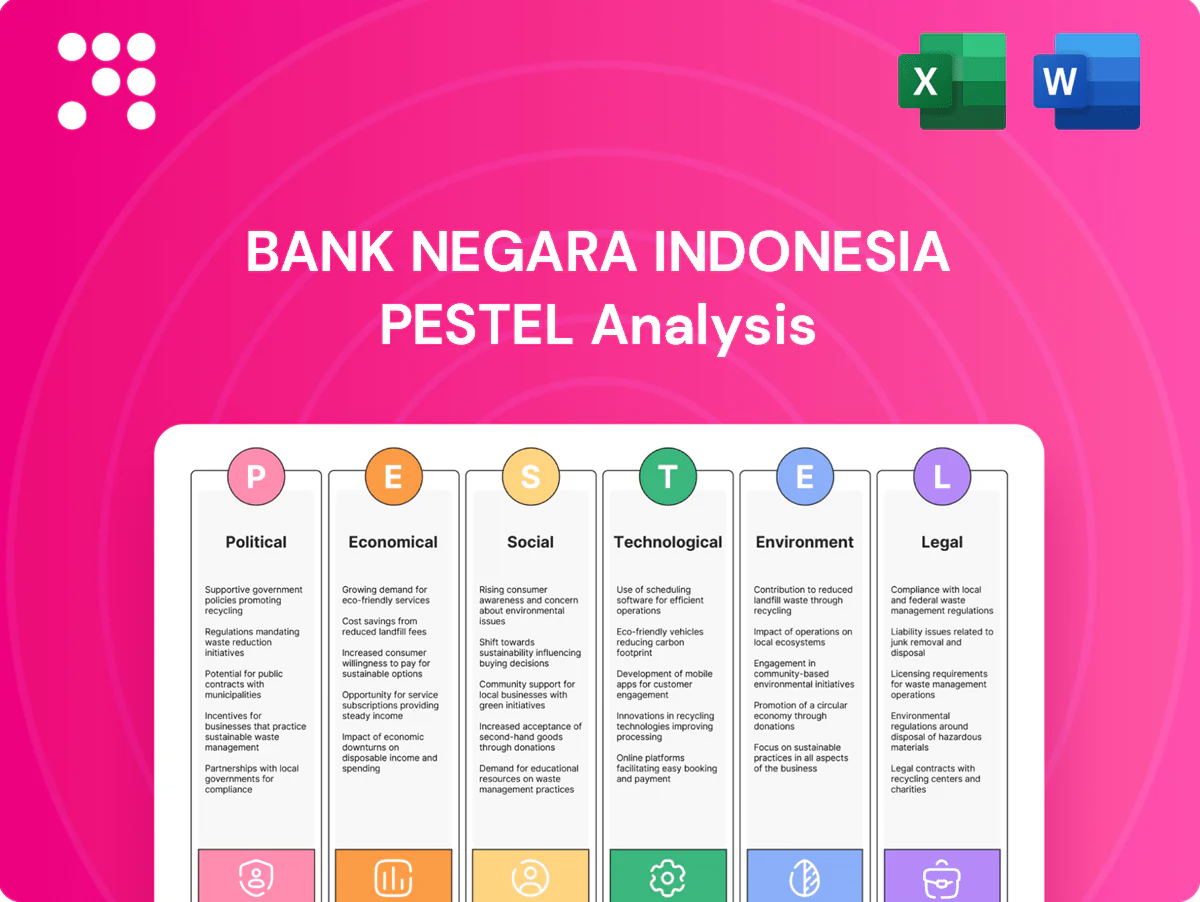
A concise, visually segmented PESTLE summary of Bank Negara Indonesia that’s easy to drop into presentations or share across teams, editable for local context and ideal for supporting risk discussions and strategic planning.
Economic factors

GDP growth and consumption
Indonesia GDP grew 5.3% in 2023 and household consumption accounts for roughly 56% of GDP, which underpins BNI’s retail deposits, cards and consumer loan expansion. A rising middle class raises wealth management and transaction-banking volumes, but growth slowdowns quickly compress loan demand and fee income. BNI must tilt its portfolio toward or away from cyclical sectors as consumption cycles shift.
Inflation and interest rates
BI rate moves (BI 7DRRR 5.75% as of mid‑2025) directly lift BNI funding costs and asset yields, compressing NIM if loan repricing lags; margin management hinges on deposit mix and repricing speed across retail CASA versus term deposits. Elevated inflation (Indonesia CPI ~3.4%–3.6% in 2024–25) strains credit quality and raises operating expenses. Robust hedging and strict ALM discipline are therefore critical to preserve capital and earnings volatility.

Commodity cycles
Commodity cycles in coal (Indonesia exported roughly 400 Mt in 2023), palm oil (export value about US$24bn in 2023), nickel (Indonesia supplies around half of global nickel ore) and gas (LNG exports ~20 Mtpa range) directly drive corporate clients’ cash flows; commodity upturns improve NPL ratios and boost fee income while downturns elevate credit risk. Diversification across sectors mitigates concentration and trade finance volumes closely track export momentum.

FX and external balances
Rupiah volatility (USD/IDR ~15,000–16,500 in 2024–H1 2025) raises risk-weighted assets via FX revaluation, stressing capital adequacy and provisioning; corporates’ hedging demand lifts fee income; external shocks can tighten liquidity and widen funding spreads; robust FX risk controls shield NII and earnings.
- FX range: 15,000–16,500
- Reserves: ~US$135–140bn
- Hedging = fee upside
- Controls protect earnings
Financial deepening
- e-wallet users: >150M (2024)
- IDX mkt cap: >IDR 15,000T (2024)
- trend: double-digit digital payments growth
SOE bank steers credit to MSMEs (~60% GDP), BI 5.75%
Indonesia GDP 5.3% (2023); household consumption ~56% of GDP supports BNI retail growth but cyclicality can compress loan demand. BI 7DRRR 5.75% (mid‑2025) and CPI ~3.5% raise funding costs and operational pressure; margin, ALM and hedging critical. Commodity export cycles (coal ~400 Mt, palm oil US$24bn, nickel ~50% global) and FX USD/IDR 15,000–16,500 drive corporate flows, NPLs and fee income.
| Indicator | Value (2024–H1 2025) |
|---|---|
| GDP growth | 5.3% (2023) |
| BI 7DRRR | 5.75% |
| CPI | ~3.5% |
| USD/IDR | 15,000–16,500 |
| Reserves | ~US$135–140bn |
| e‑wallet users | >150M |
Same Document Delivered
Bank Negara Indonesia PESTLE Analysis
The preview shown here is the exact Bank Negara Indonesia PESTLE Analysis you’ll receive after purchase—fully formatted and ready to use. This is the real, finished document with the same content, layout, and structure visible in the sample—no placeholders or surprises. After checkout you’ll instantly download this exact file, professionally structured for immediate use.

Original: $10.00
-65%$10.00
$3.50Product Information
Product Information
Shipping & Returns
Shipping & Returns
Description
Make Smarter Strategic Decisions with a Complete PESTEL View
Explore how regulatory shifts, macroeconomic volatility, and digital banking trends shape Bank Negara Indonesia’s strategic outlook in our concise PESTLE snapshot—highlighting risks and growth levers for investors and planners. Purchase the full PESTLE for exhaustive, actionable insights and ready-to-use analysis.
Political factors
State ownership dynamics
As a state-owned bank under the Ministry of SOEs, BNI aligns lending with government priorities on financial inclusion, MSMEs and infrastructure; Indonesian MSMEs contribute about 60% of GDP, making this focus material. Post-election policy shifts can redirect lending focus or capital allocation. Coordination with the Ministry of SOEs shapes governance, dividends and strategic initiatives. Political backing can ease funding costs but increases policy-execution obligations.
Regulatory oversight (BI & OJK)
Bank Indonesia (BI) and OJK jointly steer monetary, prudential and conduct standards for BNI, with BI 7-day reverse repo at 5.75% and OJK enforcing a minimum CAR of 8%.
Macroprudential tools—reserve requirements and lending caps—shape credit growth and risk appetite, while supervisory intensity on digital banking and consumer protection is rising.
Consistent compliance underpins license stability and potential expansion.
Public investment and nationalism
Large national projects—transport corridors, power plants and the Nusantara new capital, for which the government allocated about IDR 466 trillion through 2024—create lending and fee opportunities for BNI across project finance, syndications and transaction banking. Political preference for domestic champions and state-owned banks often positions BNI favorably for guarantees and lead roles in consortiums. However, directed lending and crowding-out risks can compress NIMs, while local-content mandates constrain supplier selection and increase procurement complexity.
Geopolitics and trade ties
Indonesia’s non-aligned stance lets Bank Negara Indonesia balance US–China tensions while courting FDI, supporting a domestic economy growing about 5.1% in 2024. Shifts in global commodity demand and reshaped supply chains (key for Indonesia’s miners and palm sectors) materially affect corporate clients’ cash flows and trade finance needs. Sanctions regimes force tighter AML/CFT screening for cross-border transactions as ASEAN integration (population ~680 million, GDP ~US$3.6 trillion) expands remittance and trade finance opportunities.
- Geopolitics: non-aligned diplomacy preserves investor access
- Supply shocks: commodity-driven cashflow volatility
- Compliance: enhanced sanctions screening required
- Regional growth: ASEAN opens remittance/trade finance upside
Subnational governance
Provincial policies across Indonesia’s 34 provinces shape BNI’s branch placement and public-sector relationships, with the bank leveraging its status as one of four state-owned commercial banks to win municipal and provincial deposits.
- 34 provinces — national scope
- One of four state-owned commercial banks — public-sector access
- Local elections — reallocation risk to municipal deposits
- Regional infrastructure plans — pipeline for project finance
SOE bank steers credit to MSMEs (~60% GDP), BI 5.75%
BNI’s SOE status ties lending to government priorities—MSMEs (~60% of GDP) and infrastructure (Nusantara IDR 466 trillion through 2024)—giving access to deposits and guarantees but raising directed-lending risk. BI policy rate 7-day RR 5.75% and OJK minimum CAR 8% shape funding costs and capital cushions. Geopolitics (non-aligned) preserves FDI access; sanctions and AML/CFT raise compliance costs.
| Factor | Metric | Value |
|---|---|---|
| MSME share | GDP contribution | ~60% |
| BI rate | 7-day RR | 5.75% |
| Nusantara | Govt allocation | IDR 466 tn |
| OJK | Min CAR | 8% |
What is included in the product
Detailed Word Document
Explores how Political, Economic, Social, Technological, Environmental and Legal forces uniquely affect Bank Negara Indonesia, with data-driven, forward-looking insights and actionable implications for executives, investors and strategists—ready to drop into reports or pitch decks.
Customizable Excel Spreadsheet
A concise, visually segmented PESTLE summary of Bank Negara Indonesia that’s easy to drop into presentations or share across teams, editable for local context and ideal for supporting risk discussions and strategic planning.
Economic factors
GDP growth and consumption
Indonesia GDP grew 5.3% in 2023 and household consumption accounts for roughly 56% of GDP, which underpins BNI’s retail deposits, cards and consumer loan expansion. A rising middle class raises wealth management and transaction-banking volumes, but growth slowdowns quickly compress loan demand and fee income. BNI must tilt its portfolio toward or away from cyclical sectors as consumption cycles shift.
Inflation and interest rates
BI rate moves (BI 7DRRR 5.75% as of mid‑2025) directly lift BNI funding costs and asset yields, compressing NIM if loan repricing lags; margin management hinges on deposit mix and repricing speed across retail CASA versus term deposits. Elevated inflation (Indonesia CPI ~3.4%–3.6% in 2024–25) strains credit quality and raises operating expenses. Robust hedging and strict ALM discipline are therefore critical to preserve capital and earnings volatility.
Commodity cycles
Commodity cycles in coal (Indonesia exported roughly 400 Mt in 2023), palm oil (export value about US$24bn in 2023), nickel (Indonesia supplies around half of global nickel ore) and gas (LNG exports ~20 Mtpa range) directly drive corporate clients’ cash flows; commodity upturns improve NPL ratios and boost fee income while downturns elevate credit risk. Diversification across sectors mitigates concentration and trade finance volumes closely track export momentum.
FX and external balances
Rupiah volatility (USD/IDR ~15,000–16,500 in 2024–H1 2025) raises risk-weighted assets via FX revaluation, stressing capital adequacy and provisioning; corporates’ hedging demand lifts fee income; external shocks can tighten liquidity and widen funding spreads; robust FX risk controls shield NII and earnings.
- FX range: 15,000–16,500
- Reserves: ~US$135–140bn
- Hedging = fee upside
- Controls protect earnings
Financial deepening
- e-wallet users: >150M (2024)
- IDX mkt cap: >IDR 15,000T (2024)
- trend: double-digit digital payments growth
SOE bank steers credit to MSMEs (~60% GDP), BI 5.75%
Indonesia GDP 5.3% (2023); household consumption ~56% of GDP supports BNI retail growth but cyclicality can compress loan demand. BI 7DRRR 5.75% (mid‑2025) and CPI ~3.5% raise funding costs and operational pressure; margin, ALM and hedging critical. Commodity export cycles (coal ~400 Mt, palm oil US$24bn, nickel ~50% global) and FX USD/IDR 15,000–16,500 drive corporate flows, NPLs and fee income.
| Indicator | Value (2024–H1 2025) |
|---|---|
| GDP growth | 5.3% (2023) |
| BI 7DRRR | 5.75% |
| CPI | ~3.5% |
| USD/IDR | 15,000–16,500 |
| Reserves | ~US$135–140bn |
| e‑wallet users | >150M |
Same Document Delivered
Bank Negara Indonesia PESTLE Analysis
The preview shown here is the exact Bank Negara Indonesia PESTLE Analysis you’ll receive after purchase—fully formatted and ready to use. This is the real, finished document with the same content, layout, and structure visible in the sample—no placeholders or surprises. After checkout you’ll instantly download this exact file, professionally structured for immediate use.