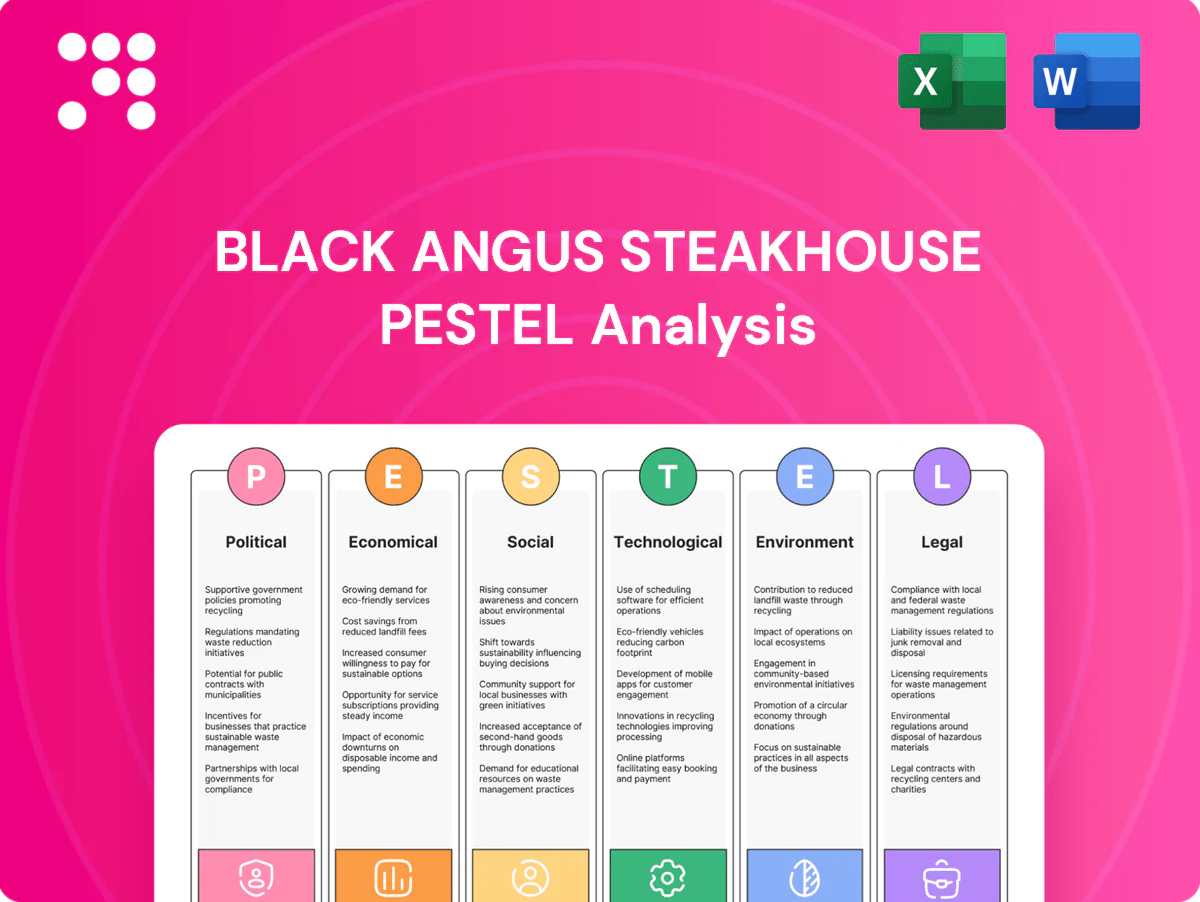
Black Angus Steakhouse PESTLE Analysis

Your Competitive Advantage Starts with This Report
Unlock strategic clarity with our PESTLE Analysis of Black Angus Steakhouse—three expert-level insights into how political, economic, social, technological, legal, and environmental forces shape its outlook. Use these findings to anticipate risks and identify growth levers for investors and managers. Purchase the full report to access the complete, actionable breakdown instantly.
Political factors

Minimum wage policy shifts
Western states frequently raise minimum wages—California $16.00/hr, Washington $16.28/hr and Oregon $15.75/hr in 2024—pushing BOH/FOH labor (≈30–35% of restaurant sales) higher. Black Angus must adjust payroll, pricing and staffing models while complying with local tip credit rules (California bans tip credits) and varied service charge laws. Proactive scheduling and productivity tools reduce overtime and labor cost creep.
Health and safety mandates
Food safety inspections and public health rules force Black Angus to fund training, sanitation protocols and equipment upgrades; CDC estimates 48 million US foodborne illnesses, 128,000 hospitalizations and 3,000 deaths annually, highlighting stakes. Changes to mask, ventilation or sick‑leave mandates can reduce labor availability and guest throughput. Standardized SOPs lower compliance risk across locations and consistent audit readiness is essential.

Trade and beef supply policy
Tariffs, import quotas and cattle health regulations shape beef availability and prices, with the US cattle inventory at 90.6 million head on Jan 1, 2024 per USDA, meaning supply shocks transmit quickly to wholesale markets. Disruptions in supply chains or disease outbreaks can compress margins on high-margin items like steak and prime rib. Diversified sourcing, contractual hedges and close supplier relationships speed response and stabilize costs.

Alcohol licensing and local ordinances
Beer, wine and spirits sales at Black Angus depend on state and municipal licensing regimes, with the national legal drinking age set at 21 since the 1984 federal law and dram shop statutes present in most states (about 44), shaping liability exposure.
Hours-of-sale, mandatory server certification and local ordinances directly affect throughput and check averages, while compliance and ongoing staff training are critical to protect bar profitability and limit costly liability claims.
- tags: dram shop ~44 states
- tags: legal drinking age 21 (federal law 1984)
- tags: hours-of-sale, server certification, staff training
- tags: compliance drives check averages & profitability
Immigration and labor availability
Policy shifts on work visas and enforcement reshape availability of kitchen and floor staff; in 2024 U.S. unemployment stayed near historic lows (~3.7%), tightening supply. I-9/E-Verify requirements increase administrative burden and compliance risk for Black Angus. Tight labor markets pushed restaurant wage growth and turnover, while strong employer branding improved recruitment and retention.
- Policy risk: visa/enforcement changes
- Compliance: I-9/E-Verify adds cost
- Labor market: low unemployment raises wages/turnover
- Mitigation: employer branding aids hiring
Rising wages, tip‑credit bans, cattle supply and liability pressures squeeze restaurant margins
Rising state minimum wages (CA $16.00, WA $16.28, OR $15.75 in 2024), tip‑credit bans and local service charge rules raise BOH/FOH costs; labor ≈30–35% of sales. Foodborne illness risk (CDC: 48M cases/yr) and health regs force training and capital spend. Tariffs, USDA cattle inventory 90.6M (Jan 1, 2024) and dram‑shop laws (~44 states) affect beef costs and alcohol liability; unemployment ~3.7% (2024) tightens labor supply.
| Factor | Key 2024 Figures |
|---|---|
| Min wage | CA $16.00; WA $16.28; OR $15.75 |
| Cattle supply | US 90.6M head (Jan 1, 2024) |
| Unemployment | ~3.7% (2024) |
| Alcohol liability | dram‑shop ~44 states; age 21 federal |
What is included in the product
 Detailed Word Document
Explores how macro-environmental forces—Political, Economic, Social, Technological, Environmental, and Legal—uniquely impact Black Angus Steakhouse, with data‑backed, regionally relevant insights, actionable risks/opportunities, and forward-looking scenarios designed for executives, investors, and strategists.

 Customizable Excel Spreadsheet
A concise, visually segmented PESTLE summary for Black Angus Steakhouse that highlights external risks and opportunities, ready to drop into presentations, share across teams, or annotate with region-specific notes for faster strategic alignment.
Economic factors

Beef price volatility
Beef price volatility—driven by 3–7 year cattle cycles, rising feed costs and episodic droughts—can swing wholesale prices by roughly 10–20% (live cattle futures showed ~15% range in 2024), pressuring margins. Menu engineering, tighter portion control and price-tiering preserve per-cover margins. Long-term supplier contracts and selective hedging cut variance exposure. Clear value messaging sustains traffic despite short-term price spikes.
Consumer discretionary spending
With US CPI at about 3.4% in 2024 and real wages essentially flat, dining-out frequency faces pressure; restaurant sales rose roughly 4% to an estimated $1.13 trillion in 2024, so Black Angus must balance price with perceived generosity. Promotions and loyalty programs commonly lift visit frequency by ~10% and smooth demand, while price elasticity for casual dining around −1.2 guides pricing tests.

Labor cost inflation
Wage growth and rising benefits are squeezing unit economics for Black Angus as BLS data shows average hourly earnings in leisure and hospitality up about 4.5% year‑over‑year as of June 2025, increasing payroll share. Cross‑training and throughput optimization preserve labor productivity by reducing idle time and turnover. Tech‑enabled scheduling (demand forecasting + labor algorithms) tightens coverage to peaks and troughs. Careful menu mix and upsell strategies lift dollars per labor hour.

Interest rates and lease costs
Higher interest rates (fed funds ~5.25–5.50% mid‑2025) materially raise financing costs for new Black Angus buildouts and harden lease negotiations; borrowing is roughly 300–400 bps above 2021 lows, lifting capex and rent hurdles. Sale‑leaseback deals and rising CAM charges (≈+5% y/y in 2024) pressure cash flow, while renegotiating terms and right‑sizing footprint can boost returns and make site selection rigor paramount.
- Interest-rate tag: fed funds ~5.25–5.50%
- Borrowing delta: +300–400 bps vs 2021
- CAM pressure: ≈+5% y/y (2024)
- Remedies: lease renegotiation, optimize footprint, stricter site selection
Energy and logistics expenses
Fuel, utilities and cold‑chain costs materially pressure Black Angus Steakhouse COGS and occupancy costs; U.S. diesel averaged about $3.85/gal in 2024 (EIA), and commercial electricity prices rose versus pre‑pandemic levels, lifting operating margins. Investing in energy‑efficient refrigeration and kitchen equipment plus route optimization can cut variable spend and shrink waste. Bulk buying and decentralized distribution hubs reduce exposure to freight spikes, while utility hedges (fixed‑price contracts) add cash‑flow stability.
- Fuel: US diesel ~$3.85/gal (2024, EIA)
- CapEx: energy‑efficient equipment lowers Opex
- Logistics: bulk buying + decentralized distribution = fewer shocks
- Risk management: utility hedges stabilize costs
Rising wages, tip‑credit bans, cattle supply and liability pressures squeeze restaurant margins
Beef price swings (~15% range 2024) and rising feed costs compress margins; menu engineering and hedging mitigate. US CPI ~3.4% (2024) and flat real wages temper dining frequency; promotions lift visits ~10%. Wages +4.5% (leisure/hospitality, Jun 2025) and fed funds ~5.25–5.50% increase labor and financing costs.
| Metric | Value |
|---|---|
| Restaurant sales (2024) | $1.13T |
Preview Before You Purchase
Black Angus Steakhouse PESTLE Analysis
This Black Angus Steakhouse PESTLE Analysis preview is the exact, fully formatted document you’ll receive after purchase. The content, structure, and layout shown here are final and ready to use. No placeholders or surprises—downloadable immediately upon payment.

Product Information
Product Information
Shipping & Returns
Shipping & Returns
Description
Your Competitive Advantage Starts with This Report
Unlock strategic clarity with our PESTLE Analysis of Black Angus Steakhouse—three expert-level insights into how political, economic, social, technological, legal, and environmental forces shape its outlook. Use these findings to anticipate risks and identify growth levers for investors and managers. Purchase the full report to access the complete, actionable breakdown instantly.
Political factors
Minimum wage policy shifts
Western states frequently raise minimum wages—California $16.00/hr, Washington $16.28/hr and Oregon $15.75/hr in 2024—pushing BOH/FOH labor (≈30–35% of restaurant sales) higher. Black Angus must adjust payroll, pricing and staffing models while complying with local tip credit rules (California bans tip credits) and varied service charge laws. Proactive scheduling and productivity tools reduce overtime and labor cost creep.
Health and safety mandates
Food safety inspections and public health rules force Black Angus to fund training, sanitation protocols and equipment upgrades; CDC estimates 48 million US foodborne illnesses, 128,000 hospitalizations and 3,000 deaths annually, highlighting stakes. Changes to mask, ventilation or sick‑leave mandates can reduce labor availability and guest throughput. Standardized SOPs lower compliance risk across locations and consistent audit readiness is essential.
Trade and beef supply policy
Tariffs, import quotas and cattle health regulations shape beef availability and prices, with the US cattle inventory at 90.6 million head on Jan 1, 2024 per USDA, meaning supply shocks transmit quickly to wholesale markets. Disruptions in supply chains or disease outbreaks can compress margins on high-margin items like steak and prime rib. Diversified sourcing, contractual hedges and close supplier relationships speed response and stabilize costs.
Alcohol licensing and local ordinances
Beer, wine and spirits sales at Black Angus depend on state and municipal licensing regimes, with the national legal drinking age set at 21 since the 1984 federal law and dram shop statutes present in most states (about 44), shaping liability exposure.
Hours-of-sale, mandatory server certification and local ordinances directly affect throughput and check averages, while compliance and ongoing staff training are critical to protect bar profitability and limit costly liability claims.
- tags: dram shop ~44 states
- tags: legal drinking age 21 (federal law 1984)
- tags: hours-of-sale, server certification, staff training
- tags: compliance drives check averages & profitability
Immigration and labor availability
Policy shifts on work visas and enforcement reshape availability of kitchen and floor staff; in 2024 U.S. unemployment stayed near historic lows (~3.7%), tightening supply. I-9/E-Verify requirements increase administrative burden and compliance risk for Black Angus. Tight labor markets pushed restaurant wage growth and turnover, while strong employer branding improved recruitment and retention.
- Policy risk: visa/enforcement changes
- Compliance: I-9/E-Verify adds cost
- Labor market: low unemployment raises wages/turnover
- Mitigation: employer branding aids hiring
Rising wages, tip‑credit bans, cattle supply and liability pressures squeeze restaurant margins
Rising state minimum wages (CA $16.00, WA $16.28, OR $15.75 in 2024), tip‑credit bans and local service charge rules raise BOH/FOH costs; labor ≈30–35% of sales. Foodborne illness risk (CDC: 48M cases/yr) and health regs force training and capital spend. Tariffs, USDA cattle inventory 90.6M (Jan 1, 2024) and dram‑shop laws (~44 states) affect beef costs and alcohol liability; unemployment ~3.7% (2024) tightens labor supply.
| Factor | Key 2024 Figures |
|---|---|
| Min wage | CA $16.00; WA $16.28; OR $15.75 |
| Cattle supply | US 90.6M head (Jan 1, 2024) |
| Unemployment | ~3.7% (2024) |
| Alcohol liability | dram‑shop ~44 states; age 21 federal |
What is included in the product
Detailed Word Document
Explores how macro-environmental forces—Political, Economic, Social, Technological, Environmental, and Legal—uniquely impact Black Angus Steakhouse, with data‑backed, regionally relevant insights, actionable risks/opportunities, and forward-looking scenarios designed for executives, investors, and strategists.
Customizable Excel Spreadsheet
A concise, visually segmented PESTLE summary for Black Angus Steakhouse that highlights external risks and opportunities, ready to drop into presentations, share across teams, or annotate with region-specific notes for faster strategic alignment.
Economic factors
Beef price volatility
Beef price volatility—driven by 3–7 year cattle cycles, rising feed costs and episodic droughts—can swing wholesale prices by roughly 10–20% (live cattle futures showed ~15% range in 2024), pressuring margins. Menu engineering, tighter portion control and price-tiering preserve per-cover margins. Long-term supplier contracts and selective hedging cut variance exposure. Clear value messaging sustains traffic despite short-term price spikes.
Consumer discretionary spending
With US CPI at about 3.4% in 2024 and real wages essentially flat, dining-out frequency faces pressure; restaurant sales rose roughly 4% to an estimated $1.13 trillion in 2024, so Black Angus must balance price with perceived generosity. Promotions and loyalty programs commonly lift visit frequency by ~10% and smooth demand, while price elasticity for casual dining around −1.2 guides pricing tests.
Labor cost inflation
Wage growth and rising benefits are squeezing unit economics for Black Angus as BLS data shows average hourly earnings in leisure and hospitality up about 4.5% year‑over‑year as of June 2025, increasing payroll share. Cross‑training and throughput optimization preserve labor productivity by reducing idle time and turnover. Tech‑enabled scheduling (demand forecasting + labor algorithms) tightens coverage to peaks and troughs. Careful menu mix and upsell strategies lift dollars per labor hour.
Interest rates and lease costs
Higher interest rates (fed funds ~5.25–5.50% mid‑2025) materially raise financing costs for new Black Angus buildouts and harden lease negotiations; borrowing is roughly 300–400 bps above 2021 lows, lifting capex and rent hurdles. Sale‑leaseback deals and rising CAM charges (≈+5% y/y in 2024) pressure cash flow, while renegotiating terms and right‑sizing footprint can boost returns and make site selection rigor paramount.
- Interest-rate tag: fed funds ~5.25–5.50%
- Borrowing delta: +300–400 bps vs 2021
- CAM pressure: ≈+5% y/y (2024)
- Remedies: lease renegotiation, optimize footprint, stricter site selection
Energy and logistics expenses
Fuel, utilities and cold‑chain costs materially pressure Black Angus Steakhouse COGS and occupancy costs; U.S. diesel averaged about $3.85/gal in 2024 (EIA), and commercial electricity prices rose versus pre‑pandemic levels, lifting operating margins. Investing in energy‑efficient refrigeration and kitchen equipment plus route optimization can cut variable spend and shrink waste. Bulk buying and decentralized distribution hubs reduce exposure to freight spikes, while utility hedges (fixed‑price contracts) add cash‑flow stability.
- Fuel: US diesel ~$3.85/gal (2024, EIA)
- CapEx: energy‑efficient equipment lowers Opex
- Logistics: bulk buying + decentralized distribution = fewer shocks
- Risk management: utility hedges stabilize costs
Rising wages, tip‑credit bans, cattle supply and liability pressures squeeze restaurant margins
Beef price swings (~15% range 2024) and rising feed costs compress margins; menu engineering and hedging mitigate. US CPI ~3.4% (2024) and flat real wages temper dining frequency; promotions lift visits ~10%. Wages +4.5% (leisure/hospitality, Jun 2025) and fed funds ~5.25–5.50% increase labor and financing costs.
| Metric | Value |
|---|---|
| Restaurant sales (2024) | $1.13T |
Preview Before You Purchase
Black Angus Steakhouse PESTLE Analysis
This Black Angus Steakhouse PESTLE Analysis preview is the exact, fully formatted document you’ll receive after purchase. The content, structure, and layout shown here are final and ready to use. No placeholders or surprises—downloadable immediately upon payment.