Bilcare PESTLE Analysis

Your Competitive Advantage Starts with This Report
Gain a strategic edge with our PESTLE analysis tailored to Bilcare. Explore how political, economic, social, technological, legal and environmental forces shape its prospects and risks. Purchase the full report for actionable insights and downloadable, board-ready deliverables.
Political factors

Healthcare policy priorities
India’s emphasis on affordable medicines and supply security—within a pharma market ~US$45 billion in 2024—tightens packaging specs and procurement norms, favoring compliant blister and foil formats. Government incentives such as the Rs 15,000 crore PLI for pharmaceuticals boost domestic manufacturing and can shift contracts toward local packaging partners. Public programs like Ayushman Bharat (covering ~500 million beneficiaries) and essential-drug tenders create stable baseline demand if Bilcare aligns products to priority therapies and tender requirements.
Trade tariffs and import dependence
Duties on aluminum foils, specialty polymers and additives can raise Bilcare’s input costs by roughly 5–15%, squeezing margins on pharma packaging; changes in FTAs or anti-dumping measures have historically swung competitiveness versus foreign converters by 10–20%. Hedging foreign-exchange exposure and dual-sourcing reduced procurement volatility in comparable firms by ~30–40%. Targeted localization of key inputs can cut import dependence towards sub-20% for critical lines, mitigating geopolitical and tariff risk.

Make-in-India and PLI schemes
Make-in-India and PLI schemes (combined outlay INR 1.97 lakh crore) extend manufacturing-linked incentives to pharma and medical devices, creating spillovers for packaging ecosystems and potential capex support and priority procurement. PLI for bulk drugs (approx. INR 6,940 crore) and device-focused plans boost eligibility when firms show technology upgrades and job creation. Strategic clustering near PLI beneficiaries cuts logistics costs and lead times, improving competitiveness.

Regulatory capacity and enforcement
Stronger enforcement against counterfeit medicines boosts demand for track-and-trace and security features; the global pharmaceutical serialization market was about USD 2.4B in 2023 and WHO estimates 10.5% of medicines in low/middle-income countries may be substandard or falsified. Variability in state-level enforcement fragments adoption timelines, while Bilcare’s anti-counterfeit portfolio aligns with central patient-safety drives and advocacy/pilot programs can accelerate standards uptake.
- Demand rise: serialization market ~USD 2.4B (2023)
- Fragmentation: state-level enforcement gaps delay rollout
- Fit: Bilcare anti-counterfeit aligns with national safety goals
- Leverage: regulator pilots/advocacy speed standards adoption
Political stability and public procurement
Stable governance supports long-horizon investments in plants and validation cycles (often 18–24 months). Public health program expansions, notably Ayushman Bharat covering ~500 million beneficiaries, drive steady orders but require competitive pricing and strict compliance. Payment cycles in government channels, commonly 60–120 days, affect working capital, while transparent e-tendering and vendor-rating systems reward quality and reliability.
- Long-horizon investment: validation 18–24m
- Public orders: Ayushman Bharat ~500M beneficiaries
- Working capital: govt payments 60–120 days
- Procurement: e-tender/vendor ratings favor quality
PLI-led localization and Ayushman Bharat boost India pharma packaging demand
India’s ~US$45B pharma market (2024) and Ayushman Bharat (~500M beneficiaries) drive steady demand for compliant blister/foil formats. PLI schemes (Rs15,000cr; total INR1.97L cr) and device/drug PLIs (e.g., INR6,940cr) favor local packagers. Tariffs can raise input costs ~5–15%, while serialization market ~USD2.4B (2023) boosts anti-counterfeit demand; govt payment cycles 60–120 days affect working capital.
| Metric | Value |
|---|---|
| Pharma market (2024) | ~US$45B |
| Ayushman Bharat | ~500M |
| PLI outlay | INR1.97L cr |
| Serialization market (2023) | USD2.4B |
| Input tariff impact | +5–15% |
What is included in the product
 Detailed Word Document
Explores how macro-environmental forces uniquely impact Bilcare across Political, Economic, Social, Technological, Environmental and Legal dimensions, with data-backed trends and region/industry-specific examples; designed for executives and investors to identify risks, opportunities and forward-looking scenarios ready for inclusion in plans, decks or reports.

 Customizable Excel Spreadsheet
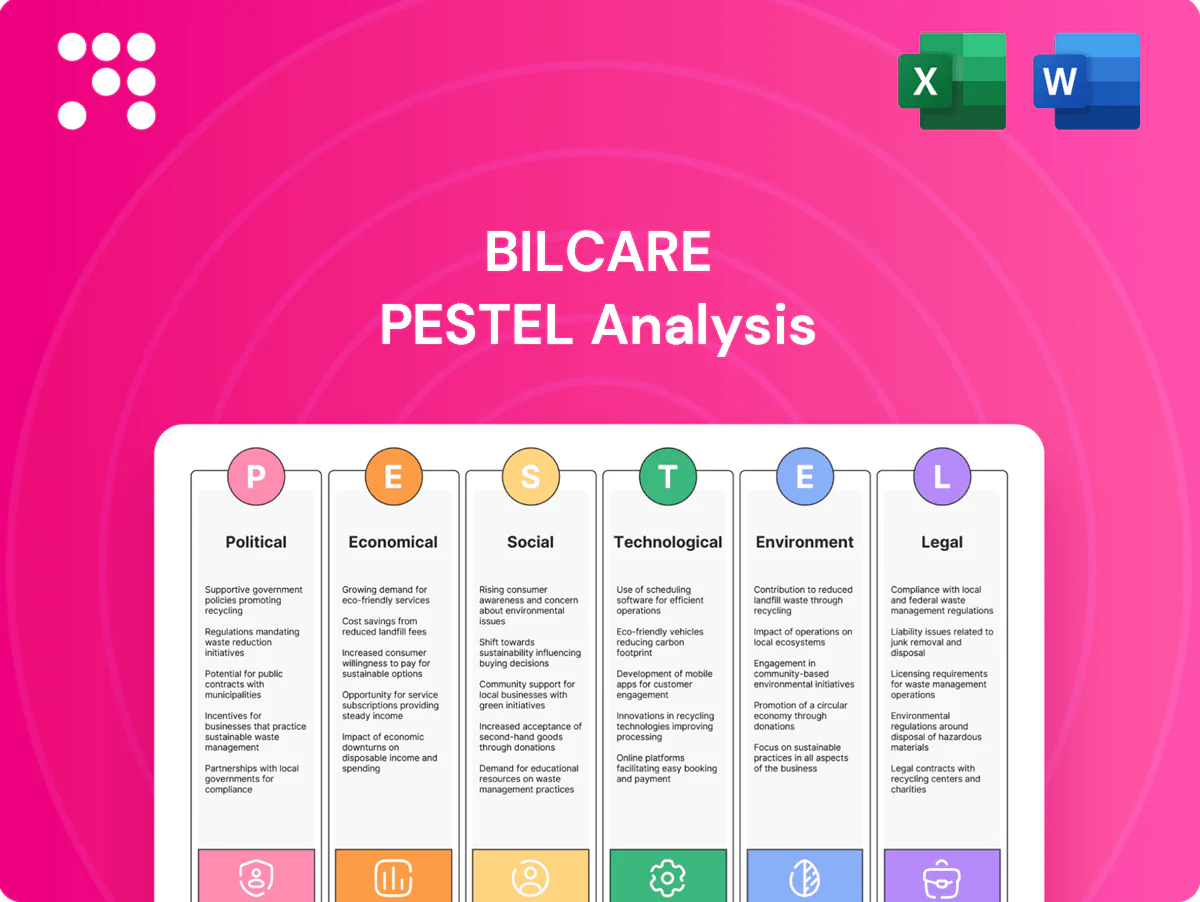
A concise, visually segmented PESTLE summary for Bilcare that’s easy to drop into presentations, share across teams, and editable with notes for local market or business-line context—ideal for aligning strategy discussions and highlighting external risks quickly.
Economic factors

Commodity and currency volatility
Aluminum foil and polymer resin costs are cyclical and FX-sensitive, with LME aluminum averaging about $2,300/ton in 2024 and common resin grades near $1,400/ton that year, amplifying input-cost swings for Bilcare. INR weakness — around 82–84/USD in 2024–25 — raises imported input and specialized-capex bills. Pricing formulas with pass-through clauses preserve margins, while proactive hedging and tighter inventory turns smooth earnings volatility.
Capital access and restructuring
Given prior stress, cost of capital and lender confidence are pivotal with RBI repo at 6.5% (June 2025) and typical corporate lending spreads ~250–400 bps; a phased revival focused on niche, higher‑margin SKUs (packaging industry EBITDA ~15% in 2024) can improve cash conversion; asset‑light collaborations/tolling cut upfront capex by ~30–50% and credible turnaround KPIs restore supplier and customer trust.

Pharma demand resilience
Essential medicines and generics, which account for roughly 80% of prescriptions by volume, provide defensive end-market demand supporting Bilcare's blister and barrier films; India’s pharma market was about $50 billion in 2024. Strong domestic formulations growth and exports—Indian pharma exports near $25 billion in FY2024—sustain packaging volumes. Recovery in clinical trial activity can revive contract-supply services, while diversification into nutraceuticals and diagnostics buffers cyclical risk.

Export market dynamics
Export market access to regulated markets (US/EU) gives Bilcare pricing power but raises compliance costs and certification timelines; regulatory overheads in pharma packaging can increase time-to-market and cost basis materially. Currency advantages—INR near 82–84/USD in 2024—improve competitiveness into Africa, LATAM and SE Asia. Volatile freight: container rates fell ~50% from 2021 peaks to 2024 averages, yet logistics still drive landed-cost risk; local warehousing or converter partnerships raise service levels and reduce lead times.
- Pricing power vs compliance burden
- INR ~82–84/USD (2024) aids exports
- Container rates down ~50% vs 2021 — logistics still material
- Local warehousing/converters improve service
Product mix and margin structure
High-barrier laminates, cold-form foils and specialty polymers deliver materially higher margins than commodity films, with serialization and security solutions shifting revenue toward recurring, fee-based streams; 2024 industry data show serialization adoption above 70% in regulated markets. Value-engineering for downgauging preserves customer economics while maintaining performance, and aftermarket services increase stickiness and lifetime value.
- Premium substrates: higher gross margin profile
- Serialization/security: recurring fee revenue, >70% adoption (2024)
- Downgauging: protects customer cost without performance loss
- Aftermarket services: boost retention and LTV
PLI-led localization and Ayushman Bharat boost India pharma packaging demand
Aluminum/resin price swings (LME Al ~$2,300/t, resins ~$1,400/t in 2024) and INR ~82–84/USD (2024–25) drive input-cost volatility but contract pass-throughs and hedging cushion margins. Higher cost of capital (RBI repo 6.5% Jun 2025; lending spreads ~250–400 bps) pressures capex; asset-light tolling can cut upfront capex 30–50%. Strong pharma demand (India $50B, exports ~$25B in 2024) supports packaging volumes.
| Metric | Value |
|---|---|
| LME Al | $2,300/t (2024) |
| Resin | $1,400/t (2024) |
| INR | 82–84/USD (2024–25) |
| RBI repo | 6.5% (Jun 2025) |
Full Version Awaits
Bilcare PESTLE Analysis
The preview shown here is the exact Bilcare PESTLE Analysis you’ll receive after purchase—fully formatted, comprehensive, and ready to use. The content, structure, and insights visible in this sample are the final deliverable with no placeholders or surprises. Download the finished file instantly after checkout.

Original: $10.00
-65%$10.00
$3.50Product Information
Product Information
Shipping & Returns
Shipping & Returns
Description
Your Competitive Advantage Starts with This Report
Gain a strategic edge with our PESTLE analysis tailored to Bilcare. Explore how political, economic, social, technological, legal and environmental forces shape its prospects and risks. Purchase the full report for actionable insights and downloadable, board-ready deliverables.
Political factors
Healthcare policy priorities
India’s emphasis on affordable medicines and supply security—within a pharma market ~US$45 billion in 2024—tightens packaging specs and procurement norms, favoring compliant blister and foil formats. Government incentives such as the Rs 15,000 crore PLI for pharmaceuticals boost domestic manufacturing and can shift contracts toward local packaging partners. Public programs like Ayushman Bharat (covering ~500 million beneficiaries) and essential-drug tenders create stable baseline demand if Bilcare aligns products to priority therapies and tender requirements.
Trade tariffs and import dependence
Duties on aluminum foils, specialty polymers and additives can raise Bilcare’s input costs by roughly 5–15%, squeezing margins on pharma packaging; changes in FTAs or anti-dumping measures have historically swung competitiveness versus foreign converters by 10–20%. Hedging foreign-exchange exposure and dual-sourcing reduced procurement volatility in comparable firms by ~30–40%. Targeted localization of key inputs can cut import dependence towards sub-20% for critical lines, mitigating geopolitical and tariff risk.
Make-in-India and PLI schemes
Make-in-India and PLI schemes (combined outlay INR 1.97 lakh crore) extend manufacturing-linked incentives to pharma and medical devices, creating spillovers for packaging ecosystems and potential capex support and priority procurement. PLI for bulk drugs (approx. INR 6,940 crore) and device-focused plans boost eligibility when firms show technology upgrades and job creation. Strategic clustering near PLI beneficiaries cuts logistics costs and lead times, improving competitiveness.
Regulatory capacity and enforcement
Stronger enforcement against counterfeit medicines boosts demand for track-and-trace and security features; the global pharmaceutical serialization market was about USD 2.4B in 2023 and WHO estimates 10.5% of medicines in low/middle-income countries may be substandard or falsified. Variability in state-level enforcement fragments adoption timelines, while Bilcare’s anti-counterfeit portfolio aligns with central patient-safety drives and advocacy/pilot programs can accelerate standards uptake.
- Demand rise: serialization market ~USD 2.4B (2023)
- Fragmentation: state-level enforcement gaps delay rollout
- Fit: Bilcare anti-counterfeit aligns with national safety goals
- Leverage: regulator pilots/advocacy speed standards adoption
Political stability and public procurement
Stable governance supports long-horizon investments in plants and validation cycles (often 18–24 months). Public health program expansions, notably Ayushman Bharat covering ~500 million beneficiaries, drive steady orders but require competitive pricing and strict compliance. Payment cycles in government channels, commonly 60–120 days, affect working capital, while transparent e-tendering and vendor-rating systems reward quality and reliability.
- Long-horizon investment: validation 18–24m
- Public orders: Ayushman Bharat ~500M beneficiaries
- Working capital: govt payments 60–120 days
- Procurement: e-tender/vendor ratings favor quality
PLI-led localization and Ayushman Bharat boost India pharma packaging demand
India’s ~US$45B pharma market (2024) and Ayushman Bharat (~500M beneficiaries) drive steady demand for compliant blister/foil formats. PLI schemes (Rs15,000cr; total INR1.97L cr) and device/drug PLIs (e.g., INR6,940cr) favor local packagers. Tariffs can raise input costs ~5–15%, while serialization market ~USD2.4B (2023) boosts anti-counterfeit demand; govt payment cycles 60–120 days affect working capital.
| Metric | Value |
|---|---|
| Pharma market (2024) | ~US$45B |
| Ayushman Bharat | ~500M |
| PLI outlay | INR1.97L cr |
| Serialization market (2023) | USD2.4B |
| Input tariff impact | +5–15% |
What is included in the product
Detailed Word Document
Explores how macro-environmental forces uniquely impact Bilcare across Political, Economic, Social, Technological, Environmental and Legal dimensions, with data-backed trends and region/industry-specific examples; designed for executives and investors to identify risks, opportunities and forward-looking scenarios ready for inclusion in plans, decks or reports.
Customizable Excel Spreadsheet
A concise, visually segmented PESTLE summary for Bilcare that’s easy to drop into presentations, share across teams, and editable with notes for local market or business-line context—ideal for aligning strategy discussions and highlighting external risks quickly.
Economic factors
Commodity and currency volatility
Aluminum foil and polymer resin costs are cyclical and FX-sensitive, with LME aluminum averaging about $2,300/ton in 2024 and common resin grades near $1,400/ton that year, amplifying input-cost swings for Bilcare. INR weakness — around 82–84/USD in 2024–25 — raises imported input and specialized-capex bills. Pricing formulas with pass-through clauses preserve margins, while proactive hedging and tighter inventory turns smooth earnings volatility.
Capital access and restructuring
Given prior stress, cost of capital and lender confidence are pivotal with RBI repo at 6.5% (June 2025) and typical corporate lending spreads ~250–400 bps; a phased revival focused on niche, higher‑margin SKUs (packaging industry EBITDA ~15% in 2024) can improve cash conversion; asset‑light collaborations/tolling cut upfront capex by ~30–50% and credible turnaround KPIs restore supplier and customer trust.
Pharma demand resilience
Essential medicines and generics, which account for roughly 80% of prescriptions by volume, provide defensive end-market demand supporting Bilcare's blister and barrier films; India’s pharma market was about $50 billion in 2024. Strong domestic formulations growth and exports—Indian pharma exports near $25 billion in FY2024—sustain packaging volumes. Recovery in clinical trial activity can revive contract-supply services, while diversification into nutraceuticals and diagnostics buffers cyclical risk.
Export market dynamics
Export market access to regulated markets (US/EU) gives Bilcare pricing power but raises compliance costs and certification timelines; regulatory overheads in pharma packaging can increase time-to-market and cost basis materially. Currency advantages—INR near 82–84/USD in 2024—improve competitiveness into Africa, LATAM and SE Asia. Volatile freight: container rates fell ~50% from 2021 peaks to 2024 averages, yet logistics still drive landed-cost risk; local warehousing or converter partnerships raise service levels and reduce lead times.
- Pricing power vs compliance burden
- INR ~82–84/USD (2024) aids exports
- Container rates down ~50% vs 2021 — logistics still material
- Local warehousing/converters improve service
Product mix and margin structure
High-barrier laminates, cold-form foils and specialty polymers deliver materially higher margins than commodity films, with serialization and security solutions shifting revenue toward recurring, fee-based streams; 2024 industry data show serialization adoption above 70% in regulated markets. Value-engineering for downgauging preserves customer economics while maintaining performance, and aftermarket services increase stickiness and lifetime value.
- Premium substrates: higher gross margin profile
- Serialization/security: recurring fee revenue, >70% adoption (2024)
- Downgauging: protects customer cost without performance loss
- Aftermarket services: boost retention and LTV
PLI-led localization and Ayushman Bharat boost India pharma packaging demand
Aluminum/resin price swings (LME Al ~$2,300/t, resins ~$1,400/t in 2024) and INR ~82–84/USD (2024–25) drive input-cost volatility but contract pass-throughs and hedging cushion margins. Higher cost of capital (RBI repo 6.5% Jun 2025; lending spreads ~250–400 bps) pressures capex; asset-light tolling can cut upfront capex 30–50%. Strong pharma demand (India $50B, exports ~$25B in 2024) supports packaging volumes.
| Metric | Value |
|---|---|
| LME Al | $2,300/t (2024) |
| Resin | $1,400/t (2024) |
| INR | 82–84/USD (2024–25) |
| RBI repo | 6.5% (Jun 2025) |
Full Version Awaits
Bilcare PESTLE Analysis
The preview shown here is the exact Bilcare PESTLE Analysis you’ll receive after purchase—fully formatted, comprehensive, and ready to use. The content, structure, and insights visible in this sample are the final deliverable with no placeholders or surprises. Download the finished file instantly after checkout.