Bidvest PESTLE Analysis

Your Competitive Advantage Starts with This Report
Gain strategic clarity with our PESTLE analysis of Bidvest, revealing political, economic and regulatory forces shaping its outlook. Perfect for investors and strategists, it highlights risks and growth levers you can act on immediately. Purchase the full, downloadable report for the complete, editable breakdown and actionable recommendations.
Political factors

Policy stability and trade
Bidvest’s cross-border trading and freight, spanning 30+ countries across Africa, Europe and Asia, depends on predictable trade policies and stable diplomatic ties; shifts in tariffs, port governance or customs rules can materially increase costs and delay transit. The African Continental Free Trade Area now covers 54 member states, so monitoring multilateral accords and regional blocs is critical to optimize routing and sourcing. Proactive advocacy and compliance readiness reduce disruption risk.
B-BBEE and localization
South Africa’s B-BBEE and local content rules materially shape Bidvest’s procurement access and joint-venture structures, with compliance increasingly determining eligibility for state and parastatal tenders worth billions (public procurement exceeds R1 trillion annually). Strong empowerment credentials unlock large facilities, logistics and services contracts; improving scorecards demands investment in supplier development and skills training, while non-compliance risks lost revenue and reputational harm.

Public infrastructure investment
Government capex on ports, rail, roads and utilities directly drives Bidvest's freight reliability and cost base; Transnet's R340 billion 10‑year investment plan for ports and rail underpins capacity improvements relevant to 2024–25. Delays or underinvestment raise congestion, demurrage and maintenance burdens and erode margins. Collaboration with SOEs and PPPs can create throughput advantages and locked‑in contracts. Scenario planning around infrastructure resilience protects service levels and revenue continuity.

Regulatory fragmentation across markets
Bidvest’s international footprint spans over 30 jurisdictions, exposing its hygiene, automotive and financial services units to divergent sectoral rules that increased compliance complexity and audit workload in FY2024; centralised governance and policy harmonisation cut duplicated controls and lowered group audit cycles. Local regulatory intelligence remains critical for timely adaptation and risk mitigation.
- jurisdictions: >30
- focus: harmonise policies, centralise governance
- priority: local regulatory intelligence for rapid adaptation
Political security and labor stability
Industrial action, civil unrest or election cycles such as South Africa’s May 2024 national election can interrupt Bidvest’s logistics and facilities management; contingency routing and diversified warehousing reduce service interruptions and protect supply chains. Strong labour relations and community engagement enhance operating continuity while insurance and risk-transfer mechanisms complement operational resilience.
- Contingency routing
- Diversified warehousing
- Labour relations focus
- Insurance/risk transfer
Trade exposure across 30+ countries, AfCFTA 54-state routing & B-BBEE, R340bn capex risk
Bidvest’s 30+ country trade and freight exposure depends on stable tariffs and port governance; AfCFTA 54 states alters routing and sourcing.
South Africa’s B‑BBEE and local content rules shape access to >R1 trillion public procurement; compliance drives JV structure and tender eligibility.
Transnet’s R340bn 10‑yr capex affects logistics capacity; May 2024 election and labor unrest heighten operational risk.
| Factor | Metric | Impact |
|---|---|---|
| Jurisdictions | >30 | Compliance burden |
| AfCFTA | 54 states | Routing/sourcing |
| Public procurement | >R1tn | Tender access |
| Transnet capex | R340bn | Capacity |
What is included in the product
 Detailed Word Document
Explores how macro-environmental forces uniquely affect Bidvest across Political, Economic, Social, Technological, Environmental and Legal dimensions, with data-driven trends, region- and industry-specific examples, forward-looking insights for scenario planning, and actionable implications to help executives and investors identify risks and opportunities.

 Customizable Excel Spreadsheet
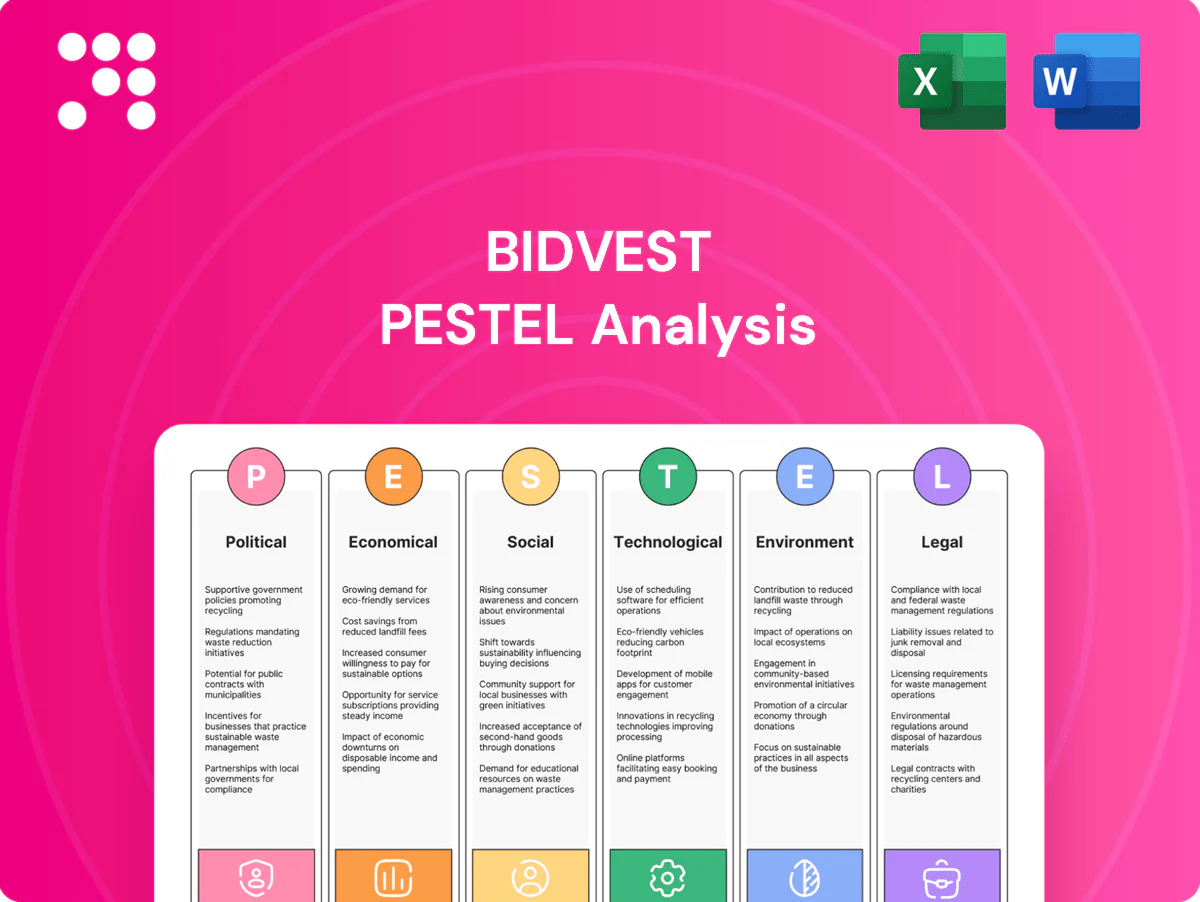
A concise, visually segmented PESTLE summary of Bidvest that can be dropped into presentations, shared across teams, and annotated for local context to streamline external-risk discussions and strategic planning.
Economic factors

Currency and inflation volatility
ZAR volatility (averaging about 18.5/ZAR per USD in 2024) and swings in other EM currencies raise Bidvest import, fuel and equipment costs, directly affecting gross margins. Inflation running near 5% in 2024 compresses margins in fixed-price contracts. Active hedging, indexation clauses, dynamic pricing and lean working capital with inventory optimisation protect profitability and absorb shocks.
GDP cycles and demand mix
Bidvest’s diversified portfolio buffers GDP-driven cyclicality across consumer, commercial and industrial clients, as slowdowns typically reduce discretionary spend but sustain countercyclical categories such as hygiene and maintenance; sector-rotation strategies and cross-selling within its service and distribution businesses help rebalance exposure and stabilise revenue through cycles.

Energy and fuel costs
Diesel (≈R20–R22/L in 2024–25), rising commercial electricity tariffs (Eskom 2023 tariff increase 18.65%) and persistent load-shedding materially lift Bidvest’s logistics and facilities costs, driving higher transport and storage unit costs. Investing in fleet efficiency, alternative fuels and onsite generation cuts dependence, while energy pass-throughs protect margins where contracts allow; data-led route and asset optimisation lowers energy intensity per service unit.

Interest rates and credit conditions
Higher interest rates—SARB repo at 8.25% (July 2025)—increase financing costs for Bidvest’s vehicle fleets, warehousing and client credit lines, squeezing margins on asset-heavy divisions.
Stricter credit cycles raise SME defaults across Bidvest’s supply chain; robust credit-risk scoring and tight receivables management have limited impairments historically, keeping bad-debt ratios below peer averages.
Flexible capex timing and staged investments allow Bidvest to align spend with rate outlooks and preserve liquidity amid tighter lending conditions.
- Higher rates: SARB repo 8.25% (July 2025)
- Impact areas: fleets, warehousing, client credit
- Mitigants: credit scoring, receivables management
- Strategy: flexible capex timing
Global supply chain normalization
Post-pandemic freight capacity and lead times are stabilizing but remain geopolitically sensitive. Drewry's World Container Index fell about 75% from 2021 peaks to 2024, reducing spot costs and transit delays for Bidvest. Route disruptions (eg Red Sea) keep volatility elevated, driving risk-adjusted inventory buffers and multi-carrier strategies.
- Inventory: shift from JIT to safety buffers
- Network: contracts with multiple carriers/ports
- Digital: improved visibility boosts ETA accuracy & customer service
Trade exposure across 30+ countries, AfCFTA 54-state routing & B-BBEE, R340bn capex risk
ZAR volatility (~18.5 ZAR/USD in 2024) and 2024 inflation ~5% pressure import and contract margins; active hedging and indexation mitigate. Energy (diesel R20–R22/L, Eskom +18.65% tariff 2023) and load‑shedding raise logistics/facilities costs; efficiency and pass‑throughs help. SARB repo 8.25% (Jul 2025) tightens financing; credit scoring, receivables control and flexible capex preserve liquidity.
| Metric | Value |
|---|---|
| ZAR vol (2024) | ~18.5/USD |
| Inflation (2024) | ~5% |
| Diesel (2024–25) | R20–R22/L |
| SARB repo (Jul 2025) | 8.25% |
Preview Before You Purchase
Bidvest PESTLE Analysis
The preview shown here is the exact Bidvest PESTLE Analysis you’ll receive after purchase—fully formatted and ready to use. The content, layout, and insights visible are the final file with no placeholders or edits required. After checkout you can download this exact document instantly.

Original: $10.00
-65%$10.00
$3.50Product Information
Product Information
Shipping & Returns
Shipping & Returns
Description
Your Competitive Advantage Starts with This Report
Gain strategic clarity with our PESTLE analysis of Bidvest, revealing political, economic and regulatory forces shaping its outlook. Perfect for investors and strategists, it highlights risks and growth levers you can act on immediately. Purchase the full, downloadable report for the complete, editable breakdown and actionable recommendations.
Political factors
Policy stability and trade
Bidvest’s cross-border trading and freight, spanning 30+ countries across Africa, Europe and Asia, depends on predictable trade policies and stable diplomatic ties; shifts in tariffs, port governance or customs rules can materially increase costs and delay transit. The African Continental Free Trade Area now covers 54 member states, so monitoring multilateral accords and regional blocs is critical to optimize routing and sourcing. Proactive advocacy and compliance readiness reduce disruption risk.
B-BBEE and localization
South Africa’s B-BBEE and local content rules materially shape Bidvest’s procurement access and joint-venture structures, with compliance increasingly determining eligibility for state and parastatal tenders worth billions (public procurement exceeds R1 trillion annually). Strong empowerment credentials unlock large facilities, logistics and services contracts; improving scorecards demands investment in supplier development and skills training, while non-compliance risks lost revenue and reputational harm.
Public infrastructure investment
Government capex on ports, rail, roads and utilities directly drives Bidvest's freight reliability and cost base; Transnet's R340 billion 10‑year investment plan for ports and rail underpins capacity improvements relevant to 2024–25. Delays or underinvestment raise congestion, demurrage and maintenance burdens and erode margins. Collaboration with SOEs and PPPs can create throughput advantages and locked‑in contracts. Scenario planning around infrastructure resilience protects service levels and revenue continuity.
Regulatory fragmentation across markets
Bidvest’s international footprint spans over 30 jurisdictions, exposing its hygiene, automotive and financial services units to divergent sectoral rules that increased compliance complexity and audit workload in FY2024; centralised governance and policy harmonisation cut duplicated controls and lowered group audit cycles. Local regulatory intelligence remains critical for timely adaptation and risk mitigation.
- jurisdictions: >30
- focus: harmonise policies, centralise governance
- priority: local regulatory intelligence for rapid adaptation
Political security and labor stability
Industrial action, civil unrest or election cycles such as South Africa’s May 2024 national election can interrupt Bidvest’s logistics and facilities management; contingency routing and diversified warehousing reduce service interruptions and protect supply chains. Strong labour relations and community engagement enhance operating continuity while insurance and risk-transfer mechanisms complement operational resilience.
- Contingency routing
- Diversified warehousing
- Labour relations focus
- Insurance/risk transfer
Trade exposure across 30+ countries, AfCFTA 54-state routing & B-BBEE, R340bn capex risk
Bidvest’s 30+ country trade and freight exposure depends on stable tariffs and port governance; AfCFTA 54 states alters routing and sourcing.
South Africa’s B‑BBEE and local content rules shape access to >R1 trillion public procurement; compliance drives JV structure and tender eligibility.
Transnet’s R340bn 10‑yr capex affects logistics capacity; May 2024 election and labor unrest heighten operational risk.
| Factor | Metric | Impact |
|---|---|---|
| Jurisdictions | >30 | Compliance burden |
| AfCFTA | 54 states | Routing/sourcing |
| Public procurement | >R1tn | Tender access |
| Transnet capex | R340bn | Capacity |
What is included in the product
Detailed Word Document
Explores how macro-environmental forces uniquely affect Bidvest across Political, Economic, Social, Technological, Environmental and Legal dimensions, with data-driven trends, region- and industry-specific examples, forward-looking insights for scenario planning, and actionable implications to help executives and investors identify risks and opportunities.
Customizable Excel Spreadsheet
A concise, visually segmented PESTLE summary of Bidvest that can be dropped into presentations, shared across teams, and annotated for local context to streamline external-risk discussions and strategic planning.
Economic factors
Currency and inflation volatility
ZAR volatility (averaging about 18.5/ZAR per USD in 2024) and swings in other EM currencies raise Bidvest import, fuel and equipment costs, directly affecting gross margins. Inflation running near 5% in 2024 compresses margins in fixed-price contracts. Active hedging, indexation clauses, dynamic pricing and lean working capital with inventory optimisation protect profitability and absorb shocks.
GDP cycles and demand mix
Bidvest’s diversified portfolio buffers GDP-driven cyclicality across consumer, commercial and industrial clients, as slowdowns typically reduce discretionary spend but sustain countercyclical categories such as hygiene and maintenance; sector-rotation strategies and cross-selling within its service and distribution businesses help rebalance exposure and stabilise revenue through cycles.
Energy and fuel costs
Diesel (≈R20–R22/L in 2024–25), rising commercial electricity tariffs (Eskom 2023 tariff increase 18.65%) and persistent load-shedding materially lift Bidvest’s logistics and facilities costs, driving higher transport and storage unit costs. Investing in fleet efficiency, alternative fuels and onsite generation cuts dependence, while energy pass-throughs protect margins where contracts allow; data-led route and asset optimisation lowers energy intensity per service unit.
Interest rates and credit conditions
Higher interest rates—SARB repo at 8.25% (July 2025)—increase financing costs for Bidvest’s vehicle fleets, warehousing and client credit lines, squeezing margins on asset-heavy divisions.
Stricter credit cycles raise SME defaults across Bidvest’s supply chain; robust credit-risk scoring and tight receivables management have limited impairments historically, keeping bad-debt ratios below peer averages.
Flexible capex timing and staged investments allow Bidvest to align spend with rate outlooks and preserve liquidity amid tighter lending conditions.
- Higher rates: SARB repo 8.25% (July 2025)
- Impact areas: fleets, warehousing, client credit
- Mitigants: credit scoring, receivables management
- Strategy: flexible capex timing
Global supply chain normalization
Post-pandemic freight capacity and lead times are stabilizing but remain geopolitically sensitive. Drewry's World Container Index fell about 75% from 2021 peaks to 2024, reducing spot costs and transit delays for Bidvest. Route disruptions (eg Red Sea) keep volatility elevated, driving risk-adjusted inventory buffers and multi-carrier strategies.
- Inventory: shift from JIT to safety buffers
- Network: contracts with multiple carriers/ports
- Digital: improved visibility boosts ETA accuracy & customer service
Trade exposure across 30+ countries, AfCFTA 54-state routing & B-BBEE, R340bn capex risk
ZAR volatility (~18.5 ZAR/USD in 2024) and 2024 inflation ~5% pressure import and contract margins; active hedging and indexation mitigate. Energy (diesel R20–R22/L, Eskom +18.65% tariff 2023) and load‑shedding raise logistics/facilities costs; efficiency and pass‑throughs help. SARB repo 8.25% (Jul 2025) tightens financing; credit scoring, receivables control and flexible capex preserve liquidity.
| Metric | Value |
|---|---|
| ZAR vol (2024) | ~18.5/USD |
| Inflation (2024) | ~5% |
| Diesel (2024–25) | R20–R22/L |
| SARB repo (Jul 2025) | 8.25% |
Preview Before You Purchase
Bidvest PESTLE Analysis
The preview shown here is the exact Bidvest PESTLE Analysis you’ll receive after purchase—fully formatted and ready to use. The content, layout, and insights visible are the final file with no placeholders or edits required. After checkout you can download this exact document instantly.