Bharat Petroleum PESTLE Analysis

Your Competitive Advantage Starts with This Report
Unlock how political shifts, energy policies, economic cycles, social demand, technological disruption, and environmental regulation are reshaping Bharat Petroleum’s strategic outlook. Our concise PESTLE highlights risks and opportunities for investors and planners. Get actionable, researched insights to inform decisions. Purchase the full PESTLE for the complete, ready-to-use analysis.
Political factors

Government ownership and policy alignment
BPCL, a central public sector undertaking with the Government of India as majority promoter (approximately 52.98% stake), operates tightly within national strategic priorities. Policy directives on energy security, pricing and capital allocation — aligned with India’s 500 GW renewable target by 2030 and net-zero by 2070 — shape BPCL’s project approvals and capex choices. Close alignment unlocks government support but can constrain commercial agility and rapid response to market shifts; political changes can quickly recalibrate priorities.
Fuel pricing and subsidy regime
Retail fuel pricing, though deregulated since 2010, remains influenced by government guidance during inflationary spells, affecting Bharat Petroleum's ability to pass through cost changes. Historical under-recoveries peaked at about Rs 1.4 lakh crore in 2012, illustrating how delayed price pass-through can severely compress margins. Subsidy decisions on LPG and kerosene alter cash flows and working capital, while unpredictability in pricing policy undermines planning and investor sentiment.

Geopolitics and crude import dependence
India imported about 85% of its crude, roughly 220 million tonnes in 2023–24, exposing BPCL to geopolitical and sanctions risks; supply routes, OPEC+ output choices and regional conflicts shift availability and raised Brent into the $80–100/bbl band in 2024. Diversifying crude sources is a political and operational priority, while diplomatic relations shape term contracts and freight security.

Disinvestment and restructuring agenda
Government plans for strategic disinvestment, with a 53.29% central stake in BPCL, can materially change ownership, board composition and strategic direction; privatization prospects already influence labor negotiations, capital-expenditure signaling and investor valuation expectations. Policy timelines and election cycles in 2024–25 have tightened deal certainty, and markets reprice BPCL on each policy signal.
- stake: 53.29%
- FY24 revenue cited around ₹4.2 lakh crore
- capex & labor risk from privatization
- deal certainty tied to election/policy timing
Centre–state dynamics and regulatory coordination
Centre–state tax and approval mix shapes BPCL's costs and timelines: GST (implemented 2017) harmonised many levies but state approvals, local cess and permitting remain critical across 28 states and 8 union territories. State policies influence distribution corridors, retail expansion and logistics; coordination gaps can raise compliance costs and delay projects, while state-level political instability risks interruptions. BPCL operates ~16,000 retail outlets (Mar 2024).
- Tax drivers: GST plus state levies
- Approvals: state/local permits affect timelines
- Scale: ~16,000 outlets (Mar 2024)
- Risk: delays/compliance costs from poor coordination
- Political: state stability affects continuity
Govt-held refiner: ₹4.2L cr, import Brent risk, privatization delay
BPCL (53.29% central stake) operates within government energy priorities, affecting capex and strategic choices; FY24 revenue ~₹4.2 lakh crore and ~16,000 retail outlets (Mar 2024). India imported ~85% crude (~220 mt in 2023–24), exposing BPCL to geopolitical supply and Brent volatility (~$80–100/bbl in 2024). Privatization timelines, subsidy and pricing guidance materially affect margins and investment certainty.
| Metric | Value |
|---|---|
| Centre stake | 53.29% |
| FY24 revenue | ₹4.2 lakh crore |
| Retail outlets (Mar 2024) | ~16,000 |
| Crude import 2023–24 | ~85% (~220 mt) |
| Brent 2024 range | $80–100/bbl |
What is included in the product
 Detailed Word Document
Explores how macro-environmental forces uniquely affect Bharat Petroleum across Political, Economic, Social, Technological, Environmental, and Legal dimensions, with data-driven subpoints and industry-specific examples. Designed for executives and investors, this PESTLE delivers forward-looking insights and scenario-ready analysis to identify regulatory risks, market opportunities, and strategic priorities.

 Customizable Excel Spreadsheet
Clean, summarized Bharat Petroleum PESTLE analysis, visually segmented by PESTEL for quick interpretation, editable for regional or business-line notes, concise enough to drop into presentations or share across teams, uses simple language to aid risk and market-position discussions, and is neatly formatted for consultants and compatibility with Excel and tablets.
Economic factors

Crude price volatility and refining margins
Global crude swings—from peaks above $120/barrel in 2022 to around $80–90/barrel in 2023–24—directly drive BPCL’s input costs and inventory gains/losses. Gross refining margins have ranged roughly $2–12/barrel as product cracks and supply‑demand cycles shift. Such volatility complicates pricing and hedging, raising working capital costs. Margin resilience hinges on BPCL’s product slate and refinery complexity (FCC, hydrocracking, coking) which capture higher cracks.
Currency movements and import costs
Rupee depreciation to about 82–84/US$ in 2024–25 raised Bharat Petroleum’s crude import bills and working capital needs, with each 1% INR fall roughly increasing import costs by a similar percentage. Forex volatility pushed up debt servicing and hedging costs as BPCL manages USD exposure and forward contracts. Exchange-rate moves feed directly into retail fuel pricing and consumer inflation sensitivity, while a stable INR improves planning accuracy and profitability.

Domestic demand growth and mobility trends
Rising domestic demand—IMF 2024 GDP forecast 6.8%—plus rapid urbanization and roughly 7% vehicle sales growth reported in 2024 lift petrol and diesel volumes; domestic aviation passengers rebounded to about 320 million (FY2023-24), aiding jet fuel offtake. Industrial activity and IIP upticks supported product sales, while CPI near 5% in 2024 or economic slowdowns can cut consumption and shift mixes; seasonal and festival spikes cause predictable volume swings.

Capital intensity and financing conditions
Capital intensity in BPCL is high as refinery upgrades, petrochemicals integration and logistics expansions are multi-thousand-crore projects; RBI policy rate ~6.5% (mid-2025) and credit availability materially affect NPV and hurdle rates. Efficient capital allocation and sustaining ROCE through cycles require strict project selectivity. Strategic partnerships can de-risk, share capex and speed execution.
- Capex scale: multi-thousand-crore projects
- Policy rate: ~6.5% (mid-2025)
- Focus: ROCE preservation via selective allocation
- Mitigation: partnerships to de-risk
Competition and market structure
Private refiners and global traders such as Reliance and Adani intensify pricing and service competition, pressuring Bharat Petroleum to match margins and logistics efficiency; PSU coordination on supply allocation can stabilize availability but reduces scope for product differentiation. Import/export arbitrage and crude price volatility transmit quickly to domestic retail margins, while loyalty programs and expanded convenience services shift market share toward more customer-centric players.
- Competition: private refiners/traders
- PSU coordination: supply stability vs differentiation
- Arbitrage: impacts domestic pricing
- Retail: loyalty and convenience drive share
Govt-held refiner: ₹4.2L cr, import Brent risk, privatization delay
Crude at ~80–90 US$/bbl (2024) and GRMs $2–12/bbl drive BPCL input costs and margins. INR ~82–84/US$ (2024–25) raises import bills; each 1% INR fall ≈1% higher crude cost. RBI policy rate ~6.5% (mid‑2025) and capex scale (multi‑thousand crore) shape funding costs and ROCE. Domestic demand: GDP ~6.8% (IMF 2024), vehicle sales +7%, jet pax ~320M (FY24).
| Metric | Value |
|---|---|
| Crude | 80–90 US$/bbl (2024) |
| INR/USD | 82–84 (2024–25) |
| RBI rate | ~6.5% (mid‑2025) |
| GDP | 6.8% (IMF 2024) |
Preview Before You Purchase
Bharat Petroleum PESTLE Analysis
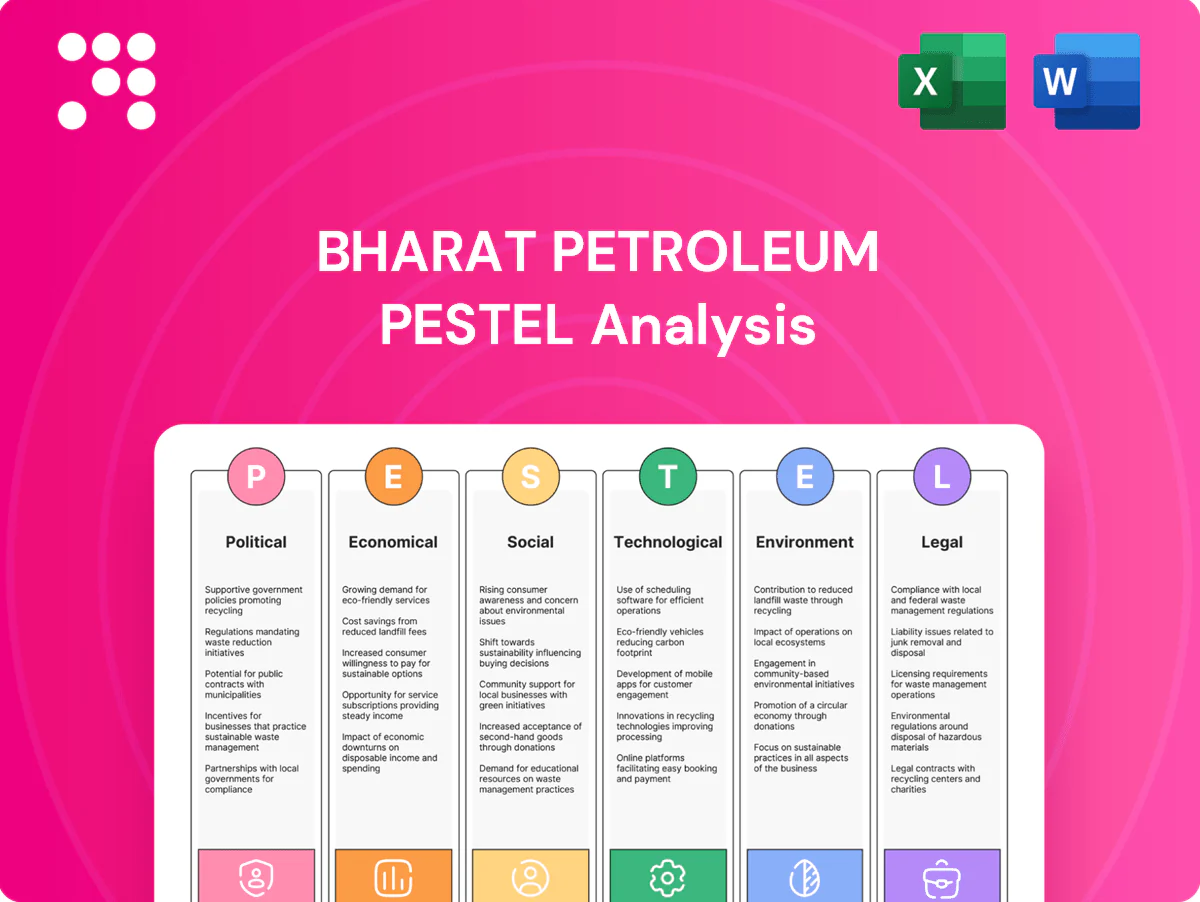
This Bharat Petroleum PESTLE Analysis preview is the exact, fully formatted document you’ll receive after purchase. It contains the complete legal, economic, social, technological, environmental, and political assessment—ready to download and use. No placeholders, no surprises.

Product Information
Product Information
Shipping & Returns
Shipping & Returns
Description
Your Competitive Advantage Starts with This Report
Unlock how political shifts, energy policies, economic cycles, social demand, technological disruption, and environmental regulation are reshaping Bharat Petroleum’s strategic outlook. Our concise PESTLE highlights risks and opportunities for investors and planners. Get actionable, researched insights to inform decisions. Purchase the full PESTLE for the complete, ready-to-use analysis.
Political factors
Government ownership and policy alignment
BPCL, a central public sector undertaking with the Government of India as majority promoter (approximately 52.98% stake), operates tightly within national strategic priorities. Policy directives on energy security, pricing and capital allocation — aligned with India’s 500 GW renewable target by 2030 and net-zero by 2070 — shape BPCL’s project approvals and capex choices. Close alignment unlocks government support but can constrain commercial agility and rapid response to market shifts; political changes can quickly recalibrate priorities.
Fuel pricing and subsidy regime
Retail fuel pricing, though deregulated since 2010, remains influenced by government guidance during inflationary spells, affecting Bharat Petroleum's ability to pass through cost changes. Historical under-recoveries peaked at about Rs 1.4 lakh crore in 2012, illustrating how delayed price pass-through can severely compress margins. Subsidy decisions on LPG and kerosene alter cash flows and working capital, while unpredictability in pricing policy undermines planning and investor sentiment.
Geopolitics and crude import dependence
India imported about 85% of its crude, roughly 220 million tonnes in 2023–24, exposing BPCL to geopolitical and sanctions risks; supply routes, OPEC+ output choices and regional conflicts shift availability and raised Brent into the $80–100/bbl band in 2024. Diversifying crude sources is a political and operational priority, while diplomatic relations shape term contracts and freight security.
Disinvestment and restructuring agenda
Government plans for strategic disinvestment, with a 53.29% central stake in BPCL, can materially change ownership, board composition and strategic direction; privatization prospects already influence labor negotiations, capital-expenditure signaling and investor valuation expectations. Policy timelines and election cycles in 2024–25 have tightened deal certainty, and markets reprice BPCL on each policy signal.
- stake: 53.29%
- FY24 revenue cited around ₹4.2 lakh crore
- capex & labor risk from privatization
- deal certainty tied to election/policy timing
Centre–state dynamics and regulatory coordination
Centre–state tax and approval mix shapes BPCL's costs and timelines: GST (implemented 2017) harmonised many levies but state approvals, local cess and permitting remain critical across 28 states and 8 union territories. State policies influence distribution corridors, retail expansion and logistics; coordination gaps can raise compliance costs and delay projects, while state-level political instability risks interruptions. BPCL operates ~16,000 retail outlets (Mar 2024).
- Tax drivers: GST plus state levies
- Approvals: state/local permits affect timelines
- Scale: ~16,000 outlets (Mar 2024)
- Risk: delays/compliance costs from poor coordination
- Political: state stability affects continuity
Govt-held refiner: ₹4.2L cr, import Brent risk, privatization delay
BPCL (53.29% central stake) operates within government energy priorities, affecting capex and strategic choices; FY24 revenue ~₹4.2 lakh crore and ~16,000 retail outlets (Mar 2024). India imported ~85% crude (~220 mt in 2023–24), exposing BPCL to geopolitical supply and Brent volatility (~$80–100/bbl in 2024). Privatization timelines, subsidy and pricing guidance materially affect margins and investment certainty.
| Metric | Value |
|---|---|
| Centre stake | 53.29% |
| FY24 revenue | ₹4.2 lakh crore |
| Retail outlets (Mar 2024) | ~16,000 |
| Crude import 2023–24 | ~85% (~220 mt) |
| Brent 2024 range | $80–100/bbl |
What is included in the product
Detailed Word Document
Explores how macro-environmental forces uniquely affect Bharat Petroleum across Political, Economic, Social, Technological, Environmental, and Legal dimensions, with data-driven subpoints and industry-specific examples. Designed for executives and investors, this PESTLE delivers forward-looking insights and scenario-ready analysis to identify regulatory risks, market opportunities, and strategic priorities.
Customizable Excel Spreadsheet
Clean, summarized Bharat Petroleum PESTLE analysis, visually segmented by PESTEL for quick interpretation, editable for regional or business-line notes, concise enough to drop into presentations or share across teams, uses simple language to aid risk and market-position discussions, and is neatly formatted for consultants and compatibility with Excel and tablets.
Economic factors
Crude price volatility and refining margins
Global crude swings—from peaks above $120/barrel in 2022 to around $80–90/barrel in 2023–24—directly drive BPCL’s input costs and inventory gains/losses. Gross refining margins have ranged roughly $2–12/barrel as product cracks and supply‑demand cycles shift. Such volatility complicates pricing and hedging, raising working capital costs. Margin resilience hinges on BPCL’s product slate and refinery complexity (FCC, hydrocracking, coking) which capture higher cracks.
Currency movements and import costs
Rupee depreciation to about 82–84/US$ in 2024–25 raised Bharat Petroleum’s crude import bills and working capital needs, with each 1% INR fall roughly increasing import costs by a similar percentage. Forex volatility pushed up debt servicing and hedging costs as BPCL manages USD exposure and forward contracts. Exchange-rate moves feed directly into retail fuel pricing and consumer inflation sensitivity, while a stable INR improves planning accuracy and profitability.
Domestic demand growth and mobility trends
Rising domestic demand—IMF 2024 GDP forecast 6.8%—plus rapid urbanization and roughly 7% vehicle sales growth reported in 2024 lift petrol and diesel volumes; domestic aviation passengers rebounded to about 320 million (FY2023-24), aiding jet fuel offtake. Industrial activity and IIP upticks supported product sales, while CPI near 5% in 2024 or economic slowdowns can cut consumption and shift mixes; seasonal and festival spikes cause predictable volume swings.
Capital intensity and financing conditions
Capital intensity in BPCL is high as refinery upgrades, petrochemicals integration and logistics expansions are multi-thousand-crore projects; RBI policy rate ~6.5% (mid-2025) and credit availability materially affect NPV and hurdle rates. Efficient capital allocation and sustaining ROCE through cycles require strict project selectivity. Strategic partnerships can de-risk, share capex and speed execution.
- Capex scale: multi-thousand-crore projects
- Policy rate: ~6.5% (mid-2025)
- Focus: ROCE preservation via selective allocation
- Mitigation: partnerships to de-risk
Competition and market structure
Private refiners and global traders such as Reliance and Adani intensify pricing and service competition, pressuring Bharat Petroleum to match margins and logistics efficiency; PSU coordination on supply allocation can stabilize availability but reduces scope for product differentiation. Import/export arbitrage and crude price volatility transmit quickly to domestic retail margins, while loyalty programs and expanded convenience services shift market share toward more customer-centric players.
- Competition: private refiners/traders
- PSU coordination: supply stability vs differentiation
- Arbitrage: impacts domestic pricing
- Retail: loyalty and convenience drive share
Govt-held refiner: ₹4.2L cr, import Brent risk, privatization delay
Crude at ~80–90 US$/bbl (2024) and GRMs $2–12/bbl drive BPCL input costs and margins. INR ~82–84/US$ (2024–25) raises import bills; each 1% INR fall ≈1% higher crude cost. RBI policy rate ~6.5% (mid‑2025) and capex scale (multi‑thousand crore) shape funding costs and ROCE. Domestic demand: GDP ~6.8% (IMF 2024), vehicle sales +7%, jet pax ~320M (FY24).
| Metric | Value |
|---|---|
| Crude | 80–90 US$/bbl (2024) |
| INR/USD | 82–84 (2024–25) |
| RBI rate | ~6.5% (mid‑2025) |
| GDP | 6.8% (IMF 2024) |
Preview Before You Purchase
Bharat Petroleum PESTLE Analysis
This Bharat Petroleum PESTLE Analysis preview is the exact, fully formatted document you’ll receive after purchase. It contains the complete legal, economic, social, technological, environmental, and political assessment—ready to download and use. No placeholders, no surprises.