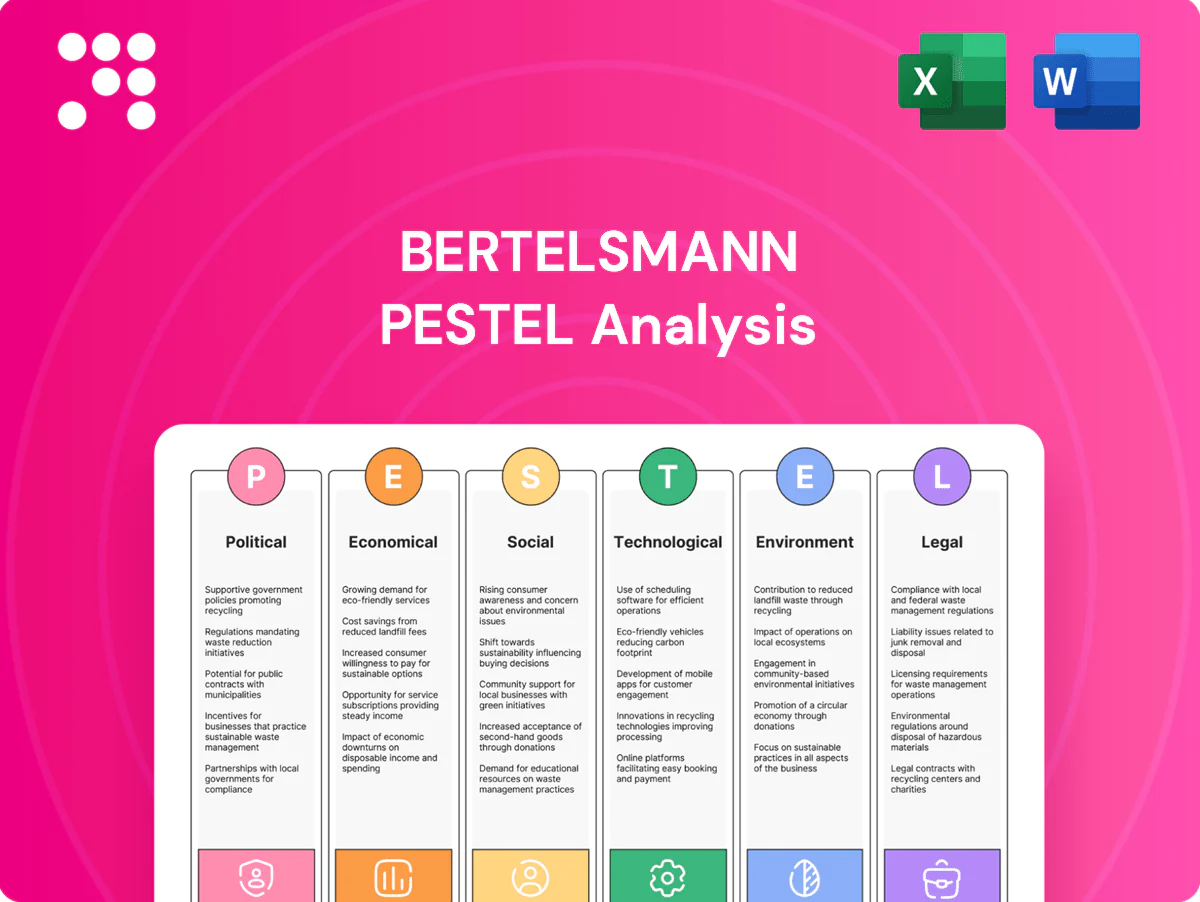
Bertelsmann PESTLE Analysis

Make Smarter Strategic Decisions with a Complete PESTEL View
Unpack how political shifts, economic cycles, social trends, and tech disruption will shape Bertelsmann’s strategy and value creation. Our concise PESTLE highlights key risks and opportunities you can act on now. Purchase the full analysis for the complete, editable report and actionable intelligence.
Political factors

Media regulation shifts
EU Audiovisual Media Services Directive (recast 2018) and the EU Digital Services Act (adopted 2022) reshape broadcast and streaming rules that directly affect Bertelsmann-owned RTL Group and digital platforms.
Platforms must promote European works under AVMSD while UK Ofcom and US regulators impose separate content, advertising and public‑service obligations.
Tighter rules raise compliance and programming costs; proactive policy engagement is essential to manage regulatory risk.
Geopolitical fragmentation
Geopolitical fragmentation — sanctions, trade barriers and data localization fragment global content distribution and complicate Arvato’s BPO operations across ~40 countries. Market exits or supply-chain rerouting elevate costs and delay releases. Heightened country risk forces diversified revenue mixes and contingency planning. Political volatility compresses and shifts ad-spend cycles.

State support and subsidies
State cultural funds, tax credits and publishing grants—backed at EU level by the Creative Europe programme (€2.44bn for 2021–2027)—can materially improve production economics for PRH, RTL and BMG and boost ROI. Accessing incentives supports local‑language content and market reach in a sector employing about 7.4 million in the EU. Sudden policy shifts can abruptly alter project viability, so subsidy‑savvy pipelines strengthen competitive positioning.

Education policy priorities
Government spending on vocational and digital upskilling—backed by EU programmes like Erasmus+ (budget €26.2bn for 2021–2027) and NextGenerationEU recovery funds (€750bn)—is a key demand driver for Bertelsmanns Education activities; public procurement rules lengthen sales cycles and constrain pricing in tendered deals. Shifts in curricula or credentialing standards can rapidly open or close markets, while partnership models with universities and training providers mitigate policy risk.
- Policy-driven demand: Erasmus+ €26.2bn
- Recovery funding: NextGenerationEU €750bn
- Procurement: extends sales cycles, tightens pricing
- Partnerships: primary hedge against policy shifts
Platform governance debates
Platform governance debates—driven by the 2024 EU Digital Services Act (DSA) and similar rules—reshape content moderation, misinformation controls and political advertising limits, directly affecting Bertelsmann’s media reach and ad monetization; the DSA allows fines up to 6% of global turnover and mandates algorithmic audits that can alter discovery and engagement metrics.
- Content moderation affects reach and ad revenue
- Algorithmic scrutiny may reduce engagement
- Transparent editorial/ad policies required for compliance
- Governance outcomes drive audience trust and brand safety
EU DSA & AVMSD tighten content; sanctions fragment distribution; EU funds boost production
EU AVMSD recast and the Digital Services Act (DSA) tighten content, advertising and algorithm rules, with DSA fines up to 6% of global turnover.
Sanctions, data‑localization and trade barriers fragment distribution and raise Arvato compliance costs across ~40 countries, shifting ad cycles.
Creative Europe €2.44bn, Erasmus+ €26.2bn and NextGenerationEU €750bn materially subsidize production, training and demand.
| Item | Value |
|---|---|
| DSA max fine | 6% turnover |
| Creative Europe | €2.44bn (2021–27) |
| Erasmus+ | €26.2bn (2021–27) |
What is included in the product
 Detailed Word Document
Explores how external macro-environmental factors uniquely affect Bertelsmann across Political, Economic, Social, Technological, Environmental, and Legal dimensions, with each category expanded into detailed, company-specific sub-points and examples. Backed by current data and forward-looking insights, the analysis is designed for executives and investors and delivered in clean, ready-to-use format for strategic planning and funding materials.

 Customizable Excel Spreadsheet
A concise, visually segmented PESTLE summary of Bertelsmann that can be dropped into presentations or shared across teams, enabling quick assessment of external risks and market positioning while allowing users to add region- or business-specific notes.
Economic factors

Advertising cycle sensitivity
RTL and broader digital properties are highly exposed to macro ad-spend swings: GroupM forecasted global ad spend to rebound ~6% in 2024 after 2023 softness, compressing CPMs in downturns and reflating inventory value on recovery.
Diversification into subscriptions and B2B services (now >10% of some broadcasters' digital mix) helps cushion cyclicality.
Dynamic pricing and programmatic optimization—programmatic ~70–80% of display by 2024—are key levers to protect yield.
Consumer spending and pricing
Book sales, music royalties and education enrollments at Bertelsmann closely track disposable income; global recorded music revenue rose to about $27.3bn in 2024 (IFPI) while global consumer book market is estimated near $140bn, signaling sensitivity to spending shifts. Inflation pressures (mid-2024 CPI ~4% in many markets) force selective price rises and tight cost control. Value tiers, bundles and subscription models help protect volume, though price elasticity varies by genre and territory.

FX and interest rate impacts
Multi-currency revenues and costs create translation and transaction exposure for Bertelsmann, especially with EUR/USD near 1.08 in H1 2024. Rate volatility—ECB deposit rate ~4.0% and US Fed funds ~5.25% in 2024—raises debt service and acquisition costs. Hedging policies and natural offsets stabilize cash flows via derivatives and operational currency matches. Capital allocation must reflect a higher cost of capital amid tighter rates.

Digital monetization mix
Shift from physical to digital compresses margins at PRH and BMG as streaming and e‑books shift revenue timing and royalty splits; streaming now represents >80% of music consumption and e‑books ~20% of trade book units, altering cash flow profiles. Data-driven D2C upsell can raise customer LTV 20–40%. Unit economics hinge on platform take rates (app stores/DSPs ≈30%).
- Streaming share >80%
- e‑book share ~20%
- Platform take ≈30%
M&A and portfolio rotation
M&A and portfolio rotation at Bertelsmann are driven by valuation cycles in media and edtech—post-2021 valuation compression (edtech valuations fell roughly 50–60% by 2023) times buy-sell timing and risk appetite. Bolt-on acquisitions in rights, labels and education scale reach and capabilities quickly, while antitrust reviews and integration typically add 10–20% to transaction costs. Strategic disposals have funded reinvestment; Bertelsmann reported group revenue of about €20.6bn in 2023, underpinning deal capacity.
- Valuation cycles: edtech valuations down ~50–60% vs 2021
- Bolt-ons: rights, labels, education accelerate scale
- Costs: antitrust + integration often 10–20% of deal value
- Disposals: streamline portfolio, free cash to fund growth
EU DSA & AVMSD tighten content; sanctions fragment distribution; EU funds boost production
Bertelsmann remains exposed to ad-spend cyclicality (GroupM +6% global ad spend 2024) with CPMs volatile, while subscriptions/B2B (>10% digital mix) and D2C (LTV +20–40%) cushion swings; streaming >80% music, e‑books ~20%. FX and rates (EUR/USD ~1.08 H1 2024; ECB ~4.0%; Fed ~5.25%) raise debt costs and WACC. Post‑2021 edtech valuations down ~50–60%, shaping M&A timing.
| Metric | Value |
|---|---|
| Group revenue (2023) | €20.6bn |
| Global recorded music (2024) | $27.3bn |
| Platform take | ≈30% |
Same Document Delivered
Bertelsmann PESTLE Analysis
The Bertelsmann PESTLE Analysis preview shown here is the exact document you’ll receive after purchase—fully formatted and ready to use. The layout, content, and structure visible are identical to the downloadable file you’ll get at checkout. No placeholders or teasers—this is the final, professionally structured analysis.

Original: $10.00
-65%$10.00
$3.50Product Information
Product Information
Shipping & Returns
Shipping & Returns
Description
Make Smarter Strategic Decisions with a Complete PESTEL View
Unpack how political shifts, economic cycles, social trends, and tech disruption will shape Bertelsmann’s strategy and value creation. Our concise PESTLE highlights key risks and opportunities you can act on now. Purchase the full analysis for the complete, editable report and actionable intelligence.
Political factors
Media regulation shifts
EU Audiovisual Media Services Directive (recast 2018) and the EU Digital Services Act (adopted 2022) reshape broadcast and streaming rules that directly affect Bertelsmann-owned RTL Group and digital platforms.
Platforms must promote European works under AVMSD while UK Ofcom and US regulators impose separate content, advertising and public‑service obligations.
Tighter rules raise compliance and programming costs; proactive policy engagement is essential to manage regulatory risk.
Geopolitical fragmentation
Geopolitical fragmentation — sanctions, trade barriers and data localization fragment global content distribution and complicate Arvato’s BPO operations across ~40 countries. Market exits or supply-chain rerouting elevate costs and delay releases. Heightened country risk forces diversified revenue mixes and contingency planning. Political volatility compresses and shifts ad-spend cycles.
State support and subsidies
State cultural funds, tax credits and publishing grants—backed at EU level by the Creative Europe programme (€2.44bn for 2021–2027)—can materially improve production economics for PRH, RTL and BMG and boost ROI. Accessing incentives supports local‑language content and market reach in a sector employing about 7.4 million in the EU. Sudden policy shifts can abruptly alter project viability, so subsidy‑savvy pipelines strengthen competitive positioning.
Education policy priorities
Government spending on vocational and digital upskilling—backed by EU programmes like Erasmus+ (budget €26.2bn for 2021–2027) and NextGenerationEU recovery funds (€750bn)—is a key demand driver for Bertelsmanns Education activities; public procurement rules lengthen sales cycles and constrain pricing in tendered deals. Shifts in curricula or credentialing standards can rapidly open or close markets, while partnership models with universities and training providers mitigate policy risk.
- Policy-driven demand: Erasmus+ €26.2bn
- Recovery funding: NextGenerationEU €750bn
- Procurement: extends sales cycles, tightens pricing
- Partnerships: primary hedge against policy shifts
Platform governance debates
Platform governance debates—driven by the 2024 EU Digital Services Act (DSA) and similar rules—reshape content moderation, misinformation controls and political advertising limits, directly affecting Bertelsmann’s media reach and ad monetization; the DSA allows fines up to 6% of global turnover and mandates algorithmic audits that can alter discovery and engagement metrics.
- Content moderation affects reach and ad revenue
- Algorithmic scrutiny may reduce engagement
- Transparent editorial/ad policies required for compliance
- Governance outcomes drive audience trust and brand safety
EU DSA & AVMSD tighten content; sanctions fragment distribution; EU funds boost production
EU AVMSD recast and the Digital Services Act (DSA) tighten content, advertising and algorithm rules, with DSA fines up to 6% of global turnover.
Sanctions, data‑localization and trade barriers fragment distribution and raise Arvato compliance costs across ~40 countries, shifting ad cycles.
Creative Europe €2.44bn, Erasmus+ €26.2bn and NextGenerationEU €750bn materially subsidize production, training and demand.
| Item | Value |
|---|---|
| DSA max fine | 6% turnover |
| Creative Europe | €2.44bn (2021–27) |
| Erasmus+ | €26.2bn (2021–27) |
What is included in the product
Detailed Word Document
Explores how external macro-environmental factors uniquely affect Bertelsmann across Political, Economic, Social, Technological, Environmental, and Legal dimensions, with each category expanded into detailed, company-specific sub-points and examples. Backed by current data and forward-looking insights, the analysis is designed for executives and investors and delivered in clean, ready-to-use format for strategic planning and funding materials.
Customizable Excel Spreadsheet
A concise, visually segmented PESTLE summary of Bertelsmann that can be dropped into presentations or shared across teams, enabling quick assessment of external risks and market positioning while allowing users to add region- or business-specific notes.
Economic factors
Advertising cycle sensitivity
RTL and broader digital properties are highly exposed to macro ad-spend swings: GroupM forecasted global ad spend to rebound ~6% in 2024 after 2023 softness, compressing CPMs in downturns and reflating inventory value on recovery.
Diversification into subscriptions and B2B services (now >10% of some broadcasters' digital mix) helps cushion cyclicality.
Dynamic pricing and programmatic optimization—programmatic ~70–80% of display by 2024—are key levers to protect yield.
Consumer spending and pricing
Book sales, music royalties and education enrollments at Bertelsmann closely track disposable income; global recorded music revenue rose to about $27.3bn in 2024 (IFPI) while global consumer book market is estimated near $140bn, signaling sensitivity to spending shifts. Inflation pressures (mid-2024 CPI ~4% in many markets) force selective price rises and tight cost control. Value tiers, bundles and subscription models help protect volume, though price elasticity varies by genre and territory.
FX and interest rate impacts
Multi-currency revenues and costs create translation and transaction exposure for Bertelsmann, especially with EUR/USD near 1.08 in H1 2024. Rate volatility—ECB deposit rate ~4.0% and US Fed funds ~5.25% in 2024—raises debt service and acquisition costs. Hedging policies and natural offsets stabilize cash flows via derivatives and operational currency matches. Capital allocation must reflect a higher cost of capital amid tighter rates.
Digital monetization mix
Shift from physical to digital compresses margins at PRH and BMG as streaming and e‑books shift revenue timing and royalty splits; streaming now represents >80% of music consumption and e‑books ~20% of trade book units, altering cash flow profiles. Data-driven D2C upsell can raise customer LTV 20–40%. Unit economics hinge on platform take rates (app stores/DSPs ≈30%).
- Streaming share >80%
- e‑book share ~20%
- Platform take ≈30%
M&A and portfolio rotation
M&A and portfolio rotation at Bertelsmann are driven by valuation cycles in media and edtech—post-2021 valuation compression (edtech valuations fell roughly 50–60% by 2023) times buy-sell timing and risk appetite. Bolt-on acquisitions in rights, labels and education scale reach and capabilities quickly, while antitrust reviews and integration typically add 10–20% to transaction costs. Strategic disposals have funded reinvestment; Bertelsmann reported group revenue of about €20.6bn in 2023, underpinning deal capacity.
- Valuation cycles: edtech valuations down ~50–60% vs 2021
- Bolt-ons: rights, labels, education accelerate scale
- Costs: antitrust + integration often 10–20% of deal value
- Disposals: streamline portfolio, free cash to fund growth
EU DSA & AVMSD tighten content; sanctions fragment distribution; EU funds boost production
Bertelsmann remains exposed to ad-spend cyclicality (GroupM +6% global ad spend 2024) with CPMs volatile, while subscriptions/B2B (>10% digital mix) and D2C (LTV +20–40%) cushion swings; streaming >80% music, e‑books ~20%. FX and rates (EUR/USD ~1.08 H1 2024; ECB ~4.0%; Fed ~5.25%) raise debt costs and WACC. Post‑2021 edtech valuations down ~50–60%, shaping M&A timing.
| Metric | Value |
|---|---|
| Group revenue (2023) | €20.6bn |
| Global recorded music (2024) | $27.3bn |
| Platform take | ≈30% |
Same Document Delivered
Bertelsmann PESTLE Analysis
The Bertelsmann PESTLE Analysis preview shown here is the exact document you’ll receive after purchase—fully formatted and ready to use. The layout, content, and structure visible are identical to the downloadable file you’ll get at checkout. No placeholders or teasers—this is the final, professionally structured analysis.