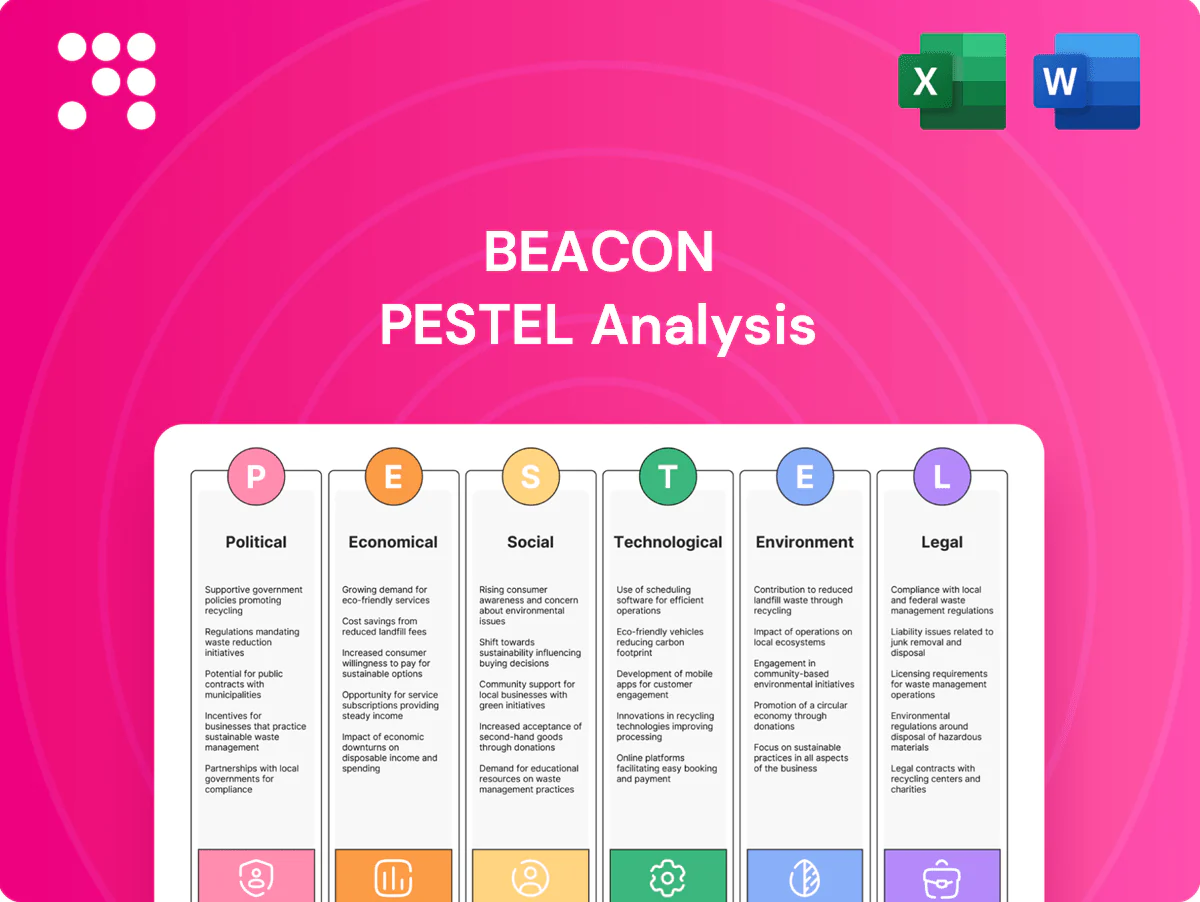
Beacon PESTLE Analysis

Your Shortcut to Market Insight Starts Here
Discover how political shifts, economic trends, and technological change are shaping Beacon’s strategic outlook with our focused PESTLE Analysis. This concise, actionable brief highlights risks and opportunities investors and strategists need now. Purchase the full report for a complete, editable deep dive you can use immediately.
Political factors

Infrastructure and housing policy tailwinds
Federal infrastructure spending such as the Bipartisan Infrastructure Law's $1.2 trillion package and the Inflation Reduction Act's $369 billion for climate and resilience can lift demand for roofing and related materials. Federal and state grants, tax credits, and resilience programs accelerate reroofing and retrofit cycles. Localization of funds benefits Beacon's dense branch network, while shifts in budget priorities pose allocation risk across regions.
Trade policy and tariffs on materials
Tariffs such as the US Section 232 levies—25% on steel and 10% on aluminum—raise shingle and accessory costs by increasing raw-material input prices and triggering higher passthroughs for asphalt and chemical components subject to product-specific duties.
Canada remains the largest supplier of US wood products and insulation inputs within a bilateral goods and services trade relationship exceeding $700 billion, tying US-Canada dynamics directly to lumber and insulation availability.
Stable trade policy enables multi-quarter price planning and inventory hedging, whereas tariff volatility compresses distributor margins through sudden cost spikes and rollover inventory losses.
Beacon’s scale allows partial offset via diversified sourcing, volume-negotiated terms, and logistics efficiencies that can blunt but not eliminate tariff-driven cost shocks.

Disaster relief and FEMA-driven rebuilds
Government disaster declarations unlock FEMA funding that often reimburses roughly 75% of eligible rebuilding costs, accelerating contractor and distributor payments. Roofing demand spikes sharply after hurricanes, hail, and wildfires, favoring distributors that can mobilize quickly. Predictability of events is low, so broad geographic coverage increases chances to capture relief-driven projects, and strict compliance with FEMA procurement rules is essential to secure reimbursements.

Buy American and domestic content rules
Build America, Buy America (part of the $1.2 trillion infrastructure package, including $550 billion in new spending) enforces domestic preference on federally funded projects, reshaping supplier mix as contractors prioritize compliant lines. Distributors with certified domestic-content SKUs gain access to civic and infrastructure contracts, while mandatory bid-stage certifications increase verification and administrative workload. Tighter Buy American rules can limit SKUs and push procurement costs higher.
- Policy: Build America, Buy America — $550B new spending
- Impact: compliant distributors access federal projects
- Admin: mandatory domestic-content certifications at bid
- Risk: SKU constraints and upward pressure on costs
Labor and immigration policy impacts
Contractor labor availability is highly sensitive to visa and immigration enforcement; the US H-2B nonimmigrant cap of 66,000 creates recurring shortages for seasonal skilled trades. Tight labor markets in 2023–24 pushed project timelines out and accelerated demand for labor-saving systems as firms repriced installed costs amid rising wages. Wage policy shifts and localized prevailing-wage rules materially affect installed-cost economics and throughput stability.
- H-2B cap 66,000 — constrains seasonal skilled labor
- Wage growth increased installed-cost pressure in 2024
- Stable skilled-trades access supports steady project throughput
BIL, IRA and BABA drive reroofing demand; tariffs and H-2B cap squeeze costs
Federal programs (BIL $1.2T, IRA $369B, Build America Buy America $550B) and FEMA (≈75% reimbursement) boost reroofing demand and favor domestic-compliant SKUs; tariffs (steel 25%, aluminum 10%) and H-2B cap 66,000 raise input and labor costs. Trade with Canada >$700B ties lumber supply. Beacon’s scale mitigates but does not eliminate shocks.
| Policy | Figure | Impact |
|---|---|---|
| BIL / IRA | $1.2T / $369B | Higher infrastructure reroofing demand |
| BABA | $550B | Domestic-content procurement |
| Tariffs | Steel 25% / Al 10% | Input cost pressure |
| H-2B | 66,000 cap | Seasonal labor shortage |
| FEMA | ~75% reimbursement | Post-disaster demand spike |
What is included in the product
 Detailed Word Document
Explores how external macro-environmental factors uniquely affect the Beacon across six dimensions—Political, Economic, Social, Technological, Environmental, and Legal—each supported by relevant data and trends. Designed for executives and investors, the analysis delivers actionable, forward-looking insights and detailed sub-points ready for business plans, pitch decks, or scenario planning.

 Customizable Excel Spreadsheet
Beacon's PESTLE delivers a clean, visually segmented summary of external risks that’s editable for region or business line, easily dropped into presentations or shared across teams to speed planning and align stakeholders.
Economic factors

Interest rates and housing cycle sensitivity
Higher interest rates (30-year peak 7.79% in Oct 2023) have depressed new construction—US housing starts were about 1.38M in 2023—while reroofing and maintenance remain resilient as urgent replacements proceed. Mortgage lock-in reduces household mobility but often redirects spend into renovations. Multi-year maintenance cycles smooth demand relative to cyclical new builds, and rate cuts historically reaccelerate volumes across channels.
Commodity input and freight cost volatility
Asphalt, petrochemical and fiberglass input swings—asphalt binder up ~18% in 2024—feed directly into shingle pricing, raising variable costs. Diesel averaged about $3.90/gal in 2024 and freight tightness (Cass Freight Index +12% yoy) compressed delivered margins. Contractual pass-throughs and dynamic pricing have preserved spreads. Inventory discipline and hedging programs reduced input-price shocks in 2024–mid‑2025.

Construction labor scarcity and wage inflation
Tight construction labor—with roughly 430,000 open U.S. construction jobs in 2024—pushes installation costs up and biases demand toward lighter, faster-to-install systems. Contractors defer projects, increasing repair work relative to full replacement. Beacon can reduce contractor hours via jobsite services and prefabrication. Persistent wage growth (mid-single digits in 2024) could squeeze contractor margins.

Consolidation and scale economics
Consolidation enhances purchasing power and private-label potential, with private-label penetration in US grocery at about 18% in 2023 (NielsenIQ). Fixed-cost leverage across branches raises route density and shortens working-capital cycles, improving per-store economics. Integration risk persists in multi-banner networks while local market share dictates rebate tiers and vendor support.
- Purchasing power up; private-label ~18% (US, 2023)
- Fixed-cost leverage → better route density & working-capital turns
- Integration risk with multi-banner portfolios
- Local share determines rebate tiers & vendor commitment
Regional weather and seasonality effects
Regional weather drives quarterly volatility in volumes and service levels; NOAA recorded 28 separate billion-dollar U.S. weather/climate disasters in 2023 totaling about 76 billion dollars, underscoring disruption risks and restocking surges.
Diverse geography smooths exposure across storms, freeze-thaw cycles and construction seasons, while severe events cause short-term stockouts followed by high replenishment demand; forecasting and pre-positioning inventory are measurable economic differentiators.
- Quarterly volume swings: elevated after severe events
- 2023 NOAA: 28 billion-dollar disasters, ~$76B loss
- Pre-positioning reduces lead-time costs and stockouts
BIL, IRA and BABA drive reroofing demand; tariffs and H-2B cap squeeze costs
Higher rates (30y peak 7.79% Oct 2023) cut new builds—US starts ~1.38M (2023)—while reroofing stays resilient; mortgage lock‑in shifts spend to renovations. Input cost pressure (asphalt binder +18% 2024; diesel ~$3.90/gal 2024) and 430k open construction jobs (2024) raise install costs. Weather volatility (28 US billion‑dollar disasters, ~$76B loss in 2023) drives replenishment spikes.
| Metric | Value |
|---|---|
| 30y rate peak | 7.79% Oct 2023 |
| US housing starts | 1.38M (2023) |
| Asphalt binder | +18% (2024) |
| Construction openings | ~430k (2024) |
| Billion-$ disasters | 28; ~$76B (2023) |
Preview the Actual Deliverable
Beacon PESTLE Analysis
The preview shown here is the exact Beacon PESTLE Analysis document you’ll receive after purchase—fully formatted and ready to use. The layout, content, and structure visible are final, professionally structured, and contain no placeholders. After payment you’ll instantly download this identical file and can apply it immediately.

Product Information
Product Information
Shipping & Returns
Shipping & Returns
Description
Your Shortcut to Market Insight Starts Here
Discover how political shifts, economic trends, and technological change are shaping Beacon’s strategic outlook with our focused PESTLE Analysis. This concise, actionable brief highlights risks and opportunities investors and strategists need now. Purchase the full report for a complete, editable deep dive you can use immediately.
Political factors
Infrastructure and housing policy tailwinds
Federal infrastructure spending such as the Bipartisan Infrastructure Law's $1.2 trillion package and the Inflation Reduction Act's $369 billion for climate and resilience can lift demand for roofing and related materials. Federal and state grants, tax credits, and resilience programs accelerate reroofing and retrofit cycles. Localization of funds benefits Beacon's dense branch network, while shifts in budget priorities pose allocation risk across regions.
Trade policy and tariffs on materials
Tariffs such as the US Section 232 levies—25% on steel and 10% on aluminum—raise shingle and accessory costs by increasing raw-material input prices and triggering higher passthroughs for asphalt and chemical components subject to product-specific duties.
Canada remains the largest supplier of US wood products and insulation inputs within a bilateral goods and services trade relationship exceeding $700 billion, tying US-Canada dynamics directly to lumber and insulation availability.
Stable trade policy enables multi-quarter price planning and inventory hedging, whereas tariff volatility compresses distributor margins through sudden cost spikes and rollover inventory losses.
Beacon’s scale allows partial offset via diversified sourcing, volume-negotiated terms, and logistics efficiencies that can blunt but not eliminate tariff-driven cost shocks.
Disaster relief and FEMA-driven rebuilds
Government disaster declarations unlock FEMA funding that often reimburses roughly 75% of eligible rebuilding costs, accelerating contractor and distributor payments. Roofing demand spikes sharply after hurricanes, hail, and wildfires, favoring distributors that can mobilize quickly. Predictability of events is low, so broad geographic coverage increases chances to capture relief-driven projects, and strict compliance with FEMA procurement rules is essential to secure reimbursements.
Buy American and domestic content rules
Build America, Buy America (part of the $1.2 trillion infrastructure package, including $550 billion in new spending) enforces domestic preference on federally funded projects, reshaping supplier mix as contractors prioritize compliant lines. Distributors with certified domestic-content SKUs gain access to civic and infrastructure contracts, while mandatory bid-stage certifications increase verification and administrative workload. Tighter Buy American rules can limit SKUs and push procurement costs higher.
- Policy: Build America, Buy America — $550B new spending
- Impact: compliant distributors access federal projects
- Admin: mandatory domestic-content certifications at bid
- Risk: SKU constraints and upward pressure on costs
Labor and immigration policy impacts
Contractor labor availability is highly sensitive to visa and immigration enforcement; the US H-2B nonimmigrant cap of 66,000 creates recurring shortages for seasonal skilled trades. Tight labor markets in 2023–24 pushed project timelines out and accelerated demand for labor-saving systems as firms repriced installed costs amid rising wages. Wage policy shifts and localized prevailing-wage rules materially affect installed-cost economics and throughput stability.
- H-2B cap 66,000 — constrains seasonal skilled labor
- Wage growth increased installed-cost pressure in 2024
- Stable skilled-trades access supports steady project throughput
BIL, IRA and BABA drive reroofing demand; tariffs and H-2B cap squeeze costs
Federal programs (BIL $1.2T, IRA $369B, Build America Buy America $550B) and FEMA (≈75% reimbursement) boost reroofing demand and favor domestic-compliant SKUs; tariffs (steel 25%, aluminum 10%) and H-2B cap 66,000 raise input and labor costs. Trade with Canada >$700B ties lumber supply. Beacon’s scale mitigates but does not eliminate shocks.
| Policy | Figure | Impact |
|---|---|---|
| BIL / IRA | $1.2T / $369B | Higher infrastructure reroofing demand |
| BABA | $550B | Domestic-content procurement |
| Tariffs | Steel 25% / Al 10% | Input cost pressure |
| H-2B | 66,000 cap | Seasonal labor shortage |
| FEMA | ~75% reimbursement | Post-disaster demand spike |
What is included in the product
Detailed Word Document
Explores how external macro-environmental factors uniquely affect the Beacon across six dimensions—Political, Economic, Social, Technological, Environmental, and Legal—each supported by relevant data and trends. Designed for executives and investors, the analysis delivers actionable, forward-looking insights and detailed sub-points ready for business plans, pitch decks, or scenario planning.
Customizable Excel Spreadsheet
Beacon's PESTLE delivers a clean, visually segmented summary of external risks that’s editable for region or business line, easily dropped into presentations or shared across teams to speed planning and align stakeholders.
Economic factors
Interest rates and housing cycle sensitivity
Higher interest rates (30-year peak 7.79% in Oct 2023) have depressed new construction—US housing starts were about 1.38M in 2023—while reroofing and maintenance remain resilient as urgent replacements proceed. Mortgage lock-in reduces household mobility but often redirects spend into renovations. Multi-year maintenance cycles smooth demand relative to cyclical new builds, and rate cuts historically reaccelerate volumes across channels.
Commodity input and freight cost volatility
Asphalt, petrochemical and fiberglass input swings—asphalt binder up ~18% in 2024—feed directly into shingle pricing, raising variable costs. Diesel averaged about $3.90/gal in 2024 and freight tightness (Cass Freight Index +12% yoy) compressed delivered margins. Contractual pass-throughs and dynamic pricing have preserved spreads. Inventory discipline and hedging programs reduced input-price shocks in 2024–mid‑2025.
Construction labor scarcity and wage inflation
Tight construction labor—with roughly 430,000 open U.S. construction jobs in 2024—pushes installation costs up and biases demand toward lighter, faster-to-install systems. Contractors defer projects, increasing repair work relative to full replacement. Beacon can reduce contractor hours via jobsite services and prefabrication. Persistent wage growth (mid-single digits in 2024) could squeeze contractor margins.
Consolidation and scale economics
Consolidation enhances purchasing power and private-label potential, with private-label penetration in US grocery at about 18% in 2023 (NielsenIQ). Fixed-cost leverage across branches raises route density and shortens working-capital cycles, improving per-store economics. Integration risk persists in multi-banner networks while local market share dictates rebate tiers and vendor support.
- Purchasing power up; private-label ~18% (US, 2023)
- Fixed-cost leverage → better route density & working-capital turns
- Integration risk with multi-banner portfolios
- Local share determines rebate tiers & vendor commitment
Regional weather and seasonality effects
Regional weather drives quarterly volatility in volumes and service levels; NOAA recorded 28 separate billion-dollar U.S. weather/climate disasters in 2023 totaling about 76 billion dollars, underscoring disruption risks and restocking surges.
Diverse geography smooths exposure across storms, freeze-thaw cycles and construction seasons, while severe events cause short-term stockouts followed by high replenishment demand; forecasting and pre-positioning inventory are measurable economic differentiators.
- Quarterly volume swings: elevated after severe events
- 2023 NOAA: 28 billion-dollar disasters, ~$76B loss
- Pre-positioning reduces lead-time costs and stockouts
BIL, IRA and BABA drive reroofing demand; tariffs and H-2B cap squeeze costs
Higher rates (30y peak 7.79% Oct 2023) cut new builds—US starts ~1.38M (2023)—while reroofing stays resilient; mortgage lock‑in shifts spend to renovations. Input cost pressure (asphalt binder +18% 2024; diesel ~$3.90/gal 2024) and 430k open construction jobs (2024) raise install costs. Weather volatility (28 US billion‑dollar disasters, ~$76B loss in 2023) drives replenishment spikes.
| Metric | Value |
|---|---|
| 30y rate peak | 7.79% Oct 2023 |
| US housing starts | 1.38M (2023) |
| Asphalt binder | +18% (2024) |
| Construction openings | ~430k (2024) |
| Billion-$ disasters | 28; ~$76B (2023) |
Preview the Actual Deliverable
Beacon PESTLE Analysis
The preview shown here is the exact Beacon PESTLE Analysis document you’ll receive after purchase—fully formatted and ready to use. The layout, content, and structure visible are final, professionally structured, and contain no placeholders. After payment you’ll instantly download this identical file and can apply it immediately.











