Beazley PESTLE Analysis

Make Smarter Strategic Decisions with a Complete PESTEL View
Discover how political, economic, social, technological, legal and environmental forces are reshaping Beazley's risk profile and growth prospects. This concise PESTLE highlights key external threats and opportunities for investors and strategists. Purchase the full analysis to access detailed, actionable intelligence and ready-to-use insights.
Political factors

Geopolitical instability and conflict exposures
Armed conflicts and geopolitical tensions are driving higher political risk, war and terrorism claims across Beazley’s specialty lines, while sudden sanctions and trade embargoes can instantly alter coverage terms and accumulation profiles. Beazley must dynamically tighten underwriting appetite, repricing and wordings, and deploy proactive scenario planning and aggregation controls to preserve capital and limit tail losses.
Sanctions regimes and compliance complexity
Frequent updates to US, UK and EU sanctions—occurring dozens of times annually—reshape placement, claims handling and broker/client selection, forcing insurers to re-evaluate exposures in real time. Screening accuracy and near-real-time speed determine deal flow and penalties risk. Lloyd’s syndicates must align with market-wide controls, and centralized sanctions governance reduces frictions while safeguarding market access.

Government cyber policy and critical infrastructure
National directives such as GDPR 72-hour breach notification and NIS2 (transposition by Oct 2024) are driving demand for cyber cover and services, with NIS2 estimated to cover roughly 160,000 EU entities. Proposed public-private backstops for systemic cyber risk could shift tail exposures away from insurers. Beazley must design products that address attribution, warlike acts and state-sponsored events and engage policymakers to shape viable market frameworks.

Trade relations, market access, and licensing
Shifts in trade policy and cross-border licensing reshape Beazley’s global distribution via Lloyd’s platforms, which operate in over 200 territories (2024). Local placement rules and fronting requirements increase compliance complexity and can raise operating costs and time to market. Targeted partnerships preserve market access in restrictive jurisdictions, while regulatory diplomacy supports selective growth in emerging markets.
- Trade shifts: Lloyd’s in 200+ territories (2024)
- Compliance: local placement/fronting adds complexity
- Strategy: targeted partnerships to retain reach
- Growth: regulatory diplomacy for emerging markets
Public policy on resilience and disaster funding
Public catastrophe schemes and resilience incentives reshape property and specialty pricing; national programs such as the US Infrastructure Investment and Jobs Act (1.2 trillion USD) shift risk baselines for flood, quake and wildfire and influence underwriting assumptions at Beazley. Policy carrots and sticks—subsidies for retrofits or higher post-event deductibles—can materially change client behavior and reduce loss frequency, so aligning products with public resilience agendas differentiates Beazley.
- Government schemes affect pricing and capacity
- Infrastructure spending alters hazard exposure
- Incentives change client mitigation and claims frequency
- Product alignment with public resilience is a competitive differentiator
Geopolitical shocks, sanctions and NIS2 boost cyber demand while insurers tighten capacity
Armed conflicts, frequent sanctions (dozens annually) and geopolitical risk are increasing war/terror and contingent claims, forcing Beazley to tighten appetite, repricing and aggregation controls. NIS2 (~160,000 EU entities) and GDPR drive cyber demand; public backstops could shift tail risk. Lloyd’s in 200+ territories (2024) raises fronting/compliance costs; US IIJA $1.2trn alters hazard baselines.
| Metric | 2024/25 | Implication |
|---|---|---|
| Sanctions updates | Dozens/yr | Realtime screening |
| NIS2 scope | ~160,000 entities | Cyber demand up |
| Lloyd’s reach | 200+ territories | Compliance costs |
What is included in the product
 Detailed Word Document
Explores how external macro-environmental factors uniquely affect Beazley across Political, Economic, Social, Technological, Environmental and Legal dimensions, with data-backed trends and forward-looking insights to support executives, investors and strategists in identifying risks, opportunities and actionable scenarios; delivered in clean, report-ready format.

 Customizable Excel Spreadsheet
A concise, visually segmented Beazley PESTLE summary that’s easily dropped into presentations and shared across teams, with editable notes for region or business-line specifics—ideal for supporting external risk discussions and quick decision alignment.
Economic factors

Interest rates and investment income
Higher yields—Bank of England base rate 5.25% and 10-year UK gilt near 4.0% in mid-2025—have lifted investment returns and lowered the cost of holding reserves for insurers. Duration management remains key as IFRS 17 amplifies earnings volatility when rates shift. Rate cycles reshape competitive dynamics and capital allocation, and Beazley’s disciplined asset-liability matching supports capital resilience in this environment.
Insurance pricing cycle and capacity
Hard/soft market cycles drive premium adequacy across Beazley’s specialty lines, with 2024 renewals showing mid-teens reinsurance price increases in many segments that bolstered top-line growth. Reinsurance capacity and pricing compress net retentions and margin; Aon/SEC reports noted reinsurance tightening in 2023–24. ILS capital (~$40bn in 2024) and traditional capital flows altered competitiveness, and cycle-aware underwriting helped protect combined ratios through turns.

Inflation and social inflation pressures
Inflation and rising claims costs are elevating loss ratios for Beazley, especially across liability lines, as social inflation—larger jury awards, growth in litigation finance and extended discovery—drives claim severity. Policy indexation and updated wordings must track shifting cost bases to preserve coverage adequacy. Rigorous reserving and continued rate momentum remain necessary to absorb higher severity and protect underwriting margins.

FX volatility across USD/GBP/EUR
FX volatility across USD/GBP/EUR raises translation and transaction risk for Beazley as multi-currency premiums, losses and expense flows drive earnings swings; IMF COFER (Q1 2025) shows USD remains dominant (around 59% of reserves) versus EUR and GBP, which can skew reported results in USD-heavy specialty lines. Hedging policies and natural portfolio offsets materially mitigate quarter-to-quarter volatility, and transparent FX governance supports earnings quality and investor confidence.
- Multi-currency exposures create translation/transaction risk
- USD dominance can skew USD-reported results
- Hedging and natural offsets reduce volatility
- Clear FX governance preserves earnings quality
Global growth and sectoral exposure mix
Geopolitical shocks, sanctions and NIS2 boost cyber demand while insurers tighten capacity
Higher yields (BoE 5.25%; UK 10y ~4.0% mid‑2025) boost investment income but demand active duration/IFRS 17 management. Reinsurance tightening and ~40bn ILS (2024) reshape retentions; disciplined underwriting preserves margins. Inflation, social inflation and FX (USD ~59% of reserves Q1 2025) elevate claims and translation risk, requiring hedging and strong reserving.
| Metric | Value |
|---|---|
| BoE base rate | 5.25% |
| UK 10y gilt | ~4.0% |
| ILS capital (2024) | ~$40bn |
| USD share (Q1 2025) | ~59% |
| IMF GDP growth | 3.0% (2024), 3.1% (2025) |
Same Document Delivered
Beazley PESTLE Analysis
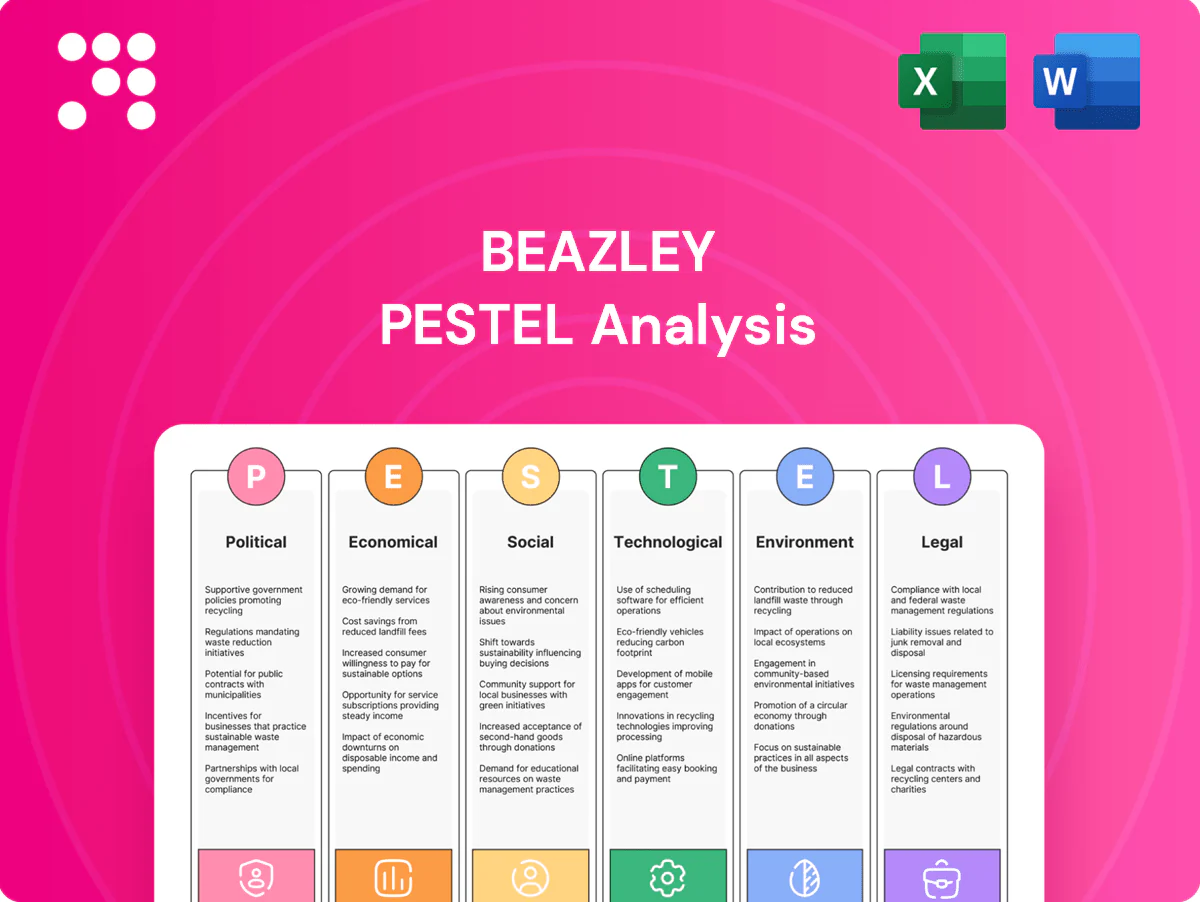
The preview shown here is the exact, fully formatted Beazley PESTLE Analysis you’ll receive after purchase—professionally structured and ready to use. The content, layout, and findings displayed are the final file you can download immediately after checkout. No placeholders, no teasers—this is the real, ready-to-use document, delivered exactly as shown.

Original: $10.00
-65%$10.00
$3.50Product Information
Product Information
Shipping & Returns
Shipping & Returns
Description
Make Smarter Strategic Decisions with a Complete PESTEL View
Discover how political, economic, social, technological, legal and environmental forces are reshaping Beazley's risk profile and growth prospects. This concise PESTLE highlights key external threats and opportunities for investors and strategists. Purchase the full analysis to access detailed, actionable intelligence and ready-to-use insights.
Political factors
Geopolitical instability and conflict exposures
Armed conflicts and geopolitical tensions are driving higher political risk, war and terrorism claims across Beazley’s specialty lines, while sudden sanctions and trade embargoes can instantly alter coverage terms and accumulation profiles. Beazley must dynamically tighten underwriting appetite, repricing and wordings, and deploy proactive scenario planning and aggregation controls to preserve capital and limit tail losses.
Sanctions regimes and compliance complexity
Frequent updates to US, UK and EU sanctions—occurring dozens of times annually—reshape placement, claims handling and broker/client selection, forcing insurers to re-evaluate exposures in real time. Screening accuracy and near-real-time speed determine deal flow and penalties risk. Lloyd’s syndicates must align with market-wide controls, and centralized sanctions governance reduces frictions while safeguarding market access.
Government cyber policy and critical infrastructure
National directives such as GDPR 72-hour breach notification and NIS2 (transposition by Oct 2024) are driving demand for cyber cover and services, with NIS2 estimated to cover roughly 160,000 EU entities. Proposed public-private backstops for systemic cyber risk could shift tail exposures away from insurers. Beazley must design products that address attribution, warlike acts and state-sponsored events and engage policymakers to shape viable market frameworks.
Trade relations, market access, and licensing
Shifts in trade policy and cross-border licensing reshape Beazley’s global distribution via Lloyd’s platforms, which operate in over 200 territories (2024). Local placement rules and fronting requirements increase compliance complexity and can raise operating costs and time to market. Targeted partnerships preserve market access in restrictive jurisdictions, while regulatory diplomacy supports selective growth in emerging markets.
- Trade shifts: Lloyd’s in 200+ territories (2024)
- Compliance: local placement/fronting adds complexity
- Strategy: targeted partnerships to retain reach
- Growth: regulatory diplomacy for emerging markets
Public policy on resilience and disaster funding
Public catastrophe schemes and resilience incentives reshape property and specialty pricing; national programs such as the US Infrastructure Investment and Jobs Act (1.2 trillion USD) shift risk baselines for flood, quake and wildfire and influence underwriting assumptions at Beazley. Policy carrots and sticks—subsidies for retrofits or higher post-event deductibles—can materially change client behavior and reduce loss frequency, so aligning products with public resilience agendas differentiates Beazley.
- Government schemes affect pricing and capacity
- Infrastructure spending alters hazard exposure
- Incentives change client mitigation and claims frequency
- Product alignment with public resilience is a competitive differentiator
Geopolitical shocks, sanctions and NIS2 boost cyber demand while insurers tighten capacity
Armed conflicts, frequent sanctions (dozens annually) and geopolitical risk are increasing war/terror and contingent claims, forcing Beazley to tighten appetite, repricing and aggregation controls. NIS2 (~160,000 EU entities) and GDPR drive cyber demand; public backstops could shift tail risk. Lloyd’s in 200+ territories (2024) raises fronting/compliance costs; US IIJA $1.2trn alters hazard baselines.
| Metric | 2024/25 | Implication |
|---|---|---|
| Sanctions updates | Dozens/yr | Realtime screening |
| NIS2 scope | ~160,000 entities | Cyber demand up |
| Lloyd’s reach | 200+ territories | Compliance costs |
What is included in the product
Detailed Word Document
Explores how external macro-environmental factors uniquely affect Beazley across Political, Economic, Social, Technological, Environmental and Legal dimensions, with data-backed trends and forward-looking insights to support executives, investors and strategists in identifying risks, opportunities and actionable scenarios; delivered in clean, report-ready format.
Customizable Excel Spreadsheet
A concise, visually segmented Beazley PESTLE summary that’s easily dropped into presentations and shared across teams, with editable notes for region or business-line specifics—ideal for supporting external risk discussions and quick decision alignment.
Economic factors
Interest rates and investment income
Higher yields—Bank of England base rate 5.25% and 10-year UK gilt near 4.0% in mid-2025—have lifted investment returns and lowered the cost of holding reserves for insurers. Duration management remains key as IFRS 17 amplifies earnings volatility when rates shift. Rate cycles reshape competitive dynamics and capital allocation, and Beazley’s disciplined asset-liability matching supports capital resilience in this environment.
Insurance pricing cycle and capacity
Hard/soft market cycles drive premium adequacy across Beazley’s specialty lines, with 2024 renewals showing mid-teens reinsurance price increases in many segments that bolstered top-line growth. Reinsurance capacity and pricing compress net retentions and margin; Aon/SEC reports noted reinsurance tightening in 2023–24. ILS capital (~$40bn in 2024) and traditional capital flows altered competitiveness, and cycle-aware underwriting helped protect combined ratios through turns.
Inflation and social inflation pressures
Inflation and rising claims costs are elevating loss ratios for Beazley, especially across liability lines, as social inflation—larger jury awards, growth in litigation finance and extended discovery—drives claim severity. Policy indexation and updated wordings must track shifting cost bases to preserve coverage adequacy. Rigorous reserving and continued rate momentum remain necessary to absorb higher severity and protect underwriting margins.
FX volatility across USD/GBP/EUR
FX volatility across USD/GBP/EUR raises translation and transaction risk for Beazley as multi-currency premiums, losses and expense flows drive earnings swings; IMF COFER (Q1 2025) shows USD remains dominant (around 59% of reserves) versus EUR and GBP, which can skew reported results in USD-heavy specialty lines. Hedging policies and natural portfolio offsets materially mitigate quarter-to-quarter volatility, and transparent FX governance supports earnings quality and investor confidence.
- Multi-currency exposures create translation/transaction risk
- USD dominance can skew USD-reported results
- Hedging and natural offsets reduce volatility
- Clear FX governance preserves earnings quality
Global growth and sectoral exposure mix
Geopolitical shocks, sanctions and NIS2 boost cyber demand while insurers tighten capacity
Higher yields (BoE 5.25%; UK 10y ~4.0% mid‑2025) boost investment income but demand active duration/IFRS 17 management. Reinsurance tightening and ~40bn ILS (2024) reshape retentions; disciplined underwriting preserves margins. Inflation, social inflation and FX (USD ~59% of reserves Q1 2025) elevate claims and translation risk, requiring hedging and strong reserving.
| Metric | Value |
|---|---|
| BoE base rate | 5.25% |
| UK 10y gilt | ~4.0% |
| ILS capital (2024) | ~$40bn |
| USD share (Q1 2025) | ~59% |
| IMF GDP growth | 3.0% (2024), 3.1% (2025) |
Same Document Delivered
Beazley PESTLE Analysis
The preview shown here is the exact, fully formatted Beazley PESTLE Analysis you’ll receive after purchase—professionally structured and ready to use. The content, layout, and findings displayed are the final file you can download immediately after checkout. No placeholders, no teasers—this is the real, ready-to-use document, delivered exactly as shown.