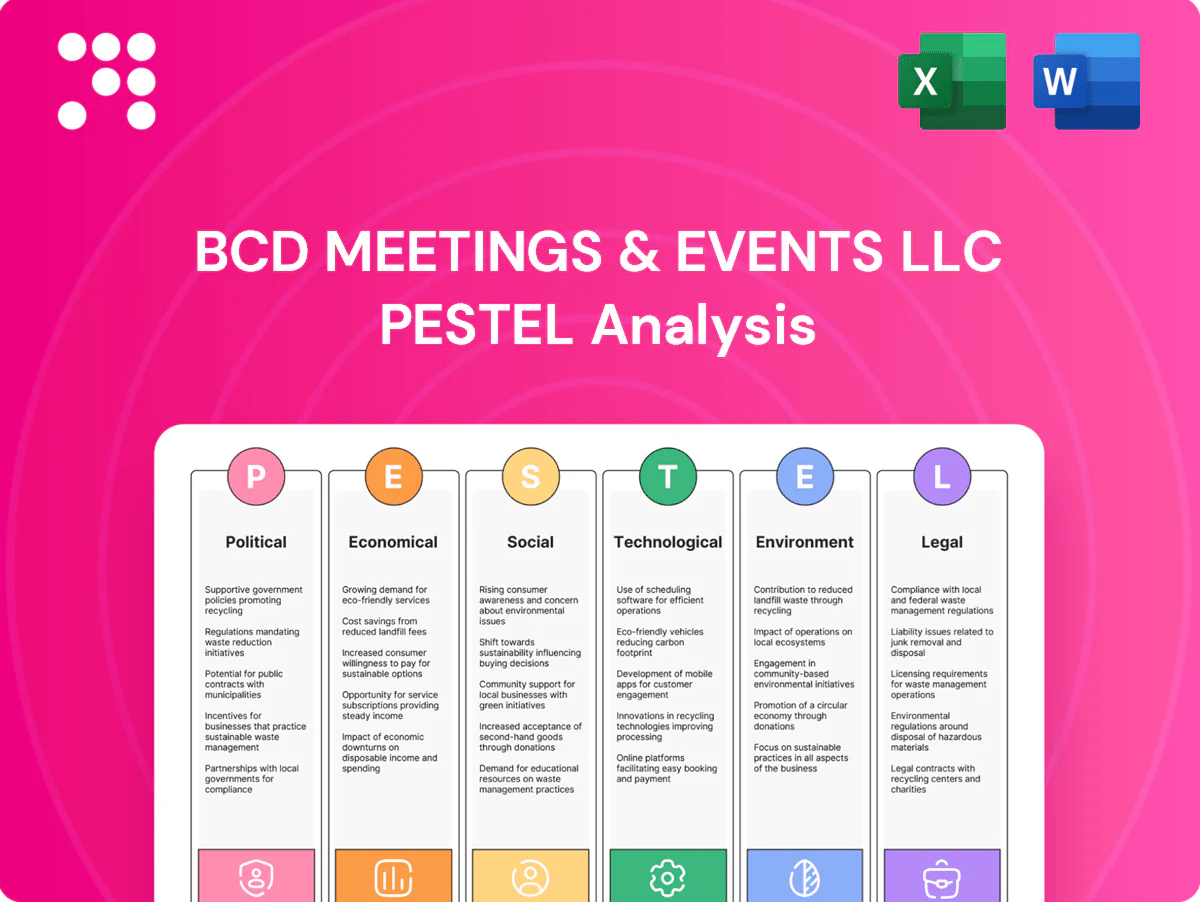
BCD Meetings & Events LLC PESTLE Analysis

Skip the Research. Get the Strategy.
Unlock strategic clarity with our targeted PESTLE Analysis of BCD Meetings & Events LLC — uncover how political shifts, economic cycles, social trends, technology, legal changes, and environmental pressures shape its outlook. Perfect for investors and planners, this concise briefing highlights risks and opportunities. Purchase the full report to access actionable, export-ready insights and strengthen your competitive strategy today.
Political factors

Cross-border travel and visa policies
Shifts in visa regimes and entry requirements directly affect attendee turnout and site feasibility; Henley Passport Index 2024 shows top passports access 193 destinations, highlighting uneven mobility that shapes sourcing and routing. BCD M&E must monitor country advisories and extend lead times—UNWTO reported 2023 arrivals reached about 85% of 2019, so preferred destinations can shift rapidly with diplomatic tensions. Proactive compliance and contingency planning preserve program objectives and budgets.
Geopolitical instability and security
Conflicts, protests and terrorism have elevated destination risk profiles, with global protest events rising ≈15% in 2024 and insurers raising event-cancellation premiums about 20% for high-risk venues. Clients demand robust risk assessments and alternative-venue guarantees; BCD M&E should leverage real-time intelligence and crisis communications and deepen security partnerships to strengthen duty-of-care.

Public sector procurement and budgets
Government spending cycles drive RFP volumes for conferences and training, with EU public procurement at about 14% of GDP (~€2 trillion/year) creating seasonal tender peaks. Compliance with procurement rules and local content requirements is often decisive for award. Transparent pricing and robust audit trails are critical to win tenders. BCD M&E can tailor procurement frameworks to meet agency-specific requirements.

Health policy and infectious disease response
Vaccination, testing and crowd policies vary across more than 190 WHO member states and can shift rapidly after WHO ended the COVID-19 global emergency in May 2023; BCD must switch between in-person, hybrid and virtual formats to maintain continuity. Clear, published health protocols increase sponsor and attendee confidence, while standardized health playbooks cut duplicative planning across markets.
- jurisdictional variance: >190 WHO member states
- formats: in-person / hybrid / virtual
- trust: clear protocols reassure sponsors
- efficiency: standardized playbooks reduce rework
Data localization and digital sovereignty
Some jurisdictions mandate in-country storage for attendee and engagement data, notably the EU (27 states) under GDPR transfer rules, China (Data Security Law, PIPL) and evolving Indian requirements, constraining platform choice and hosting architecture. BCD Meetings & Events must deploy regional data hubs and contract compliant vendors to avoid service disruptions and pass corporate security assessments. Transparent data flows and auditable residency controls expedite client security approvals.
- Regional hubs: EU, China, India
- Vendor compliance: PIPL, DSA/GDPR
- Auditability: residency + transfer logs
Visa shifts and 85% travel recovery raise sourcing lead times; protests +15% lift costs +20%
Shifts in visa regimes (Henley Passport Index 2024: top passports access 193 destinations) and travel recovery (UNWTO 2023 arrivals ~85% of 2019) alter sourcing and lead times. Rising protests (~+15% in 2024) and higher insurer premiums (~+20% for high-risk events) raise security costs. Public procurement (EU ≈14% GDP, ~€2tn/year) creates seasonal RFP spikes and compliance demands.
| Factor | Key metric | Impact |
|---|---|---|
| Mobility | Henley 2024: 193 | Routing, visas |
| Recovery | UNWTO 2023: 85% | Demand shifts |
| Risk | Protests +15% (2024) | Security costs +20% |
| Procurement | EU ~14% GDP (~€2tn) | RFP seasonality |
What is included in the product
 Detailed Word Document
Explores how Political, Economic, Social, Technological, Environmental, and Legal forces uniquely impact BCD Meetings & Events LLC, providing data-backed trends, forward-looking insights, and actionable implications to support executives, investors, and strategists.

 Customizable Excel Spreadsheet
Condenses BCD Meetings & Events LLC's full PESTLE into a clean, shareable summary—visually segmented by category—for quick reference in presentations, planning sessions, or client reports, with editable notes to tailor insights to your region or business unit.
Economic factors

Corporate budget cycles and GDP sensitivity
Event spend closely tracks macro growth: IMF projected global GDP growth of 3.1% in 2024, and GBTA estimated global business travel spend around 1.35 trillion USD in 2023, underscoring sensitivity to GDP and sector performance. In downturns programs often shift to smaller, regional, or virtual formats to cut costs. Upswings favor incentive travel and large conferences, boosting higher-margin offerings. BCD M&E can deploy tiered packages to preserve demand across cycles.
Currency fluctuations and pricing
Multicurrency exposure can shift venue, airfare and supplier costs by 3–10% annually, pressuring margins; using hedging and localized contracts has cut margin volatility by up to 60% for event firms. Clear FX pass‑through clauses reduce client disputes by ~30%, while regular rate benchmarking against 5 regional peers preserves competitiveness and win rates.

Inflation in venues, labor, and airfare
Venue, labor and airfare inflation—with U.S. CPI averaging ~3.4% in 2024 and industry wage growth near 4–5%—is squeezing event ROI and forcing higher attendee fees; early contracting and volume deals have yielded discounts up to 10–15%, while menu engineering and production optimization cut overruns 5–12%; BCD M&E can deploy cost-to-impact modeling to shield outcomes and prioritize high-ROI elements.

Industry consolidation and partner ecosystem
Hotel chains continue to consolidate—Marriott operates over 8,000 properties globally (2024), while the top four US airlines now account for roughly 80% of domestic capacity, shifting negotiation leverage and constraining availability for large RFPs. Strategic alliances and preferred-partner deals unlock blocked inventory and negotiated rates, but reliance on few partners raises exposure; diversified supplier panels reduce concentration and improve resilience.
- hotel-chains: Marriott 8,000+ properties (2024)
- airline-concentration: top-4 ≈80% domestic capacity
- alliances: preferred inventory + rate access
- mitigation: diversify supplier panels
Growth in emerging markets
Asia, Middle East and Africa are expanding MICE infrastructure with APAC representing roughly 45% of global events capacity in 2024; GCC nations committed over $20bn to events and hospitality projects from 2021–2024 and Africa venue inventory rose ~9% YoY in 2024. Local compliance and cultural fluency are essential to scale, while clients demand global standards with local execution.
- Regional delivery hubs: build talent pools regionally
- Compliance: local licensing and visa facilitation
- Standards: global SOPs + localized service
Visa shifts and 85% travel recovery raise sourcing lead times; protests +15% lift costs +20%
Event spend tracks GDP (IMF 2024 growth 3.1%; GBTA business travel ~1.35T USD 2023) making demand cyclical; FX moves (3–10%) and U.S. CPI ~3.4% (2024) squeeze margins, while venue consolidation (Marriott 8,000+ properties) and top‑4 airlines ~80% US capacity shift leverage; APAC ~45% events capacity and GCC $20bn projects 2021–24 expand supply.
| Metric | Value |
|---|---|
| Global GDP (2024) | 3.1% (IMF) |
| Business travel spend | ~1.35T USD (2023) |
| FX volatility | 3–10% |
| US CPI (2024) | ~3.4% |
| Marriott properties | 8,000+ |
| Top‑4 airlines US | ~80% capacity |
| APAC events capacity | ~45% |
| GCC events/hospitality spend | $20bn (2021–24) |
What You See Is What You Get
BCD Meetings & Events LLC PESTLE Analysis
The preview shown here is the exact BCD Meetings & Events LLC PESTLE Analysis you’ll receive after purchase—fully formatted and ready to use. The layout, content, and structure visible are identical to the downloadable file. No placeholders or teasers—this is the final, professionally structured document.

Product Information
Product Information
Shipping & Returns
Shipping & Returns
Description
Skip the Research. Get the Strategy.
Unlock strategic clarity with our targeted PESTLE Analysis of BCD Meetings & Events LLC — uncover how political shifts, economic cycles, social trends, technology, legal changes, and environmental pressures shape its outlook. Perfect for investors and planners, this concise briefing highlights risks and opportunities. Purchase the full report to access actionable, export-ready insights and strengthen your competitive strategy today.
Political factors
Cross-border travel and visa policies
Shifts in visa regimes and entry requirements directly affect attendee turnout and site feasibility; Henley Passport Index 2024 shows top passports access 193 destinations, highlighting uneven mobility that shapes sourcing and routing. BCD M&E must monitor country advisories and extend lead times—UNWTO reported 2023 arrivals reached about 85% of 2019, so preferred destinations can shift rapidly with diplomatic tensions. Proactive compliance and contingency planning preserve program objectives and budgets.
Geopolitical instability and security
Conflicts, protests and terrorism have elevated destination risk profiles, with global protest events rising ≈15% in 2024 and insurers raising event-cancellation premiums about 20% for high-risk venues. Clients demand robust risk assessments and alternative-venue guarantees; BCD M&E should leverage real-time intelligence and crisis communications and deepen security partnerships to strengthen duty-of-care.
Public sector procurement and budgets
Government spending cycles drive RFP volumes for conferences and training, with EU public procurement at about 14% of GDP (~€2 trillion/year) creating seasonal tender peaks. Compliance with procurement rules and local content requirements is often decisive for award. Transparent pricing and robust audit trails are critical to win tenders. BCD M&E can tailor procurement frameworks to meet agency-specific requirements.
Health policy and infectious disease response
Vaccination, testing and crowd policies vary across more than 190 WHO member states and can shift rapidly after WHO ended the COVID-19 global emergency in May 2023; BCD must switch between in-person, hybrid and virtual formats to maintain continuity. Clear, published health protocols increase sponsor and attendee confidence, while standardized health playbooks cut duplicative planning across markets.
- jurisdictional variance: >190 WHO member states
- formats: in-person / hybrid / virtual
- trust: clear protocols reassure sponsors
- efficiency: standardized playbooks reduce rework
Data localization and digital sovereignty
Some jurisdictions mandate in-country storage for attendee and engagement data, notably the EU (27 states) under GDPR transfer rules, China (Data Security Law, PIPL) and evolving Indian requirements, constraining platform choice and hosting architecture. BCD Meetings & Events must deploy regional data hubs and contract compliant vendors to avoid service disruptions and pass corporate security assessments. Transparent data flows and auditable residency controls expedite client security approvals.
- Regional hubs: EU, China, India
- Vendor compliance: PIPL, DSA/GDPR
- Auditability: residency + transfer logs
Visa shifts and 85% travel recovery raise sourcing lead times; protests +15% lift costs +20%
Shifts in visa regimes (Henley Passport Index 2024: top passports access 193 destinations) and travel recovery (UNWTO 2023 arrivals ~85% of 2019) alter sourcing and lead times. Rising protests (~+15% in 2024) and higher insurer premiums (~+20% for high-risk events) raise security costs. Public procurement (EU ≈14% GDP, ~€2tn/year) creates seasonal RFP spikes and compliance demands.
| Factor | Key metric | Impact |
|---|---|---|
| Mobility | Henley 2024: 193 | Routing, visas |
| Recovery | UNWTO 2023: 85% | Demand shifts |
| Risk | Protests +15% (2024) | Security costs +20% |
| Procurement | EU ~14% GDP (~€2tn) | RFP seasonality |
What is included in the product
Detailed Word Document
Explores how Political, Economic, Social, Technological, Environmental, and Legal forces uniquely impact BCD Meetings & Events LLC, providing data-backed trends, forward-looking insights, and actionable implications to support executives, investors, and strategists.
Customizable Excel Spreadsheet
Condenses BCD Meetings & Events LLC's full PESTLE into a clean, shareable summary—visually segmented by category—for quick reference in presentations, planning sessions, or client reports, with editable notes to tailor insights to your region or business unit.
Economic factors
Corporate budget cycles and GDP sensitivity
Event spend closely tracks macro growth: IMF projected global GDP growth of 3.1% in 2024, and GBTA estimated global business travel spend around 1.35 trillion USD in 2023, underscoring sensitivity to GDP and sector performance. In downturns programs often shift to smaller, regional, or virtual formats to cut costs. Upswings favor incentive travel and large conferences, boosting higher-margin offerings. BCD M&E can deploy tiered packages to preserve demand across cycles.
Currency fluctuations and pricing
Multicurrency exposure can shift venue, airfare and supplier costs by 3–10% annually, pressuring margins; using hedging and localized contracts has cut margin volatility by up to 60% for event firms. Clear FX pass‑through clauses reduce client disputes by ~30%, while regular rate benchmarking against 5 regional peers preserves competitiveness and win rates.
Inflation in venues, labor, and airfare
Venue, labor and airfare inflation—with U.S. CPI averaging ~3.4% in 2024 and industry wage growth near 4–5%—is squeezing event ROI and forcing higher attendee fees; early contracting and volume deals have yielded discounts up to 10–15%, while menu engineering and production optimization cut overruns 5–12%; BCD M&E can deploy cost-to-impact modeling to shield outcomes and prioritize high-ROI elements.
Industry consolidation and partner ecosystem
Hotel chains continue to consolidate—Marriott operates over 8,000 properties globally (2024), while the top four US airlines now account for roughly 80% of domestic capacity, shifting negotiation leverage and constraining availability for large RFPs. Strategic alliances and preferred-partner deals unlock blocked inventory and negotiated rates, but reliance on few partners raises exposure; diversified supplier panels reduce concentration and improve resilience.
- hotel-chains: Marriott 8,000+ properties (2024)
- airline-concentration: top-4 ≈80% domestic capacity
- alliances: preferred inventory + rate access
- mitigation: diversify supplier panels
Growth in emerging markets
Asia, Middle East and Africa are expanding MICE infrastructure with APAC representing roughly 45% of global events capacity in 2024; GCC nations committed over $20bn to events and hospitality projects from 2021–2024 and Africa venue inventory rose ~9% YoY in 2024. Local compliance and cultural fluency are essential to scale, while clients demand global standards with local execution.
- Regional delivery hubs: build talent pools regionally
- Compliance: local licensing and visa facilitation
- Standards: global SOPs + localized service
Visa shifts and 85% travel recovery raise sourcing lead times; protests +15% lift costs +20%
Event spend tracks GDP (IMF 2024 growth 3.1%; GBTA business travel ~1.35T USD 2023) making demand cyclical; FX moves (3–10%) and U.S. CPI ~3.4% (2024) squeeze margins, while venue consolidation (Marriott 8,000+ properties) and top‑4 airlines ~80% US capacity shift leverage; APAC ~45% events capacity and GCC $20bn projects 2021–24 expand supply.
| Metric | Value |
|---|---|
| Global GDP (2024) | 3.1% (IMF) |
| Business travel spend | ~1.35T USD (2023) |
| FX volatility | 3–10% |
| US CPI (2024) | ~3.4% |
| Marriott properties | 8,000+ |
| Top‑4 airlines US | ~80% capacity |
| APAC events capacity | ~45% |
| GCC events/hospitality spend | $20bn (2021–24) |
What You See Is What You Get
BCD Meetings & Events LLC PESTLE Analysis
The preview shown here is the exact BCD Meetings & Events LLC PESTLE Analysis you’ll receive after purchase—fully formatted and ready to use. The layout, content, and structure visible are identical to the downloadable file. No placeholders or teasers—this is the final, professionally structured document.