Baxter International Business Model Canvas

Business Model Canvas: Scalable medical solutions and margin-focused strategy
Unlock a strategic blueprint of Baxter International with our Business Model Canvas that maps its value propositions, key partners, and revenue drivers. This concise analysis reveals how Baxter scales medical solutions and manages cost structure to sustain margins. Ideal for investors, consultants, and founders seeking actionable insights. Download the full, editable Canvas in Word and Excel to apply these lessons to your strategy.
Partnerships

Hospitals, IDNs & GPO alliances
Collaborations with hospitals, IDNs and GPOs drive volume via contracted pricing, underpinning Baxter’s FY2024 net sales of about $13.9 billion and ensuring formulary access across networks that represent over 80% of U.S. hospital purchasing. These partnerships standardize products and clinical protocols, with joint value analyses showing total-cost-of-care improvements often in the mid-single-digit to low-double-digit percentage range. Long-term agreements (commonly 3–7 years) secure predictable demand and margin visibility.
Dialysis providers & home-care networks
Partnerships with dialysis chains and home-care agencies extend Baxter’s therapy reach into clinics and patients’ homes, supporting ~3.6 million people worldwide on dialysis. Joint programs drive home dialysis adoption—about 10–12% of dialysis in high-income markets in 2024—by delivering training and remote monitoring. Coordinated logistics secure timely delivery of consumables and equipment. Shared data from partners improves adherence and clinical outcomes.

Suppliers & contract manufacturers
Strategic suppliers provide resins, APIs, plastics and sterile components that feed Baxter’s device and infusion portfolios, supporting operations in more than 100 countries and about 50 manufacturing sites worldwide in 2024. Contract manufacturers add scalable capacity and redundancy, enabling faster surge production and geographic risk mitigation. Binding quality agreements and regular GMP audits enforce compliance, while dual-sourcing across critical product lines reduces single-source disruption risk.

Research institutions & clinicians
Research institutions and clinicians support Baxter-led trials, post-market studies, and evidence generation, with Baxter operating in over 100 countries to scale clinical validation. Co-development with academic and clinical partners validates safety, efficacy, and usability while real-world data from these collaborations informs product improvements and label expansions. Engagement with key opinion leaders accelerates clinical adoption and guideline inclusion.
- Supports trials & post-market studies
- Co-development validates safety and usability
- Real-world data informs improvements and indications
- KOLs accelerate adoption
Regulators & reimbursement stakeholders
Ongoing engagement with FDA, EMA and other agencies secures regulatory approvals and compliance, supporting Baxter's operations in 100+ countries and over 50,000 employees (2024). Payers and HTA bodies shape value dossiers and coverage decisions, while coding, billing and reimbursement alignment enables market access. Policy collaboration advances standards of care and adoption.
- Regulatory approvals: FDA, EMA engagement
- Payer/HTA input: value dossiers & coverage
- Coding & billing: reimbursement alignment
- Policy collaboration: standards of care
Hospital contracts drive $13.9B sales and >80% U.S. coverage
Key partnerships with hospitals/IDNs/GPOs drive contracted access supporting FY2024 net sales ~$13.9B and cover >80% of U.S. hospital purchasing. Dialysis chains/home-care extend reach to ~3.6M dialysis patients globally and boost home dialysis to ~10–12% in high-income markets (2024). Suppliers and CMOs support 50+ manufacturing sites across 100+ countries with dual-sourcing and GMP audits.
| Metric | 2024/Scope |
|---|---|
| Net sales | $13.9B |
| U.S. hospital coverage | >80% |
| Dialysis patients served | ~3.6M |
| Manufacturing sites | 50+ |
| Operating countries | 100+ |
What is included in the product
 Detailed Word Document
A comprehensive Business Model Canvas for Baxter International detailing customer segments, channels, value propositions, revenue streams, key resources, partners, activities, cost structure and customer relationships with narrative and insights. Ideal for presentations, investor discussions and decision-making, it links competitive advantages and SWOT elements to real-world operations.

 Customizable Excel Spreadsheet
High-level view of Baxter International’s business model with editable cells to quickly map product lines, care settings, and regulatory risks for faster decision-making.
Activities

R&D and clinical development
Designing infusion systems, IV solutions and renal therapies to clinical specs, Baxter sustained R&D operations in 2024 with annual R&D investment exceeding $500 million; teams run preclinical studies, clinical trials and human factors testing to validate usability. Design controls, ISO 13485-aligned risk management and post-market surveillance feed iterative product updates driven by clinical evidence and user feedback.
Sterile manufacturing & quality
Operating aseptic filling, sterilization, and device assembly at scale across Baxter’s global network of over 30 manufacturing sites supports supply for critical therapies; the company employed roughly 50,000 people in 2024. Maintaining GMP, ISO, and robust quality systems with rigorous testing yields high compliance and lot-release controls. Validation, lot release, and end-to-end traceability are managed digitally to meet regulatory demands. Continuous improvement programs reduced defects and process variance year-over-year.

Regulatory & safety compliance
Baxter prepares global regulatory submissions, technical files, and change controls to maintain market access across roughly 100 countries, aligning with regional authorities and standards. The company monitors vigilance, CAPA, and field actions to address safety signals, leveraging global quality systems across about 50,000 employees. Labeling, UDI implementation, and connected-device cybersecurity programs are maintained to meet FDA, EU MDR, and global requirements. Ongoing training programs support evolving standards alongside roughly $500 million annual R&D investment.

Global supply chain & logistics
Global supply chain and logistics secure redundant suppliers for raw materials and components to maintain Baxter’s operations; Baxter reported approximately $11.9 billion in revenue in 2024, emphasizing supply resilience. Production planning, inventory optimization and cold-chain distribution ensure product integrity across 600+ distribution hubs. Tenders, rolling forecasts and agreed delivery windows are coordinated with providers; crisis teams manage shortages and geopolitical disruptions.
- Redundancy: multi-sourcing
- Cold-chain: temperature-controlled networks
- Coordination: tenders & forecasts
- Crisis: shortage & geopolitical response
Clinical education & service
Infusion and renal therapy: >$500M R&D, 30+ sites, 600+ hubs, 99.2% uptime
Designing and validating infusion, renal and IV therapy systems with >$500M R&D (2024); iterative updates via clinical trials and user testing. Operating 30+ manufacturing sites and GMP lines to supply critical therapies; ~50,000 employees. Managing regulatory submissions across ~100 countries, global supply resilience and 600+ distribution hubs. Clinical education supporting 60,000 trainees, 99.2% device uptime.
| Metric | 2024 |
|---|---|
| Net sales | $13.2B |
| R&D spend | >$500M |
| Employees | ~50,000 |
| Manufacturing sites | 30+ |
| Distribution hubs | 600+ |
| Clinicians trained | 60,000 |
| Device uptime | 99.2% |
| Helpdesk contacts | 1.2M |
Full Version Awaits
Business Model Canvas
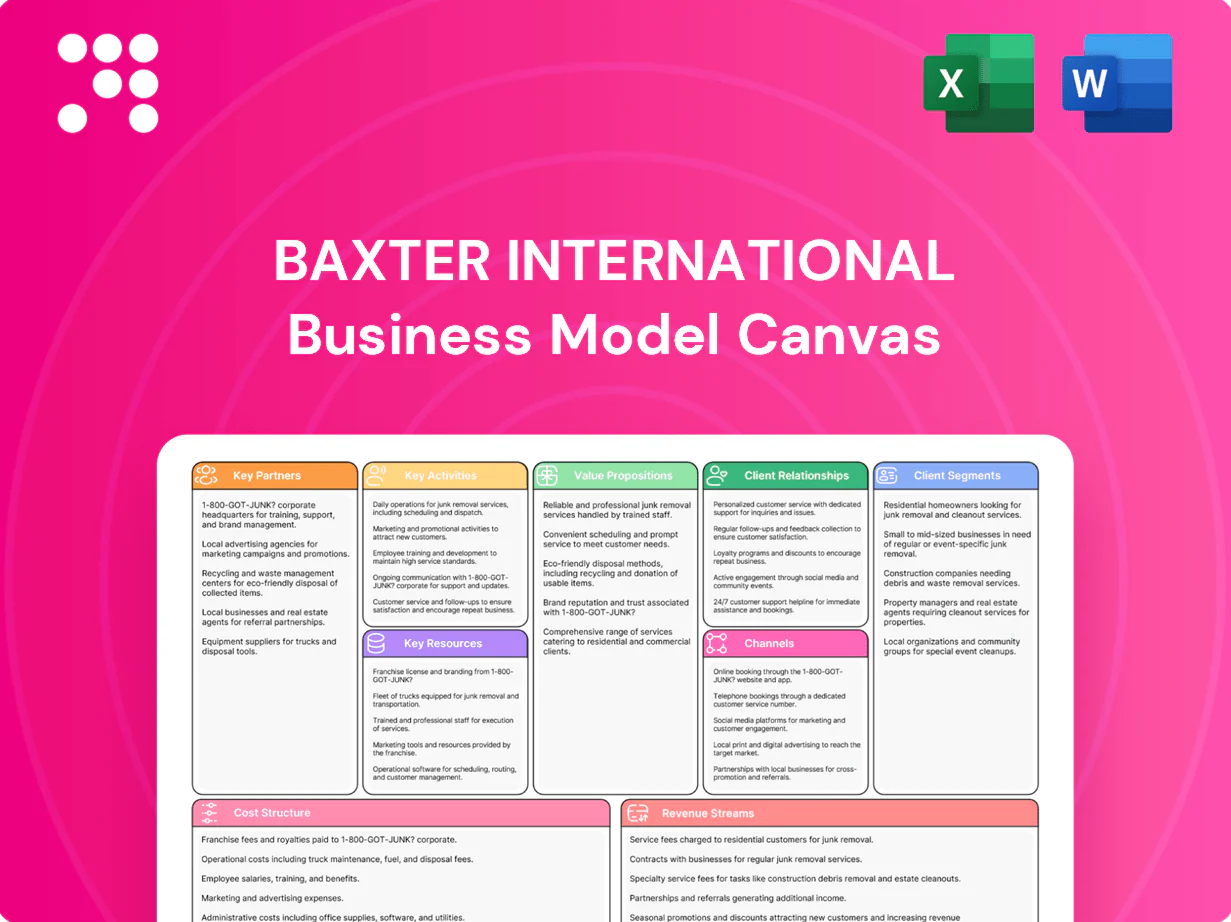
The document you're previewing is the actual Baxter International Business Model Canvas you will receive—no mockup or sample. When you purchase, you'll instantly download this same fully formatted, editable file in Word and Excel with all sections included. Use it immediately for analysis, presentation, or strategy development with no surprises.

Product Information
Product Information
Shipping & Returns
Shipping & Returns
Description
Business Model Canvas: Scalable medical solutions and margin-focused strategy
Unlock a strategic blueprint of Baxter International with our Business Model Canvas that maps its value propositions, key partners, and revenue drivers. This concise analysis reveals how Baxter scales medical solutions and manages cost structure to sustain margins. Ideal for investors, consultants, and founders seeking actionable insights. Download the full, editable Canvas in Word and Excel to apply these lessons to your strategy.
Partnerships
Hospitals, IDNs & GPO alliances
Collaborations with hospitals, IDNs and GPOs drive volume via contracted pricing, underpinning Baxter’s FY2024 net sales of about $13.9 billion and ensuring formulary access across networks that represent over 80% of U.S. hospital purchasing. These partnerships standardize products and clinical protocols, with joint value analyses showing total-cost-of-care improvements often in the mid-single-digit to low-double-digit percentage range. Long-term agreements (commonly 3–7 years) secure predictable demand and margin visibility.
Dialysis providers & home-care networks
Partnerships with dialysis chains and home-care agencies extend Baxter’s therapy reach into clinics and patients’ homes, supporting ~3.6 million people worldwide on dialysis. Joint programs drive home dialysis adoption—about 10–12% of dialysis in high-income markets in 2024—by delivering training and remote monitoring. Coordinated logistics secure timely delivery of consumables and equipment. Shared data from partners improves adherence and clinical outcomes.
Suppliers & contract manufacturers
Strategic suppliers provide resins, APIs, plastics and sterile components that feed Baxter’s device and infusion portfolios, supporting operations in more than 100 countries and about 50 manufacturing sites worldwide in 2024. Contract manufacturers add scalable capacity and redundancy, enabling faster surge production and geographic risk mitigation. Binding quality agreements and regular GMP audits enforce compliance, while dual-sourcing across critical product lines reduces single-source disruption risk.
Research institutions & clinicians
Research institutions and clinicians support Baxter-led trials, post-market studies, and evidence generation, with Baxter operating in over 100 countries to scale clinical validation. Co-development with academic and clinical partners validates safety, efficacy, and usability while real-world data from these collaborations informs product improvements and label expansions. Engagement with key opinion leaders accelerates clinical adoption and guideline inclusion.
- Supports trials & post-market studies
- Co-development validates safety and usability
- Real-world data informs improvements and indications
- KOLs accelerate adoption
Regulators & reimbursement stakeholders
Ongoing engagement with FDA, EMA and other agencies secures regulatory approvals and compliance, supporting Baxter's operations in 100+ countries and over 50,000 employees (2024). Payers and HTA bodies shape value dossiers and coverage decisions, while coding, billing and reimbursement alignment enables market access. Policy collaboration advances standards of care and adoption.
- Regulatory approvals: FDA, EMA engagement
- Payer/HTA input: value dossiers & coverage
- Coding & billing: reimbursement alignment
- Policy collaboration: standards of care
Hospital contracts drive $13.9B sales and >80% U.S. coverage
Key partnerships with hospitals/IDNs/GPOs drive contracted access supporting FY2024 net sales ~$13.9B and cover >80% of U.S. hospital purchasing. Dialysis chains/home-care extend reach to ~3.6M dialysis patients globally and boost home dialysis to ~10–12% in high-income markets (2024). Suppliers and CMOs support 50+ manufacturing sites across 100+ countries with dual-sourcing and GMP audits.
| Metric | 2024/Scope |
|---|---|
| Net sales | $13.9B |
| U.S. hospital coverage | >80% |
| Dialysis patients served | ~3.6M |
| Manufacturing sites | 50+ |
| Operating countries | 100+ |
What is included in the product
Detailed Word Document
A comprehensive Business Model Canvas for Baxter International detailing customer segments, channels, value propositions, revenue streams, key resources, partners, activities, cost structure and customer relationships with narrative and insights. Ideal for presentations, investor discussions and decision-making, it links competitive advantages and SWOT elements to real-world operations.
Customizable Excel Spreadsheet
High-level view of Baxter International’s business model with editable cells to quickly map product lines, care settings, and regulatory risks for faster decision-making.
Activities
R&D and clinical development
Designing infusion systems, IV solutions and renal therapies to clinical specs, Baxter sustained R&D operations in 2024 with annual R&D investment exceeding $500 million; teams run preclinical studies, clinical trials and human factors testing to validate usability. Design controls, ISO 13485-aligned risk management and post-market surveillance feed iterative product updates driven by clinical evidence and user feedback.
Sterile manufacturing & quality
Operating aseptic filling, sterilization, and device assembly at scale across Baxter’s global network of over 30 manufacturing sites supports supply for critical therapies; the company employed roughly 50,000 people in 2024. Maintaining GMP, ISO, and robust quality systems with rigorous testing yields high compliance and lot-release controls. Validation, lot release, and end-to-end traceability are managed digitally to meet regulatory demands. Continuous improvement programs reduced defects and process variance year-over-year.
Regulatory & safety compliance
Baxter prepares global regulatory submissions, technical files, and change controls to maintain market access across roughly 100 countries, aligning with regional authorities and standards. The company monitors vigilance, CAPA, and field actions to address safety signals, leveraging global quality systems across about 50,000 employees. Labeling, UDI implementation, and connected-device cybersecurity programs are maintained to meet FDA, EU MDR, and global requirements. Ongoing training programs support evolving standards alongside roughly $500 million annual R&D investment.
Global supply chain & logistics
Global supply chain and logistics secure redundant suppliers for raw materials and components to maintain Baxter’s operations; Baxter reported approximately $11.9 billion in revenue in 2024, emphasizing supply resilience. Production planning, inventory optimization and cold-chain distribution ensure product integrity across 600+ distribution hubs. Tenders, rolling forecasts and agreed delivery windows are coordinated with providers; crisis teams manage shortages and geopolitical disruptions.
- Redundancy: multi-sourcing
- Cold-chain: temperature-controlled networks
- Coordination: tenders & forecasts
- Crisis: shortage & geopolitical response
Clinical education & service
Infusion and renal therapy: >$500M R&D, 30+ sites, 600+ hubs, 99.2% uptime
Designing and validating infusion, renal and IV therapy systems with >$500M R&D (2024); iterative updates via clinical trials and user testing. Operating 30+ manufacturing sites and GMP lines to supply critical therapies; ~50,000 employees. Managing regulatory submissions across ~100 countries, global supply resilience and 600+ distribution hubs. Clinical education supporting 60,000 trainees, 99.2% device uptime.
| Metric | 2024 |
|---|---|
| Net sales | $13.2B |
| R&D spend | >$500M |
| Employees | ~50,000 |
| Manufacturing sites | 30+ |
| Distribution hubs | 600+ |
| Clinicians trained | 60,000 |
| Device uptime | 99.2% |
| Helpdesk contacts | 1.2M |
Full Version Awaits
Business Model Canvas
The document you're previewing is the actual Baxter International Business Model Canvas you will receive—no mockup or sample. When you purchase, you'll instantly download this same fully formatted, editable file in Word and Excel with all sections included. Use it immediately for analysis, presentation, or strategy development with no surprises.