Barito Pacific SWOT Analysis

Dive Deeper Into the Company’s Strategic Blueprint
Barito Pacific’s diversified energy and petrochemical footprint hides both scale advantages and exposure to commodity cycles—our SWOT teases key strengths, weaknesses, opportunities, and threats in context. Want the full strategic picture? Purchase the complete SWOT analysis for a research-backed, investor-ready Word report plus an editable Excel matrix to plan, present, and act with confidence.
Strengths

Diversified energy-petrochem portfolio
Barito Pacific combines geothermal and power via Supreme Energy (~1,000 MW installed) with petrochemicals through majority ownership of Chandra Asri (c.3.2 mtpa capacity), plus property assets, which reduces earnings volatility across cycles. Cross-segment synergies allow risk balancing and flexible capital allocation between upstream power and petrochemical cash flows. This mix enhances resilience to sector shocks and enables portfolio optimization aligned with macro and policy trends.
Market-leading subsidiaries
Chandra Asri, Indonesia’s largest integrated petrochemical producer, and Star Energy, a leading geothermal operator, give Barito Pacific scale advantages in procurement, plant utilization and pricing. Their strong brands and multi-decade track records smooth permitting and attract lower-cost financing. Market leadership enhances ecosystem influence and partnership optionality across upstream, midstream and project finance.

Energy transition positioning
Barito Pacifics geothermal assets align with Indonesia’s target of 23% renewable energy by 2025 and tap a national geothermal resource estimated at about 23 GW with roughly 2.3 GW installed capacity (2023), strengthening its decarbonization credentials. This boosts ESG metrics and improves access to green capital pools and sustainable financing. Long-dated PPAs provide anchored, predictable cash flows. The renewables mix supports regulator and community acceptance.

Integrated growth platform
Integrated growth platform enhances margins through vertical linkage across feedstock, cracking and downstream chains, enabling feedstock-to-product margin capture and reduced intersegment trading losses.
Industrial clustering and shared utilities lower unit costs via economies of scale and logistics synergies; coordinated capex and sequencing drive scale efficiencies across projects.
Integration raises barriers to entry by locking feedstock access, offtake and infrastructure.
- vertical-integration
- cost-synergies
- capex-efficiency
- entry-barriers
Local market knowledge
- Local expertise
- Stakeholder access
- Demand alignment
- Supply/talent network
Scale in power, petrochemicals and geothermal cuts unit costs and opens green financing
Barito Pacific combines ~1,000 MW power (Supreme Energy) and c.3.2 mtpa petrochemical capacity (Chandra Asri), diversifying cash flows and improving capex allocation. Geothermal assets support Indonesia 23% renewables target and tap ~23 GW resource (2.3 GW installed). Scale and vertical integration lower unit costs, raise entry barriers and unlock green financing.
| Strength | Metric | Value (latest) |
|---|---|---|
| Power capacity | Installed | ~1,000 MW |
| Petrochemical | Cracking capacity | ~3.2 mtpa |
| Geothermal | Resource / installed | ~23 GW / 2.3 GW |
| Market | Indonesia (2024) | Population 277M; GDP ≈ USD 1.4T |
What is included in the product
 Detailed Word Document
Provides a concise SWOT overview of Barito Pacific, highlighting its core strengths, operational weaknesses, market opportunities, and external threats that shape the company’s strategic direction.

 Customizable Excel Spreadsheet
Provides a concise Barito Pacific SWOT matrix for fast, visual strategy alignment, highlighting key strengths, weaknesses, opportunities and threats to streamline decision-making and mitigate operational risks.
Weaknesses

Commodity margin cyclicality
Petrochem earnings at Barito Pacific are highly sensitive to oil/naphtha spreads and global demand; with Brent averaging about $88/bbl in 2024, narrowing spreads in downcycles have compressed cracker margins and impaired returns. Margin volatility complicates production planning and pressures dividend stability. Hedging programs provide limited relief, often only partially offsetting spot-era swings.
Capital intensity and leverage
Large-scale plants and geothermal fields require heavy upfront capital expenditure, pushing Barito Pacific into capital-intensive projects that absorb cash and extend payback periods. Project overruns have historically strained the company’s balance sheet, increasing reported leverage and weakening key solvency ratios. Higher leverage elevates refinancing and interest-rate risks, particularly in volatile Indonesian markets. This capital structure also reduces financial flexibility during sector downturns and commodity price shocks.

Asset concentration
Barito Pacific’s results remain tied to a small set of flagship complexes, notably its 50.1% stake in Chandra Asri, so shutdowns or maintenance at core units can materially dent consolidated EBITDA. Concentration raises counterparty and offtake risk, as loss of a major customer or supplier would have outsized effects on cash flow. Geographic clustering in Indonesia increases the probability of correlated disruptions from weather, logistics or regulatory events.

Execution and permitting risk
Long lead times for geothermal drilling (12–36 months) and petrochemical expansions expose Barito Pacific to technical and permitting risk; Indonesian environmental and community approvals commonly add 9–18 months to schedules in 2024–25. Cost escalation of 15–30% can erode project IRR, while global supply-chain constraints have added ~6 months to equipment delivery.
- Lead times: 12–36 months
- Permitting delays: 9–18 months
- Cost escalation: 15–30%
- Supply delays: ~6 months
Currency and input exposure
Barito Pacific faces FX mismatches as a significant portion of revenues are USD-linked while operating costs and local contracts are predominantly in IDR, exposing margins to rupiah swings and global dollar strength. Reliance on imported feedstocks ties input costs to volatile commodity markets and shipping, amplifying cost pass-through risk. Limited domestic feedstock diversification concentrates exposure, and hedging programs—while used—add premium costs and do not fully eliminate short-term volatility.
- USD revenue vs IDR cost mismatch
- Imported feedstocks → commodity and freight volatility
- Low domestic feedstock diversification
- Hedging increases cost and is imperfect
Petrochem margins cyclic; Brent $88, capex, FX, 50.1%
Petrochem margins remain highly cyclical (Brent ~$88/bbl in 2024), compressing returns and dividend visibility. Heavy capex and past overruns raise leverage and refinancing risk, with long lead times and permitting delays increasing project risk. Concentration in a 50.1% Chandra Asri stake and USD/IDR mismatches amplify operational and FX exposure.
| Metric | Value |
|---|---|
| Brent 2024 | $88/bbl |
| Chandra Asri stake | 50.1% |
| Lead times | 12–36 months |
| Permitting delays | 9–18 months |
| Cost escalation | 15–30% |
| Supply delays | ~6 months |
Preview the Actual Deliverable
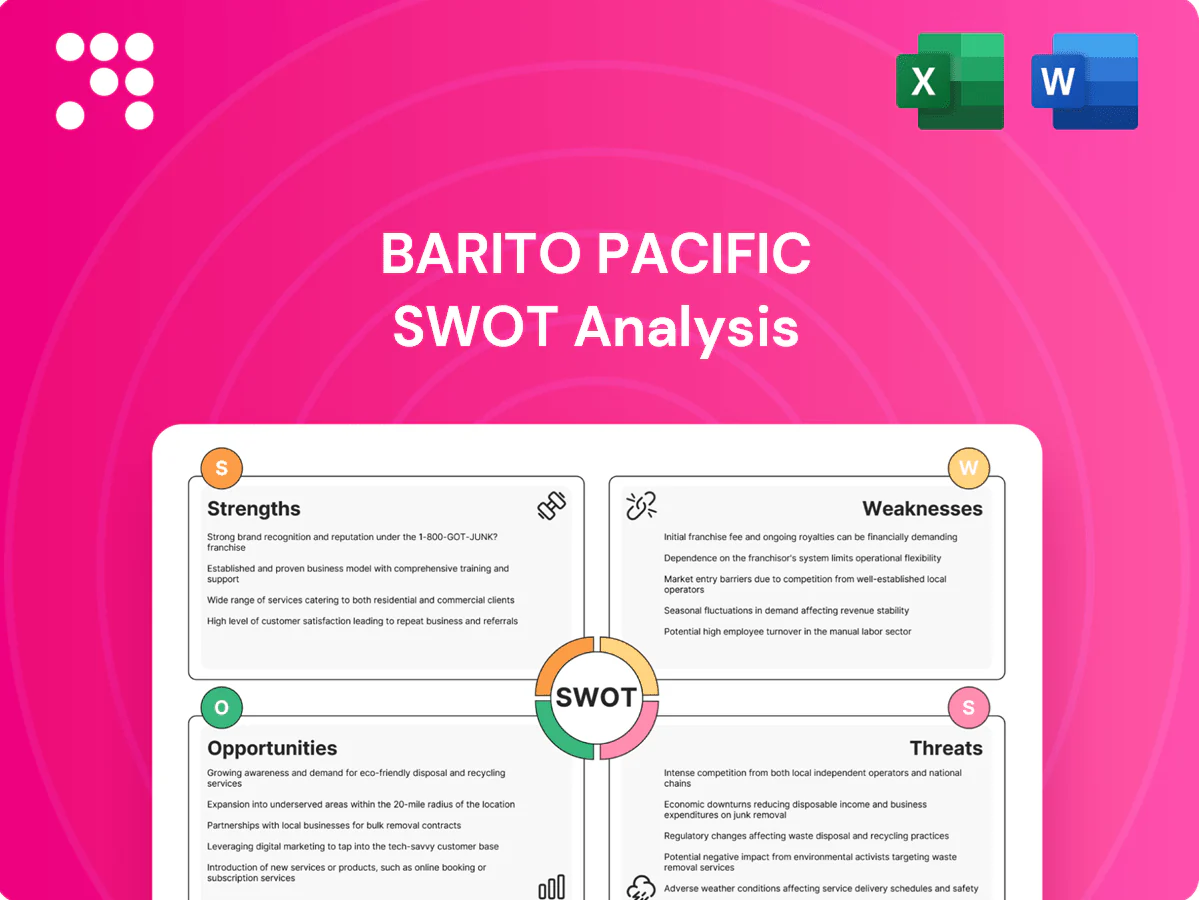
Barito Pacific SWOT Analysis
This is the actual SWOT analysis document for Barito Pacific you’ll receive upon purchase—no surprises, just professional quality. The preview below is taken directly from the full report and reflects the same structured strengths, weaknesses, opportunities and threats included in the downloadable file. Buy to unlock the complete, editable version.

Product Information
Product Information
Shipping & Returns
Shipping & Returns
Description
Dive Deeper Into the Company’s Strategic Blueprint
Barito Pacific’s diversified energy and petrochemical footprint hides both scale advantages and exposure to commodity cycles—our SWOT teases key strengths, weaknesses, opportunities, and threats in context. Want the full strategic picture? Purchase the complete SWOT analysis for a research-backed, investor-ready Word report plus an editable Excel matrix to plan, present, and act with confidence.
Strengths
Diversified energy-petrochem portfolio
Barito Pacific combines geothermal and power via Supreme Energy (~1,000 MW installed) with petrochemicals through majority ownership of Chandra Asri (c.3.2 mtpa capacity), plus property assets, which reduces earnings volatility across cycles. Cross-segment synergies allow risk balancing and flexible capital allocation between upstream power and petrochemical cash flows. This mix enhances resilience to sector shocks and enables portfolio optimization aligned with macro and policy trends.
Market-leading subsidiaries
Chandra Asri, Indonesia’s largest integrated petrochemical producer, and Star Energy, a leading geothermal operator, give Barito Pacific scale advantages in procurement, plant utilization and pricing. Their strong brands and multi-decade track records smooth permitting and attract lower-cost financing. Market leadership enhances ecosystem influence and partnership optionality across upstream, midstream and project finance.
Energy transition positioning
Barito Pacifics geothermal assets align with Indonesia’s target of 23% renewable energy by 2025 and tap a national geothermal resource estimated at about 23 GW with roughly 2.3 GW installed capacity (2023), strengthening its decarbonization credentials. This boosts ESG metrics and improves access to green capital pools and sustainable financing. Long-dated PPAs provide anchored, predictable cash flows. The renewables mix supports regulator and community acceptance.
Integrated growth platform
Integrated growth platform enhances margins through vertical linkage across feedstock, cracking and downstream chains, enabling feedstock-to-product margin capture and reduced intersegment trading losses.
Industrial clustering and shared utilities lower unit costs via economies of scale and logistics synergies; coordinated capex and sequencing drive scale efficiencies across projects.
Integration raises barriers to entry by locking feedstock access, offtake and infrastructure.
- vertical-integration
- cost-synergies
- capex-efficiency
- entry-barriers
Local market knowledge
- Local expertise
- Stakeholder access
- Demand alignment
- Supply/talent network
Scale in power, petrochemicals and geothermal cuts unit costs and opens green financing
Barito Pacific combines ~1,000 MW power (Supreme Energy) and c.3.2 mtpa petrochemical capacity (Chandra Asri), diversifying cash flows and improving capex allocation. Geothermal assets support Indonesia 23% renewables target and tap ~23 GW resource (2.3 GW installed). Scale and vertical integration lower unit costs, raise entry barriers and unlock green financing.
| Strength | Metric | Value (latest) |
|---|---|---|
| Power capacity | Installed | ~1,000 MW |
| Petrochemical | Cracking capacity | ~3.2 mtpa |
| Geothermal | Resource / installed | ~23 GW / 2.3 GW |
| Market | Indonesia (2024) | Population 277M; GDP ≈ USD 1.4T |
What is included in the product
Detailed Word Document
Provides a concise SWOT overview of Barito Pacific, highlighting its core strengths, operational weaknesses, market opportunities, and external threats that shape the company’s strategic direction.
Customizable Excel Spreadsheet
Provides a concise Barito Pacific SWOT matrix for fast, visual strategy alignment, highlighting key strengths, weaknesses, opportunities and threats to streamline decision-making and mitigate operational risks.
Weaknesses
Commodity margin cyclicality
Petrochem earnings at Barito Pacific are highly sensitive to oil/naphtha spreads and global demand; with Brent averaging about $88/bbl in 2024, narrowing spreads in downcycles have compressed cracker margins and impaired returns. Margin volatility complicates production planning and pressures dividend stability. Hedging programs provide limited relief, often only partially offsetting spot-era swings.
Capital intensity and leverage
Large-scale plants and geothermal fields require heavy upfront capital expenditure, pushing Barito Pacific into capital-intensive projects that absorb cash and extend payback periods. Project overruns have historically strained the company’s balance sheet, increasing reported leverage and weakening key solvency ratios. Higher leverage elevates refinancing and interest-rate risks, particularly in volatile Indonesian markets. This capital structure also reduces financial flexibility during sector downturns and commodity price shocks.
Asset concentration
Barito Pacific’s results remain tied to a small set of flagship complexes, notably its 50.1% stake in Chandra Asri, so shutdowns or maintenance at core units can materially dent consolidated EBITDA. Concentration raises counterparty and offtake risk, as loss of a major customer or supplier would have outsized effects on cash flow. Geographic clustering in Indonesia increases the probability of correlated disruptions from weather, logistics or regulatory events.
Execution and permitting risk
Long lead times for geothermal drilling (12–36 months) and petrochemical expansions expose Barito Pacific to technical and permitting risk; Indonesian environmental and community approvals commonly add 9–18 months to schedules in 2024–25. Cost escalation of 15–30% can erode project IRR, while global supply-chain constraints have added ~6 months to equipment delivery.
- Lead times: 12–36 months
- Permitting delays: 9–18 months
- Cost escalation: 15–30%
- Supply delays: ~6 months
Currency and input exposure
Barito Pacific faces FX mismatches as a significant portion of revenues are USD-linked while operating costs and local contracts are predominantly in IDR, exposing margins to rupiah swings and global dollar strength. Reliance on imported feedstocks ties input costs to volatile commodity markets and shipping, amplifying cost pass-through risk. Limited domestic feedstock diversification concentrates exposure, and hedging programs—while used—add premium costs and do not fully eliminate short-term volatility.
- USD revenue vs IDR cost mismatch
- Imported feedstocks → commodity and freight volatility
- Low domestic feedstock diversification
- Hedging increases cost and is imperfect
Petrochem margins cyclic; Brent $88, capex, FX, 50.1%
Petrochem margins remain highly cyclical (Brent ~$88/bbl in 2024), compressing returns and dividend visibility. Heavy capex and past overruns raise leverage and refinancing risk, with long lead times and permitting delays increasing project risk. Concentration in a 50.1% Chandra Asri stake and USD/IDR mismatches amplify operational and FX exposure.
| Metric | Value |
|---|---|
| Brent 2024 | $88/bbl |
| Chandra Asri stake | 50.1% |
| Lead times | 12–36 months |
| Permitting delays | 9–18 months |
| Cost escalation | 15–30% |
| Supply delays | ~6 months |
Preview the Actual Deliverable
Barito Pacific SWOT Analysis
This is the actual SWOT analysis document for Barito Pacific you’ll receive upon purchase—no surprises, just professional quality. The preview below is taken directly from the full report and reflects the same structured strengths, weaknesses, opportunities and threats included in the downloadable file. Buy to unlock the complete, editable version.