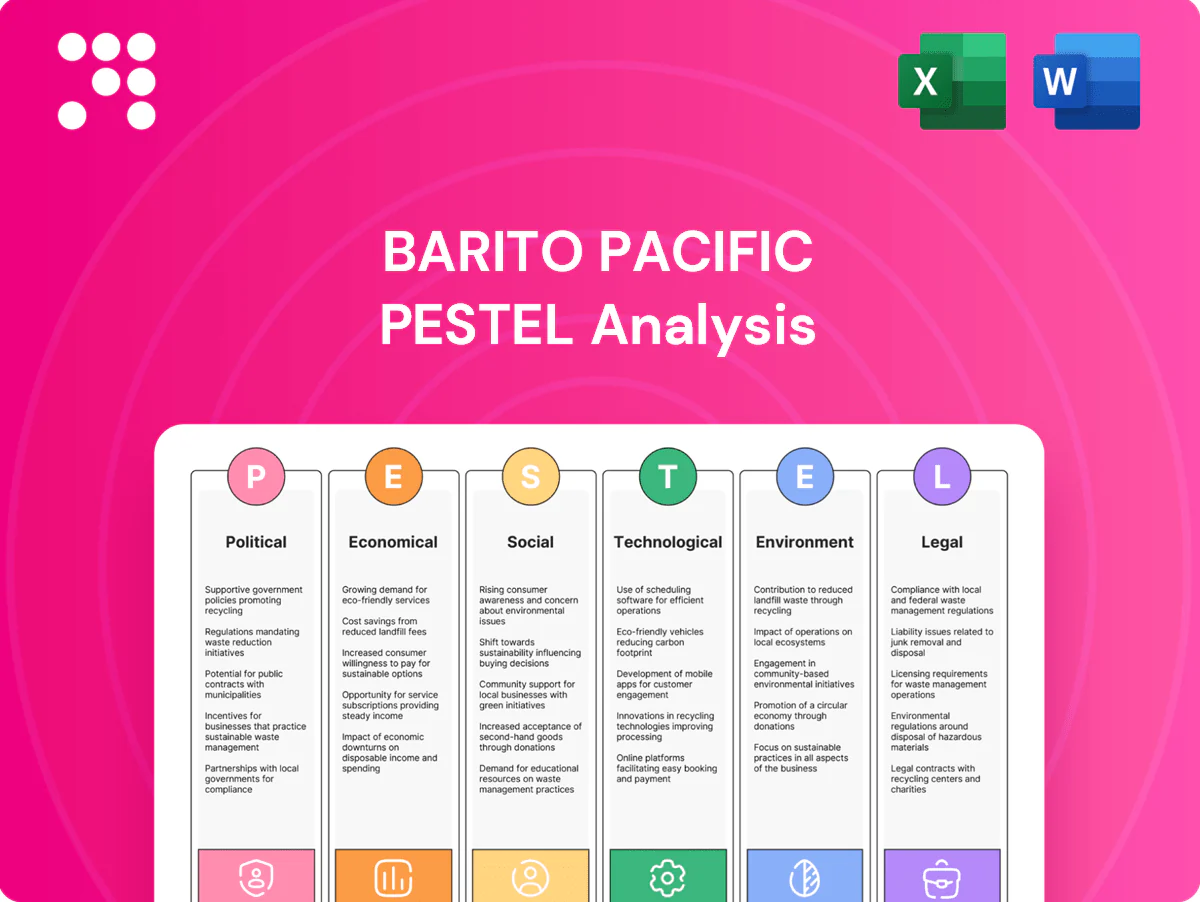
Barito Pacific PESTLE Analysis

Your Shortcut to Market Insight Starts Here
Discover how political shifts, commodity cycles, and environmental regulations are shaping Barito Pacific's strategic outlook. Our concise PESTLE highlights the key risks and opportunities investors and strategists must monitor. Purchase the full analysis for complete, ready-to-use intelligence to inform your next move.
Political factors

Energy transition and renewables push
Indonesia’s policy push toward net-zero by 2060 and higher renewables share prioritizes geothermal—national potential ~23 GW vs installed ~2.3 GW—boosting permit and PPA prospects for Star Energy Geothermal. Implementation timing and tariff certainty remain variable across administrations. Barito must align its project pipeline with evolving RUEN and PLN RUPTL roadmaps to secure offtake and financing.
Petrochemical industrial policy
Indonesia's downstreaming and import-substitution agenda bolsters domestic petrochemical capacity such as Chandra Asri (Barito Pacific majority owner, ~66% stake) with ethylene capacity around 1.25 mtpa, supporting local margins. Tax incentives and protectionist measures can lift profitability but may trigger trade scrutiny. Naphtha tariff structures and refinery integration are politically set; policy shifts could materially change feedstock economics and expansion feasibility.

Regulatory stability and elections
Election cycles (presidential and legislative votes on 14 Feb 2024; new administration sworn 20 Oct 2024) can shift priorities on energy pricing, subsidies and enforcement, affecting offtake economics. Long-dated geothermal projects (payback often >10 years) and crackers (capex typically $1–2bn) need cross-party backing to cut policy risk. Continuity from PLN, which supplies >90% of the national grid, is critical for offtake certainty; Barito should hedge via diversified stakeholder engagement and flexible contract structures.

State utility and PPA dynamics
Geothermal projects rely on state utility PLN for procurement, PPAs and dispatch; Indonesia had roughly 2.4 GW geothermal capacity by end-2024, almost entirely sold into PLN-controlled markets, making negotiated tariffs, escalation clauses and curtailment terms highly politically sensitive and bankability-critical.
- PLN buyer dominance: central to revenue certainty
- PPA delays: common cause of stalled capacity additions
- Tariff/escalation: drive investor risk premia
- Government-utility alignment: improves financing terms
Regional geopolitics and trade
ASEAN integration via RCEP (15 members, ~30% global GDP, ~28% world trade) reshapes petrochemical export routes and feedstock flows; global trade tensions and sanctions since 2022 have tightened naphtha availability and raised sourcing and freight-security costs, while preferential trade deals expand polymer market access—Barito must monitor diplomatic shifts affecting supply chains.
- RCEP scale: 15 members, ~30% GDP
- Sanctions raise naphtha sourcing risk
- Freight/security impacts costs
- Preferential deals open polymer markets
Net-zero by 2060 boosts geothermal (23GW pot., 2.4GW); PLN >90% drives PPA risk
Policy push to net-zero by 2060 and RUEN/RUPTL updates favor geothermal (national potential ~23 GW; installed ~2.4 GW end-2024), while downstreaming supports Chandra Asri (Barito ~66%; ethylene ~1.25 mtpa). PLN (>90% grid) dominance, PPA/tariff risk and election-driven shifts (2024 cycle) drive offtake and financing uncertainty.
| Metric | Value |
|---|---|
| Geothermal potential/installed | 23 GW / 2.4 GW (2024) |
| PLN share | >90% |
What is included in the product
 Detailed Word Document
Explores how external macro-environmental factors uniquely affect Barito Pacific across Political, Economic, Social, Technological, Environmental and Legal dimensions, with region- and industry-specific data and trends. Designed for executives, investors and strategists, the analysis delivers forward-looking insights, scenario implications and ready-to-use content for plans, decks and reports.

 Customizable Excel Spreadsheet
A concise, visually segmented Barito Pacific PESTLE summary that eases meeting prep and strategy sessions by highlighting key external risks and opportunities, editable for local context and ready to drop into presentations for quick team alignment.
Economic factors

Commodity and feedstock volatility
Crude oil (Brent ~80–90 USD/bbl in 2024–H1 2025) and naphtha swings directly drive Chandra Asri cracker margins, with naphtha-crack volatility up to ~200 USD/ton in 2024–25; hedging and feedstock flexibility are vital to protect spreads. Geothermal assets deliver inflation-linked, stable revenue streams, and the diversified portfolio smooths earnings across cycles.
Rupiah fluctuations and financing
Rupiah volatility (USD/IDR ~15,300 in June 2025) raises imported capex and feedstock costs and increases USD debt service burden for Barito Pacific. Natural USD receipts from exports and USD-denominated PPAs provide partial natural hedges. Interest rate cycles (BI 7-day reverse repo ~5.75% mid‑2025) compress project IRRs and affect refinancing windows. Prudent treasury and duration management are essential to smooth cash flows and rollover risk.

Domestic demand and urbanization
Indonesia’s rising urbanization (about 57% of ~276.4 million people in 2024) and an expanding middle class are driving higher demand for plastics, packaging and construction materials, supporting Barito Pacific’s core segments.
Property and infrastructure cycles tied to 2024 GDP growth of ~5.2% (IMF) further lift petrochemical consumption and pricing power.
Growing geothermal capacity (~2.3 GW installed by 2024) adds baseload reliability that underpins industrial expansion, while macroeconomic slowdowns would temper volumes and pricing leverage.

Capital intensity and scale
Steamfield projects, drilling campaigns and petrochemical cracker expansions require very large upfront capital—crackers typically exceed $1bn while upstream steamfloods/drilling run into the low hundreds of millions—and deliver multi-year paybacks. Access to project finance, green bonds (global green bond market >$1tn by 2023) and strategic partners lowers WACC; disciplined, phased execution cuts execution risk and scale drives regional cost competitiveness.
- Capex scale: crackers >$1bn
- Upstream: hundreds of $m, multi-year paybacks
- Funding: project finance + green bonds reduce WACC
- Execution: phased builds lower execution risk
Energy pricing and subsidies
Energy pricing and subsidy reforms shift PLN-administered electricity tariffs (around 1,400–1,600 IDR/kWh in 2024), affecting affordability and industrial demand; reduced fossil fuel subsidies improves geothermal competitiveness as LCOE for modern geothermal projects centers near 50–90 USD/MWh; petrochemical margins follow global naphtha/ethylene cycles but domestic policy can distort price signals, requiring active margin management for Barito Pacific.
- Tariff impact: PLN 1,400–1,600 IDR/kWh (2024)
- Geothermal LCOE: ~50–90 USD/MWh
- Petrochemicals: global naphtha-linked pricing
- Action: hedge/policy scenario planning
Net-zero by 2060 boosts geothermal (23GW pot., 2.4GW); PLN >90% drives PPA risk
Brent ~85 USD/bbl (2024–H1 2025) and naphtha swings drive cracker margins; hedging/feedstock flexibility essential. Rupiah ~15,300 USD/IDR (Jun 2025) and BI rate ~5.75% pressure imported capex and USD debt service. Indonesia GDP ~5.2% (2024) and urbanization (~57%) support petrochemical demand; geothermal 2.3 GW adds stable revenue.
| Metric | Value |
|---|---|
| Brent | ~85 USD/bbl |
| USD/IDR | ~15,300 (Jun 2025) |
| BI rate | ~5.75% |
| GDP | ~5.2% (2024) |
| Geothermal | ~2.3 GW (2024) |
| Cracker capex | >$1bn |
What You See Is What You Get
Barito Pacific PESTLE Analysis
The preview shown here is the exact Barito Pacific PESTLE Analysis you’ll receive after purchase—fully formatted and ready to use. This screenshot reflects the real, final document with complete content, structure, and professional layout. No placeholders or teasers—after checkout you’ll instantly download this same file and can begin analysis immediately.

Product Information
Product Information
Shipping & Returns
Shipping & Returns
Description
Your Shortcut to Market Insight Starts Here
Discover how political shifts, commodity cycles, and environmental regulations are shaping Barito Pacific's strategic outlook. Our concise PESTLE highlights the key risks and opportunities investors and strategists must monitor. Purchase the full analysis for complete, ready-to-use intelligence to inform your next move.
Political factors
Energy transition and renewables push
Indonesia’s policy push toward net-zero by 2060 and higher renewables share prioritizes geothermal—national potential ~23 GW vs installed ~2.3 GW—boosting permit and PPA prospects for Star Energy Geothermal. Implementation timing and tariff certainty remain variable across administrations. Barito must align its project pipeline with evolving RUEN and PLN RUPTL roadmaps to secure offtake and financing.
Petrochemical industrial policy
Indonesia's downstreaming and import-substitution agenda bolsters domestic petrochemical capacity such as Chandra Asri (Barito Pacific majority owner, ~66% stake) with ethylene capacity around 1.25 mtpa, supporting local margins. Tax incentives and protectionist measures can lift profitability but may trigger trade scrutiny. Naphtha tariff structures and refinery integration are politically set; policy shifts could materially change feedstock economics and expansion feasibility.
Regulatory stability and elections
Election cycles (presidential and legislative votes on 14 Feb 2024; new administration sworn 20 Oct 2024) can shift priorities on energy pricing, subsidies and enforcement, affecting offtake economics. Long-dated geothermal projects (payback often >10 years) and crackers (capex typically $1–2bn) need cross-party backing to cut policy risk. Continuity from PLN, which supplies >90% of the national grid, is critical for offtake certainty; Barito should hedge via diversified stakeholder engagement and flexible contract structures.
State utility and PPA dynamics
Geothermal projects rely on state utility PLN for procurement, PPAs and dispatch; Indonesia had roughly 2.4 GW geothermal capacity by end-2024, almost entirely sold into PLN-controlled markets, making negotiated tariffs, escalation clauses and curtailment terms highly politically sensitive and bankability-critical.
- PLN buyer dominance: central to revenue certainty
- PPA delays: common cause of stalled capacity additions
- Tariff/escalation: drive investor risk premia
- Government-utility alignment: improves financing terms
Regional geopolitics and trade
ASEAN integration via RCEP (15 members, ~30% global GDP, ~28% world trade) reshapes petrochemical export routes and feedstock flows; global trade tensions and sanctions since 2022 have tightened naphtha availability and raised sourcing and freight-security costs, while preferential trade deals expand polymer market access—Barito must monitor diplomatic shifts affecting supply chains.
- RCEP scale: 15 members, ~30% GDP
- Sanctions raise naphtha sourcing risk
- Freight/security impacts costs
- Preferential deals open polymer markets
Net-zero by 2060 boosts geothermal (23GW pot., 2.4GW); PLN >90% drives PPA risk
Policy push to net-zero by 2060 and RUEN/RUPTL updates favor geothermal (national potential ~23 GW; installed ~2.4 GW end-2024), while downstreaming supports Chandra Asri (Barito ~66%; ethylene ~1.25 mtpa). PLN (>90% grid) dominance, PPA/tariff risk and election-driven shifts (2024 cycle) drive offtake and financing uncertainty.
| Metric | Value |
|---|---|
| Geothermal potential/installed | 23 GW / 2.4 GW (2024) |
| PLN share | >90% |
What is included in the product
Detailed Word Document
Explores how external macro-environmental factors uniquely affect Barito Pacific across Political, Economic, Social, Technological, Environmental and Legal dimensions, with region- and industry-specific data and trends. Designed for executives, investors and strategists, the analysis delivers forward-looking insights, scenario implications and ready-to-use content for plans, decks and reports.
Customizable Excel Spreadsheet
A concise, visually segmented Barito Pacific PESTLE summary that eases meeting prep and strategy sessions by highlighting key external risks and opportunities, editable for local context and ready to drop into presentations for quick team alignment.
Economic factors
Commodity and feedstock volatility
Crude oil (Brent ~80–90 USD/bbl in 2024–H1 2025) and naphtha swings directly drive Chandra Asri cracker margins, with naphtha-crack volatility up to ~200 USD/ton in 2024–25; hedging and feedstock flexibility are vital to protect spreads. Geothermal assets deliver inflation-linked, stable revenue streams, and the diversified portfolio smooths earnings across cycles.
Rupiah fluctuations and financing
Rupiah volatility (USD/IDR ~15,300 in June 2025) raises imported capex and feedstock costs and increases USD debt service burden for Barito Pacific. Natural USD receipts from exports and USD-denominated PPAs provide partial natural hedges. Interest rate cycles (BI 7-day reverse repo ~5.75% mid‑2025) compress project IRRs and affect refinancing windows. Prudent treasury and duration management are essential to smooth cash flows and rollover risk.
Domestic demand and urbanization
Indonesia’s rising urbanization (about 57% of ~276.4 million people in 2024) and an expanding middle class are driving higher demand for plastics, packaging and construction materials, supporting Barito Pacific’s core segments.
Property and infrastructure cycles tied to 2024 GDP growth of ~5.2% (IMF) further lift petrochemical consumption and pricing power.
Growing geothermal capacity (~2.3 GW installed by 2024) adds baseload reliability that underpins industrial expansion, while macroeconomic slowdowns would temper volumes and pricing leverage.
Capital intensity and scale
Steamfield projects, drilling campaigns and petrochemical cracker expansions require very large upfront capital—crackers typically exceed $1bn while upstream steamfloods/drilling run into the low hundreds of millions—and deliver multi-year paybacks. Access to project finance, green bonds (global green bond market >$1tn by 2023) and strategic partners lowers WACC; disciplined, phased execution cuts execution risk and scale drives regional cost competitiveness.
- Capex scale: crackers >$1bn
- Upstream: hundreds of $m, multi-year paybacks
- Funding: project finance + green bonds reduce WACC
- Execution: phased builds lower execution risk
Energy pricing and subsidies
Energy pricing and subsidy reforms shift PLN-administered electricity tariffs (around 1,400–1,600 IDR/kWh in 2024), affecting affordability and industrial demand; reduced fossil fuel subsidies improves geothermal competitiveness as LCOE for modern geothermal projects centers near 50–90 USD/MWh; petrochemical margins follow global naphtha/ethylene cycles but domestic policy can distort price signals, requiring active margin management for Barito Pacific.
- Tariff impact: PLN 1,400–1,600 IDR/kWh (2024)
- Geothermal LCOE: ~50–90 USD/MWh
- Petrochemicals: global naphtha-linked pricing
- Action: hedge/policy scenario planning
Net-zero by 2060 boosts geothermal (23GW pot., 2.4GW); PLN >90% drives PPA risk
Brent ~85 USD/bbl (2024–H1 2025) and naphtha swings drive cracker margins; hedging/feedstock flexibility essential. Rupiah ~15,300 USD/IDR (Jun 2025) and BI rate ~5.75% pressure imported capex and USD debt service. Indonesia GDP ~5.2% (2024) and urbanization (~57%) support petrochemical demand; geothermal 2.3 GW adds stable revenue.
| Metric | Value |
|---|---|
| Brent | ~85 USD/bbl |
| USD/IDR | ~15,300 (Jun 2025) |
| BI rate | ~5.75% |
| GDP | ~5.2% (2024) |
| Geothermal | ~2.3 GW (2024) |
| Cracker capex | >$1bn |
What You See Is What You Get
Barito Pacific PESTLE Analysis
The preview shown here is the exact Barito Pacific PESTLE Analysis you’ll receive after purchase—fully formatted and ready to use. This screenshot reflects the real, final document with complete content, structure, and professional layout. No placeholders or teasers—after checkout you’ll instantly download this same file and can begin analysis immediately.











